Boat and Yacht Shipping from Saudi Arabia 0552803439 | Sling Lifting, Custom Cradles, Sea, Road and Air Freight to the Marina
Boat and yacht shipping from Saudi Arabia from the marinas of Jeddah, Dammam, Khobar and Yanbu to the ports of the Gulf, the Mediterranean, Europe and America. A small boat or a jet ski travels inside a closed container, a mid-sized boat on a cradle on a flat-rack container or on its own trailer by …
Do you need boat and yacht shipping from Saudi Arabia to a marina in the Gulf, on the Mediterranean or further away, and are not sure whether your boat travels inside a container or on the deck of a ship? Home Safe lifts the boat from the water with slings, secures it on a cradle built to its hull, and ships it by sea from the ports of Jeddah and Dammam, by road to the Gulf states, or by air for jet skis and equipment. Container freight for a small boat starts from SAR 4,600 to nearby ports, air freight from SAR 14 per kilogram, and larger yachts are priced on their measurements. For bookings and enquiries: 0552803439.
In this guide49ShowHide
- Who needs boat and yacht shipping from Saudi Arabia?
- Why ship a boat on a vessel instead of sailing it?
- Boat and yacht shipping methods from Saudi Arabia: which suits your boat?
- Shipping a boat from Saudi Arabia on a custom cradle on a flat-rack container
- Small boats and jet skis inside a closed container
- RoRo: the boat boards the ship on its trailer
- Large yachts: on the ship’s deck or on specialised carriers
- Lifting with slings and a crane: the step that allows no mistake
- Wrapping the boat and protecting the hull before shipping from Saudi Arabia
- Preparing the boat before handover: what is drained and what is removed
- Moving the boat by road on a low-bed trailer to Saudi ports
- Boat shipping ports in Saudi Arabia
- Destinations and expected transit times
- What lengthens the transit?
- Cost of boat and yacht shipping from Saudi Arabia
- What sets the price?
- How to bring the cost down
- Documents required to ship a boat from Saudi Arabia
- Customs in the arrival country: permanent exit or temporary admission?
- What is not shipped inside the boat
- Insuring the boat during shipping
- Air freight from Saudi Arabia for jet skis and boat equipment
- Where do we collect the boat? Marinas and cities
- Steps for shipping your boat with Home Safe
- Tracking and photographic records
- Launching at the arrival marina
- Importing boats and yachts into Saudi Arabia
- How to choose a company to ship your boat
- Recommendations for a safe shipment
- Common mistakes in boat and yacht shipping
- Why Home Safe for boat and yacht shipping?
- Related articles and pages
- Tags
- Frequently asked questions about boat and yacht shipping from Saudi Arabia
- How much does boat and yacht shipping from Saudi Arabia cost?
- What is the largest boat that fits in a closed container?
- What is the difference between a flat rack and deck cargo?
- Can a boat be shipped on its own trailer by RoRo?
- How long does a yacht take by sea?
- Which documents are needed to ship a boat from Saudi Arabia?
- Do I pay customs in the arrival country?
- Is the boat wrapped before shipping?
- What is dismantled from the boat before shipping?
- Should I leave fuel and water in the tanks?
- Do you ship jet skis by air?
- Is the yacht insured during shipping?
- Which Saudi port will my boat leave from?
- Do you ship a boat I bought abroad to Saudi Arabia?
- Do you move the boat from the marina to the port?
What we ship: boats, yachts and jet skis · Methods: sea, road and air · Ports: Jeddah Islamic, King Abdullah, King Abdulaziz in Dammam · Service: marina to marina.
In brief
- What is shipped: jet skis, fishing and leisure boats, sailing boats, motor yachts.
- Method: closed container for small craft, flat rack or RoRo for mid-sized, deck cargo for large.
- Lifting: wide slings and a crane, at the points the builder marked on the hull.
- Protection: a padded steel cradle made to measure and shrink-wrap with vents.
- Prices: 20ft container from SAR 4,600, 40ft container from SAR 5,200, the rest set on request.
- Urgent: air freight for jet skis, engines and parts from Riyadh, Jeddah and Dammam airports.
- Booking: 0552803439 by call or WhatsApp.
Who needs boat and yacht shipping from Saudi Arabia?
Boat owners in the Kingdom are growing in number as marinas spread along the Red Sea and the Arabian Gulf, and so are the reasons for moving a boat to another country. Some have sold their boat to a buyer abroad, some are relocating to a coastal country and taking the boat along, and some want a season in other waters before coming back. Each case has different paperwork and a different shipping method, so the first thing we ask is why the boat is being shipped.
| Shipper | What they ship | What matters most to them |
|---|---|---|
| An owner who sold the boat to a buyer outside the Kingdom | A used leisure boat or yacht | Permanent-exit papers and delivery at the buyer’s port |
| A resident returning home | A small boat or jet skis with household furniture | Adding the boat to the household container |
| An owner spending the summer in the Mediterranean | A motor yacht or sailing boat | Temporary admission and a date that fits the season |
| A race or boat-show participant | A racing boat or display boat | A firm arrival date and a return after the event |
| A boat dealer or agent | New boats or engines and parts | Repeat shipments and commercial invoices |
| A club or diving and water-sports centre | Jet skis, inflatable boats and gear | Several pieces in one shipment |
Why ship a boat on a vessel instead of sailing it?
The first question every owner asks: a boat is built to sail, so why carry it on a ship? The answer is that a long passage wears out both the boat and its owner. A trip from Jeddah to the Mediterranean means transiting the Suez Canal with its dues and pilot, a qualified delivery crew, fuel for hundreds of miles and insurance for an open-sea voyage. And a small boat was never designed for that distance in the first place.
- A saving in cost: the freight is known before the boat moves, whereas a delivery passage brings fuel, crew, transit dues, marinas on the way and maintenance after arrival.
- No hours on the engine: the boat arrives with its engine-hour meter as it left, which protects its resale value.
- More time for cruising: you fly and find your boat in the marina, so your holiday starts in the destination’s waters, not on the way to them.
- Lower risk: a carried boat meets no storm and no breakdown at sea.
- Destinations a boat cannot reach alone: from the Arabian Gulf to Europe or America is a distance no leisure boat covers.
Sailing remains reasonable for a large yacht with a permanent crew on medium passages. Below that, shipping is cheaper and safer.
Boat and yacht shipping methods from Saudi Arabia: which suits your boat?
The method is chosen neither by the customer nor by us; the boat’s measurements dictate it. Beam and height decide whether it fits a container, and length and weight decide whether a flat rack can carry it or it needs a ship’s deck. The table gives the general rule, and the final decision comes once we have the four figures: length, beam, height and weight.
| Boat | Usual method | What sets it apart |
|---|---|---|
| Jet skis and inflatable boats | Closed container, or air for urgent cases | Full protection and several pieces per container |
| Boats up to about 7 metres with a beam under 2.3 metres | 40ft closed container | The most economical, and luggage can be added |
| Boats of 7–12 metres | Flat rack with a cradle, or RoRo on the trailer | They travel on regular container services |
| Yachts of 12–24 metres | On the deck of a cargo vessel on their cradle | Lifted by the port crane or the ship’s crane |
| Larger yachts | Specialised yacht carriers | Arranged by route and season |
These limits are approximate: an eight-metre boat with a slender hull may fit a container, and a shorter one with a wide hull may not. Each method is explained on the yacht and boat shipping page.
Shipping a boat from Saudi Arabia on a custom cradle on a flat-rack container
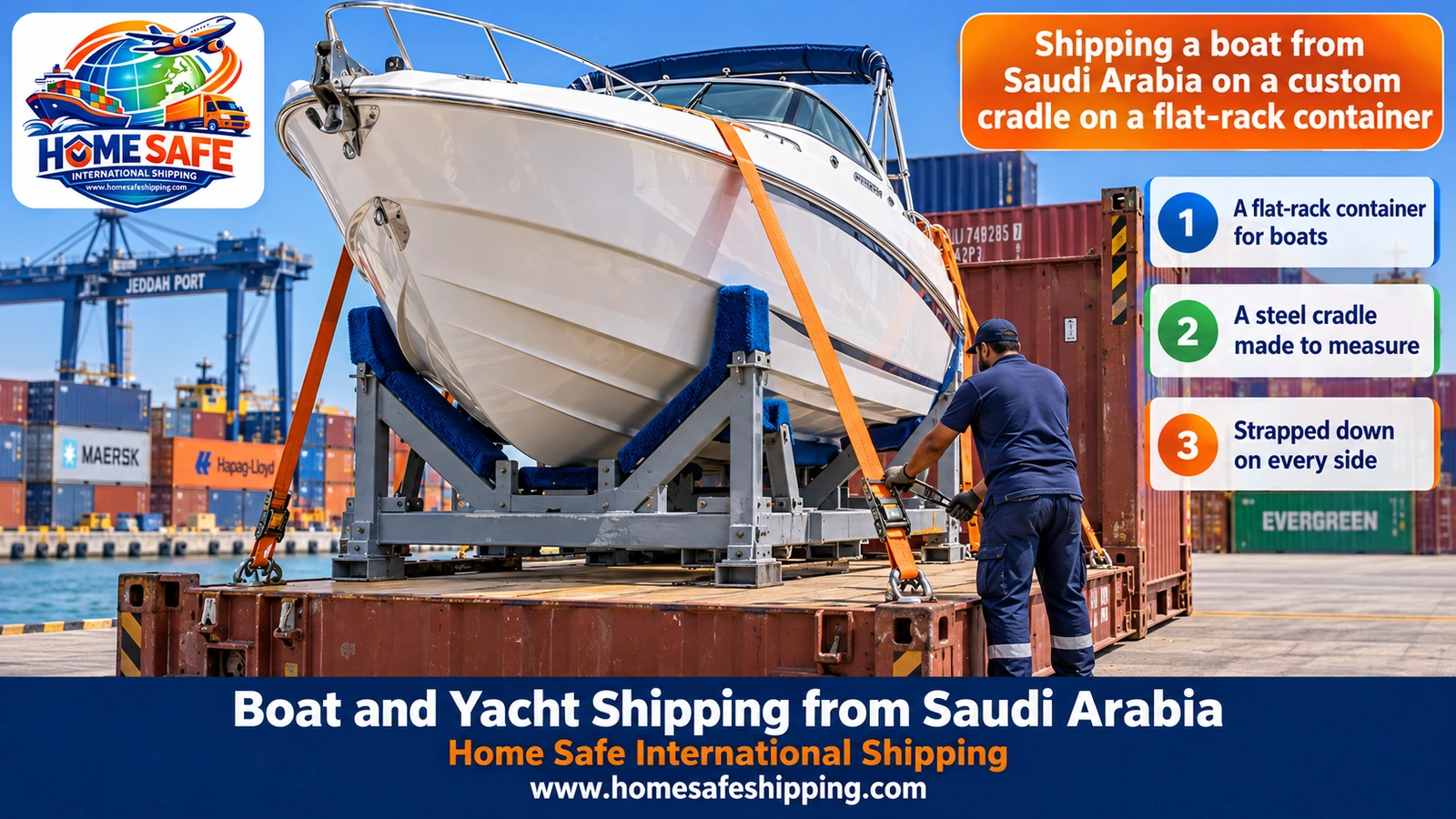
A flat rack is a steel base the length of an ordinary container, with two short end walls and no roof or sides. That is why it carries what cannot pass through a door: a boat wider than 2.3 metres or taller than a container roof. Its advantage is that it travels on regular container vessels, so its dates are clearer and its ports more numerous than those of general cargo ships.
The boat is not set straight on the base. A steel cradle is built to the measure of its hull, with padded supports holding it at the keel and the strong frames, and the cradle is then welded or bolted to the base. After that, wide straps are tensioned from every side to the container’s lashing rings: straps that stop it sliding fore and aft, and straps that stop it leaning to either side.
| Item | 20ft flat rack | 40ft flat rack |
|---|---|---|
| Approximate deck length | About 5.6 metres | About 11.6 metres |
| Deck width | About 2.4 metres | About 2.4 metres |
| Suits | A small wide boat or jet skis | A boat up to 11 or 12 metres |
| If width or height is exceeded | Accepted with a charge for the neighbouring slots | Accepted with a charge for the neighbouring slots |
A boat wider than the base is called out-of-gauge cargo. The vessel accepts it, but it takes the place of the containers that would have been stowed beside or above it, so its owner pays for those empty slots. This is why we measure the boat with its cradle and not on its own, as ten extra centimetres can change the freight.
Small boats and jet skis inside a closed container
A closed container is the cheapest and most protective method, and its only condition is that the boat passes through the door. The door is about 2.34 metres wide, and about 2.28 metres high on a standard container and 2.58 metres on a high-cube. A 40ft container is about 12 metres long inside, so it takes a fishing boat with its trailer, or four jet skis on their stands.
The boat is rolled in on its trailer or on a wheeled cradle, and its wheels and frame are then lashed to the container floor and braced with wooden chocks. The outboard engine is tilted up and secured so that it does not shake on the transom. The space left around the boat is useful for a returning resident’s belongings: cartons, fishing gear and furniture, provided all of it is listed on the packing list.
RoRo: the boat boards the ship on its trailer
RoRo vessels carry anything on wheels: cars, trucks and machinery, and boats on their trailers with them. The trailer is towed up the ship’s ramp into the hold, parked in position, and its wheels and frame are lashed to the deck with chains and straps. No crane and no cradle to build, which removes a large item from the cost.
The condition is a sound trailer: inflated tyres, axles that make no noise and strong lashing points. A boat with no trailer is placed with its cradle on a roll trailer supplied by the shipping line. RoRo freight is calculated on the volume of the whole unit: length by width by height. The method stays tied to the ports that RoRo vessels call at, so we check the service before proposing it. The two methods are compared for vehicles on the RoRo shipping page.
Large yachts: on the ship’s deck or on specialised carriers
A yacht that a flat rack cannot carry travels as a single piece of cargo on a ship’s deck. This takes three forms, and the choice between them follows the yacht’s weight and the route available:
- Lift-on, lift-off: the port crane or the ship’s crane lifts the yacht from the water or the quay and sets it on its cradle on deck, then the cradle is welded to the deck and the yacht lashed to it.
- General cargo and project vessels: they carry yachts along with other equipment, and their dates follow the cargo available rather than a fixed schedule.
- Semi-submersible yacht carriers: they partly submerge their deck so the yacht floats in, then rise so it settles on its supports. They run on specific seasonal routes, so we check whether one passes the region on your date.
In every form the yacht travels exposed to wind and salt spray, which is why wrapping comes before anything else.
Lifting with slings and a crane: the step that allows no mistake
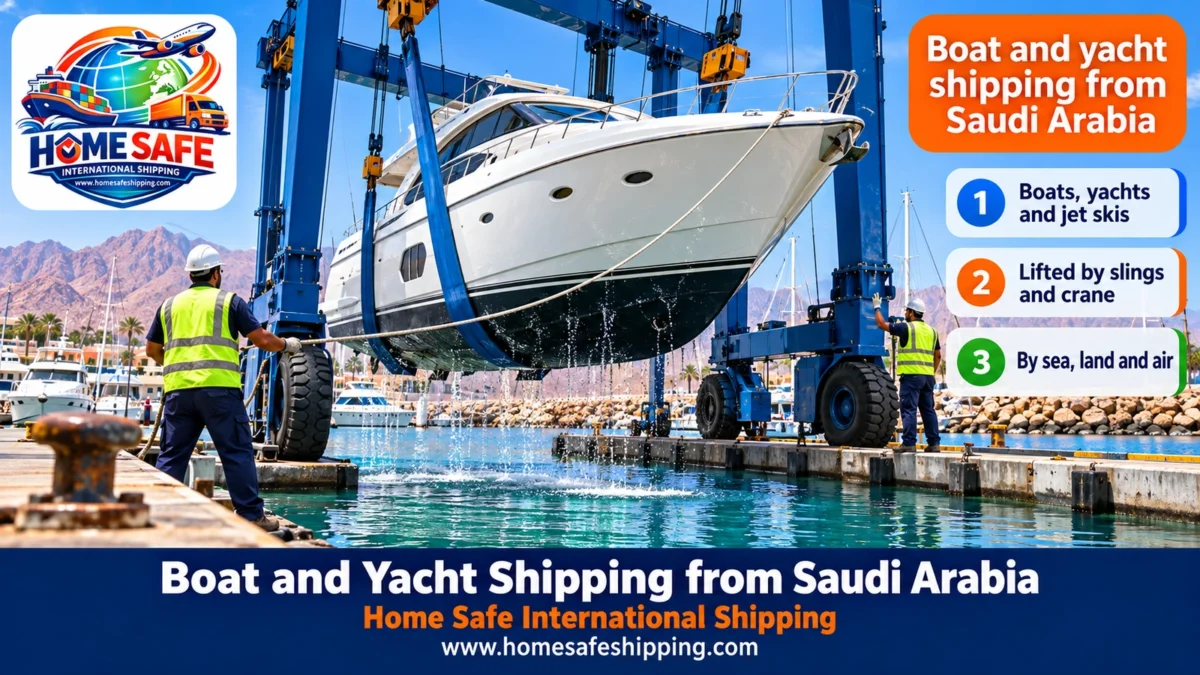
The most sensitive moments in shipping are the minutes when the boat hangs in the air. Its whole weight passes to two or four slings, and if one is placed under the propeller shaft, the rudder or the depth transducer, whatever is beneath it breaks. So lifting does not begin before there is a written plan.
- Lifting points: most builders put marks on the hull showing where the slings go. Where the marks are missing we go back to the builder’s drawing or to the weight distribution between the engine and the tanks.
- The slings: wide webbing, not chains or wire rope, so that the pressure spreads over a broad area of the hull.
- The spreader bar: a steel beam above the boat that keeps the slings vertical, so they do not squeeze the edges of the deck.
- Guide lines: two lines at the bow and stern held by two men, to stop the boat turning in the wind.
- The report: the underside of the hull, the propellers and the rudder are photographed as soon as the boat leaves the water, and its condition is written down and signed by the owner.
Wrapping the boat and protecting the hull before shipping from Saudi Arabia
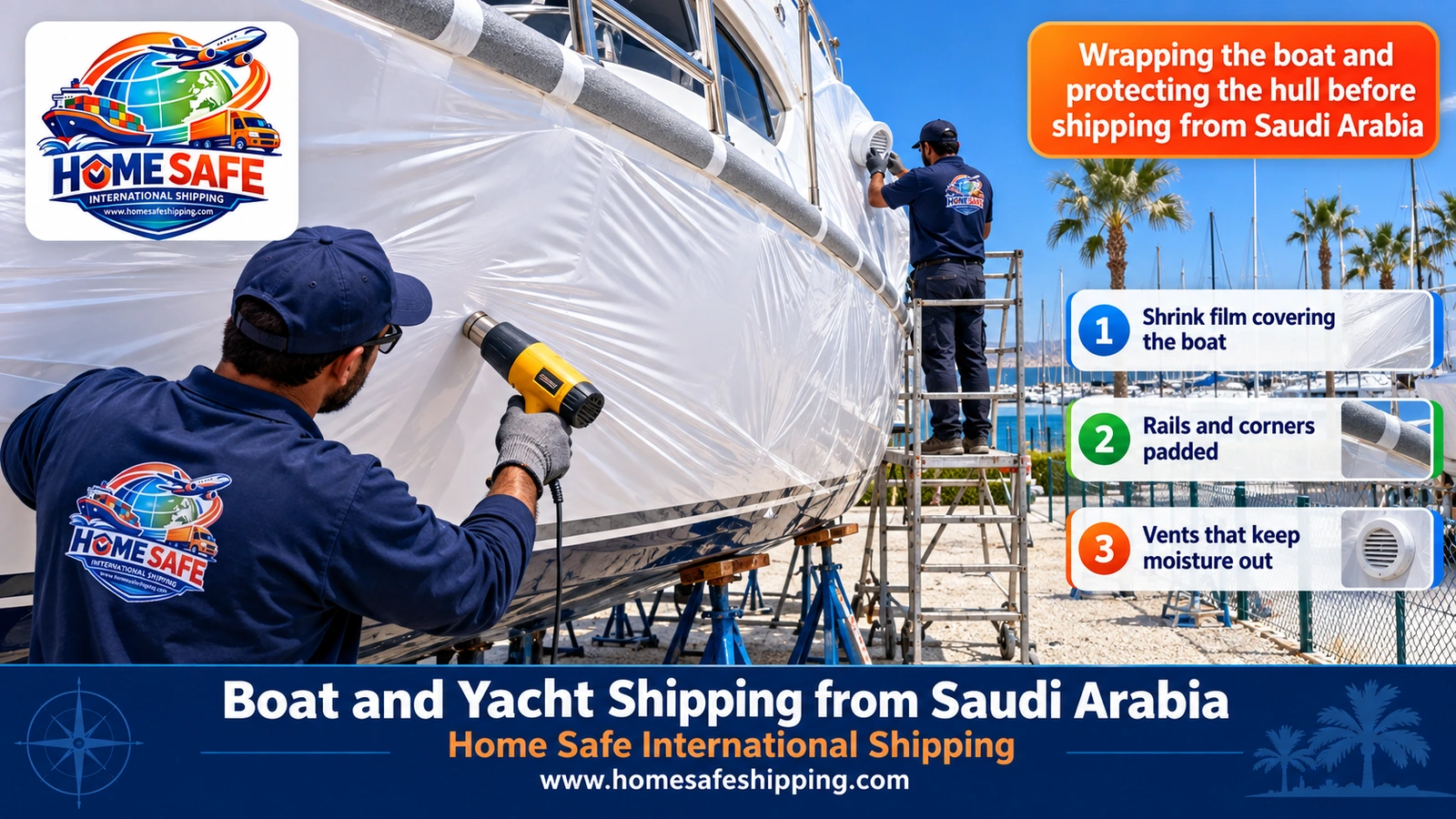
A boat on a ship’s deck spends days or weeks under sun, salt spray and funnel smoke. A boat on a truck faces the sand of the road. The canvas cover that is enough in the marina does not survive open-sea winds; it tears and beats against the hull. So a thick plastic film is used, spread over the boat and then heated so that it shrinks and takes its exact shape.
| Step | What is done | Why |
|---|---|---|
| Washing and drying | The boat is washed with fresh water and left to dry | Salt and damp under the film cause stains and mould |
| Padding | Metal rails, corners and cleats are wrapped in foam | So they neither pierce the film nor chafe against it |
| The support frame | Strapping is tensioned over the boat like a tent | So water runs off and does not gather in pockets |
| The shrink film | Spread out, then heated until it shrinks | It does not flap in the wind or let water in |
| Vents | Fitted at the top and sides of the film | They stop moisture condensing inside the boat |
| A zipped door | Fitted at the entrance if customs ask for it | It opens for inspection without tearing the film |
The underside of the hull stays bare where the cradle and straps sit, since film is not placed between the hull and the cradle pad, so that the boat cannot slide on it. Some countries require the hull to arrive clean of marine growth, so we pressure-wash below the waterline straight after the lift. Securing is detailed on the packing and lashing page.
Preparing the boat before handover: what is drained and what is removed
Preparation begins days before the lift, and part of it falls to the owner, who knows the boat best. The aim is three things: to make the boat lighter, to bring its height down, and to make sure nothing moves inside it when the ship rolls.
| Item | What is required |
|---|---|
| Fuel | Brought down to the lowest level the carrier allows |
| Fresh water, holding tanks and bait wells | Emptied completely, with their valves left open |
| Batteries | Disconnected, with the terminals insulated |
| Gas cylinders and flares | Taken off the boat, as they are not shipped with it |
| Mast, aerials, radar and bimini | Removed, numbered, wrapped and secured inside the cabin |
| Portable electronics and valuables | The owner takes them along |
| Doors, hatches and drawers | Locked and secured with tape that leaves no mark |
| Keys and documents | One copy handed over against a report, originals with the owner |
Tell us about every fault you know of: a small leak, an old crack in the gelcoat, or a pump that does not work. It is written in the handover report so that it does not become a dispute on arrival. The full list is in the yacht shipping guide.
Moving the boat by road on a low-bed trailer to Saudi ports
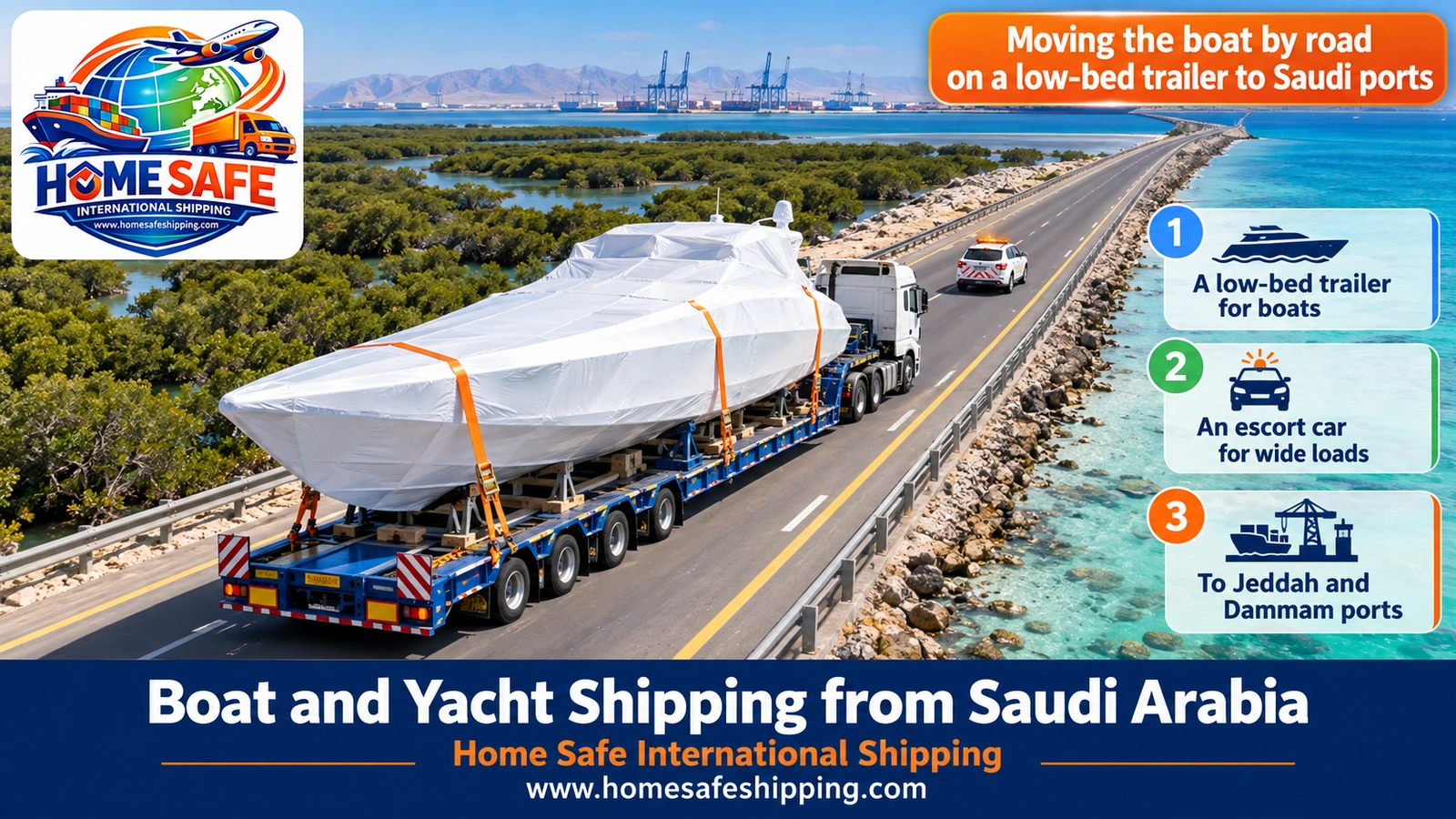
Before the sea there is a road leg that is often overlooked: the distance between the marina and the loading quay. It may be ten kilometres inside Jeddah, or hundreds of kilometres for a boat kept in Riyadh or a marina in Yanbu or Jazan. A low-bed trailer is used for it, because every centimetre the boat sits lower keeps it clear of bridges, signs and power lines.
| Dimension | Legal limit in the Kingdom for a truck with its load | If the boat exceeds it |
|---|---|---|
| Width | 2.6 metres | An abnormal-load permit and an escort car |
| Height from the ground | 4.8 metres | A route survey, and removal of whatever stands tall |
| Length | 23 metres | An extendable trailer and a permit |
A wide load travels at limited speed and in the hours the permit sets, with an escort car with warning lights ahead of or behind it. We review the route before moving: bridge heights, the width of entrances, and the tight turns at the marina gate and the port gate. Our usual destinations are Jeddah Islamic Port in the west and King Abdulaziz Port in Dammam in the east.
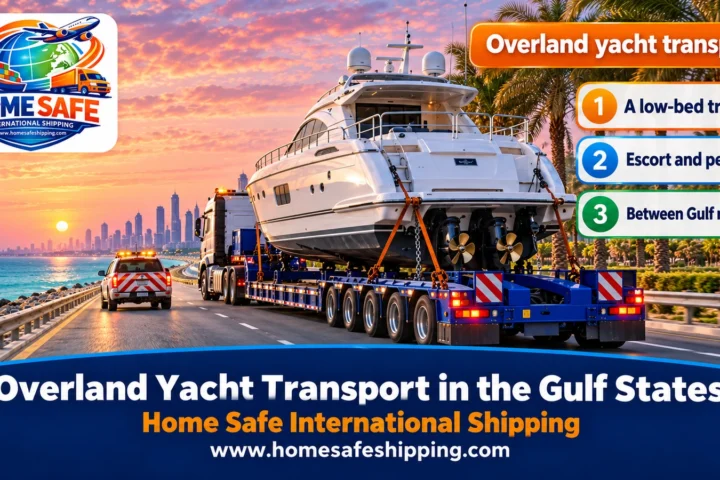
And if the boat is bound for a Gulf state, it may not need a ship at all: the same trailer completes the journey to the arrival marina through the land border. That service is explained in the article on overland yacht transport in the Gulf.
Boat shipping ports in Saudi Arabia
The Kingdom has two coasts, and the port of exit follows the destination, not where the boat lies. A boat berthed in Khobar and bound for Greece is moved by road to Jeddah, because a vessel leaving Dammam for the Mediterranean sails round the whole Arabian Peninsula. The reverse holds for a boat in Jeddah bound for India.
| Port | Coast | Destinations it serves |
|---|---|---|
| Jeddah Islamic Port | Red Sea | Egypt, the eastern Mediterranean, Turkey, North Africa, Europe and America |
| King Abdullah Port | Red Sea, north of Jeddah | Container and RoRo services, depending on the vessel available |
| King Abdulaziz Port, Dammam | Arabian Gulf | Gulf ports, India and East Asia |
A flat rack enters the port through the container terminal like any other box. A yacht carried on deck, however, needs a general cargo berth and a crane of sufficient capacity, so we book the berth and the crane with the ship’s agent before the boat leaves its marina. The ports are described on the ports and gateways page.
Destinations and expected transit times
Transit time has three parts: preparation in the Kingdom, the sailing, and clearance and launching in the arrival country. The sailing is the clearest, and the other two follow the readiness of the papers and the crane appointment. The figures below are for regular container vessels, and a yacht carried on a general cargo ship waits for a vessel calling at the port.
| Destination | Main method | Usual transit |
|---|---|---|
| UAE, Kuwait, Qatar, Bahrain and Oman | By road on a trailer | 1 to 3 days from Dammam, and 4–6 days from Jeddah |
| Egypt and the eastern Mediterranean | By sea from Jeddah | 3–10 days sailing |
| Cyprus | By sea to Limassol | 4–7 days sailing |
| Turkey | By sea to Mersin or Istanbul | 18–28 days door to door |
| North Africa and Morocco | By sea from Jeddah | 10–22 days sailing |
| Northern Europe and the UK | By sea from Jeddah | 14–22 days sailing |
| US East Coast | By sea from Jeddah | 23–35 days sailing |
What lengthens the transit?
- Building the cradle: a made-to-measure cradle needs days in the workshop before lifting day.
- The crane appointment: marina hoists are booked up at the start and end of the season.
- Exit papers: closing the registration or transferring ownership, if not completed before booking.
- Out-of-gauge cargo: not every vessel accepts it, so we wait for the ship that has room.
- Weather: strong winds stop lifting and the road transport of tall loads.
General transit times for each destination are on the transit times page.
Cost of boat and yacht shipping from Saudi Arabia
A boat is priced neither like a carton nor like a car. Two cars of the same class cost the same to ship, whereas two boats of the same length may differ in beam, weight and height enough to move one of them from a container to a ship’s deck. So we publish what has a fixed starting price and ask for the measurements for everything else. The reply reaches you the same day on 0552803439.
| Service | Pricing unit | Price |
|---|---|---|
| A small boat or jet skis in a 20ft container to the ports of Egypt, Turkey, Lebanon and Libya | Container freight | Starts from SAR 4,600 |
| A boat with its trailer in a 40ft container to the same ports | Container freight | Starts from SAR 5,200 |
| A full container to the ports of western and northern Europe | Container freight | Starts from SAR 11,000 |
| A boat on a flat rack | The piece by its measurements | Set on request |
| A boat on its trailer by RoRo | Volume in cubic metres | Set on request |
| A yacht on the ship’s deck | The piece by its measurements and weight | Set on request |
| Cradle, shrink-wrap and lifting | According to the boat | Set on request |
| Road transport to the port or to a Gulf marina | The trip | Set on request |
| Equipment and parts by air to the Gulf states | Chargeable kilogram | Starts from SAR 14 |
Market prices for this service are almost never published: in our research we found no company in the Kingdom that states a figure for shipping a boat or a yacht, and all of them ask for the measurements first. That is understandable, since freight for out-of-gauge cargo changes from one vessel to the next. So be wary of anyone who gives you a final figure for a yacht before asking about its height and weight.
What sets the price?
| Factor | Its effect on the cost |
|---|---|
| Measurements and weight | They decide the whole method, and make the biggest difference in price |
| Distance and destination | A nearby port on a regular service costs less than a distant one needing transhipment |
| Type of service | Port to port, or marina to marina with everything in between |
| The cradle | The boat’s original cradle, if there is one, saves building a new one |
| Lifting | The marina hoist costs less than a mobile crane hired for a day |
| Insurance | A percentage of the declared value |
| Arrival-country charges | Customs, taxes, port and marina fees, which differ from country to country |
How to bring the cost down
- Remove whatever lowers the height: an equipment arch taken off may put the boat in a closed container instead of on a flat rack.
- Send the boat’s original cradle with it: many boats are sold with their cradle or trailer.
- Choose a flexible date: two weeks of flexibility allow waiting for a vessel with lower freight.
- Combine the pieces: a boat, two jet skis and gear in one container cost less than three shipments.
- Prepare the papers early: a day’s delay in the port carries a storage charge.
The general pricing factors are on the pricing factors page.
Documents required to ship a boat from Saudi Arabia
A boat is an asset registered in its owner’s name, like a car, so it does not leave the Kingdom on an invoice alone. The papers are of two kinds: those proving ownership and the right to dispose of the boat, and those describing it to the carrier and customs. We go through them with you before booking the vessel, not after.
| Document | Note |
|---|---|
| Boat registration certificate or title document | Valid and in the shipper’s name; boats are registered with the Transport General Authority |
| Owner’s ID or commercial registration | Residence permit and passport for non-Saudis |
| Invoice or sale contract | Shows the value, which is the basis for customs and insurance |
| Proof that the registration is closed | For a sale or permanent exit, as the registering body requires |
| Boat details | Builder, model, hull number, engine number, measurements and weight |
| Authorisation | If the person handing over the boat is not its owner |
| Consignee details | Name as in the passport, marina or address, and a phone number |
We issue the bill of lading and the export declaration. The established practice is that a boat registered in one country is deleted from its register before it is registered under another flag, so we confirm with the Transport General Authority what your case needs before shipping. General paperwork is explained on the shipping documents page.
Customs in the arrival country: permanent exit or temporary admission?
This question changes the bill more than the freight itself. A boat entering a country to be sold or registered there is treated as an import, and its duties are calculated on its value plus freight and insurance. A boat that enters for use and then returns falls under a different, lighter regime.
| Case | Usual treatment | What we check before shipping |
|---|---|---|
| Sale or registration in a Gulf state | 5% customs duty, and VAT where it applies | Registration conditions with the maritime body there |
| A seasonal visit to a Gulf state | Temporary admission for a set period | The period allowed and the guarantee required |
| Seasonal use in the European Union by a non-resident | Temporary admission with no tax, in practice up to eighteen months | Conditions on residence, flag and who may use the boat |
| Sale or permanent stay in the European Union | VAT at the country’s rate, and conformity with European standards | Whether the boat has a conformity certificate and marking |
| Other destinations | According to each country’s rules | We ask our agent there and tell you in writing |
These rules change, and their rates differ between countries within the same region, so we do not treat the table as final and we confirm what is in force before shipping. Exit from the Kingdom is made on an export declaration that we issue. The service is detailed on the customs clearance page.
What is not shipped inside the boat
A boat travels as empty as possible. Some of what is left in it is a danger to the ship, some of it stops clearance in the arrival country, and some of it is simply lost because an open boat is not a locked cupboard.
| Item | Ruling | Alternative |
|---|---|---|
| Gas cylinders and spare fuel cans | Not shipped | Bought in the arrival country |
| Flares and distress signals | Dangerous goods that do not travel with the boat | Handed to a competent body and bought new |
| Life rafts with their pressurised cylinders | Shipped under a dangerous-goods declaration or taken off | We review them case by case |
| Food and drink | Not left on the boat | Fridges are emptied and left open |
| Spearguns and restricted gear | According to the arrival country’s rules | Listed on the inventory or left behind |
| Cash, jewellery and portable devices | Not placed on the boat | They travel with the owner |
The general list is on the prohibited items page.
Insuring the boat during shipping
Many owners assume the yacht’s insurance policy is enough, then find out that it covers the boat sailing, not carried. Once lifted onto a ship a boat becomes cargo, and the sea carrier’s liability for cargo is capped by the limits of international conventions, calculated on weight or number of packages and not on the value of a yacht.
So we arrange separate transit insurance that names the boat by model and hull number, starts when it is lifted from the water and ends when it is launched at the arrival marina, covering both lifts, the road leg and the sea. It is built on the declared value and, in a claim, relies on the lifting report and its photographs. Read what it excludes before signing: surface scratches and pre-existing mechanical faults, for instance. The cover terms and rate are stated in the booking confirmation and explained on the cargo insurance page.
Air freight from Saudi Arabia for jet skis and boat equipment
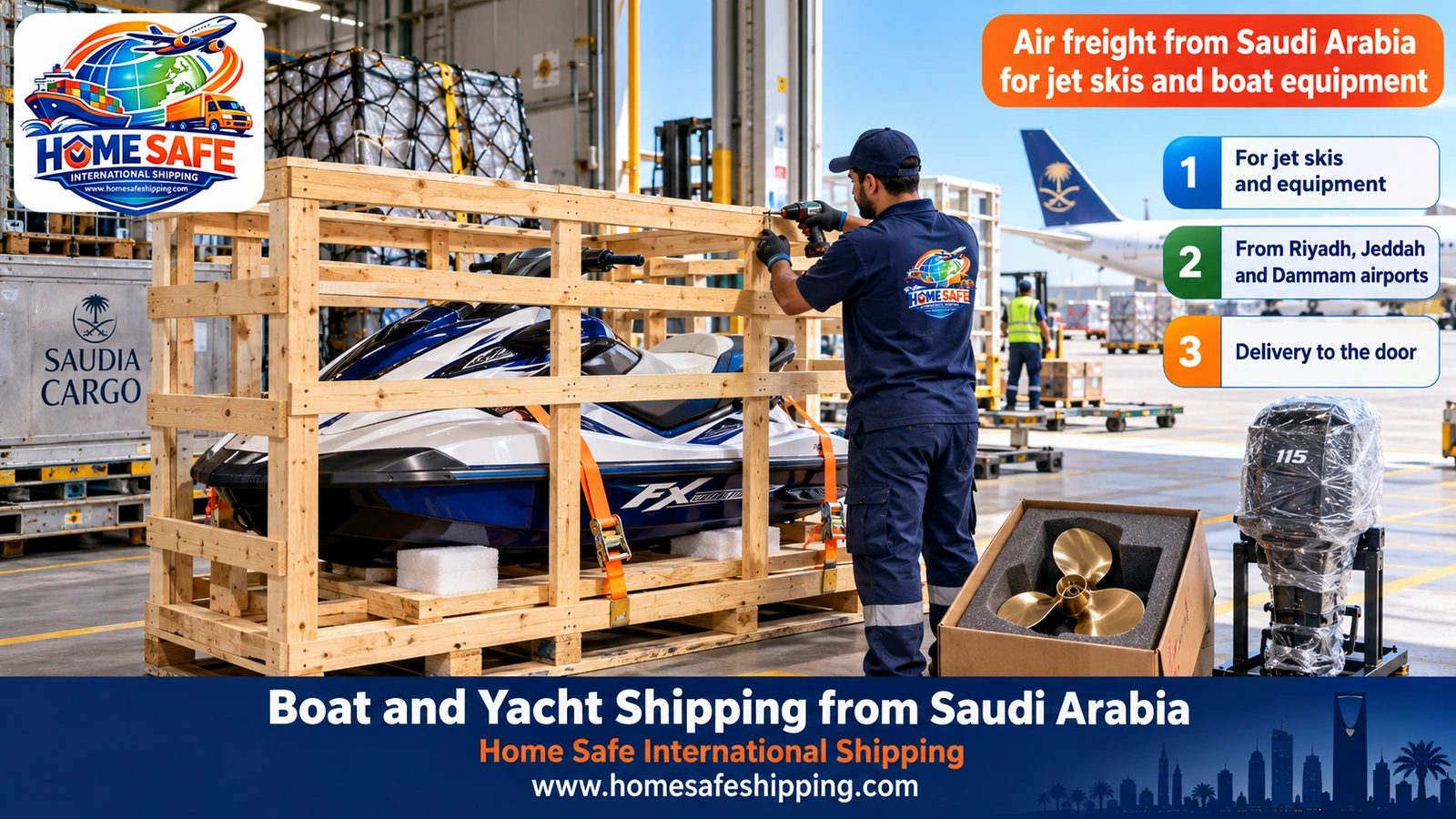
The boat itself rarely boards an aircraft, but what surrounds it flies every day. A jet ski its owner needs for a holiday starting in a week, an outboard engine a buyer is waiting for, a spare part that a yacht in a distant marina depends on, and sails, navigation electronics and diving gear. We ship them from Riyadh, Jeddah and Dammam airports, with delivery to the door or to the marina.
- The jet ski: fixed to a wooden base inside a crate, with its tank drained and its battery disconnected, and presented to the airline as an internal-combustion vehicle under the dangerous-goods rules for air transport.
- Engines: outboard or inboard, drained of fuel and oil and shipped on a pallet inside a wooden case.
- Parts and electronics: in padded cartons, and the quickest to clear.
- What does not fly: flares, gas cylinders and damaged batteries.
| Destination | Price per kilogram starts from | Usual time to the address |
|---|---|---|
| Gulf states | SAR 14 | 2–4 days |
| Europe | SAR 23 | 3–6 days |
| United Kingdom | SAR 26 | 3–6 days |
| United States | SAR 41 | 5–8 days |
| Original boat documents by express courier | SAR 83 per envelope | 2–4 working days |
The charge is on the greater of scale weight and volumetric weight. A jet ski in its crate is large for its weight, so its volume is usually what is paid for, and the airline may add dangerous-goods handling charges. Work out the weight with the volumetric weight calculator; the details are in the article on air freight from Saudi Arabia.
Where do we collect the boat? Marinas and cities
We collect the boat wherever it is: afloat at a marina berth, ashore in a storage yard, or in the courtyard of a house on its trailer. What we need differs at each site, since a marina has a hoist and a house does not.
| Location | Usual port of exit | Note |
|---|---|---|
| Jeddah: the Obhur and Corniche marinas | Jeddah Islamic Port | The shortest road leg |
| Yanbu, Umluj and Al Wajh | Jeddah or King Abdullah Port | Road transport along the coastal highway |
| Jazan, Farasan, Al Qunfudhah and Al Lith | Jeddah Islamic Port | The crane appointment is arranged in advance |
| Dammam, Khobar, Qatif and Jubail | Dammam for the Gulf and Asia, Jeddah for the Mediterranean | And by road straight to Gulf marinas |
| Riyadh, Qassim and inland cities | According to the destination | Mostly boats on trailers and jet skis |
Steps for shipping your boat with Home Safe
Eight steps from the first message until the boat is back in the water, and at each one you know what is required of you:
- You send the four figures: length, beam, height and weight, with photos of the hull from both sides and the bow, on 0552803439.
- You tell us the two marinas and the reason for shipping: a sale, a relocation or a season, as this decides the papers.
- We propose the method: container, flat rack, RoRo or deck cargo, and from which port.
- You receive the price itemised: lifting, cradle, wrapping, road transport, sea freight and clearance, each on its own line.
- We book the vessel and the crane: and agree a lifting day that fits the loading cut-off.
- Lifting and preparation: a report and photos, then the cradle, the straps and the shrink-wrap.
- Clearance and sailing: the export declaration, then you receive the bill of lading and the vessel’s name.
- Launching and delivery: our agent clears the boat and launches it at its marina, and you sign after checking it.
Tracking and photographic records
Transport technology has moved on, and the most useful part of it for an owner is seeing the boat while it is far away. After sailing you receive the bill of lading with the container number or the vessel’s name on it. A flat rack is followed by its number on the shipping line’s website, and a yacht carried on deck is followed by the vessel’s name on ship-tracking sites.
More important than the map are the photographs. We send you pictures at every handling: after the lift from the water, after securing on the cradle, after wrapping, on the port quay and at launching. If a scratch appears, we know at which stage it happened and who is responsible. How to follow a shipment is on the shipment tracking page.
Launching at the arrival marina
Shipping does not end on the port quay. The boat needs someone to discharge it from the ship, clear it, move it to the marina and put it back in the water. This stage is arranged by our agent in the arrival country, as we have no offices outside the Kingdom and we say so plainly.
- Book the marina before shipping: a boat that arrives with no berth waiting stays in the port on daily charges.
- Checking first: the film is removed and the hull compared with the lifting report and its photos before it touches the water.
- Refitting: the mast, radar and aerials go back in place by their numbers, and the batteries are connected.
- A test afloat: the slings stay slack under the boat for some minutes while it is checked for leaks, then the engine is started at the berth.
Importing boats and yachts into Saudi Arabia
The service works in both directions, and demand for imports is greater: a new boat from a builder in Europe or America, or a used yacht from a marina in the UAE or Turkey. Our agent in the country of purchase inspects the boat, collects it, prepares it and ships it to Jeddah Islamic Port or Dammam port, and we then clear it and move it to your marina.
What enters the Kingdom has its own rules: customs duty according to the tariff heading, 15% VAT on the value including freight and insurance, then registration of the boat with the Transport General Authority before it is launched. Large tourist yachts in the Red Sea have their own regulations issued by the Saudi Red Sea Authority. We confirm which of these rules are in force before you pay for the boat.
How to choose a company to ship your boat
A company’s reputation is the first thing to ask about, and it is known from two sources: customer reviews on independent sites, and what boat owners in the marina itself say. Ask someone who has shipped a boat before you about the experience, and read the negative review before the positive one. Then test the company with your questions in the first call, since the way it answers shows who has shipped a boat before and who sees it as cargo like any other.
| Ask about | A reassuring answer | An answer that calls for caution |
|---|---|---|
| The first thing it asks of you | The four measurements and photos of the hull | The length only, then an instant price |
| Lifting | It asks about lifting marks or the builder’s drawing | ‘The crane driver knows his job’ |
| The cradle | Made to the hull’s measure and padded | Timber and old tyres under the boat |
| The contract | A written booking confirmation in the establishment’s name with its registration | A verbal agreement and a transfer to a personal account |
| Insurance | A transit policy naming the boat by hull number | ‘Your yacht insurance is enough’ |
| The arrival country | It names who discharges and clears the boat there | ‘Our part ends at the port’ with no explanation |
Read the contract before paying: where the price starts and where it ends, the transit time expected rather than guaranteed, and what happens if the vessel or your papers are late. Do not rely on a guarantee given in a phone call, since what is not written in the booking confirmation cannot be claimed.
Recommendations for a safe shipment
- Start a month before the date: the cradle, the crane and the vessel are three appointments that have to meet.
- Photograph your boat yourself as well: your dated pictures are a reference independent of ours.
- Be there on lifting day if you can: or authorise someone who knows the boat to sign the report.
- Do not hide a defect: a fault written in the report protects you and protects us.
- Ask about arrival-country charges before shipping: port fees, marina fees and tax may exceed the freight.
- Keep the originals: the registration certificate and the spare key stay with you, not on the boat.
Common mistakes in boat and yacht shipping
- Sending the length alone, then being surprised that the beam moves the boat to a dearer method.
- Measuring the boat without its cradle, so the real height exceeds what was booked.
- Leaving fuel and water in the tanks, which adds weight and upsets the balance.
- Relying on the canvas cover on an open ship’s deck.
- Shipping the boat before its ownership or registration papers are finished.
- Assuming the yacht’s marine insurance covers it while it is carried.
- Arriving in a country where no marina was booked and no tax was worked out.
Why Home Safe for boat and yacht shipping?
A registered establishment
Home Safe Logistics Services Establishment, commercial registration 4030601060.
A lifting plan before the crane
We set the sling positions from the builder’s marks, not by eye.
The method fits the boat
Container, flat rack, RoRo or deck cargo, by the measurements and not by what we happen to have.
A report and photos at every handling
From the lift at the departure marina to the launch at the arrival marina.
To book: 0552803439 by call or WhatsApp, from 7 am to 11 pm. Or through the request a quote page.
Related articles and pages
- Overland yacht transport in the Gulf
- Sea freight company in Saudi Arabia
- Shipping from Saudi Arabia to Cyprus
- Car shipping from Saudi Arabia
- Heavy equipment shipping
- Sea freight
Tags
boat and yacht shipping from Saudi Arabia, yacht shipping from Saudi Arabia, boat shipping from Saudi Arabia, yacht shipping company, boat shipping company, yacht shipping cost, boat shipping from Jeddah, yacht shipping from Dammam, boat shipping on a flat rack, RoRo boat shipping, jet ski shipping, personal watercraft shipping, boat shrink-wrapping, boat transport on a trailer, importing a boat into Saudi Arabia, Home Safe International Shipping
Frequently asked questions about boat and yacht shipping from Saudi Arabia
How much does boat and yacht shipping from Saudi Arabia cost?
There is no single figure, because a boat is priced on its length, beam, height and weight and on the method that suits it. For a small boat or jet skis inside a container, the container freight starts from SAR 4,600 for a 20ft and SAR 5,200 for a 40ft to nearby ports. Flat-rack, deck and RoRo freight is set on request once the measurements reach us on 0552803439.
What is the largest boat that fits in a closed container?
The door opening decides, not the length of the box. The door is about 2.34 metres wide and about 2.58 metres high on a high-cube container, and a 40ft container is about 12 metres long inside. A boat narrower than 2.3 metres with its cradle and lower than 2.5 metres after dismantling usually goes in, and anything beyond that moves to a flat rack.
What is the difference between a flat rack and deck cargo?
A flat rack is a steel base with no side walls and no roof; the boat is secured to it in our yard and it is then lifted onto a container vessel like any other box. It suits boats up to about 11 or 12 metres. A longer or heavier yacht is lifted by crane and placed on its cradle directly on the deck of a general cargo or specialised vessel, with the cradle welded or lashed to the deck.
Can a boat be shipped on its own trailer by RoRo?
Yes, if the boat has a sound trailer. The trailer is towed up the ramp, parked in the hold and its wheels and frame are lashed to the floor, so no crane and no new cradle are needed. A boat without a trailer sits on a roll trailer supplied by the shipping line. The condition is that the arrival port is on a RoRo service.
How long does a yacht take by sea?
The sailing itself is 3 to 10 days to the ports of Egypt and the eastern Mediterranean, 14 to 22 days to northern Europe and 23 to 35 days to the US East Coast. Before it come one to two weeks for lifting, preparation and clearance. A yacht travelling on the deck of a general cargo vessel waits for a ship calling at the port, so its date is less regular than a container’s.
Which documents are needed to ship a boat from Saudi Arabia?
The boat’s registration certificate or title document, the owner’s ID or the commercial registration of the owning entity, an invoice or sale contract showing the value, the boat’s measurements and weight, and an authorisation for whoever hands it over on the owner’s behalf. For a permanent exit, proof that the Saudi registration has been closed is needed as the Transport General Authority requires, and we confirm what applies before booking the vessel.
Do I pay customs in the arrival country?
That depends on the status of entry. A boat that is sold or registered in the new country pays its duties and taxes in full. A boat entering for seasonal use and then returning is accepted in many countries under temporary admission for a set period with no duty. Because the rules differ from country to country and change, we check what is in force with our agent there before the boat moves.
Is the boat wrapped before shipping?
Yes, in most cases. The whole boat is covered with a plastic film that is heat-shrunk until it hugs its shape, the metal rails and sharp corners beneath are padded so they do not pierce it, and vents are fitted so that moisture does not condense inside. The exception is a boat travelling in a closed container, for which its canvas cover and padding at the contact points are enough.
What is dismantled from the boat before shipping?
Everything that adds height or sticks out from the hull: the mast, aerials, radar dome, bimini, fishing outriggers and sometimes the whole equipment arch. The outboard engine is removed in some cases or tilted up and secured. Each part is numbered, photographed and wrapped on its own, travels inside the cabin or in an accompanying crate, and is refitted on arrival.
Should I leave fuel and water in the tanks?
No. Fuel is brought down to the lowest level the carrier allows, and the fresh-water tanks, holding tanks and live-bait wells are emptied. Moving liquid shifts the boat’s balance on its cradle with every roll of the ship, and surplus fuel brings the shipment under dangerous-goods restrictions. The batteries are disconnected and their terminals insulated.
Do you ship jet skis by air?
Yes, from Riyadh, Jeddah and Dammam airports with delivery to the door. The jet ski is fixed to a wooden base inside a crate, its tank is drained and its battery disconnected, and it is presented to the airline as an internal-combustion vehicle under the dangerous-goods rules. The price is on chargeable weight and starts from SAR 14 per kilogram to the Gulf states.
Is the yacht insured during shipping?
The yacht’s marine policy covers it while it sails and usually does not cover it as cargo carried on a ship or a truck. So we arrange separate transit insurance that starts when the boat is lifted from the water and ends when it is launched at the arrival marina, calculated as a percentage of the declared value. Its terms and exclusions are written in the booking confirmation.
Which Saudi port will my boat leave from?
From the port closest to the destination’s trade lane. Boats bound for the Mediterranean, Europe, America and North Africa leave from Jeddah Islamic Port or King Abdullah Port on the Red Sea. Those bound for Gulf ports, India and East Asia leave from King Abdulaziz Port in Dammam. To the UAE, Kuwait, Qatar and Bahrain the road route is usually shorter than the sea.
Do you ship a boat I bought abroad to Saudi Arabia?
Yes. Our agent in the country of purchase collects the boat from the marina or showroom, prepares it and ships it to Jeddah or Dammam, and we then clear it and move it to your marina. Imports into the Kingdom carry customs duty according to the tariff heading and 15% VAT, and the boat is then registered with the Transport General Authority before it is launched.
Do you move the boat from the marina to the port?
Yes, and this leg is part of the service. The boat is lifted by the marina’s hoist or by a mobile crane, placed on a low-bed trailer and taken to Jeddah or Dammam port. If its beam exceeds 2.6 metres or its height on the trailer exceeds 4.8 metres, we obtain an abnormal-load permit and an escort car travels with it.
That is the guide — now let us price your shipment
Choose what applies to you and receive a reply with the price, the method and the time.
RoRo, container or sling lift — we recommend what suits your vehicle’s value and its destination.
Get a vehicle priceA full or shared container, or urgent air freight, with packing and clearance.
Get a shipment priceRoutes in the same section
Options related to the same type of service.