Sea Freight Company in Saudi Arabia 0552803439 | Full and Shared Containers and Car Shipping by RoRo from Jeddah and Dammam
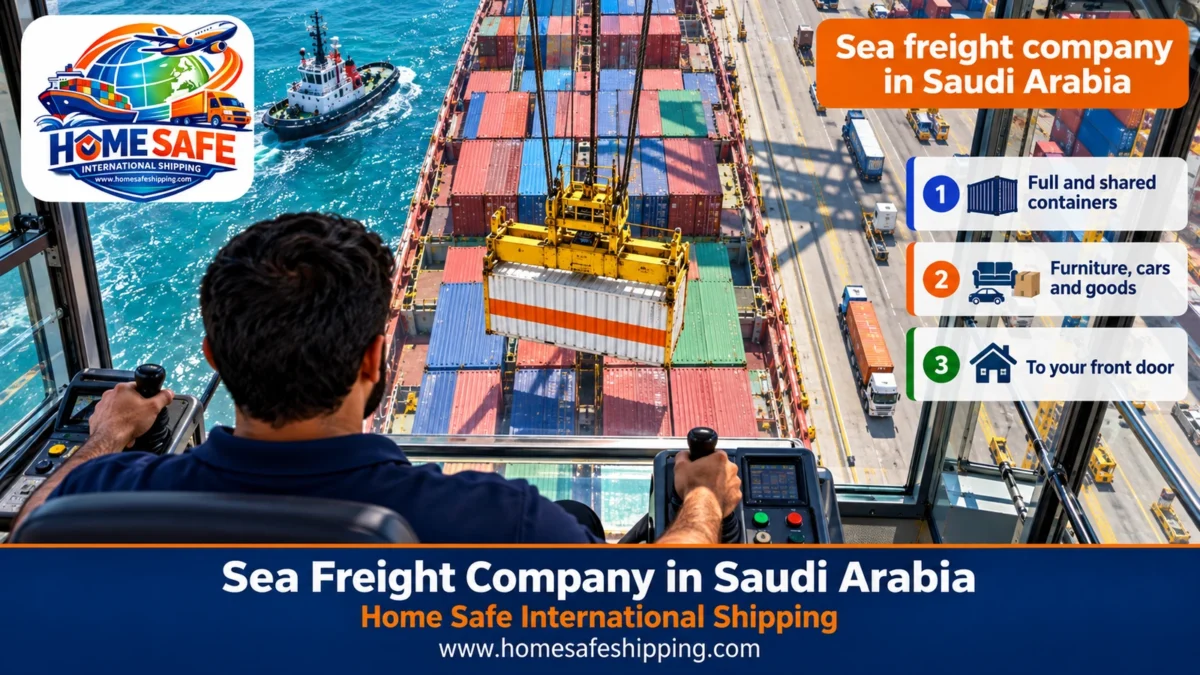
A sea freight company in Saudi Arabia that collects from every city in the Kingdom and ships from Jeddah Islamic Port, King Abdulaziz Port in Dammam and King Abdullah Port to the ports of Turkey, Egypt, North Africa, Europe and America. Shipping is in a full container, a shared container or by RoRo …
Looking for a sea freight company in Saudi Arabia that takes your container, your car or your cartons from your door and delivers them to a distant port and then to the consignee’s door? Home Safe ships by sea from Jeddah Islamic Port, King Abdulaziz Port in Dammam and King Abdullah Port, in a full container, a shared container or by RoRo for cars, and collects from every city in the Kingdom. A 20ft container starts from SAR 4,600 to nearby ports, a cubic metre in a shared container from SAR 415 and a saloon car by RoRo from SAR 2,800. Bookings and enquiries: 0552803439.
In this guide48ShowHide
- Who needs a sea freight company in Saudi Arabia?
- Saudi Arabia’s sea freight ports: Jeddah, Dammam and King Abdullah
- Which port does your city’s shipment leave from?
- Sea freight from Saudi Arabia in a full container or a shared container
- Container sizes: a 20ft or 40ft container and what lies between
- Sea freight destinations from Saudi Arabia and their prices
- The cost of sea freight from Saudi Arabia
- What is the price made up of?
- How do you get sea freight at the lowest cost?
- Comparing offers and negotiating the price
- Sea freight duration from Saudi Arabia, stage by stage
- What lengthens the duration?
- Shipping furniture and belongings by sea from Saudi Arabia
- Commercial cargo and exports in containers
- Car shipping by sea from Saudi Arabia by RoRo or inside a container
- Heavy cargo, equipment and refrigerated loads
- Storage and packing services before sea freight
- Sea freight documents
- Customs clearance in Saudi Arabia and in the arrival country
- What cannot be shipped by sea and what ships on conditions
- Sea or land freight? The Gulf states, Jordan and Egypt
- Air freight from Saudi Arabia when sea freight is too slow
- Importing by sea into Saudi Arabia
- Sea freight steps with Home Safe
- Container tracking and marine insurance
- Checking goods and documents before loading, and tips that spare you trouble
- How do you choose a sea freight company in Saudi Arabia?
- The importance of sea freight to trade in Saudi Arabia
- Common mistakes in sea freight from Saudi Arabia
- Why Home Safe for sea freight from Saudi Arabia?
- Related articles and pages
- Tags
- Frequently asked questions about sea freight from Saudi Arabia
- How much does sea freight from Saudi Arabia cost?
- How long does a sea shipment from Saudi Arabia take to arrive?
- Which are the main sea freight ports in Saudi Arabia?
- I am in Riyadh, so which port does my shipment leave from?
- What is the difference between a full container and a shared container?
- How much do a 20ft and a 40ft container hold?
- How is a car shipped by sea, and is it covered?
- Can I leave my belongings inside the shipped car?
- What documents does a personal sea shipment need?
- What are storage and demurrage charges and how do I avoid them?
- Is marine insurance necessary?
- Is sea freight suitable for the Gulf states and Jordan?
- When should I choose air freight instead of sea?
- Do you collect shipments outside Jeddah and Dammam?
- Do you import by sea into Saudi Arabia?
Ports: Jeddah Islamic, King Abdulaziz in Dammam, King Abdullah · Methods: full container, shared container, RoRo · Service: to the arrival port or to the front door.
In brief
- From where: every city in the Kingdom, through the ports of Jeddah, Dammam and King Abdullah.
- How: a full 20ft or 40ft container, a shared container by the cubic metre, or RoRo for cars.
- To where: Turkey, Egypt, Lebanon, North Africa, Europe, the UK, America and beyond.
- Duration: sailing of 3–10 days to nearby ports, 14–22 days to northern Europe and 23–35 days to America.
- Prices: a 20ft container from SAR 4,600, a cubic metre from SAR 415 and a car from SAR 2,800.
- Urgent: air freight from Riyadh, Jeddah and Dammam airports, from SAR 14 per kilogram.
- Booking: 0552803439 by phone or WhatsApp.
Who needs a sea freight company in Saudi Arabia?
Sea freight is the route for anyone with a large volume and a distant destination. Someone sending a suitcase to London has no need of it; someone moving a whole household there will find nothing cheaper. Most of the people who call us are one of the following, and each has a method that suits them:
| Who | What they ship | Best method |
|---|---|---|
| A resident whose job has ended and who is going home | Household furniture, appliances and belongings | Full container, or shared if the volume is small |
| A scholarship student or a transferred employee | Cartons, books and personal effects | Shared container by the cubic metre |
| A car owner | A car for export or for a long trip | RoRo, or a container for a luxury car |
| A factory or exporter | Products in quantity on pallets | Regular full containers |
| A small trader or online shop | A few pallets or cartons | Shared container |
| A contractor or project company | Equipment, machinery and generators | RoRo or a flat rack |
Saudi Arabia’s sea freight ports: Jeddah, Dammam and King Abdullah
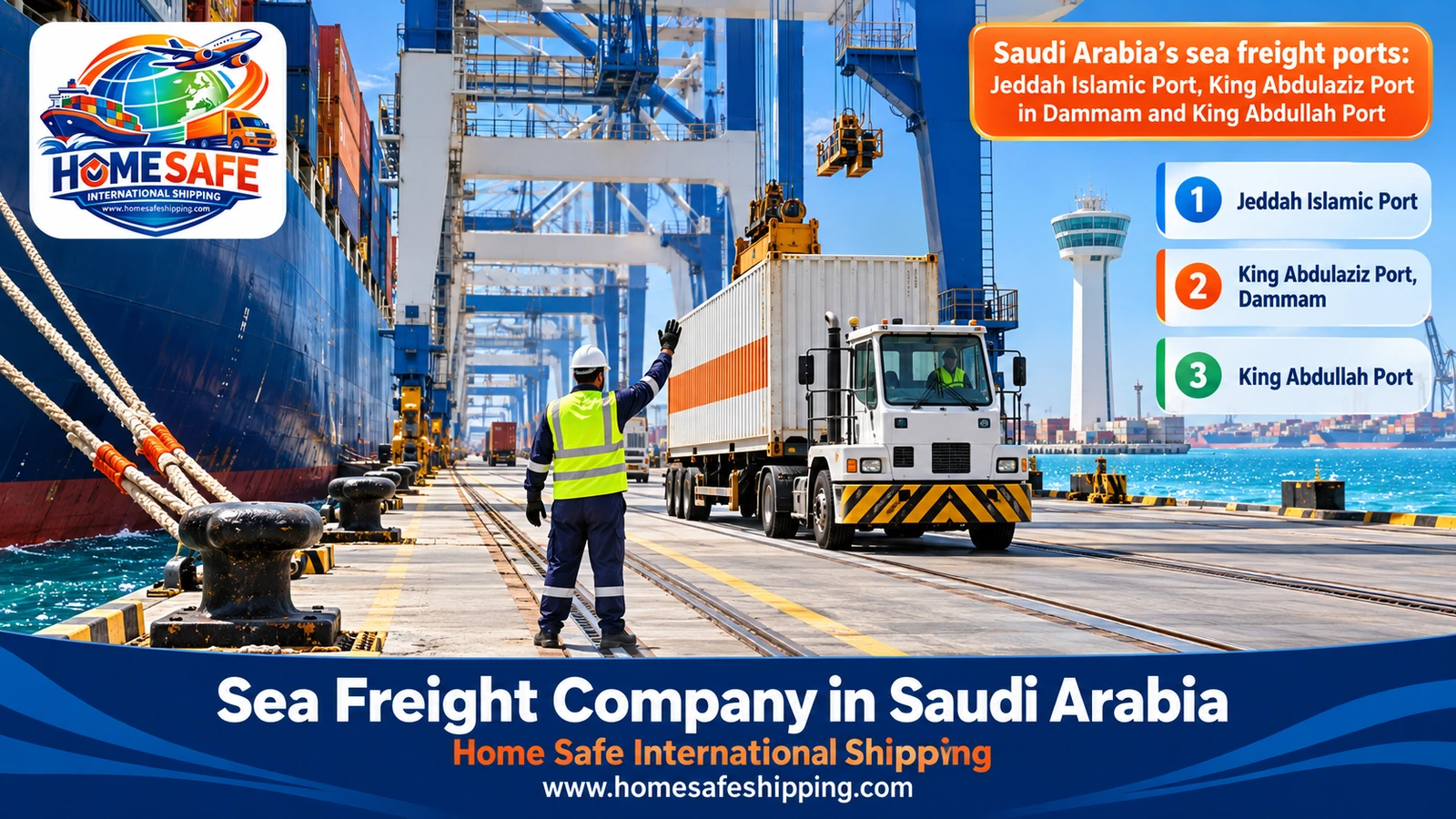
The Kingdom has two coasts: the Red Sea in the west and the Arabian Gulf in the east. The port your shipment leaves from is chosen by destination before it is chosen by how close it is to you. Cargo bound for the Mediterranean, Europe, Africa and America leaves from the west coast and avoids sailing round the Arabian Peninsula, while cargo bound for the Gulf, India and East Asia leaves from the east coast.
| Port | Location | Role | Mostly serves |
|---|---|---|---|
| Jeddah Islamic Port | Red Sea, inside the city of Jeddah | The Kingdom’s largest port, with container terminals and berths for general cargo and vehicles | Turkey, Egypt, North Africa, Europe and America |
| King Abdulaziz Port, Dammam | Arabian Gulf | The main container gateway on the east coast, linked by rail to Riyadh Dry Port | The Gulf, India and East Asia, and shipments from Riyadh and the Eastern Province |
| King Abdullah Port | King Abdullah Economic City, north of Jeddah | A modern port with deep berths for large vessels and a RoRo terminal for cars and equipment | Containers on the main trade lanes, and cars |
| Jubail Commercial Port | Arabian Gulf | General cargo and containers for the industrial zone | The factories of Jubail and its surroundings |
| Yanbu Commercial Port | Red Sea | The nearest port to Madinah | Madinah and Qassim |
| Duba Port | Northern Red Sea | Ferries and RoRo; the closest to the Suez Canal | Tabuk, and trucks heading for Egypt |
| Jazan Port | Southern Red Sea | General cargo and containers for the south of the Kingdom | Jazan and Asir |
It is the shipping lines that decide which port their vessels call at and on which day, and that changes from one season to the next. So we do not promise you a particular port before we have seen the destination and the loading date; we then book the nearest suitable vessel. All ports and border crossings are on the ports and gateways page.
Which port does your city’s shipment leave from?
We collect from your site wherever you are in the Kingdom, and the shipment then covers an inland leg to the port. That leg adds hours from the coastal cities and one to three days from the inland ones, and its charge is a separate line in the price, set on request according to the distance and the size of the shipment.
| Collection city | Usual port | How the shipment reaches it | More detail |
|---|---|---|---|
| Jeddah | Jeddah Islamic Port | Inside the city | International sea freight from Jeddah |
| Makkah and Taif | Jeddah Islamic Port | Truck, about 80 km from Makkah | Served from Jeddah |
| Riyadh and Al-Kharj | Jeddah to the west, or Dammam to the east | Truck to Jeddah, or train from the dry port to Dammam | International shipping company in Riyadh |
| Dammam, Khobar, Jubail and Al-Ahsa | King Abdulaziz Port, Dammam | Within the Eastern Province | International shipping company in Dammam |
| Madinah and Yanbu | Jeddah port, or Yanbu Commercial Port | Truck, about 420 km to Jeddah and 220 km to Yanbu | Served from Jeddah |
| Qassim and Hail | Jeddah or Dammam, depending on the destination | Truck to the port, or via Riyadh | International shipping company in Qassim |
| Tabuk | Jeddah port, and Duba for ferries | Truck along the coastal road | Served from Jeddah |
| Abha, Khamis Mushait and Jazan | Jeddah port, and Jazan for some cargo | Truck along the coast road | Served from Jeddah |
Sea freight from Saudi Arabia in a full container or a shared container
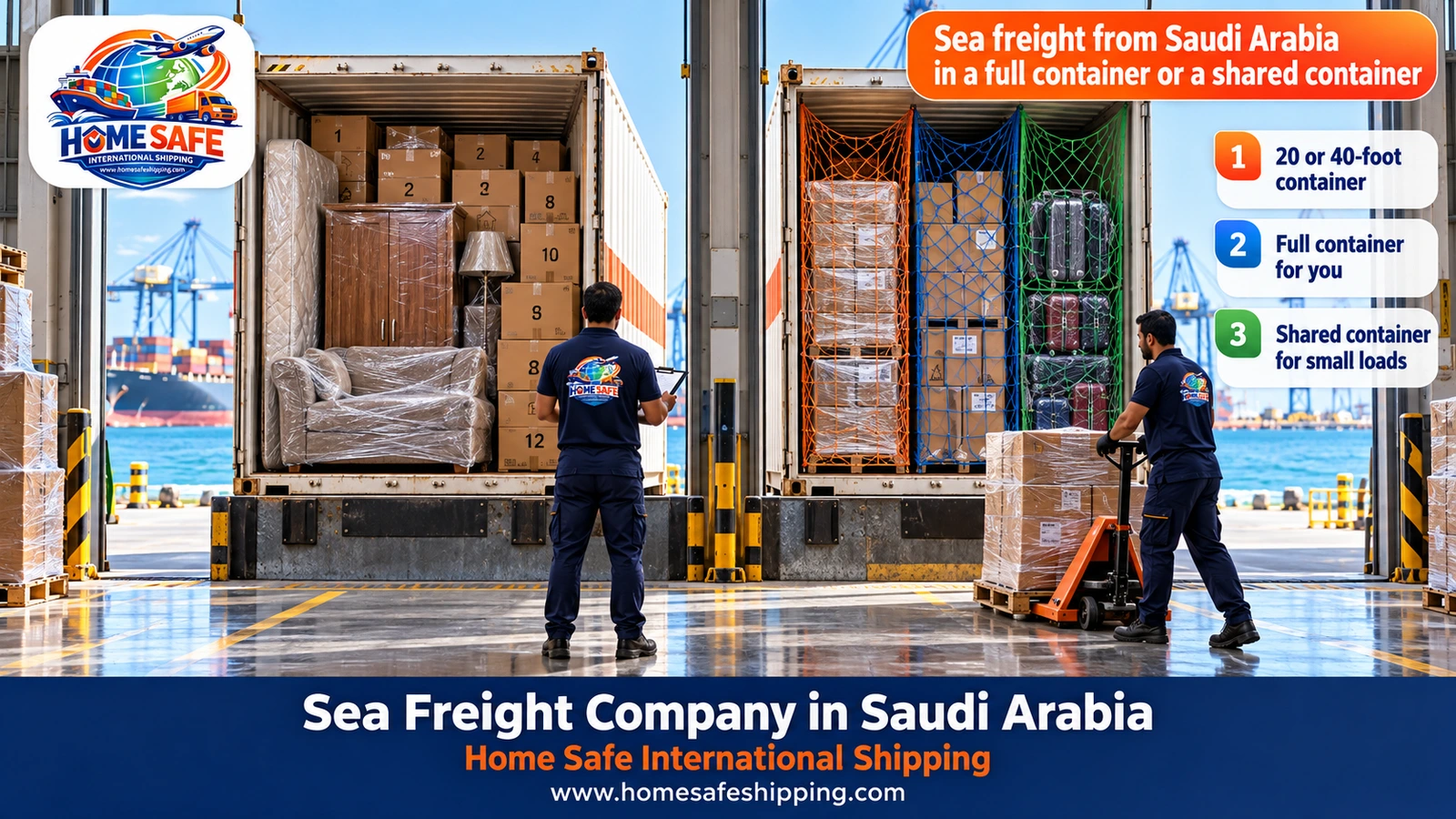
This is the first decision in any sea shipment, and the price, the duration and the packing are all built on it. A full container is a box for you alone; a shared container is a box you split with others, paying for your part of it. The working rule: anything under roughly fifteen cubic metres goes shared, and above that a full container becomes cheaper and safer.
| Point of comparison | A full container for your shipment | A shared container for small shipments |
|---|---|---|
| You pay for | The whole container, whether you fill it or not | The cubic metres you take up, usually with a minimum of one |
| Loading | At your door, then sealed with a number written on the bill of lading | We take the shipment to the consolidation warehouse, where it is loaded with others |
| Handling | One loading and one unloading | Several times: consolidation here and sorting in the arrival country |
| Duration | Shorter; it moves when it is ready | Days longer, waiting for the container to fill and then to be unpacked |
| Packing | Good securing inside the box is enough | Sturdier, with pallets or wooden crates for delicate pieces |
| Clearance | Your file alone | May be affected by the files of the other owners in the container |
In the middle band between 12 and 18 cubic metres we cost both options side by side for you. Work out your volume before you call with the volume calculator.
Container sizes: a 20ft or 40ft container and what lies between
The two common sizes are 20ft and 40ft, with special types for cargo that does not suit an ordinary dry box. Volume is not the only limit: every container has a weight limit, and the road to the port has another, so marble, steel and tiles reach the permitted weight before they fill half the box.
| Container | Approximate internal dimensions | Volume | Usually enough for |
|---|---|---|---|
| 20ft dry | 5.9 × 2.35 × 2.39 m | About 33 m³ | The furniture of a two- to three-bedroom flat, or a car with belongings |
| 40ft dry | 12 × 2.35 × 2.39 m | About 67 m³ | The furniture of a villa, or two cars |
| 40ft high cube | 12 × 2.35 × 2.69 m | About 76 m³ | Light, bulky loads such as wrapped furniture and foam |
| Refrigerated | Slightly smaller than a dry box because of the insulation | Depends on the size | Soft dates, foodstuffs and medicines |
| Open top and flat rack | For loads taller or wider than the door | Depends on the load | Equipment, generators and boats |
The full tables of dimensions and weights are on the container sizes page, and the service itself is explained on the sea freight page.
Sea freight destinations from Saudi Arabia and their prices
This table lists the destinations we ship to by sea from the Kingdom on a regular basis, with the usual sailing time and the starting price. The time given is for the vessel alone between the two ports, and an indirect service that changes vessel at a transhipment port adds to it.
| Destination | Arrival ports | Usual sailing time | Price starts from | Detailed article |
|---|---|---|---|---|
| Egypt | Ain Sokhna, Alexandria, Port Said | 3–10 days | SAR 4,600 for a 20ft container | Shipping from Saudi Arabia to Egypt |
| Lebanon | Beirut, Tripoli | 5–9 days | SAR 4,600 for a 20ft container | Saudi Arabia to Lebanon shipping company |
| Turkey | Mersin, Iskenderun, Izmir, Ambarli | 7–12 days on a direct service | SAR 4,600 per container and SAR 415 per cubic metre | Saudi Arabia to Turkey shipping company |
| Libya | Tripoli, Misrata, Benghazi | 10–20 days | SAR 4,600 per container and SAR 415 per cubic metre | Saudi Arabia to Libya shipping company |
| Tunisia | Rades, Sfax, Sousse | 10–20 days | SAR 4,600 per container and SAR 415 per cubic metre | Saudi Arabia to Tunisia shipping company |
| Algeria | Algiers, Oran, Annaba | 10–20 days | SAR 4,600 per container and SAR 415 per cubic metre | Saudi Arabia to Algeria shipping company |
| Morocco | Tanger Med, Casablanca | 10–22 days | SAR 7,800 per container and SAR 780 per cubic metre | Saudi Arabia to Morocco shipping company |
| Europe | Genoa, Marseille, Barcelona, Rotterdam, Hamburg | 8–22 days | SAR 5,500 for shared-container furniture and SAR 11,000 for a whole-household container | Shipping from Saudi Arabia to Europe |
| United Kingdom | Felixstowe, Southampton, London Gateway | 14–20 days | SAR 5,500 for shared-container furniture and SAR 11,000 for a whole-household container | Saudi Arabia to UK shipping company |
| United States | New York, Savannah, Houston | 23–35 days to the East Coast | SAR 7,800 per container and SAR 2,750 for shared-container furniture | Shipping from Saudi Arabia to the USA |
| Canada | Montreal and the east-coast ports | 25–40 days | Set on request | Shipping from Jeddah to Canada |
| West Africa | Dakar, Lome, Abidjan | Depends on the line and transhipment | Set on request | Jeddah to Senegal shipping company |
| India and East Asia | Mumbai, Karachi, Singapore, Shanghai | 8–28 days | Set on request | Priced by port |
Is your destination not in the table? Most of the world’s container ports are reached from Jeddah or Dammam by a direct vessel or with one transhipment. Send the name of the city to 0552803439 and we will tell you its nearest port and the expected duration.
The cost of sea freight from Saudi Arabia
Ocean freight is not a fixed tariff: shipping lines adjust it with supply and demand, the price of fuel and the seasons. That is why we give starting prices, after which you receive the figure for your shipment itemised, with its validity period. These are the figures we are working with now:
| What you ship | Method and destination | Price starts from |
|---|---|---|
| 20ft container | Ocean freight from Jeddah port to the ports of the Red Sea, the eastern Mediterranean, Libya, Tunisia and Algeria | SAR 4,600 |
| 40ft container | The same ports | SAR 5,200 |
| 20ft container | To Morocco, or to America | SAR 7,800 |
| 40ft container | To Morocco | SAR 14,720 |
| Cubic metre in a shared container | Turkey, Libya, Tunisia and Algeria | SAR 415 |
| Cubic metre in a shared container | Morocco, with a minimum of SAR 1,000 per shipment | SAR 780 |
| Furniture and belongings in a shared container | Europe and the UK | SAR 5,500 |
| A whole household in a container | Europe and the UK, door to door | SAR 11,000 |
| Furniture and belongings in a shared container | America | SAR 2,750 |
| Saloon car | RoRo to the ports a RoRo line serves | SAR 2,800 |
| Inland transport from your city to the port | Truck or train | Set on request |
Prices quoted in the market: few offices in the Kingdom publish a container rate, because it changes from one week to the next. What we found published are illustrative examples, not offers: one export guide puts ocean freight at SAR 7,500 for a 20ft container, with SAR 800 for port and documentation fees and SAR 1,200 for insurance. Other sites repeat global indices in dollars for trade lanes that do not start from the Kingdom at all. So do not compare an offer with a general figure; compare two offers for your own shipment and your own destination.
What is the price made up of?
| Item | What it covers | Who sets it |
|---|---|---|
| Ocean freight | Carrying the container or the cubic metre between the two ports | The shipping line; it moves with the market |
| Handling at both ports | Lifting the container onto the vessel and off it | The terminal operator at each port |
| Documents | The bill of lading, the export declaration and any certificates needed | The shipping line and the issuing bodies |
| Inland transport | From your site to the port, and from the arrival port to the address | Distance and the size of the shipment |
| Packing and loading | Dismantling, packing and securing inside the container | The type of shipment and the number of pieces |
| Clearance | Export release here and the import declaration there | The regulations of both countries |
| Duties and taxes in the arrival country | Whatever its customs levy on the shipment | The receiving state, and paid to it |
| Insurance | Optional, a percentage of the declared value | The value of the shipment and the type of cover |
Each factor is explained more fully on the pricing factors page, and container prices from Jeddah, destination by destination, are in the article Container shipping prices from Jeddah.
How do you get sea freight at the lowest cost?
The cheapest shipment is not the one with the lowest figure on the offer but the one that brings no invoices after sailing. Real savings come from decisions you make yourself before booking:
- Control the volume: leave behind whatever can be bought in the arrival country for less than its freight; you pay by the metre, not by the value.
- Pick the right size: a 40ft container costs far less than twice a 20ft one, so if your volume approaches two small boxes, take one large one.
- Book two or three weeks ahead: an early booking lets us choose a direct vessel at a calmer rate.
- Avoid the peaks if you can: the end of the school year and the run-up to the Eids are crowded with orders.
- Prepare the arrival papers early: a single day of port storage can wipe out everything you saved on the freight.
Comparing offers and negotiating the price
Ask for two or three offers for the same shipment and set their items in facing columns: where does each one end, at the port or at the door? Does it include handling at the arrival port and clearance? How long is it valid? An offer that ends at the port looks two thousand riyals cheaper, and then the consignee pays more than that to get the container out. Negotiation is reasonable on service items such as packing and inland transport, and on repeat shipments and multiple containers. The ocean freight itself has a narrow margin.
Sea freight duration from Saudi Arabia, stage by stage
Sailing is part of the duration, not all of it. Between the shipment leaving your door and entering the consignee’s home there are six stages, each with its own time.
| Stage | What happens | Usual time |
|---|---|---|
| Collection and packing | Dismantling, packing, inventory and loading at your site | One to two days |
| Transport to the port | Truck from your city, or train from Riyadh to Dammam | Hours from the coastal cities, 1–3 days from inland |
| Export and waiting for the vessel | Export declaration and the container entering the line’s yard | 2–7 days |
| Sailing | The voyage between the two ports, direct or with transhipment | 3–35 days depending on the destination |
| Clearance in the arrival country | Import declaration, inspection and payment of duties | 2–7 days with a complete file |
| Delivery | Truck from the port to the address, and unloading | 1–5 days depending on the city |
That makes the door-to-door duration about two to four weeks for Turkey and Libya, three to five weeks for Morocco and the UK, and a month and a half to two months for a shared shipment to America. The table of durations for every destination is on the expected transit times page.
What lengthens the duration?
- Transhipment: an indirect service sets the container down at an intermediate port to wait for a second vessel.
- Missing the vessel: some destinations have a sailing every week or two, and loading a day late can cost a week.
- Filling the shared container: it does not move until it is full of cargo for the same destination.
- An incomplete file on arrival: an exemption or residence paper not yet issued keeps the container in the port.
- Port congestion and rerouting: when lines change their route the voyage grows longer, and we tell you so at booking.
Shipping furniture and belongings by sea from Saudi Arabia
Household furniture is what individuals ship most in containers. The sea voyage differs from a truck in two respects: humidity and time. A container is a steel box that heats up by day and cools at night, so water vapour condenses on its roof and drips onto whatever is below. And the vessel rolls for weeks, so every gap between pieces becomes room for them to move.
That is why we dry the fridge and the washing machine for two days before loading and leave their doors ajar, wrap wood in a material that breathes rather than in airtight plastic, and hang moisture-absorbing bags in the container. Bedroom sets are dismantled and their panels numbered, and glass and marble go into treated wooden crates bearing the ISPM 15 stamp that most countries require on timber entering them. A numbered inventory is then written, each carton with its contents; it is the basis of clearance and of any insurance claim.
Anyone returning home for good benefits in many countries from a returning resident’s exemption for personal effects, on conditions concerning the length of residence abroad, the presence of the owner and the arrival date. These conditions differ from one country to another and change, so we confirm the current ones before shipping. The packing guide is on the packing and lashing page, and the full furniture service is in the article International furniture shipping company from Saudi Arabia.
Commercial cargo and exports in containers
A trader and a manufacturer ask something an individual does not: at which point do responsibility and cost pass from the seller to the buyer? That is what the international delivery terms written into the sales contract decide.
| Delivery term | Where the seller’s responsibility ends | Who pays the ocean freight |
|---|---|---|
| Ex Works (EXW) | At the door of the factory or warehouse | The buyer, along with everything after it |
| Free On Board (FOB) | Once the goods are loaded on the vessel at the Saudi port | The buyer |
| Cost, Insurance and Freight (CIF) | At the arrival port, with insurance on the goods | The seller |
| Delivered at Place (DAP) | At the buyer’s address, before customs duties | The seller |
For exporters we ship dates, foodstuffs, plastics, building materials and industrial products, in full containers or on pallets in a shared container. Before loading we check what the arrival country’s customs require: a commercial invoice, a packing list and a certificate of origin, plus health or conformity certificates for the goods subject to them. A container does not enter the port without its verified gross mass certificate, so we weigh it loaded before handing it over. Details are on the commercial shipping page.
Car shipping by sea from Saudi Arabia by RoRo or inside a container
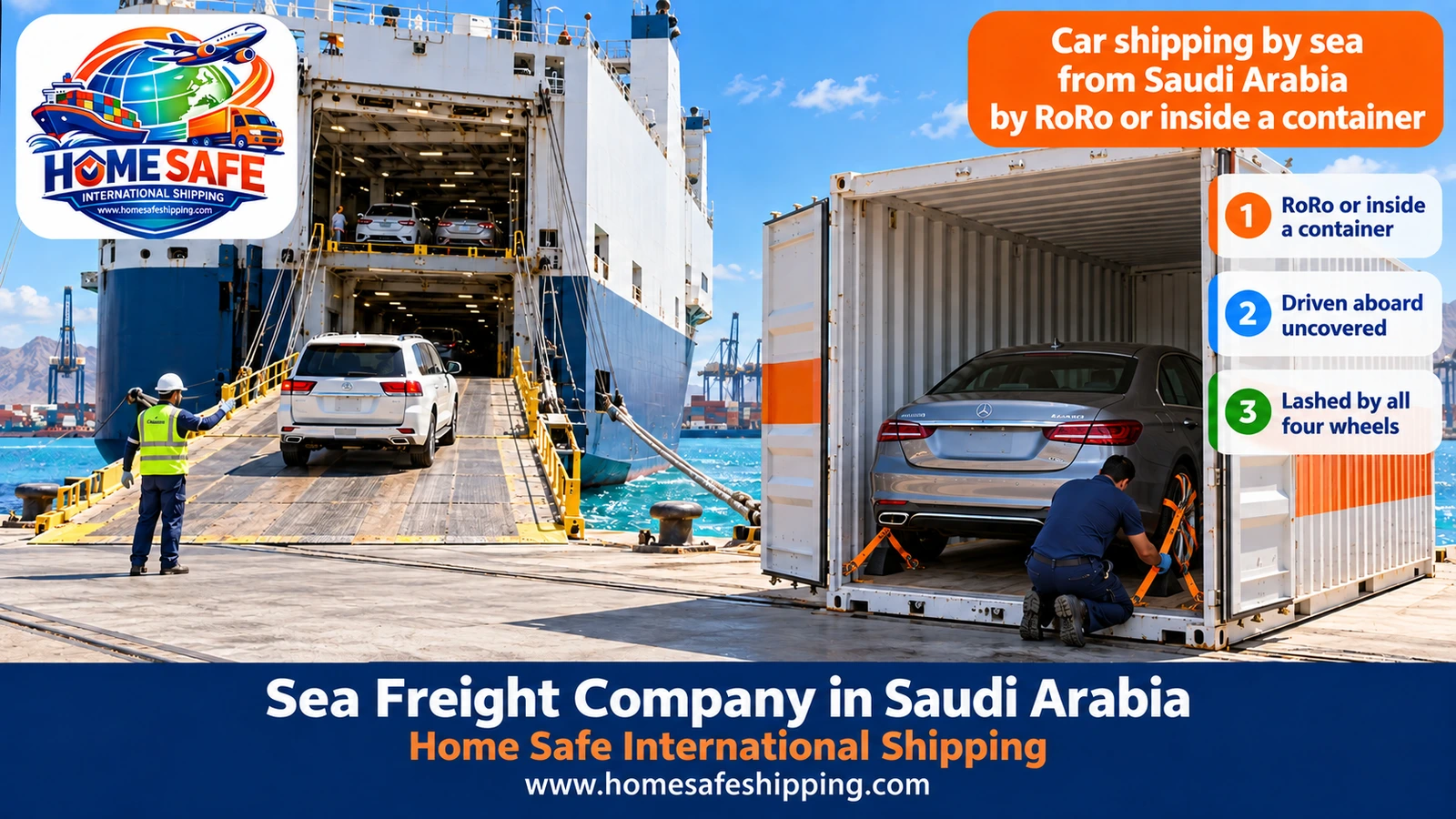
A car has two routes at sea. A RoRo vessel is like a floating car park: the car is driven inside over a ramp, uncovered just as it is, and then secured by all four wheels with straps to the deck. A container is a closed box the car enters to be lashed, chocked and sealed. The first is cheaper and simpler; the second is more protective and allows belongings with it.
| Point of comparison | RoRo | Inside a container |
|---|---|---|
| How it is loaded | Driven onto the vessel uncovered and parked by a port driver | Taken in over a ramp, wheels lashed and chocked |
| Acceptance condition | An engine that runs, and working brakes and steering | Non-runners and damaged cars are accepted |
| Belongings | Not allowed inside the car | Possible in the container if declared |
| Price | Starts from SAR 2,800 for a saloon | The container rate, from SAR 4,600 to nearby ports |
| Ports | Those a RoRo line calls at | Every container port |
| Suits | An ordinary running car and 4x4s | Luxury and classic cars, and a car with household furniture |
Before handover the car is washed and photographed from every side, about a quarter of a tank of fuel is left in it, and personal items and non-original tracking devices are removed. Anyone exporting a car for good completes the export procedure with the traffic department and receives proof of it, while anyone travelling with it temporarily keeps its plates. And the main question is asked before booking: does the arrival country accept this car? Many countries restrict the age or specification of imported cars, so we check the rule in force before it moves. Details are in the article Car shipping from Saudi Arabia and on the RoRo car shipping and container car shipping pages.
Heavy cargo, equipment and refrigerated loads
Not everything that is shipped fits a standard box. An excavator, a forklift and a truck travel on their own wheels or tracks onto a RoRo vessel. A large generator, a tank and a boat are lifted by crane onto a flat rack or into an open-top container and secured with chains and beams calculated on their centre of gravity.
Cargo that heat would spoil travels in a refrigerated container held at a set temperature for the whole voyage: soft dates, juices, dairy and medicines. These shipments are priced one by one once the dimensions, the weight and the required temperature are known. The equipment service is on the heavy equipment shipping page.
Storage and packing services before sea freight
The date for handing back a home does not always match the vessel’s date. A tenant vacates the flat at the end of the month while the shared container closes ten days later, or the arrival country’s visa has not yet been issued. In such cases we take the shipment packed and inventoried and keep it in a closed warehouse until it is due to load, for a charge based on volume and time that is stated in the booking confirmation.
Sea packing is a service in its own right, even for someone who brings the shipment to the warehouse themselves: double-wall cartons, protective wrap for furniture, made-to-measure wooden crates for screens, paintings and marble, and pallets for commercial goods that are wrapped and strapped. Details are on the storage page.
Sea freight documents
A container travels with its paperwork. One wrong letter in the consignee’s name, or a vague description of the contents, holds it at the arrival port for days that are charged as storage. These are the usual documents and who issues each of them:
| Document | Who issues it | What it is for |
|---|---|---|
| Ocean bill of lading | The shipping line or the freight agent | The contract of carriage, the receipt and the title to collect the goods on arrival |
| Commercial invoice | The seller or exporter | The basis for assessing value and duties on commercial goods |
| Packing list or inventory | We prepare it with the owner | Shows the contents of every carton, the number of pieces and the weights |
| Export declaration | Filed electronically with Saudi customs | Permission for the shipment to leave the Kingdom |
| Certificate of origin | The competent body in the Kingdom, electronically | Proves where the goods were made; required for commercial cargo |
| The owner’s identity document | ID, or passport and residence permit | Matching the names of the shipper and the consignee |
| The car’s papers | The registration, and what the traffic department issues on export | Proof of ownership and permission to leave |
| Verified gross mass certificate | An approved weighbridge before entry to the port | An international condition for loading any container on a vessel |
| Special certificates | Health, agricultural or technical bodies | For food, plants and dangerous goods |
In practice the bill of lading comes in two forms: a paper original sent to the consignee to present, or an electronic release under which the cargo is handed over without paper. The second is quicker for individuals; the first is what a trader asks for when payment is tied to the documents. The complete list is on the shipping documents page.
Customs clearance in Saudi Arabia and in the arrival country
Every sea shipment passes two customs authorities. In the Kingdom the export declaration is filed electronically with the Zakat, Tax and Customs Authority, the container may be X-rayed or opened, and it is then released to the loading quay. Individuals’ used belongings normally carry no charge on leaving; what matters is that the inventory matches what is actually in the container.
In the arrival country our agent files the import declaration in the consignee’s name. Here countries differ widely: one exempts a returning resident’s belongings if the owner attends in person, another asks for a tax number or a tenancy contract, and a third requires the shipment to be registered in advance before it leaves the Kingdom. The duties and taxes that country levies are not part of the freight charge and are paid to it directly, and we give you an estimate of them before booking so that they do not come as a surprise. The service is explained on the customs clearance page.
What cannot be shipped by sea and what ships on conditions
The sea is more accommodating than an aircraft with dangerous goods, but it does not accept them hidden among belongings. An undeclared tin of paint or gas cylinder inside a furniture container is an offence that can end in a fine and a seizure. The rule: declare everything, and we tell you what is accepted and how.
| Item | Status | Note |
|---|---|---|
| Explosives, fireworks, weapons and ammunition | Not shipped | Prohibited in all cases |
| Narcotics and psychotropic substances | Not shipped | A crime in both the shipping and the arrival country |
| Counterfeit goods | Not shipped | Confiscated and fined |
| Paints, solvents and alcohol-based perfumes in quantity | With declaration and classification | Treated as dangerous goods under the international maritime code |
| Loose lithium batteries and gas cylinders | With declaration and special packing | A cylinder is emptied completely, and electric bikes are declared |
| Meat, dairy, plants and seeds | Depends on the arrival country | Many countries ban them in personal effects |
| Medicines | A personal quantity with a prescription | Commercial quantities need a licence |
| Cash, gold, jewellery and original documents | Not placed in the container | Carried by the traveller |
| Zamzam water | Not shipped as cargo | Carried by the traveller in the pack made for it |
Each country has its own list on top of this one, so we check it against your inventory before packing. The general list is on the prohibited items page.
Sea or land freight? The Gulf states, Jordan and Egypt
Not every destination that looks close on the map suits a vessel. A closed truck reaches the UAE, Qatar, Kuwait, Bahrain, Oman and Jordan from any Saudi city within days and stops at the consignee’s door. A container from Jeddah to a Gulf port, by contrast, sails round the Arabian Peninsula and goes into and out of two ports. So we do not suggest the sea for individuals’ belongings to these countries. It remains sound for heavy commercial cargo from Dammam to Gulf ports.
Egypt is a case in between: most individuals’ shipments go there on a truck that crosses the Red Sea on the ferry, with the sea container kept for large loads and commercial cargo. The land route is detailed in the article Land freight company in Saudi Arabia and the article Shipping from Saudi Arabia to the Gulf states.
Air freight from Saudi Arabia when sea freight is too slow
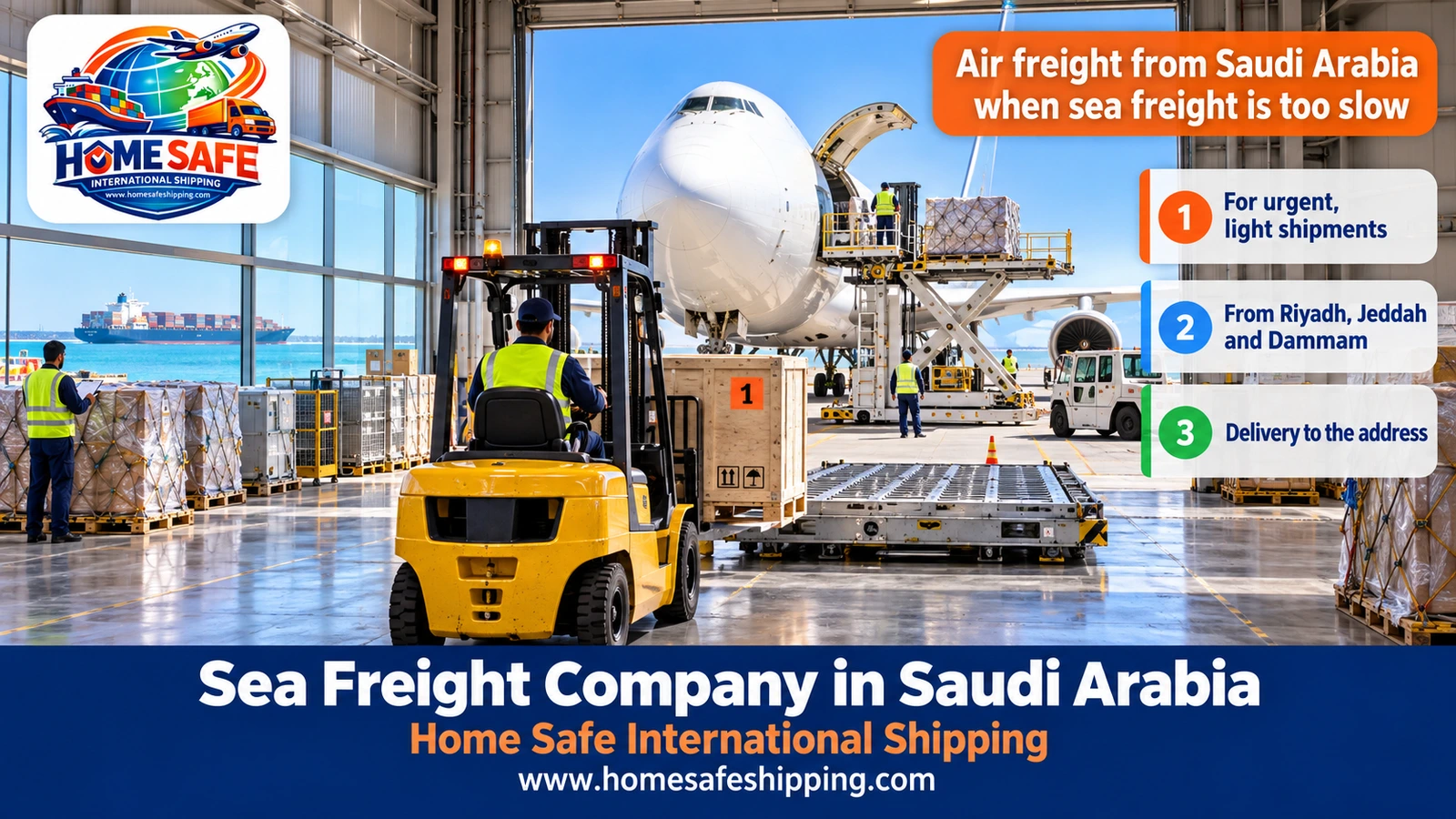
The sea saves money and takes time. When a shipment is urgent or light, its place is on an aircraft: documents that are awaited, the suitcases of a student whose term starts in a week, samples for a customer, a spare part a production line is waiting for. We ship by air from Riyadh, Jeddah and Dammam airports, with delivery to the address in days rather than weeks.
| Destination | Price per kilogram starts from | Usual time to the address |
|---|---|---|
| Gulf states | SAR 14 | 2–4 days |
| Europe | SAR 23 | 3–6 days |
| United Kingdom | SAR 26 | 3–6 days |
| North and West Africa | SAR 28 | Depends on the flights available |
| United States | SAR 41 | 5–8 days |
| Document envelope up to one kilogram | SAR 83 | 2–4 working days |
Air freight is charged on the greater of the scale weight and the volumetric weight, so a large, light carton is paid for by its size. The answer many returning residents choose is to split the shipment: furniture and appliances in the container, and two suitcases with what is needed in the first week on the aircraft. Details are in the article Air freight from Saudi Arabia and on the air freight page.
Importing by sea into Saudi Arabia
The service works in both directions. We collect from your supplier abroad or from your home there, book the container to Jeddah Islamic Port or King Abdulaziz Port in Dammam depending on your city, then clear it and deliver it. Cargo coming into the Kingdom has its own rules: products covered by technical regulations need a conformity certificate before shipping, a commercial importer needs a commercial registration and a tax number, and a used car is subject to age and specification conditions. We confirm which of these rules are in force before you pay the supplier.
Sea freight steps with Home Safe
From the first call to the signature on delivery there are eight steps, and at each one you know where your shipment is and what is needed from you:
- You send the list and the destination: what you are shipping, as photos or a list, with the city and country, to 0552803439.
- We work out the volume and suggest the method: full container, shared container or RoRo, and from which port.
- You receive the price itemised: where it ends, what it includes and how long it is valid.
- We book the vessel: and agree a collection day that fits the loading cut-off.
- We pack and load: dismantling, packing and a numbered inventory, then securing inside the container and sealing it in front of you.
- We clear for export: the export declaration, the container’s weight and its entry to the port.
- You receive the bill of lading and the container number: and follow the vessel to the arrival port.
- Clearance and delivery: the arrival-side agent releases the container, a truck takes it to the address, and the consignee checks the pieces against the inventory and signs.
Container tracking and marine insurance
After sailing you receive the bill of lading showing the container number and the vessel’s name. With that number you can see on the shipping line’s website where the container was discharged, when it was reloaded and its expected arrival date. Sea tracking is not live like the tracking of an express parcel; it updates at each port. We also send you an update ourselves at every important point. How to track is on the shipment tracking page.
Insurance is what people ask about once it is too late. The ocean carrier is liable for the container within limits set by international conventions and calculated on weight or number of packages, not on the value of the contents. And the sea has an old rule called general average: if part of the cargo is sacrificed to save the vessel, all the cargo owners share the loss, and your container is not released until you pay your share or your insurer does. So choose the type of cover after reading what it includes and excludes, and review the policy before loading, not after. The terms and rate of cover are stated in the booking confirmation and explained on the cargo insurance page.
Checking goods and documents before loading, and tips that spare you trouble
Most sea freight problems are sown before the container is closed and reaped a month later in a distant port. A quarter of an hour of checking at loading saves weeks of correspondence:
- Inspect pieces before they are wrapped: an old scratch on a table is written into the inventory today so that it does not become a dispute at delivery.
- Match the inventory to the cartons: a number on each carton with a line in the list to match, and no entries reading miscellaneous.
- Check the name letter by letter: the consignee’s name on the bill of lading as it is in the passport, with a phone number that is answered.
- Photograph the container twice: once loading is complete with the doors open, and again after closing, with the seal number.
- Write down remarks at delivery: any visible damage is noted on the delivery receipt before signing, as it is the basis of a claim.
How do you choose a sea freight company in Saudi Arabia?
Reputation, price, duration and customer service are headings everyone mentions. The real test is a set of specific questions you put in the first call, and the way they are answered shows who knows the job. A visit to the office or the warehouse, where possible, settles a good many doubts.
| Ask about | A reassuring answer | An answer that calls for caution |
|---|---|---|
| Legal status | A commercial registration and a contract or booking confirmation in the establishment’s name | A transfer to a personal account with no document |
| Where the price ends | States whether to the port or to the door, and names what is excluded | All-inclusive with no list of items |
| The method | Asks about the volume, then suggests full or shared | Sells a full container to every caller |
| The arrival country | Asks about the consignee’s status and papers there | Customs is your problem, with no explanation |
| The duration | Separates the sailing from the other stages | One short figure with no breakdown |
| After sailing | A bill of lading with the container number and the vessel’s name | We will call you when it arrives |
And read the booking terms before paying: what is paid in advance and what on arrival, and what happens if your papers are late or the vessel’s date changes. The place for these terms is the written booking confirmation, not the phone call.
The importance of sea freight to trade in Saudi Arabia
The Kingdom looks out on two of the busiest shipping lanes: the Red Sea, which links Asia to Europe through the Suez Canal, and the Arabian Gulf. The greater part of the country’s imports and non-oil exports passes through its ports, from food for the markets to factories’ materials and products. That is why container terminals are being expanded and the ports linked to railways and logistics zones.
Common mistakes in sea freight from Saudi Arabia
- Booking a full container for ten cubic metres, or shipping thirty shared metres for more than a container costs.
- Choosing the cheapest offer and then discovering that it ends on the quay of the arrival port.
- Loading a fridge that has not dried, so the container arrives with a smell of mould in everything inside.
- Hiding a dangerous substance or a banned item among the cartons, so the whole container is detained.
- Shipping a car before making sure the arrival country accepts its age and specification.
- The owner travelling weeks after the shipment arrives, so storage charges pile up in their absence.
- Skipping insurance to save a small sum on a shipment holding a whole household.
Why Home Safe for sea freight from Saudi Arabia?
A registered establishment
Home Safe Logistics Services Establishment, commercial registration 4030601060.
The port fits the destination
We choose Jeddah, Dammam or King Abdullah by the vessel service, not by habit.
A price you can read
Ocean freight, handling, clearance and delivery each on its own line, with the validity period.
Door to door
Collection from your city, clearance in both countries and delivery to the consignee’s address.
To book: 0552803439 by phone or WhatsApp, from 7 am to 11 pm. Or use the request a quote page.
Related articles and pages
- International sea freight from Jeddah
- Sea car shipping from Jeddah
- Land freight company in Saudi Arabia
- Air freight from Saudi Arabia
- Door-to-door shipping
- Shipping services
Tags
sea freight company in Saudi Arabia, sea freight companies in Saudi Arabia, best sea freight company in Saudi Arabia, cheapest sea freight company, sea freight from Saudi Arabia, sea freight prices from Saudi Arabia, container shipping from Saudi Arabia, 20ft container, 40ft container, shared container, car shipping by sea from Saudi Arabia, RoRo car shipping, Jeddah Islamic Port, King Abdulaziz Port Dammam, King Abdullah Port, Home Safe International Shipping
Frequently asked questions about sea freight from Saudi Arabia
How much does sea freight from Saudi Arabia cost?
The price follows the arrival port and the shipping method. A 20ft container to the ports of Egypt, Lebanon, Turkey, Libya, Tunisia and Algeria starts from SAR 4,600, a 40ft container from SAR 5,200, a cubic metre in a shared container from SAR 415 and a saloon car by RoRo from SAR 2,800. Ocean rates move with the market, so ask for the figure for your own shipment on 0552803439.
How long does a sea shipment from Saudi Arabia take to arrive?
The vessel needs 3 to 10 days for the ports of Egypt and the eastern Mediterranean, 10 to 22 days for North Africa and Morocco, 14 to 22 days for northern Europe and the UK, and 23 to 35 days for the US East Coast. On top of the sailing comes what precedes it in the Kingdom and what follows it in the arrival country, usually ten days to two weeks.
Which are the main sea freight ports in Saudi Arabia?
Three ports carry most of the Kingdom’s containers: Jeddah Islamic Port on the Red Sea, which is the largest; King Abdulaziz Port in Dammam on the Arabian Gulf, the gateway of the Eastern Province and Riyadh; and King Abdullah Port in King Abdullah Economic City north of Jeddah.
I am in Riyadh, so which port does my shipment leave from?
Riyadh has no seaport, so its container leaves by one of two routes. The first is a truck to Jeddah Islamic Port when the destination is Turkey, Egypt, North Africa, Europe or America. The second is a train from Riyadh Dry Port to King Abdulaziz Port in Dammam when the destination is in the Gulf, India or East Asia. We name the better one once we know the destination.
What is the difference between a full container and a shared container?
With a full container you hire the whole box: it is loaded at your door, sealed and opened only at the consignee’s address or in front of customs. With a shared container you pay only for the cubic metres your shipment takes up; it is consolidated with other people’s cargo in a warehouse and sorted in the arrival country. The first is quicker with less handling, the second is cheaper for small shipments.
How much do a 20ft and a 40ft container hold?
A 20ft container has an internal volume of about 33 cubic metres and usually takes the furniture of a two- to three-bedroom flat, or one car with belongings. A 40ft container is about 67 cubic metres and takes the furniture of a villa or two cars.
How is a car shipped by sea, and is it covered?
By RoRo the car is driven into the vessel uncovered, with no wrapping; a port driver parks it in its place and it is then secured by all four wheels with straps to the deck. Inside a container it goes in over a ramp, its wheels are lashed and chocked with timber, and the container is sealed. RoRo is cheaper for a running car; a container suits luxury, classic and non-running cars.
Can I leave my belongings inside the shipped car?
Not with RoRo: the car is handed over empty apart from its original kit such as the spare wheel and the jack, because it stays unlocked in the port yard and on board. In a private container, declared belongings can travel beside the car in the same box, provided they are listed on the packing list and the arrival country does not ban them.
What documents does a personal sea shipment need?
A copy of the ID or of the passport and residence permit, an inventory of the shipment item by item with an estimated value, and the consignee’s name, address and phone number matching their document. A car needs its registration and whatever the traffic department requires to export it. We issue the bill of lading and the export declaration, and tell you which exemption or residence papers the arrival country asks for.
What are storage and demurrage charges and how do I avoid them?
Every container has free days at the arrival port. Once they run out before clearance, daily charges are raised by the port, and others by the shipping line if the empty box is returned late. Avoiding them is simple: the clearance file is prepared while the vessel is still at sea, the consignee is present with their documents on arrival day, and nothing is shipped that needs a permit not yet issued.
Is marine insurance necessary?
It is optional, but we recommend it for any shipment of value. The ocean carrier’s liability for damage is capped by international conventions at far less than the value of a household or a car. Insurance also covers your share of general average if it is declared on the vessel. It is calculated as a percentage of the declared value, and its terms are stated in the booking confirmation.
Is sea freight suitable for the Gulf states and Jordan?
Mostly not. A closed truck reaches the UAE, Qatar, Kuwait, Bahrain, Oman and Jordan in a few days, door to door, whereas a container passes through two ports and waits for a vessel. The sea remains an option for heavy commercial cargo in containers between Dammam and Gulf ports. For personal shipments to these countries we suggest land freight.
When should I choose air freight instead of sea?
When time matters more than the charge, or when the shipment is light. Documents, parcels, suitcases, samples and urgent spare parts belong on an aircraft and arrive within days. Anything beyond a few hundred kilograms, or furniture, or an ordinary car is clearly cheaper by sea.
Do you collect shipments outside Jeddah and Dammam?
Yes. We collect from Riyadh, Makkah, Madinah, Taif, Qassim, Hail, Tabuk, Abha, Khamis Mushait, Jazan, Al-Ahsa, Jubail and elsewhere. A full container arrives empty at your site on a truck and is loaded there, while a small shipment is carried to the consolidation warehouse near the port. The inland transport charge is set on request according to the distance.
Do you import by sea into Saudi Arabia?
Yes. We arrange collection from the supplier or from your home abroad, shipping to Jeddah Islamic Port or the port of Dammam, then clearance and delivery in your city. Importing into the Kingdom has its own requirements: conformity for products covered by technical regulations, registration of the commercial importer, and special rules for used cars. We go through them with you before the shipment moves.
That is the guide — now let us price your shipment
Choose what applies to you and receive a reply with the price, the method and the time.
RoRo, container or sling lift — we recommend what suits your vehicle’s value and its destination.
Get a vehicle priceA full or shared container, or urgent air freight, with packing and clearance.
Get a shipment priceRoutes in the same section
Options related to the same type of service.