
Packing Furniture for a Move 0552803439 | Materials, Item-by-Item Methods, Dismantling and Labelling for Land, Sea and Air

Want to know how the furniture of your home should be packed before a move inside the Kingdom or a shipment abroad? This guide explains the materials you need, how to wrap sofas, mattresses, wooden pieces, glass, mirrors, screens, appliances and kitchenware, how to dismantle, label and list everythi…
Packing furniture for a move is what separates a home that arrives as it left from one that arrives with scratches, broken glass and missing screws. In this guide Home Safe explains the way its crew works: which material for which piece, how pieces are dismantled, numbered and listed, and what changes when the shipment travels by truck, in a sea container or on an aircraft. If you would like the crew to do it in your home, the price of dismantling and packing is set on request once the pieces are counted. To book or enquire: 0552803439.
In this guide44ShowHide
- Why does furniture get damaged on the way?
- Furniture packing materials before shipping from Saudi Arabia: cartons, bubble wrap, blankets and corner guards
- Plastic packing and cardboard packing compared
- How much packing material do you need?
- Tips for dismantling furniture before packing
- How to keep fittings and small parts
- Wrapping sofas, mattresses and wooden pieces before a move from Saudi Arabia
- Packing glass, mirrors and screens in wooden crates before shipping from Saudi Arabia
- Packing electrical appliances
- Packing kitchenware, china and crystal
- Packing carpets, curtains, clothes and books
- Packing room by room: in what order do you start?
- Numbering and the inventory
- How to secure furniture properly inside the truck and the container
- How packing differs for land, sea and air
- Packing for air freight from Saudi Arabia: light, strong cartons
- Packing for long storage
- Pack it yourself or use a professional crew?
- The cost of packing furniture for a move
- Packing steps on moving day
- Tips before packing day
- What is not packed with the furniture
- Unpacking and reassembly in the new home
- How do you choose who packs your furniture?
- Common mistakes in packing furniture
- Why Home Safe for packing your furniture?
- Related articles and pages
- Tags
- Frequently asked questions about packing furniture for a move
- What is the best way of packing furniture for a move?
- Which materials do I need to pack the furniture of a home?
- Should I pack the furniture myself or leave it to the crew?
- How much does furniture packing cost?
- How do I wrap a sofa without harming the fabric or leather?
- How do I protect a mattress during the move?
- How is a screen packed when its original box is gone?
- Is a wooden crate necessary for glass and marble?
- Which is better: plastic packing or cardboard packing?
- Do I dismantle every piece of furniture before the move?
- Where do I put the screws and small keys?
- How does packing for sea freight differ?
- How do I pack for air freight without paying for excess weight?
- When should I start packing the home before moving day?
- Does packing affect the insurance on the shipment?
In brief
- The rule: a soft layer touching the piece, and over it a layer that holds tight and keeps out dust and water.
- Before packing: dismantle what comes apart, photograph the piece and keep its screws in a bag carrying its number.
- Materials: reinforced cartons, bubble wrap, blankets, stretch film, corrugated card and corner guards.
- Fragile items: glass, mirrors and marble in made-to-measure wooden crates; screens travel upright.
- Numbering: a number and a room name on every piece and carton, and a signed inventory.
- By mode: land needs strapping, sea needs moisture protection, air needs light cartons of exact size.
- Booking: 0552803439 by call or WhatsApp.
Why does furniture get damaged on the way?
Furniture is not damaged because the road is long, but because something moved, rubbed, was crushed or got wet. Those are the four causes, with hardly a fifth, and every packing material exists to prevent one of them. Once you know what threatens a piece you know what to wrap it in, and you do not buy a material you do not need.
| Cause of damage | What happens to the piece | What prevents it |
|---|---|---|
| Movement inside the truck or container | One piece strikes another at every stop and bend | Stowing with no gaps, and straps |
| Rubbing | Scratches in paint, veneer and polish | A blanket or foam touching the surface |
| Pressure and stacking | A crushed carton or a cracked panel | Reinforced cartons, heavy items at the bottom |
| Impact on corners | A chipped edge or an opened joint | Cardboard or foam corner guards |
| Dust, water and humidity | Stains on fabric and swelling in chipboard | Stretch film, sealed bags and desiccants |
| Lost parts | A sound piece that cannot be assembled | Numbered bags and an inventory |
Furniture packing materials before shipping from Saudi Arabia: cartons, bubble wrap, blankets and corner guards
No single material suits everything. Each has a job: cartons carry and stack, bubble wrap absorbs shock for fragile items, blankets prevent rubbing on large surfaces, stretch film holds tight and keeps dust out, and corner guards take the knock instead of the edge. Good packing means the right material on the right piece, not a great deal of one material.
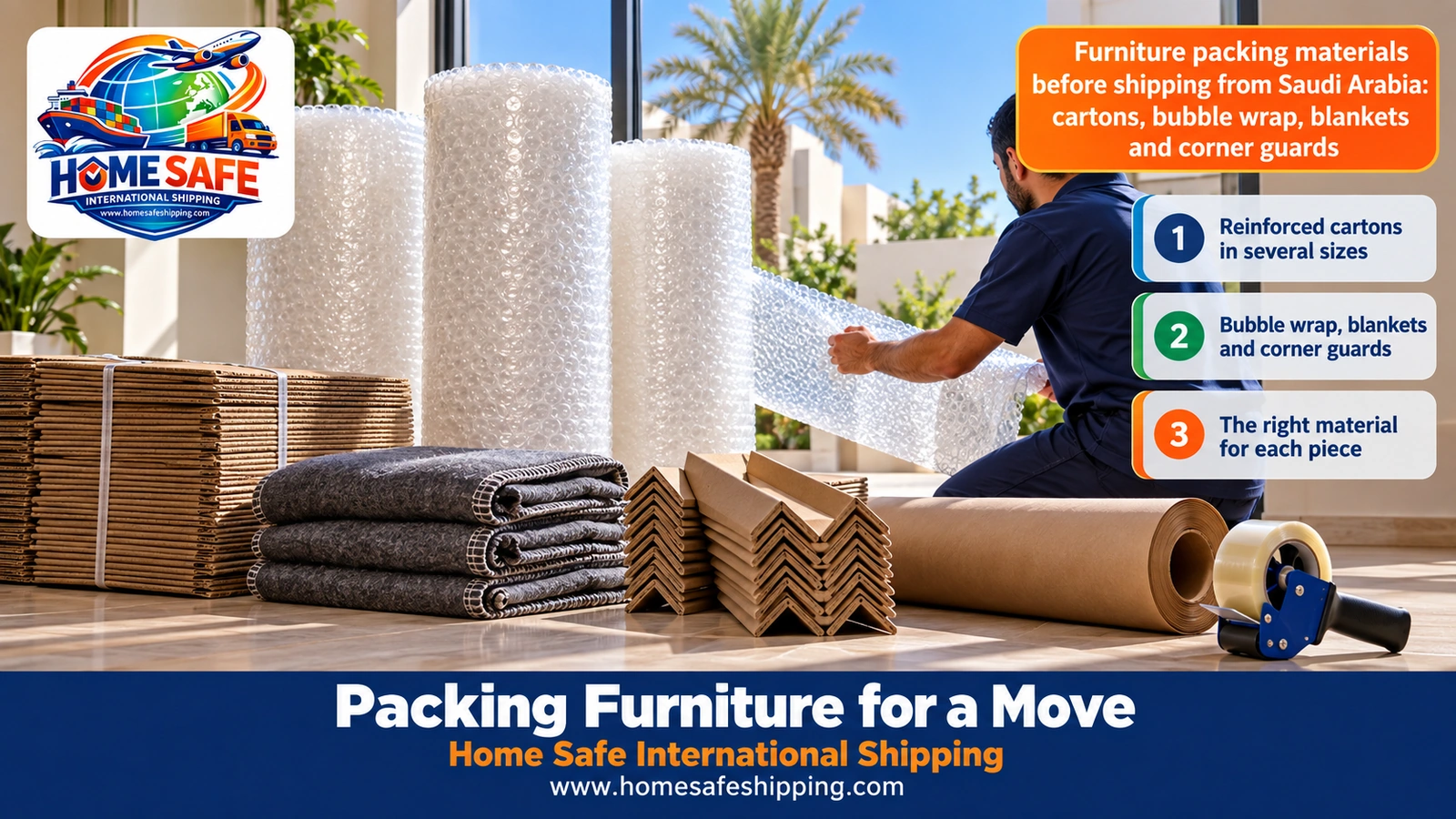
Cartons themselves come in types. The reinforced double-wall carton, that is five plies, is the standard for moving and shipping because it can bear others stacked on it. Shop cartons that have carried goods once have softened walls and suit only clothes and light bedding. Cartons are used in different sizes for a simple reason: heavy things in small ones, light things in large ones.
| Material | Its job | Used with |
|---|---|---|
| Small reinforced carton | Carries weight without the base giving way | Books, crockery, tins and tools |
| Medium reinforced carton | The general size for household items | Kitchen utensils, small appliances and toys |
| Large reinforced carton | Takes volume, not weight | Duvets, pillows, clothes and lampshades |
| Wardrobe carton with a rail | Moves hanging clothes as they are | Thobes, abayas, suits and dresses |
| Bubble wrap | Absorbs shock | Glass, ornaments and electronics |
| Moving blankets | Prevent scratches on large surfaces | Sofas, wood and appliances |
| Stretch film | Holds tight and keeps out dust and water | Over the blanket, and around drawers and doors |
| Corrugated card on the roll | A flexible shield that takes the shape of the piece | Wardrobe panels, headboards and tables |
| Foam sheets | A soft layer that leaves no mark | Glossy surfaces, screens and marble |
| Corner guards | Take the knock instead of the edge | Tables, mirrors, frames and appliances |
| White packing paper | Separates and pads without ink | Plates, cups and silverware |
| Mattress bags and sofa covers | A sealed cover of the piece’s size | Mattresses, sofas and rolled carpets |
The list is completed by things nobody notices until they run out: good-quality wide adhesive tape, a cutter, broad markers in two colours, “Fragile” and “This side up” labels, small zip bags for screws, and straps. A fuller account of each material is on the packing guide page.
Plastic packing and cardboard packing compared
The common question “which is better?” has this answer: they do not compete. Plastic and cardboard protect against two different dangers, and one piece usually needs both. Plastic is a barrier and cardboard is a shield. The barrier stops what seeps in: dust, rain and sea spray. The shield takes what strikes and presses.
As for cost and durability, stretch film is the cheapest material per metre and the quickest to apply, but its protection against impact is close to nil. Bubble wrap costs more and protects fragile items. A reinforced carton costs more per piece but is used more than once if it stays dry, and is recycled after that. The wooden crate is the dearest and the strongest, and is built only for what deserves it.
| Point of comparison | Plastic packing | Cardboard packing |
|---|---|---|
| What it protects against | Dust, water, humidity and parts coming loose | Impact, pressure and stacking |
| Durability | Does not tear easily but carries no weight | Carries and stacks; weakens when wet |
| Cost | Low for film, higher for bubble wrap | Moderate, offset by reuse |
| Speed of work | Fast; wrapped in minutes | Slower; cut and folded to size |
| Cautions | Traps moisture on wood and leather if it touches them | Leaves paper dust and needs strong tape |
| After the move | Usually thrown away | Reused or recycled |
| Best use | An outer layer over a blanket or card | A load-bearing layer or a box for items |
How much packing material do you need?
What most unsettles people who pack for themselves is running out of materials halfway through. The figures in the table are rough estimates for a home with ordinary furniture; they rise with large libraries and full kitchens and fall with lightly furnished homes. Buy a tenth more cartons than you think you need: a surplus is returned or used, while a shortage stops the work.
| Size of home | Cartons, roughly | Note |
|---|---|---|
| One room or shared accommodation | 15–25 cartons | Mostly medium and large |
| Two-bedroom flat | 40–60 cartons | The kitchen takes a third of them |
| Three- or four-bedroom flat | 70–100 cartons | Add wardrobe cartons for hanging clothes |
| Villa | 120 cartons or more | Counted by survey, not by estimate |
Tips for dismantling furniture before packing
Dismantling furniture before packing it is not extra work; it is what makes packing possible. A wardrobe with its four doors will not pass the stairwell, and if it does, its hinges bear a weight they were not made for. A standing bed takes the room of three pieces in the truck, whereas dismantled it is a bundle of panels standing against the wall. Dismantling protects the piece, reduces the volume and makes carrying easier.
Not everything is dismantled, however. Some chipboard furniture has holes that weaken once a screw has gone out and come back, so it travels in one piece if the door allows. Any piece held by glue and dowels rather than screws stays as it is.
- Photograph the piece from the front, the back and at its joints before you touch it; the photo is the assembly manual.
- Empty it completely: drawers, shelves and whatever is on top; never move a wardrobe with its contents.
- Use the right tools: a screwdriver that fits the screw head and an Allen key, because the wrong size ruins the head.
- Start with what moves: doors, drawers, shelves and mirrors, then the frame.
- Number the panels with a paper label on the inner face: “Wardrobe 1 – right side”.
- Collect each piece’s screws in its bag before you move on to the next piece.
- Tie similar panels into one bundle separated by foam or card.
- Go back to the piece’s manual if there is one; some joints come apart in a set order.
| Piece | What comes off | What stays |
|---|---|---|
| Bed | Headboard, side rails and slats | An upholstered headboard in one piece |
| Wardrobe | Doors, shelves and drawers, then the frame if it is large | A small wardrobe with its frame |
| Dining table | Legs and the glass top | A cast base in one piece |
| Sofa | Legs, cushions and corner sections | The frame |
| Desk and bookcase | Shelves, drawers and the top | Small units |
| Dressing table | Mirror and drawers | The body |
How to keep fittings and small parts
The smallest things in the home are the ones most often lost: screws, drawer keys, shelf supports, appliance cables and remote controls. Their loss does not show on packing day but on assembly day, when the bed stands four screws short of a kind not sold singly. The cure is one habit that is never broken: nobody moves on to a new piece before the bag of the piece in hand is closed.
- A zip bag for each piece, marked in pen with its name and its number in the inventory.
- The bag is taped to an unpainted inner part of the same piece, or collected with the others in one box.
- The box holding all the bags does not go into the truck with the furniture; it stays with the householder or the crew leader.
- Parts that are detached and hung, such as glass shelves and curtain rods, are bundled and carry a label describing where they go.
- Each appliance’s cables are coiled, tied and put in a bag with the remote control, and the bag is taped to the appliance.
- Keys of cupboards and drawers are tied by a string to the handle from the inside, or collected in one named bag.
Wrapping sofas, mattresses and wooden pieces before a move from Saudi Arabia
These three kinds fill most of the volume of a home, and each has its own enemy. Sofas suffer from dust, rubbing and being pulled from the wrong point. Mattresses suffer from damp and folding. Wood suffers from scratches on the surface and knocks on the edge. So sofas get blankets and film, mattresses get sealed bags, and wooden pieces get corrugated card.

With a sofa, the cushions are removed and gathered in large clean bags, and the legs are taken off and kept in their bag. A moving blanket is then spread over the whole sofa and stretch film is wound over it in overlapping turns that hold the blanket in place. The order is deliberate: the blanket first because it breathes, the film over it. Leather sofas in particular must not be touched by film, because the heat of a truck in the Saudi summer traps moisture beneath it that marks the leather.
A mattress goes into a bag of its size, closed at the end with tape. A sprung one is carried standing on its long side or laid flat at the top of the load, and is never bent. An upholstered bed base is treated like a sofa. Pillows and duvets are the best free padding: they fill large cartons and close the gaps between pieces.
Wooden pieces have their visible surfaces covered with a foam sheet, then wrapped in corrugated card cut from the roll to the size of the panel and folded over its edges, then held with film or tape on the card, not on the wood. Adhesive tape never touches paint or veneer, since it lifts the polish when removed. Drawers that stay in place are secured by a turn of film around the whole body, not by tape on the front.
| Piece | First layer | Second layer | Position in transit |
|---|---|---|---|
| Fabric sofa | Moving blanket | Stretch film | On its base, or standing on its side if space is tight |
| Leather sofa | Blanket or breathable cloth cover | Film over the blanket only | On its base, with nothing stacked on it |
| Sprung mattress | Sealed mattress bag | Card on the corners | Standing on its side or flat on top |
| Wardrobe and bed panels | Foam on the painted face | Corrugated card | Standing on edge, in tied bundles |
| Wooden table | Foam on the top | Corrugated card and corner guards | Top standing, legs in a bundle |
| Carved or gilded wood | Soft paper, then bubble wrap | Card or a made-to-measure crate | Nothing stacked on it |
The bedroom has more panels than any other room, and moving it well depends on numbering more than on wrapping. A six-door wardrobe turns into twenty similar panels, and once right is mixed with left, assembly becomes guesswork. So each panel has its name and position written on its inner face, and the piece is photographed standing before it is taken apart.
Packing glass, mirrors and screens in wooden crates before shipping from Saudi Arabia
Glass does not forgive two mistakes: being laid flat, so that it bears its own weight and that of whatever is above it, and having a corner left bare to take the first knock. So every glass panel is wrapped on its own, its corners are fitted with guards, and it travels standing on its edge. In international shipping a made-to-measure wooden crate is built for it, which takes the shock and stops anything being stacked on it.
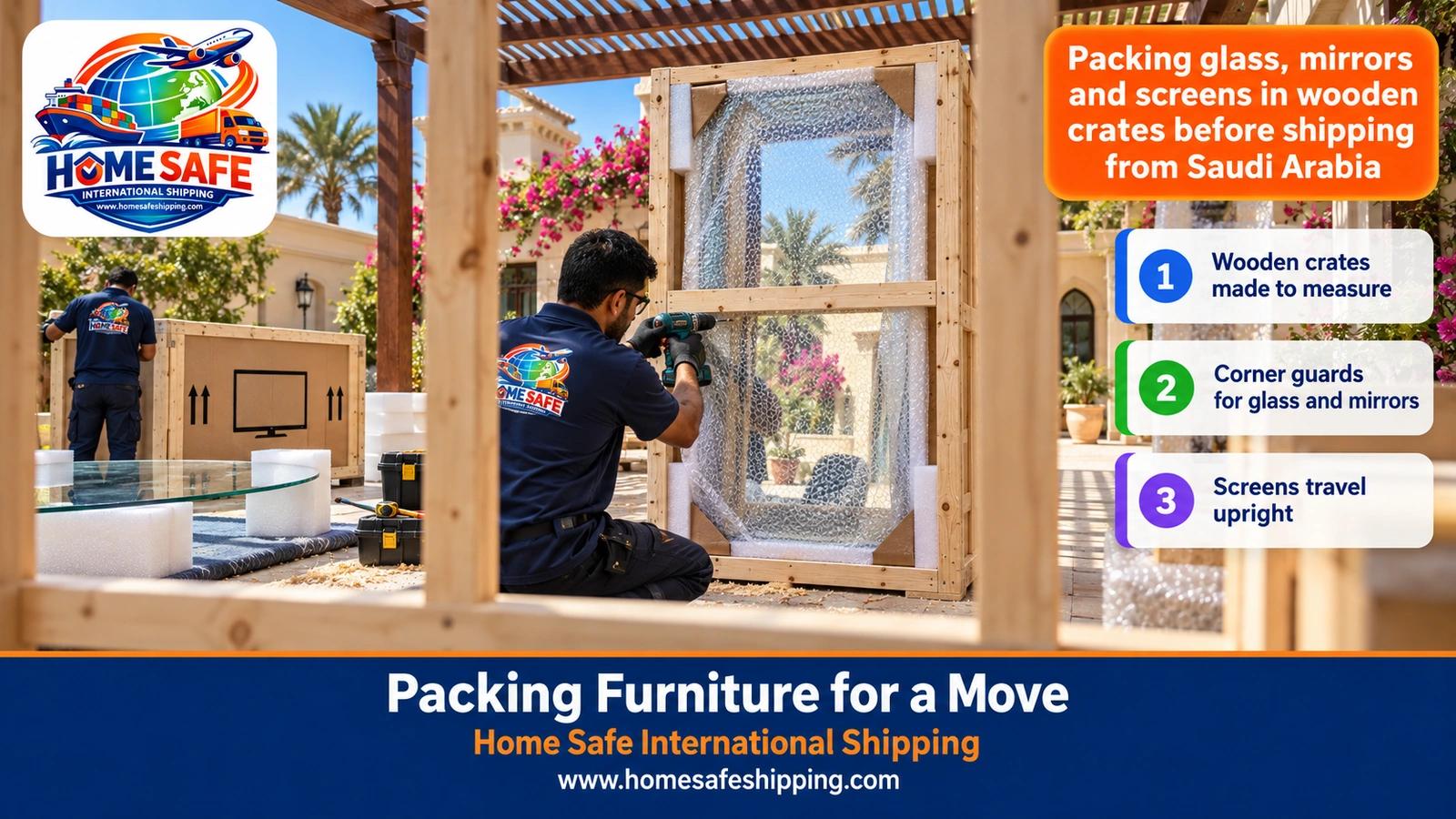
The method for a mirror and a glass panel is the same. Paper tape is stuck across the face in the shape of a cross, so that if the panel breaks its fragments hold together. It is then covered with paper or a foam sheet, then a corrugated board on each face, then bubble wrap, and the four corner guards are fitted. When several panels share one crate, foam separates each pair and all stand on their edges.
Flat screens are more delicate than glass, because the panel is damaged by pressure that breaks nothing visible. The best carrier is the original box with the polystyrene moulds it came with. If the box is gone, a flat-screen carton or a made-to-measure crate is used, with a foam sheet on the face and guards on the corners. Screens travel upright, as they stand on their base, not on their face or back, and nothing leans on the panel.
| Piece | Packing | Wooden crate | Position in transit |
|---|---|---|---|
| Wall mirror or dressing-table mirror | Crossed tape, foam, card, corner guards | For large ones and for international shipping | Standing on its edge |
| Glass table top | Foam and corrugated card on both faces | Made-to-measure crate | Standing, not flat |
| Marble slab or stone top | Thick foam and card | Required, with internal bracing | Standing on its edge |
| Flat screen | Foam on the face and a flat-screen carton | For large sizes and for sea freight | Upright |
| Painting or glazed frame | Soft paper, bubble wrap, corner guards | For valuable paintings | Standing, face to face with a separator |
The wooden crate in international shipping carries a condition that many do not know. Solid wood used in packaging must, in most countries, be heat-treated or fumigated and stamped with the international mark that shows it, so that it does not carry wood pests from one country to another. Manufactured wood, such as plywood and chipboard panels, normally falls outside this condition. This is current practice, and we confirm what the destination country requires before building the crate.
Packing electrical appliances
Appliances are damaged less by scratches than by what is inside them: water left in a hose, a washing-machine drum that swings, a fridge compressor carried on its side. Preparing the appliance before wrapping therefore matters more than the wrapping itself. Every appliance is disconnected from power and water before moving day, not in its last hour.
| Appliance | Preparation before packing | Packing and transport |
|---|---|---|
| Fridge and freezer | Unplugged a day ahead, defrosted and dried, shelves taken out | Foam, blanket and film; carried upright; left for some hours before switching on |
| Washing machine | Water drained from the hoses, drum transit bolts fitted | Card on the corners and film; carried upright |
| Oven and cooker | Gas disconnected by a technician, racks and trays taken out | The front glass gets card; the door is held with film |
| Split air conditioner | The technician pumps the gas down into the outdoor unit before removal | Each unit in its carton; pipe ends sealed |
| Microwave and small appliances | The glass plate taken out and wrapped on its own | A medium carton with padding around the appliance |
| Computer and printer | Data backed up, ink cartridges removed | The original box, or bubble wrap and a double-wall carton |
Packing kitchenware, china and crystal
The kitchen takes the longest to pack, because every item in it is wrapped singly. The rule professionals work by: a plate stands, it does not lie down. With plates stacked on one another, the lowest bears the weight of all at every bump, whereas plates standing on edge inside the carton share the load.
- The bottom of the carton is lined with a thick layer of crumpled paper, and the same goes on top before closing.
- Each plate is wrapped in a white sheet, and the plates stand close together like books on a shelf.
- Cups and glasses are stuffed with paper inside and then wrapped, and stand rim-down in the top row.
- Crystal and guest sets get bubble wrap over the paper, and a carton with internal dividers where available.
- Pots nest by size with paper between them, and their glass lids are wrapped separately.
- Knife blades are wrapped in card and tied, and the bundle is marked with what it holds.
- The carton is shaken before closing: if you hear movement, the padding is short.
Newspaper is not used on white crockery, as its ink transfers. Opened foodstuffs, oils and liquid detergents do not go into shipping cartons; one spilt container ruins a whole carton and what lies beneath it.
Packing carpets, curtains, clothes and books
These are the easiest things in the home, and they are what we advise householders to pack themselves if they wish to lighten the cost. Nothing among them breaks, but some of it gets dirty and some of it is heavy, and the mistake here is one of weight, not of protection.
- Carpets: cleaned and dried, then rolled with the pile inwards, tied and slipped into a bag or film. A handmade carpet is not folded.
- Curtains: taken off their rods and folded into large cartons; the rods are bundled and their ends wrapped.
- Clothes: hanging ones in rail cartons, folded ones in large cartons or in the suitcases themselves.
- Books: in small cartons only, flat or standing on their spines, and no carton heavier than one person can carry.
- Shoes and bags: stuffed with paper to keep their shape and gathered in medium cartons.
- Children’s toys: in large cartons, with small parts in bags so that they do not scatter.
Packing room by room: in what order do you start?
Random packing leaves the whole home half packed and none of it ready. The right order starts with what you do not use and ends with what you need until the last night. Each room is finished entirely before moving to the next, and its cartons are stacked in one corner of it.
| Order | Room | What is packed in it | Note |
|---|---|---|---|
| 1 | Storeroom and library | Books, ornaments and seasonal items | Two weeks before the move |
| 2 | Guest majlis | Guest sets, paintings and carpets | Sofas are left for loading day |
| 3 | Children’s rooms | Toys and spare clothes | Leave enough for a week |
| 4 | Master bedroom | Out-of-season clothes and spare bedding | The wardrobe is dismantled on loading day |
| 5 | Kitchen | Guest crockery first, then everyday items | A small set stays until the last day |
| 6 | Living room and appliances | Screen, appliances and sofas | On loading day or the day before |
| 7 | Bathrooms and the first-day carton | What you need on the night of arrival | Last loaded and first unloaded |
Numbering and the inventory
Numbering is what turns sixty similar cartons into an orderly home. Every carton and every piece carries a serial number and the name of the room it will go to in the new home, not the one it came from. Each number is matched by a line in the inventory that briefly states the contents. If fifty-nine arrive, you know which one is missing and what was in it.
In international shipping the list is not only organisation; it is a document. It is what the customs officer reads at the border and the port, what the insurance is based on and what the consignee signs. So it is written in a language the destination country understands, and appliances are listed by type. The other papers are on the shipping documents page.
| What is written on the carton | Example | Its use |
|---|---|---|
| Serial number | 27 of 64 | Counting at loading and delivery |
| Room in the new home | Kitchen | The carton is set down in its place at once |
| Contents in brief | Plates and cups | You know what to open first |
| Fragile and orientation marks | Fragile – this side up | Carried and stacked with care |
| Consignee’s name and mobile | In shared and air shipments | It is not mixed with another shipment |
How to secure furniture properly inside the truck and the container
Packing is half the protection, and the other half is how the load is stowed. A piece wrapped as well as can be is damaged if left free to slide two metres at every stop. Securing furniture begins with carrying it: a wheeled trolley under heavy pieces, lifting straps for the fridge and the wardrobe, and covers on the floors and door frames so that neither the place nor the piece is scratched.
- Heavy and solid items at the bottom and at the front of the body: appliances and cartons of books and crockery.
- Panels, mirrors and mattresses stand on edge along the wall and are strapped to it.
- Sofas go on top or at the front, with nothing sharp-edged placed on them.
- Cartons are stacked in columns from heaviest to lightest, with nothing above the fragile ones.
- Every gap is closed with pillows, duvets or light cartons so that no room for movement remains.
- The load is held by cross straps roughly every metre and a half, and rows are separated by blankets.
- Protective covers are fixed with strong tape on the cover itself, not on the surface of the piece.
In a container there is the further step of tying the load to the rings in the floor and walls, because the container is lifted and tilts. Details are on the packing and lashing page.
How packing differs for land, sea and air
The piece is the same and the material is the same, but what it meets on the way changes. A truck shakes and stops, a container sweats and is lifted, and an aircraft charges by volume and handles fast. Packing prepared for one mode is not necessarily enough for another, which is why we ask about the destination before preparing the materials.
| Aspect | Land transport | Sea freight | Air freight |
|---|---|---|---|
| Time on the way | Hours to days | Weeks | A few days |
| Main danger | Vibration and stops | Humidity, rolling and lifting | Frequent handling and stacking |
| What is added to the packing | Straps and separating blankets | Desiccants, wooden crates and lashing to the floor | Double-wall cartons and full padding |
| What the price is based on | Volume or the truck | The cubic metre or the container | The greater of actual and volumetric weight |
| Effect of packing on cost | Small | Moderate: extra volume is paid for | Large: every centimetre and kilo counts |
| Suits | Household furniture to the Gulf, Jordan and the Levant | A whole home to Turkey, Africa and Europe | Personal effects and urgent pieces |
In land freight the furniture passes a border post where some cartons may be opened, so it is packed in a way that allows opening and closing without tearing, and the inventory is kept within the driver’s reach. In sea freight the enemy is humidity: the steel walls of the container cool at night, vapour condenses on them and drips. So desiccant bags are hung in the container, varnished wood is not wrapped directly in film, and no fridge or washing machine goes in with a drop of water inside. A cubic metre in a shared container starts from SAR 415 to Turkey and North Africa, so the volume saved by good dismantling shows on the invoice. Work out your volume with the CBM calculator.
Packing for air freight from Saudi Arabia: light, strong cartons
Air freight turns the packing rule upside down. By land and sea you add materials for peace of mind; by air every addition is paid for. The aircraft charges volumetric weight when it exceeds actual weight, so a roomy, half-empty carton costs as if it were full. What is needed, then, is light double-wall cartons, smaller in size and lower in weight, with no loss of protection.

Volumetric weight is the carton’s length multiplied by its width and its height in centimetres, divided by 6,000. A carton of 60 × 50 × 50 cm has a volumetric weight of 25 kg, so if it holds 12 kg of clothes you pay for 25. The answer is to choose a carton that fits the contents, compress bedding in vacuum bags and fill gaps with things you are shipping anyway rather than with paper. Try your figures in the volumetric weight calculator.
| Item | In air freight | Reason |
|---|---|---|
| Type of carton | Double-wall, new | Withstands stacking and fast handling at low weight |
| Size of carton | Fitted to the contents, no empty space | Volumetric weight is taken from the outer dimensions |
| Weight of one carton | What one person carries comfortably | Heavy cartons get dropped; light ones get carried |
| Padding | Clothes, bedding and light bubble wrap | Protects without adding wasted weight |
| Wooden crate | For a valuable piece only | Its weight enters the calculation |
| Closing | Wide tape in an H pattern | Stops the flaps opening |
| Marking | Consignee’s name and mobile on two sides | Parcels are sorted one by one |
Aviation has its own prohibited items that do not go into a carton however it is packed: perfumes and aerosols in quantity, loose batteries and flammable liquids. Air shipments leave from the airports of Riyadh, Jeddah and Dammam: King Khalid International Airport, King Abdulaziz International Airport and King Fahd International Airport. A kilo starts from SAR 14 to the Gulf states. The full service is on the air freight page.
Packing for long storage
What is stored for months needs packing that breathes. Tight film that serves for a week on the road traps moisture on wood and fabric if it stays for half a year. Stored furniture is therefore covered with blankets, cloth covers and card, raised off the floor on bases, with space left between pieces for air. Appliances go in completely dry with their doors ajar.
A small space in our warehouse starts from SAR 185 a month. Details are in the article furniture storage company in Jeddah and on the storage page.
Pack it yourself or use a professional crew?
The fair answer: divide the work. Every home has things its family can pack safely and save on, and things where a mistake costs more than the packing fee. A professional crew stands out not by being stronger but by arriving with its materials and tools, finishing in a day what would take you a week, and answering for what it packs.
| Item | Packing it yourself | Packing by the crew |
|---|---|---|
| Suits | Clothes, books, bedding and toys | Dismantling, large pieces, glass and appliances |
| Materials | You buy them and estimate the quantity | They arrive with the crew, in every type |
| Time | Days to weeks after work | Usually a day for a flat |
| Responsibility | Yours | The packer’s, as set out in the booking confirmation |
| At customs | Your cartons may be opened for checking | The crew’s list describes every carton |
| For insurance | Owner-packed items may be excluded | Covered, according to the policy |
If you pack some cartons yourself, leave them open until the crew has seen and recorded them, and then closes them. The whole shipping service is described in the article international furniture shipping company from Saudi Arabia.
The cost of packing furniture for a move
Packing is normally a line inside the moving or shipping price, not a service priced on its own. Even so, we itemise it in the quotation so that you see what you pay for materials and what you pay for labour. We do not publish a fixed figure for it, because two homes with the same number of rooms may differ twofold in packing: one has a library, crystal sets and marble, the other has simple furniture.
| Item | Price | What determines it |
|---|---|---|
| Dismantling and packing one room | Set on request | The number of pieces to dismantle |
| Dismantling and packing a flat | Set on request after the count | The number of rooms and the amount of fragile items |
| Dismantling and packing a villa | Set on request after a survey | Quantity, floors and access |
| Made-to-measure wooden crate | Set on request | The piece’s dimensions and the type of wood |
| Packing crockery and belongings in cartons | Set on request | The number of cartons |
| Cubic metre by sea in a shared container | Starts from SAR 415 | Volume after packing |
| Kilo by air to the Gulf states | Starts from SAR 14 | The greater of actual and volumetric weight |
| Storage of a small space | Starts from SAR 185 a month | Volume and duration |
Prices quoted in the market: the pages we reviewed from moving companies in the Kingdom do not publish a separate packing price; they fold it into the moving price by number of rooms and distance. Packing materials are sold in the market by the piece for cartons and by the roll for bubble wrap and film, and their prices vary with thickness and size. We found no reliable published figure for the packing service alone on which to base a price, so we have left it to the count. The site’s earlier article gave no prices either.
There are ways to cut the cost that do not touch protection: pack clothes and books yourself, empty drawers and wardrobes before the crew arrives, get rid of what is not worth moving before the count rather than after it, keep the original boxes of screens and appliances if you have them, and book outside the last days of the month and the end of the school year. Do not economise on two things: glass and appliances.
Packing steps on moving day
Packing day passes calmly when it is preceded by order, and turns into chaos when each worker starts wherever he likes. These are the steps in the order our crew follows in the home.
- The first walk-through: the crew leader goes round the rooms with the householder, settling what moves, what stays and what is fragile or valuable.
- Protecting the place: floors, door frames, stair corners and the lift are covered.
- Small items: packed in cartons room after room, each carton numbered as soon as it is closed.
- Dismantling: pieces are photographed and taken apart, and each piece’s screws are kept in its bag.
- Wrapping large pieces: a soft layer, then a tight layer, and guards on the corners.
- Fragile items: glass, mirrors and screens are wrapped singly and set aside standing.
- The inventory: the numbers are checked with the householder and both sides sign, each keeping a copy.
- Loading: heavy items first, then panels standing, then cartons, then sofas and mattresses, and the load is strapped.
Tips before packing day
- Sort before you pack. What you will not use in the new home deserves neither a carton nor room in the truck.
- Prepare a bag that travels with you: passports, papers, medicines, jewellery and phone chargers.
- Prepare the “first-day carton”: a kettle, cups, towels, sheets and a small toolkit, loaded last.
- Photograph the connections of the screen, the router and the appliances before unplugging them.
- Measure the doors, stairs and lift of the new home, and tell the crew what will not pass in one piece.
- Empty the gas cylinder, and drain the tank of the steam iron and the wet vacuum cleaner.
What is not packed with the furniture
Some things no packing protects, because the danger lies in them rather than to them, or because their place is with their owner, not in the truck. International shipping adds what customs and airlines forbid. The full list is on the prohibited items page.
- Gas cylinders, fuel, paints, solvents and anything flammable.
- Liquid detergents, oils and opened containers that spill.
- Cash, jewellery, valuable watches and original documents.
- Live plants in international shipping, because they are subject to plant quarantine.
- Loose batteries and perfumes in quantity in air freight.
Unpacking and reassembly in the new home
Half the benefit of numbering shows here. The carton marked “Kitchen” is set down in the kitchen and the numbered panels go to their room, so the whole home does not pile up in the living room. Reassembly starts with the beds, then the wardrobes, then the tables, so that the family sleeps its first night on its own bedding.
Check the pieces against the inventory before the crew leaves, inspect glass, screens and appliances in its presence and record any remark on the delivery sheet there and then. The fridge is left standing for some hours before it is plugged in. For shipments leaving the Kingdom, unloading and reassembly are done by our partner’s crew in the destination country, and the booking confirmation states what the service covers there.
How do you choose who packs your furniture?
Packing can be judged before it begins, from the company’s questions and from what it brings with it. Whoever quotes over the phone without asking about glass, appliances and the destination will wrap everything in a turn of film. These are signs by which to read whoever is in front of you.
| What you look at | Reassuring sign | Warning sign |
|---|---|---|
| Before pricing | Asks for photos or surveys, and asks about the destination | One ready figure for every home |
| Materials | New cartons, blankets, foam and corner guards | Film only and used cartons |
| Glass and marble | Offers a wooden crate or individual packing | “We will carry it carefully” |
| Dismantling | A full toolkit and numbered bags for screws | One screwdriver and the worker’s pocket |
| Documentation | Numbering and a signed inventory | Loading without a sheet of paper |
| Legal standing | A commercial registration and a known address | A mobile number only |
Common mistakes in packing furniture
- Winding film directly onto varnished wood or leather, which traps moisture and leaves a mark.
- Sticking tape onto the surface of the piece, which lifts paint or veneer when removed.
- Filling a large carton with books, so that its base opens or nobody can lift it.
- Leaving the corners of tables and mirrors without guards, though they are hit first.
- Moving glass and screens flat beneath other pieces.
- Throwing the screws of the whole home into one bag, or into a pocket.
- Loading a fridge or washing machine with water in it, or a washing machine without its drum transit bolts.
Why Home Safe for packing your furniture?
Because with us the one who packs is the one who ships, so nobody wraps a load only to see it off and forget it. The crew wrapping the piece knows whether it will board a truck to the Gulf, a container to a distant port or an aircraft, and packs for that journey, not for the front door. What we commit to is written in the booking confirmation.
Registered establishment
Home Safe Logistics Services Est., Commercial Registration 4030601060.
Professional packing for every piece
A material to suit each piece: blankets for sofas, corrugated card for wood and crates for glass.
Dismantling, numbering and inventory
Each piece’s screws in its bag, a number on every carton and a signed list of which you keep a copy.
For land, sea and air
Packing prepared for the mode and the destination, from Saudi cities to other countries.
To book: 0552803439 by call or WhatsApp, 7 am to 11 pm. Or through the request a quote page.
Related articles and pages
- International furniture shipping company from Saudi Arabia
- Furniture storage company in Jeddah
- Packing guide
- Packing and lashing
- Furniture shipping
- Door-to-door shipping
Tags
packing furniture for a move, important tips for packing furniture, how to pack household furniture, furniture packing materials, wrapping sofas for a move, mattress packing, packing glass and mirrors, packing screens for shipping, wooden crates for shipping, moving cartons, furniture dismantling and packing, dismantling furniture before a move, carton numbering and inventory, packing for air freight, packing for sea freight, packing electrical appliances
Frequently asked questions about packing furniture for a move
What is the best way of packing furniture for a move?
Dismantle first, then wrap in two layers: a soft one that touches the piece, which is a blanket, foam or paper, and over it a layer that holds tight and keeps dust out, which is stretch film or corrugated card. Corners get their guards before anything else, glass is isolated and stands on its edge, and every piece carries a number matched by a line in the inventory. In that order the piece arrives as it left.
Which materials do I need to pack the furniture of a home?
Reinforced cartons in at least three sizes, rolls of bubble wrap, moving blankets, stretch film, foam sheets, white packing paper for crockery, corrugated card on the roll for wood, corner guards, mattress bags, wide adhesive tape, small zip bags for screws, a broad marker and labels. Large glass or marble needs a wooden crate as well.
Should I pack the furniture myself or leave it to the crew?
Clothes, books, bedding and children’s toys you can pack yourself without worry, and it saves the crew’s time. Dismantling, large pieces, glass, screens and appliances are better left to those who have the materials, tools and experience. International shipping adds a reason: a carton closed by its owner may be opened at customs and may fall outside the insurance cover.
How much does furniture packing cost?
It is set on request once the pieces are counted, because it follows the number of pieces to dismantle, the amount of glass and fragile items, whether some need wooden crates, and the mode of transport. Send photos of the rooms or a list of pieces to 0552803439 and you receive an itemised price: materials, labour and crates. Packing is normally a line inside the moving price, not a separate invoice.
How do I wrap a sofa without harming the fabric or leather?
Take off the cushions and legs first. Then cover the sofa with a moving blanket that touches the fabric or leather directly, and pull stretch film over it so that the blanket does not slip and dust stays out. Do not put film straight onto leather; it traps moisture and marks the surface in hot weather. Exposed wooden corners get a cardboard guard.
How do I protect a mattress during the move?
Put it in a mattress bag of its size and seal the bag with tape, which protects it from dust, damp and hands. A sprung mattress is not folded or tied bent; it is carried standing on its side or laid flat on top of the load, with nothing heavy and sharp-edged placed on it. A compressed foam mattress can be rolled, but do not leave it rolled for weeks.
How is a screen packed when its original box is gone?
Its face is covered with a soft foam sheet, then a corrugated board cut to size, then it is wrapped in bubble wrap and placed in a flat-screen carton or a made-to-measure crate, with guards on all four corners. It travels upright, as it stands on its base, never laid on its face or back, and nothing leans on the panel. The stand, cables and remote go in a bag taped to the same carton.
Is a wooden crate necessary for glass and marble?
For a move within the city, foam, corrugated card and corner guards are usually enough if the panel travels upright. In international shipping, where handling is repeated and the journey is long, a made-to-measure wooden crate is the accepted protection for a glass table top, a large mirror, a marble slab and valuable paintings. Solid wood must be treated and stamped in line with international practice.
Which is better: plastic packing or cardboard packing?
Neither replaces the other. Plastic, meaning stretch film and bubble wrap, keeps out dust and water and holds parts together, but it carries no weight and does not absorb a hard knock on its own. Cardboard withstands stacking and weight and protects edges, but it weakens when wet. So they are used together on one piece: card or a blanket for impact, and film over it for dust and tightness.
Do I dismantle every piece of furniture before the move?
No. You dismantle what will not pass through the door or stairwell, and what has protruding parts that break: beds, large wardrobes, dining tables, desks, sofa legs, shelves and fixed mirrors. What was built as a single piece stays as it is, and so does anything weakened by repeated dismantling, such as some chipboard furniture whose holes will not take a screw twice.
Where do I put the screws and small keys?
In a zip bag for each piece, marked with its name and number, then taped to an inner part of the piece or collected with the other bags in one box that stays with you. Do not put them in your pocket or in a general carton; eight missing screws stop a whole wardrobe from being assembled. Photograph the piece before taking it apart so that you know where each part goes.
How does packing for sea freight differ?
The voyage lasts weeks inside a steel container whose temperature swings between night and day, so vapour condenses on its walls. Ordinary packing is therefore supplemented with moisture protection: desiccant bags, paper separating varnished wood from film, and no damp item allowed in. Everything is strapped, because the container is lifted and tilts.
How do I pack for air freight without paying for excess weight?
The aircraft charges the greater of actual weight and volumetric weight, which is the carton’s dimensions in centimetres multiplied together and divided by 6,000. So choose a double-wall carton that fits the contents with no empty space, fill gaps with clothes rather than paper, and keep the heavy wooden crate for what deserves it. A carton of the right size protects you and saves you money at once.
When should I start packing the home before moving day?
About two weeks ahead for what you do not use: books, out-of-season clothes, guest crockery and ornaments. In the last week, the everyday kitchen and clothes. Large furniture and appliances are dismantled and wrapped on loading day or the day before. If the crew does the packing, a medium flat usually takes one day.
Does packing affect the insurance on the shipment?
Yes. Insurance policies normally require packing that is adequate for the mode of transport, and many exclude damage to what the owner packed personally when the carton shows no outside mark. That is why we note in the inventory who packed each carton and photograph valuable pieces before wrapping them. The exact terms are in the policy and the booking confirmation.
That is the guide — now let us price your shipment
Choose what applies to you and receive a reply with the price, the method and the time.
RoRo, container or sling lift — we recommend what suits your vehicle’s value and its destination.
Get a vehicle priceA full or shared container, or urgent air freight, with packing and clearance.
Get a shipment priceRoutes in the same section
Options related to the same type of service.