Car Shipping Company from Qatar to Morocco 0552803439 | RoRo and Containers from Hamad Port to Casablanca and Tanger Med
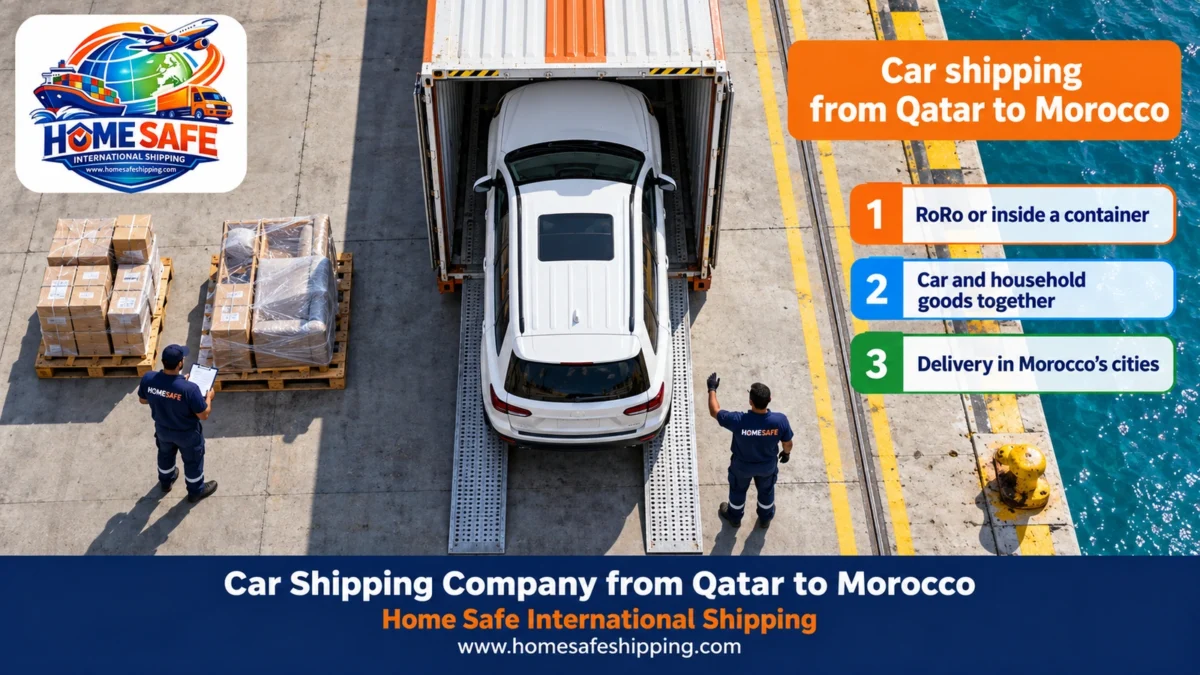
Ship your car from Doha, Al Rayyan, Al Wakrah and Al Khor to Casablanca, Rabat, Tangier and Marrakech, by sea from Hamad Port on a RoRo vessel or inside a container, with your household goods if you wish, or by air from Hamad International Airport for a luxury or urgent car. The sea journey takes 35…
Home Safe is a car shipping company from Qatar to Morocco that arranges your car’s journey from the door of your home in Doha to your address in Casablanca, Rabat, Tangier or Marrakech. The main route is by sea from Hamad Port, on a RoRo vessel or inside a container, and takes 35 to 50 days door to door; the fast route is by air from Hamad International Airport in 4 to 7 days. The price of this route is set on request once the car and the method are known; for comparison, RoRo for a saloon on our line from Jeddah port to Moroccan ports starts from SAR 2,200, and a car in a 20ft container from SAR 10,100. To book: 0552803439.
In this guide45ShowHide
- Who ships a car from Qatar to Morocco?
- Will Morocco accept your car coming from Qatar?
- Car shipping by sea from Hamad Port in Qatar to Casablanca and Tanger Med
- Transit time for a car from Qatar to Morocco by method
- Price of shipping a car from Qatar to Morocco
- How does Home Safe serve the Qatar route from Jeddah?
- Collecting cars from Doha and the cities of Qatar
- RoRo or container: which is for your car?
- Shipping the car with household goods in one container from Qatar to Morocco
- Types of vehicle we ship from Qatar to Morocco
- Preparing the car before handing it over in Qatar
- A summer on Qatari plates, or permanent export?
- Procedure for exporting a car from Qatar
- Documents for shipping the car, and what is not shipped with it
- Moroccan customs, duties on the car and its registration
- Insuring the car and tracking it to the Moroccan port
- Delivering cars from Qatar in Casablanca, Rabat, Tangier and Marrakech
- What is shipped with the car: furniture, appliances, goods and parcels
- Car shipping for individuals, companies, government bodies and embassies
- Land, sea and air: which gets the car to Morocco?
- Air freight for cars from Qatar to Morocco
- Steps for shipping a car from Qatar to Morocco
- Car shipping from Morocco to Qatar
- Advice before shipping your car from Qatar to Morocco
- How do you choose a car shipping company from Qatar to Morocco?
- Common mistakes in shipping cars from Qatar to Morocco
- Why Home Safe for shipping your car from Qatar to Morocco?
- Related articles and pages
- Tags
- Frequently asked questions about car shipping from Qatar to Morocco
- Which is the best car shipping company from Qatar to Morocco?
- How much does it cost to ship a car from Qatar to Morocco?
- How long does a car take from Doha to Casablanca?
- What is the cheapest way to ship a car from Qatar to Morocco?
- Does Morocco accept a Qatari car registered more than five years ago?
- I am a Moroccan working in Doha and I spend the summer at home. Do I export my car?
- What are the conditions of the reduction for a Moroccan retiree returning from Qatar?
- How is the vehicle export certificate obtained in Qatar?
- Can I ship my household goods with the car in one container?
- Tanger Med or Casablanca: which port should I choose?
- Can the car be shipped by air from Hamad International Airport to Morocco?
- My car is financed by a bank in Qatar. Can it leave?
- Does a Gulf-specification car need changes to be registered in Morocco?
- How do I follow my car between Hamad Port and the Moroccan port?
- Who pays the Moroccan duties, and are they inside the shipping price?
The ship’s course: your home in Qatar → the quay at Hamad Port → Hormuz → the Arabian Sea → Bab el-Mandeb → Suez → the Mediterranean as far as Gibraltar → Tanger Med or Casablanca → your city in Morocco · Time: 35–50 days by sea door to door, and 4–7 days by plane.
In brief
- What we ship: passenger cars, 4x4s and pickups, luxury and classic cars, and motorcycles.
- The method: RoRo or inside a container from Hamad Port, and the car and household belongings together in a 40ft container for anyone returning for good.
- The two arrival ports: Tanger Med for the northern cities and Casablanca for the centre and south, then clearance and delivery in the cities of Morocco.
- Transit time: 35–50 days by sea door to door, and 4–7 days by air.
- Before any booking: we check the age of the car and your status in Morocco, since permanent import is limited to five years from first registration.
- Price: set on request; the reference is our line from Jeddah port: SAR 2,200 for a saloon on RoRo.
- Booking: 0552803439 by call or WhatsApp, from 7 am to 11 pm.
Who ships a car from Qatar to Morocco?
Qatar has a large Moroccan community working in education, security, hospitality and aviation, and they ask about this route more than anyone. Alongside them are Qataris who have homes in Marrakech and Tangier and want their own car there in the season. The ship is the same for everyone, but what is asked of each person in Qatar and in Morocco differs:
| The owner | Purpose of shipping | What suits them | The first thing we check with them |
|---|---|---|---|
| A Moroccan who has finished working in Doha | Returning for good with the car and the home | A 40ft container for the car and the furniture | Date of first registration, and the residence certificate from the consulate |
| A retired Moroccan who has reached sixty | Using the returnees’ reduction | A 20ft container or RoRo | Proof of ten years’ residence abroad |
| A resident spending the summer at home | Using the car for some months, then bringing it back | Out and back by sea, or by air if in a hurry | The temporary exit permit and the admission period in Morocco |
| A Qatari with a seasonal home in Morocco | Their own car for the holiday season | A sealed container or air freight | Insurance inside Morocco and the return date |
| An embassy or a company | Moving work cars or the car of a transferred employee | Depends on the number and the date | The organisation’s letter and the exemption file, if any |
Will Morocco accept your car coming from Qatar?
This question comes before everything else on the Morocco route. Moroccan customs restricts the permanent import of used cars by age, and the rule in force is that the car must be no more than five years old, counted from the date of its first registration, not from the model year. The outcome depends on the status of the owner, not on the car alone:
| Your case | How the car enters Morocco | Conditions in force |
|---|---|---|
| Returning for good, with a car five years old or less | Permanent import with duties, after the value is reduced according to age | The years are counted on the day it reaches the Moroccan port, not the day it leaves Qatar |
| A retired Moroccan who has reached sixty | Permanent import with a 90% reduction of the assessed value | Ten years or more abroad, a passenger car up to ten years old, once only, a ceiling on value, and attendance in person |
| A resident abroad or a visitor, and the car will return | Temporary admission free of duty | 180 days a year, personal use, and no sale or lending |
| Your car is over five years old and no exception applies | It cannot be imported permanently | It enters temporarily only, or is sold in Qatar |
The retirees’ reduction is limited to a passenger car, so a pickup or a motorcycle does not qualify. The residence certificate issued by the Moroccan consular section in Doha has a short validity, so it is requested in the last weeks before travel. These rules are amended by Morocco’s finance law from one year to the next, and we confirm what is in force before shipping.
Watch how the age is counted: the voyage from Qatar is about two weeks longer than the voyage from Jeddah. A car with two months left before it turns five may turn five at sea, and arrive outside the rule. We work out the date with you against the expected arrival and leave a margin for delay. What applies to every destination is in the car shipping guide.
Car shipping by sea from Hamad Port in Qatar to Casablanca and Tanger Med
Hamad Port at Umm Al Houl, south of Doha, is Qatar’s maritime gateway, with container terminals and a vehicle terminal. From there the ship heads east to the Strait of Hormuz, rounds the Arabian Peninsula through the Arabian Sea, enters the Red Sea at Bab el-Mandeb, passes through the Suez Canal, and then crosses the Mediterranean from end to end. At the far end of the Mediterranean is the Strait of Gibraltar, and on it stands the port of Tanger Med. Casablanca lies beyond it on the Atlantic.
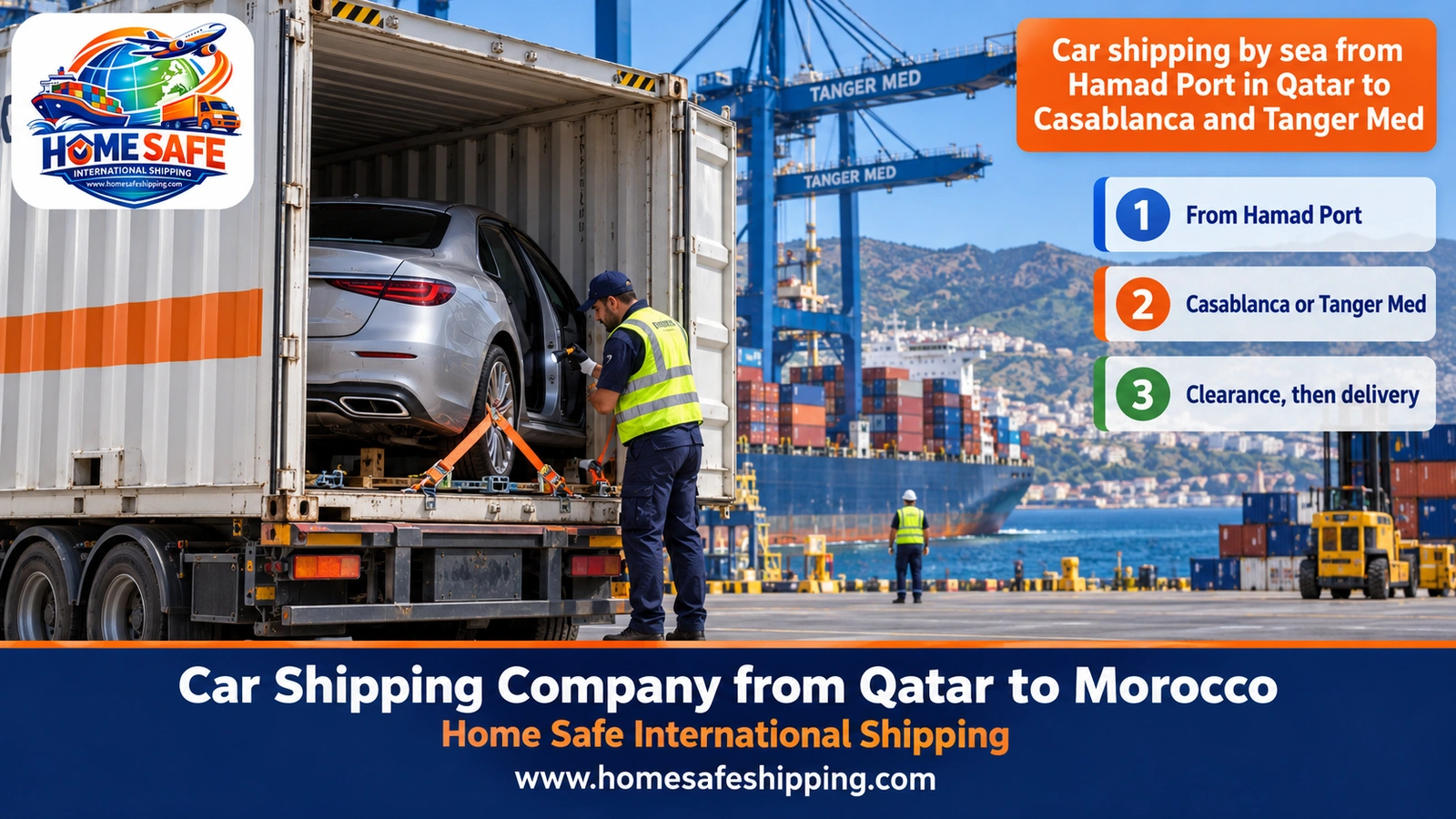
There is no regular car service linking Doha directly with Morocco. The container is loaded at Hamad Port onto a feeder or a mainline vessel, then moved at a hub port onto a ship heading west. A RoRo car may be gathered at another Gulf port before it sails. These are the stages of the journey:
| Stage | What happens to the car | Approximate time |
|---|---|---|
| From your home to the loading yard in Qatar | Collection on a recovery truck, photographs, and a condition report | One day |
| Preparation and entry to Hamad Port | Lashing in the container or handover to the vehicle terminal, and the Qatari export declaration | 3–5 days |
| Sailing to Tanger Med | With a change of ship at an intermediate port | About 20–30 days |
| Or sailing to Casablanca | Through the strait, then south in the Atlantic | About 24–34 days |
| Clearance at the Moroccan port | Declaration, inspection, valuation and payment | 2–6 days with a complete file |
| Delivery in your city | A carrier from the port to the address | 1 to 3 days |
The times are estimates; they change with the routing the shipping lines choose at the time of booking and with the wait at the transhipment port, so we fix them for you on the actual sailing schedule. The ports we work through are on the ports and gateways page.
Transit time for a car from Qatar to Morocco by method
The difference between one method and another is not the speed of the ship but when the car finds its ship. A full container leaves on the first sailing after the papers are complete. A shared place waits for a partner heading to the same Moroccan port. RoRo follows the schedule of the car carriers, which are fewer in this direction than container ships.
| Method | Door to door | When it moves |
|---|---|---|
| 20ft container for one car to Tanger Med | 35–45 days | First ship after the export certificate |
| 40ft container, car and furniture, to Casablanca | 38–50 days | After the furniture is packed and the list signed |
| A place in a container shared with a second car | 40–50 days, sometimes more | When the partner is found |
| RoRo | 40–50 days | According to the car carrier’s date |
| Air to Mohammed V Airport | 4–7 days | After the space on the aircraft is confirmed |
What lengthens the time?
- The transhipment port: if the container misses its second ship, it waits a week for the next.
- The summer return: in July and August Moroccan ports fill with the cars of Moroccans arriving from Europe, and the inspection queue grows.
- An incomplete file in Morocco: a missing residence certificate or an owner who arrives late leaves the car on the quay accruing storage charges.
Times for the other routes are on the transit times page.
Price of shipping a car from Qatar to Morocco
We do not write a fixed figure here for the Qatar route, and we say why plainly. Sea freight from Hamad Port to Morocco involves two ships and a transhipment port, and it shifts with every change in the lines’ routings, so a published figure ages quickly. The price is therefore set on request, and it reaches you itemised: collection in Qatar, lashing, sea or air freight, charges at both ports, and clearance and delivery in Morocco if you ask for them. Moroccan customs duties are outside the price. At the end of the table are the prices of our line from Jeddah port, which are a reference to measure against, not a price for this route:
| Service | Price | Note |
|---|---|---|
| Saloon on a RoRo vessel from Hamad Port | Set on request | According to the RoRo schedule available |
| Car in a private 20ft container | Set on request | Including lashing and sealing |
| Car and household goods in a 40ft container | Set on request | According to the volume of furniture and the port |
| Air freight for the car from Hamad International Airport | Set on request | By weight, dimensions and fuel type |
| Reference: RoRo for a saloon from Jeddah port to a Moroccan port | Starts from SAR 2,200 | Price of our line from Saudi Arabia |
| Reference: car in a 20ft container from Jeddah port | Starts from SAR 10,100 | Price of our line from Saudi Arabia |
| Reference: 40ft container for a car and furniture from Jeddah port | Starts from SAR 14,720 | Price of our line from Saudi Arabia |
Prices circulating in the market: little is published about this route, and the figures are far apart. For sea freight from Qatar to Morocco, between QAR 2,800 and 5,000 is quoted depending on the size of the car, and for air between QAR 4,500 and 7,500. By contrast, figures published for shipping cars from Doha to neighbouring North African ports run between QAR 12,500 and 14,500 for a saloon on RoRo, between QAR 17,500 and 20,000 for a 20ft container, and between QAR 10,000 and 12,000 for a place in a shared container. The gap between the two groups arises because the first is bare sea freight and the second includes charges at both ports and clearance. So ask what the last point is that any figure offered to you covers.
| What changes the price | How |
|---|---|
| Dimensions of the car | RoRo is charged by the cubic metre, and a tall car may not fit a standard container |
| The method | A private container costs more than RoRo, and air is several times both |
| What travels with the car | Furniture in the same container spreads the freight over two loads |
| The Moroccan port | Freight to Tanger Med differs from Casablanca, as does the haulage after each |
| The season | The weeks before summer are dearer and harder to book |
How do you cut the cost?
- If you are moving your home, put the car in the furniture container and do not book it a second shipment.
- Look among your colleagues for someone returning to the same city, and share a 40ft container for two cars.
- Send the car in spring if you want it for the summer, as freight in May is lower than in July.
The pricing items are explained on the pricing factors page.
How does Home Safe serve the Qatar route from Jeddah?
We answer this before you ask. Home Safe is a Saudi establishment based in Jeddah, and we own neither a yard nor an office in Qatar. Shipments that start there are handled by partner agents in Doha: they send the recovery truck, complete the exit formalities, and take the car into Hamad Port or Hamad International Airport. Our team manages the booking, the documents and the Moroccan clearing agent, and you keep one number from the first message to the handover of the key. This arrangement has two practical consequences:
- The main route is Hamad Port: moving the car overland to Jeddah port to sail from there shortens the sea leg, but it adds a land border and a third customs declaration. We do not propose it at the outset, and we study it for anyone who asks when sailings from Qatar are far apart.
- A new showroom car: the rule in force in Qatar is that a new car is not exported before a year has passed since its local registration, under a circular addressed to dealerships and showrooms. We check whether it covers your car before you pay for it with the intention of exporting it.
If your car is in the Kingdom rather than in Qatar, its route is in the article on car shipping from Saudi Arabia to Morocco, and the general service is on the car shipping page.
Collecting cars from Doha and the cities of Qatar
The furthest address in Qatar is no more than two hours from Hamad Port, so the collection itself is easy. The hard part is car parks and gates, so the agent calls a day before the appointment and agrees with you on a point the driver can reach. The car is inspected there and its report written before it leaves the ground.
| Area | Districts and towns | Collection note |
|---|---|---|
| Coastal Doha and Lusail | West Bay, The Pearl, Al Dafna, Lusail | The car is brought out of the garage to the street with a permit from the tower management |
| Central Doha | Al Sadd, Al Mansoura, Najma, Old Airport, Msheireb | Daytime congestion, so early morning is preferred |
| Al Rayyan and the west | Al Rayyan, Al Gharrafa, Al Waab, Ain Khaled, Muaither | Villas and compounds, and a compound gate pass is needed |
| Al Wakrah and the south | Al Wakrah, Al Wukair, Mesaieed | The closest to Hamad Port |
| Al Khor and the north | Umm Salal, Al Khor, Al Thakhira, Madinat ash Shamal | The appointment is combined with other cars where possible |
RoRo or container: which is for your car?
There are two methods from Hamad Port: RoRo or inside a container. On RoRo the terminal driver takes your car up a ramp to a deck in a ship that resembles a multi-storey car park; it travels as it is, uncovered, and is then driven to the quay on arrival. In a container the car is pushed into a steel box, its wheels are strapped to the floor, and it is locked in with a seal that is broken only in front of Moroccan customs. Because the voyage from Qatar passes through a transhipment port, the difference between the two weighs more than on short voyages:
| Point of comparison | RoRo | Private 20ft container | 40ft container |
|---|---|---|---|
| Loading | Driven under its own power, uncovered | Lashed by the wheels and sealed | A car with furniture, or two cars |
| At the transhipment port | Driven off and on again | The container is lifted closed | The container is lifted closed |
| Belongings with the car | Not allowed at all | A few, with a list | A whole home, with a detailed list |
| Cost | The lowest for a car on its own | The highest for a single car | The most economical when the freight is shared |
| For whom | An ordinary running car with nothing accompanying it | Luxury, classic or non-running | The permanent returnee, and the showroom |
On this route we lean towards the container, because most of those who ask are returning with their homes, and because a closed container passing through an intermediate port is safer than a car driven there twice. Each method is explained on the RoRo car shipping and container car shipping pages.
Shipping the car with household goods in one container from Qatar to Morocco
Anyone closing their home in Doha after years of work faces two shipments: a car, and the furniture of a flat or a villa. Combining them in a 40ft container is the most common arrangement on this route. The container is about twelve metres long inside; the car takes five of them, and about seven metres remain, enough for the furniture of two or three rooms once dismantled and wrapped. Loading follows a fixed order:
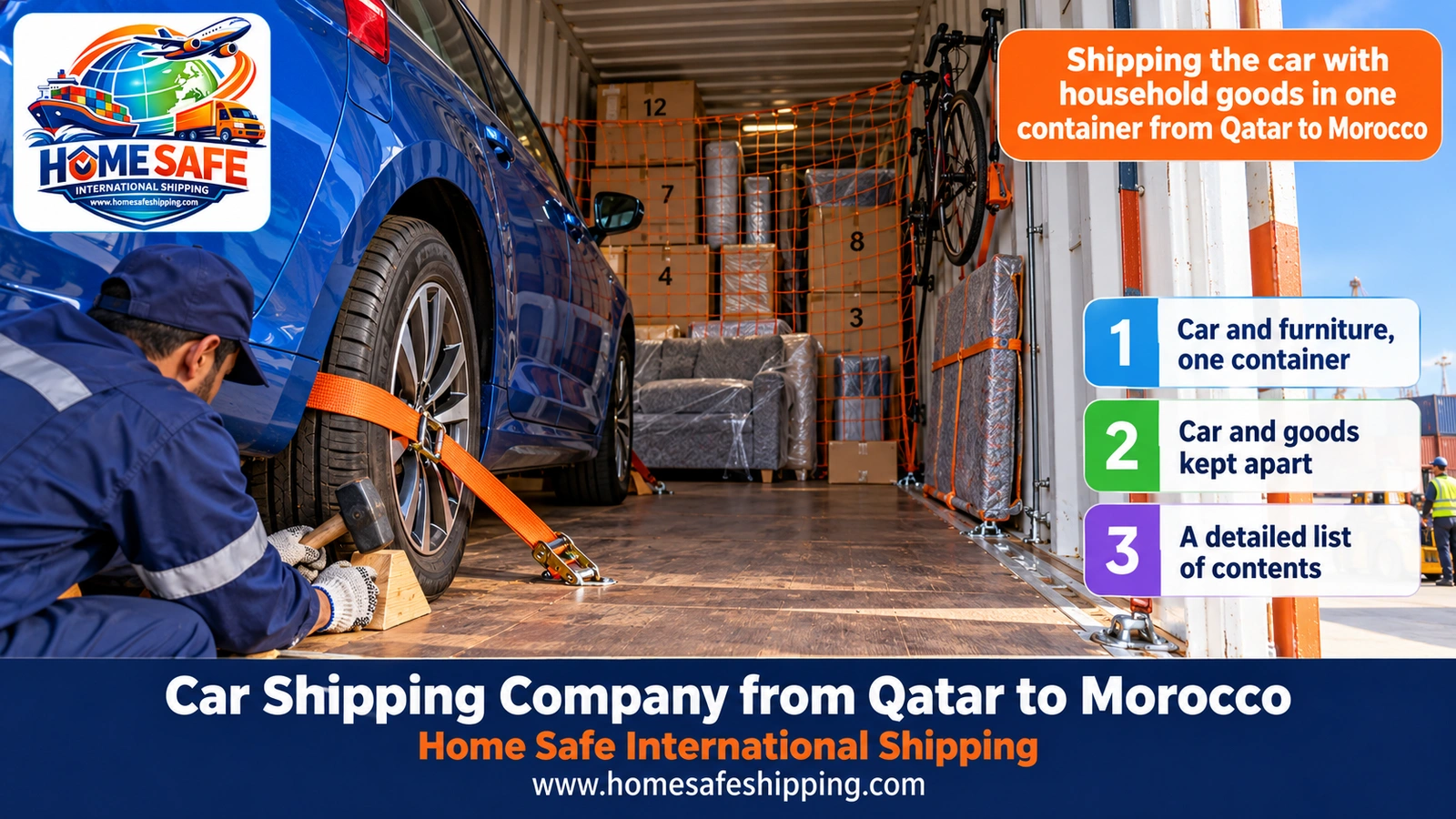
- The car goes in first: to the far end of the container against the closed wall, with its four tyres strapped to the floor rings and chocked with wooden wedges.
- A partition between the car and the belongings: a frame of beams and boards fixed to both sides of the container, which stops any carton reaching the bumper or the glass if the ship rolls.
- The furniture behind the partition: heavy pieces on the floor, cartons on top of them, and mattresses and cushions filling the gaps.
- The cabin empty: nothing on the seats or in the boot, so that the inspector can examine the car without emptying it.
- A detailed list of the contents: every carton with a number, a description and an approximate value, and the car on a separate line with its chassis number.
In Morocco two files are opened for the container. The car enters under its own regime: duties, the retiree’s reduction, or temporary admission. Used furniture enters under the exemption granted to those returning for good, which requires the change-of-residence certificate from the consulate and a signed list of the contents. New appliances in their boxes are not covered by the exemption. Packing furniture is covered on the furniture shipping page, and Morocco’s rules for personal effects in the article on shipping to Morocco.
Types of vehicle we ship from Qatar to Morocco
The car market in Qatar is dominated by large 4x4s, and that changes the calculation: height decides the container, and engine power raises the Moroccan tax. So we measure and ask before we suggest:
| Vehicle | Shipping method | What we watch for on this route |
|---|---|---|
| Saloon and hatchback | RoRo, or a place in a shared container | The easiest to get accepted, with lighter taxes |
| Large 4×4 | A container after measuring the height, or RoRo | The container door is about 2.28 metres, and engine power raises the tax |
| Pickup | RoRo in most cases | Classed as a utility vehicle in Morocco, and outside the retirees’ reduction |
| Luxury and sports | A private container with a long ramp, or air | Ground clearance, and insurance for the full value |
| Classic | A sealed container | The age rule first; it is not shipped until its entry regime is clear |
| Motorcycle | A wooden base inside a container | Draining the fuel and disconnecting the battery |
Preparing the car before handing it over in Qatar
The car will stand for five weeks or more, and it moves from the heat of the Gulf to the damp of the Atlantic. What you leave in it stays there, and what is not photographed cannot be proved. These are six things we ask for before the recovery truck arrives:
- Fuel: a quarter of a tank or less. The port rejects more than that, and an empty tank stops the car being moved.
- Washing: outside and underneath, so that every old scratch shows in the photographs for the report.
- Emptying: take out papers, cash, parking cards, perfumes, and tracking and toll devices.
- Battery and alarm: switch off the alarm, and tell us if the battery is weak so that it is disconnected in the container.
- Photographs: from all four sides, with the roof, the wheels, the cabin and the odometer reading.
- Keys: one key travels with the car together with the locking wheel nut key, and the second stays with you.
Lashing and wrapping methods are on the packing and lashing page.
A summer on Qatari plates, or permanent export?
The paper requested from the Qatari traffic department depends on the answer to one question: is the car coming back? A car that returns is not exported; it leaves on a permit and stays in its Qatari record. A car that does not return has its plates cancelled and leaves on an export certificate, and is then imported into Morocco under all the import conditions. Confusing the two paths is the costliest mistake on this route:
| Item | Temporary exit, then return | Permanent export |
|---|---|---|
| Plates and registration | Qatari and valid | The plates are removed and export plates fitted |
| Qatari traffic paper | Vehicle exit permit | Vehicle export certificate |
| In Morocco | Temporary admission, 180 days a year for a non-resident | Permanent import, then Moroccan plates |
| The Moroccan age rule | Not applied to a car that enters and leaves | Five years, and ten for the eligible retiree |
| Moroccan duties | Not paid as long as it leaves within its period | In full or reduced |
The temporary admission regime was designed for a car its owner drives off the ferry onto the road, not for a car that comes out of a container. So anyone shipping a car for the summer needs to be present at the Moroccan port with passport and registration, and to have the admission recorded in their name. How the customs office applies that to a shipped car is something we ask the clearing agent before the sailing, not after. Morocco works with its own customs declaration rather than the international carnet, and the carnet is explained for the countries that require it on the triptik page.
Procedure for exporting a car from Qatar
The competent authority is the General Directorate of Traffic at the Ministry of Interior. Some of its services are completed from a phone through the Metrash app or from the ministry’s website, and some at the service centre. What is available online changes, so the table describes the practice in force, and we confirm what applies on the day your request is submitted:
| Step | What is required | Our note |
|---|---|---|
| Clearing fines | Payment of everything outstanding on the car and its owner | Checked a week before booking, as some fines appear late |
| Finance | Lifting the lien, or a no-objection letter for a temporary exit | The longest step, so start with it |
| The application | A vehicle export certificate in the name of the owner or their agent | Online or at the service centre |
| The plates | Handing in the originals and fitting export plates | The car runs on them to the port only |
| Qatari customs | An export declaration at Hamad Port or Hamad airport | Submitted by the partner agent |
We ask you to keep a certified copy of the old registration card, because Moroccan customs bases the age calculation on the date of first registration, and that is written on the card, not on the export certificate.
Documents for shipping the car, and what is not shipped with it
The papers on this route are written in Arabic in Qatar and read in Arabic and French in Morocco, so as a rule they need no translation. What they do need is consistency: the name on the registration is the name on the passport and on the bill of lading, letter for letter. We check the copies first, then the originals travel with the owner or by courier, and not in the glovebox of the car.
| Document | Who needs it | Note |
|---|---|---|
| Qatari vehicle registration | Everyone | It shows the date of first registration |
| Export certificate or exit permit | According to the path | From the General Directorate of Traffic |
| Passport and Qatari ID card | Everyone | And the national ID card for a Moroccan |
| Residence certificate from the Moroccan consulate | The returnee and the retiree | Recently issued |
| Proof of retirement and years of residence | Anyone claiming the 90% reduction | Who also attends in person |
| Signed list of contents | Anyone shipping furniture with the car | With the change-of-residence certificate |
| Bill of lading | Everyone | In the owner’s name, showing the chassis number |
These are things that are not loaded with the car, or are loaded on a condition:
| Item | Ruling |
|---|---|
| Personal belongings in a RoRo car | Not allowed, and removed before entering the port |
| Fuel cans, oils and gas cylinders | Not allowed in the container or on the aircraft |
| Cash, gold and original papers | Not left in the car or among the furniture |
| Weapons, ammunition and drones | Prohibited, or with prior authorisation from Morocco |
| New goods in commercial quantities | Treated as merchandise, with duties paid |
The general lists are on the shipping documents and prohibited items pages.
Moroccan customs, duties on the car and its registration
For a permanent import, Moroccan customs does not look at what you paid in a Doha showroom. It takes the value of the car when new from its own tables, deducts a percentage that follows its age, and then calculates the duties on the result. The practice in force is as follows:
| Item | In force | What we do before shipping |
|---|---|---|
| Import duty | 17.5% in most cases, on the assessed value | We ask the clearing agent for an estimate for your model |
| Value added tax | 20% on the value plus the duty | Included in the same estimate |
| Other taxes | They rise with engine power and with a high-value car | We ask about the engine capacity |
| Reduction for the returning retiree | 90% of the value before the duties are calculated | We go through the conditions document by document |
| Individual approval | A conformity check: chassis, engine, lights and emissions | We tell you what is usually asked of a Gulf car |
| Technical inspection and registration card | At an approved centre, then registration and plates | Handled by the owner or their agent in their city |
A car built for the Gulf differs slightly in specification from the European standard followed in Morocco. A document from the dealer on emissions may be asked for, or a change to a rear light or to the instrument cluster. The steering side is the same in both countries, so it is not touched. The rates change with the finance law, so we confirm those in force with the clearing agent before loading. The procedure is explained on the customs clearance page.
Insuring the car and tracking it to the Moroccan port
The cover of a Qatari motor policy ends at the limits written in it, and does not extend to a ship in the Red Sea. What the shipping line pays in the event of damage is a limited sum unrelated to the price of the car. Real protection is therefore a marine or air cargo policy for the agreed value of the car, from the door of the home in Qatar to delivery in Morocco. The basis of any claim under it is the condition report and the photographs. These are the tracking messages:
- In Qatar: a message with the container number and the seal number, and a photograph of the car lashed before the door is closed.
- On the way: you look the voyage up yourself with the lading number the line gives us, and we write to you the moment the box is moved to its second vessel.
- In Morocco: notice of berthing, then of the customs inspection appointment, then of the release.
Types of cover are on the cargo insurance page, and how to follow a shipment on the tracking page.
Delivering cars from Qatar in Casablanca, Rabat, Tangier and Marrakech
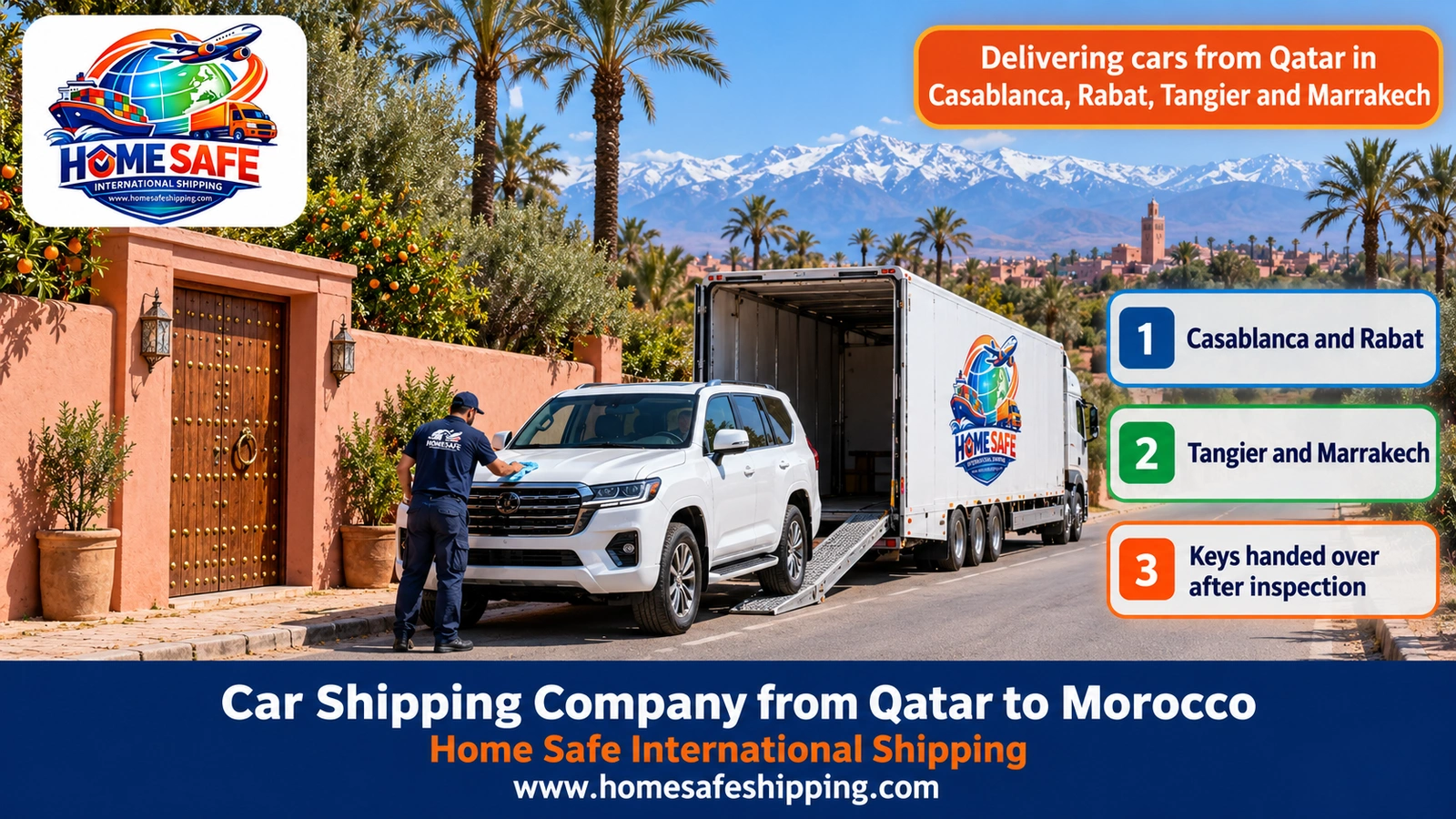
After release the car is loaded onto a carrier to its owner’s city, since a permanently imported car has no plates and is not driven before it is registered. The port is chosen from the start by the delivery address: Casablanca for Rabat, Marrakech and their surroundings, and Tanger Med for Tangier and the north. At the address the owner or their agent walks round the car with the driver, with the loading photographs from Qatar in hand, and the key is handed over only after this inspection and the signature.
| Delivery city | Most suitable port | Approximate distance | Note |
|---|---|---|---|
| Casablanca and Mohammedia | Casablanca | Within the city | Delivery on the day of release or the next |
| Rabat, Salé and Temara | Casablanca | About 90 km | Seat of the embassies; mission cars are coordinated in advance |
| Tangier and Tetouan | Tanger Med | About 45 km to Tangier | The quickest to reach from the sea |
| Marrakech | Casablanca | About 240 km | The carrier does not enter the old city, so a nearby point is agreed |
| Agadir | Casablanca | About 460 km | Two to three days |
Any remark on the bodywork or the glass is written on the delivery report before signing, as it is what a claim is built on. Delivery to the address is covered on the door to door page.
What is shipped with the car: furniture, appliances, goods and parcels
This article is about cars, but on this route the car seldom travels alone. We give each type a line and refer you to its page:
- Household and office furniture: dismantled, wrapped and loaded into the car’s container behind the partition, or into a separate container if there is a lot of it.
- Electrical and electronic appliances: in their original cartons or in wooden crates, bearing in mind that new ones are outside the returnees’ exemption.
- Commercial goods: with an invoice and a packing list in the name of a Moroccan importer, explained on the commercial shipping page.
- Parcels: whatever the owner needs urgently goes ahead of the car by air, with details on the parcel shipping page.
Car shipping for individuals, companies, government bodies and embassies
An individual cares that the car is accepted and wants to know what will be paid in Morocco. A company asks about an invoice and a schedule. An embassy asks about a letter and an exemption. The journey is the same, and the file changes:
| Customer | What they usually ask for | What we arrange for them |
|---|---|---|
| Individuals and families | One car, and sometimes a home with it | A check of the age and the entitlement, an itemised price, and one person following the file |
| Companies, showrooms and government bodies | Several cars on one sailing | 40ft containers for two cars, an invoice, and a condition report for each chassis |
| Embassies and consulates | The car of an employee transferred to Rabat | A sealed container, and papers matching the exemption request submitted by the mission |
Land, sea and air: which gets the car to Morocco?
Sea and air only. The land route from Qatar to Morocco crosses Saudi Arabia, then Egypt, Libya, Tunisia and Algeria, and ends at a closed land border between Algeria and Morocco. No car carrier therefore reaches Casablanca by road, and we do not offer it. The role of road transport with us is confined to Qatar, from your home to Hamad Port or the airport, and then to Morocco, from the port to your city. Land freight for cars from Qatar is a service to the neighbouring Gulf states, covered on the car shipping from the Gulf states page, and the general comparison is on the shipping methods comparison page.
Air freight for cars from Qatar to Morocco
Anyone who cannot wait five weeks at sea sends the car by plane. It is handed over in the cargo area at Hamad International Airport, driven onto a metal pallet with its tyres strapped to it, and the pallet is then lifted into a freighter or into the hold of a wide-body aircraft if the height of the car allows. It lands at Mohammed V Airport in Casablanca, is cleared at the airport customs, and is then delivered in Casablanca or moved on an enclosed carrier to another city. The whole time is 4 to 7 days.
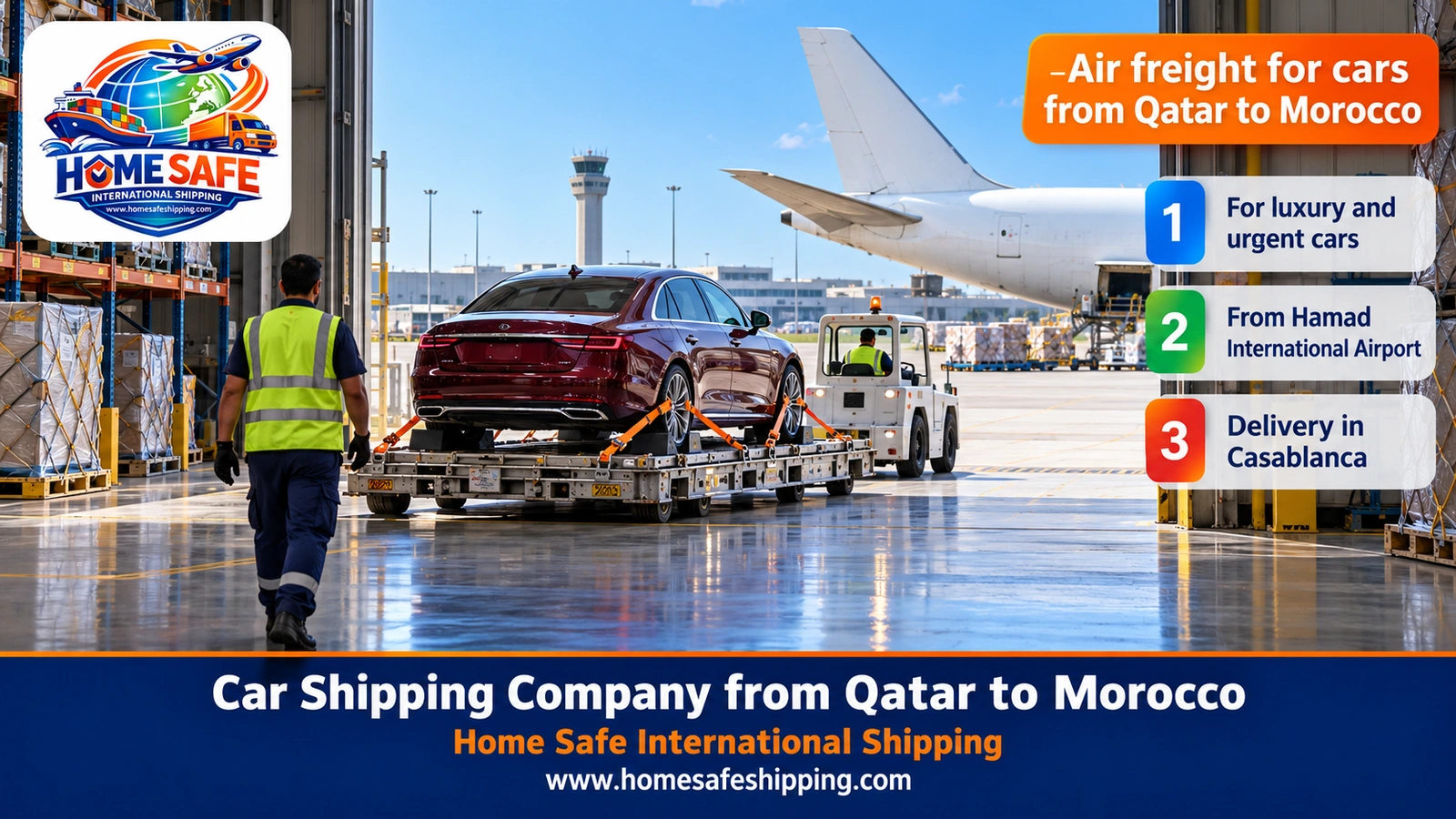
- For whom: for luxury and urgent cars: a valuable sports car, a car for an exhibition or an event, or the car of a Qatari who wants it in Marrakech when they arrive.
- Classification: a car on an aircraft is dangerous goods because of the fuel and the battery, and its declaration is prepared by a specialist approved by the carrier.
- Preparation: very little fuel, as the carrier requires, a secured battery, and no leak of any kind.
- Papers: the same papers as for sea with an air waybill, and the age rule and duties in Morocco remain as they are.
- Price: set on request by the weight and dimensions of the car, and several times the sea price.
There are regular flights between Doha and Casablanca, but whether a car is accepted on a particular flight depends on the aircraft type and the space available on it, so the car does not leave the house before the booking is confirmed. Air services for anything other than cars are on the air freight page.
Steps for shipping a car from Qatar to Morocco
Eight steps, half of them settled before the car moves:
- You send to 0552803439 a photograph of the registration and the model, your city in Morocco, and whether the car is coming back or not.
- We check the age rule and your status, and ask the Moroccan clearing agent about the expected duties and the approval.
- The itemised price reaches you with the method, the port and the time, and you confirm the booking.
- Fines are paid and the lien lifted, and the export certificate or the exit permit is requested from the Qatari traffic department.
- The partner agent collects the car from your address, and the condition report is written and photographs taken.
- It is lashed in the container with the furniture, if any, and sealed, or handed to the RoRo terminal or to air cargo.
- The ship sails from Hamad Port, and you receive the bill of lading, the tracking number and the stage messages.
- The clearing agent submits the file at the Moroccan port, then the car is delivered after the inspection and the key handed over.
Car shipping from Morocco to Qatar
The reverse direction has two cases. A Qatari car that has spent its summer in Morocco and is going back: it leaves temporary admission before its period ends and returns to its record in Qatar with no fresh import. And a car bought in Morocco to be registered in Qatar: these are few, and they enter Qatar as imports. The rule in force there is a customs duty of 5% of the value, a light vehicle no more than five years old from the year of manufacture, left-hand drive, and passing the technical inspection before registration. The destination page is shipping to Qatar.
Advice before shipping your car from Qatar to Morocco
Most of what we advise is done in Qatar weeks before the sailing:
- Work out the value of your car on the Moroccan market, add the freight and the duties, then compare with selling it in Doha and buying its equivalent there.
- Do not cancel the Qatari plates before the clearing agent confirms that the car gets in, and under which regime.
- Gather the proof of your years of residence before the residence permit is cancelled, as some bodies do not issue their certificates after departure.
- Request the consulate certificate in the last weeks, not months before shipping.
- Start eight weeks before your date for sea, and two weeks for air.
How do you choose a car shipping company from Qatar to Morocco?
The advertisements all promise safety, speed and tracking. The difference shows in the questions you are asked, and in the answers you hear when you do the asking:
| What you ask about | A reassuring answer | An answer that calls for caution |
|---|---|---|
| Will my car get into Morocco? | They ask for the date of first registration and your status | They confirm acceptance without asking anything |
| Who collects it in Qatar? | They say they work through an agent and introduce you | They speak of branches for which you find no address |
| How long does the journey take? | A range in weeks, and they mention the transhipment port | Two weeks by sea to Casablanca |
| Where does the price end? | Itemised, with Moroccan duties outside it | One all-inclusive figure |
| How do you document it? | A condition report, photographs and a bill of lading in your name | A handwritten receipt and a mobile number |
Common mistakes in shipping cars from Qatar to Morocco
Seven mistakes recur, and every one is avoided by a call before booking:
- Shipping a car more than five years old in the hope that it gets through at the port.
- Counting the age of the car on the day it leaves Doha, not the day it reaches Morocco.
- Exporting a car that will come back after the summer, so it loses its Qatari plates for nothing.
- Appointing a relative to clear a car for which the retiree’s reduction is claimed, a privilege that requires its holder to attend.
- Filling the cabin of the car with gifts inside the container without mentioning them on the list.
- Choosing the Moroccan port by the sea freight, then paying the difference twice over on the carrier.
- The owner reaching Morocco weeks after the car, so that storage charges pile up.
Why Home Safe for shipping your car from Qatar to Morocco?
Because we tell you what you would rather not hear before you pay: that your car may not be accepted, that the duties may exceed the freight, and that we work in Qatar through partners, not through a branch. Then we arrange everything after that in one file.
A registered establishment
Home Safe Logistics Services Est., commercial registration 4030601060.
Agents in Qatar and Morocco
A partner collects the car in Doha, a clearing agent receives it at the Moroccan port, and our team is between them.
Age before price
We check the five-year rule and your status in Morocco before we send you a figure.
Car and home in one file
One container for the car and the furniture, with a partition, a detailed list and papers for each.
To book: 0552803439 by call or WhatsApp, from 7 am to 11 pm. Or from the request a quote page.
Related articles and pages
- Car shipping company from Saudi Arabia to Morocco
- Car shipping company from Kuwait to Morocco
- Car shipping company from Qatar to Spain
- Car shipping company from Qatar to France
- Sea freight
- Container sizes
Tags
car shipping company from Qatar to Morocco, car shipping from Qatar to Morocco, car shipping from Doha to Casablanca, car shipping from Doha to Tangier, cost of shipping a car from Qatar to Morocco, sea car shipping from Hamad Port, RoRo car shipping from Qatar, shipping a car in a container from Qatar to Morocco, shipping a car with furniture from Qatar to Morocco, air freight for cars from Hamad International Airport, car shipping to Tanger Med, conditions for importing cars into Morocco from the Gulf, exporting a car from Qatar to Morocco, car transit time from Qatar to Morocco, car shipping from Qatar to Marrakech, car shipping from Morocco to Qatar
Frequently asked questions about car shipping from Qatar to Morocco
Which is the best car shipping company from Qatar to Morocco?
The one that asks you for the date your car was first registered and for your status in Morocco before it talks to you about a ship. Home Safe is a registered establishment in Jeddah that arranges collection and the port in Qatar through partner agents and follows the file with its own team until the key is handed over; its number is 0552803439.
How much does it cost to ship a car from Qatar to Morocco?
We do not publish a fixed figure for this route; the price is set on request once the car, the method and the Moroccan port are known. What circulates for sea freight is between QAR 2,800 and 5,000 for a small car as far as the port. For comparison, RoRo for a saloon on our line from Jeddah port to Moroccan ports starts from SAR 2,200.
How long does a car take from Doha to Casablanca?
By sea, 35 to 50 days from the day it leaves your home in Qatar until it leaves the Moroccan port. By air, 4 to 7 days including clearance at both airports. We fix the time on the actual booking.
What is the cheapest way to ship a car from Qatar to Morocco?
Sea, always. Among the sea options, RoRo or a place in a 40ft container shared by two owners costs less than a full container for a single car. Anyone already moving their home to Morocco pays almost no separate freight for the car, because it goes into the container they booked for their furniture.
Does Morocco accept a Qatari car registered more than five years ago?
The rule in force is that it cannot be imported permanently once it is more than five years from the date of first registration. The known exception is for a retired Moroccan returning after a long stay abroad, whose car is accepted up to ten years old under conditions. The rule is reviewed in Morocco, so we confirm it for your car before booking.
I am a Moroccan working in Doha and I spend the summer at home. Do I export my car?
No. Anyone taking the car back to Doha leaves it on its Qatari plates and registration and asks the Qatari traffic department for a vehicle exit permit. Morocco applies the temporary admission regime to residents abroad, for 180 days a year free of duty. How it is applied to a car that arrived as cargo is decided by the customs office at the port of arrival, so we ask about it before shipping.
What are the conditions of the reduction for a Moroccan retiree returning from Qatar?
The rule in force is that the person has reached sixty and has lived outside Morocco for ten years or more, and that the car is a passenger car no more than ten years old. It is granted once in a lifetime, has a ceiling on value, and the beneficiary appears before customs in person.
How is the vehicle export certificate obtained in Qatar?
From the General Directorate of Traffic at the Ministry of Interior, through the electronic services and the Metrash app or at the service centre, depending on what is available on the day of the request. Before that, fines are paid and the lien is lifted, short-term insurance is required, and then the plates are exchanged for export plates. Its validity is short, so it is requested once the sailing date is firm.
Can I ship my household goods with the car in one container?
Yes, in a 40ft container. The car goes to the far end of the container and is lashed by its wheels, a wooden partition is built behind it, and then the furniture and cartons are stacked. A detailed list of the contents is written, because Moroccan customs handles the car under one file and the furniture under another.
Tanger Med or Casablanca: which port should I choose?
The port is chosen by the city where the car will be delivered. Tanger Med for Tangier, Tetouan, Fez and the cities of the east, and Casablanca for Rabat, Marrakech, Agadir and Casablanca itself. The difference in sea freight between the two is lost if the car then covers hundreds of kilometres on a carrier.
Can the car be shipped by air from Hamad International Airport to Morocco?
Yes, to Mohammed V Airport in Casablanca. The car is lashed onto an air cargo pallet, and arrives and is cleared within 4 to 7 days of collection in Qatar. The price is set on request once the weight, dimensions and fuel type are known, and the Moroccan age rule does not change with the means of arrival.
My car is financed by a bank in Qatar. Can it leave?
Not before the bank gives permission. The lien is recorded against the car at the traffic department, so no export certificate is issued until it is lifted, and as a rule the temporary exit permit is not given without a no-objection letter from the lender. Ask for the letter first, then book the ship.
Does a Gulf-specification car need changes to be registered in Morocco?
The steering wheel is on the left in both countries, so nothing changes on that side. But a permanently imported car goes through individual approval and a technical inspection before the registration card, and something may be asked for in the lights or the instrument cluster, or a document on emissions, depending on the model.
How do I follow my car between Hamad Port and the Moroccan port?
With the container number or the bill of lading number on the shipping line’s website, and with a message from us at every move: entry to Hamad Port, the departure of the ship, the container coming off at the intermediate port and going onto the second ship, berthing in Morocco, and then the release.
Who pays the Moroccan duties, and are they inside the shipping price?
The owner or the consignee in Morocco pays them at clearance, and they are a separate item from the freight. Customs calculates them on a value that it assesses for the car itself, not on your invoice. The rule in force is an import duty of 17.5% in most cases and value added tax of 20%, and together they can exceed the sea freight several times over.
That is the guide — now let us price your shipment
Choose what applies to you and receive a reply with the price, the method and the time.
RoRo, container or sling lift — we recommend what suits your vehicle’s value and its destination.
Get a vehicle priceA full or shared container, or urgent air freight, with packing and clearance.
Get a shipment priceRoutes in the same section
Options related to the same type of service.