
Land Freight from Saudi Arabia to Egypt 0552803439 | Truck and Ferry to the Door: Furniture, Appliances, Goods, Car Shipping

Ship by land from Riyadh, Jeddah, Dammam and the other Saudi cities to Cairo, Alexandria, the Delta and Upper Egypt: furniture, appliances, cartons and goods. The closed truck drives to the port of Duba and boards the ferry with its load, is cleared at Safaga or Nuweiba, and the shipments are distri…
Home Safe offers land freight from Saudi Arabia to Egypt in closed trucks that cross the Red Sea by ferry. Shipments are consolidated in your city, the truck drives to the port of Duba, boards the ferry with its full load, and lands at Safaga or Nuweiba, where inspection and clearance take place. The shipments are then sorted at the warehouse and delivered to homes by small vans. Door to door takes 7 to 15 days depending on the city of origin. A medium carton starts from SAR 140, a bedroom from SAR 1,650, and a flat’s furniture from SAR 4,150. To book: 0552803439.
In this guide45ShowHide
- What is land freight from Saudi Arabia to Egypt?
- Who ships to Egypt by land, and what do they send?
- The stages of the journey from your city to the door in Egypt
- Consolidation in Saudi cities and the road to the port
- The port of Duba: how does the truck board the ferry?
- Inspection and customs clearance at Nuweiba or Safaga
- Transit time by land to Egypt, and what lengthens it
- The cost of land freight from Saudi Arabia to Egypt
- Shared load or dedicated truck?
- Truck types, capacity and storage before shipping
- Shipping furniture, appliances and cartons by land
- Shipping commercial goods and cars to Egypt
- Documents required for land freight to Egypt
- Egyptian customs duties: what should you expect?
- What cannot be shipped by land to Egypt, or is restricted
- The warehouse in Egypt: unloading the truck and sorting the shipments
- Door distribution in Cairo, Alexandria, the Delta and Upper Egypt
- Land, sea or air: which method should you choose?
- Air freight to Egypt: when to keep it for the urgent
- Packing for a long road and a ferry
- Insurance, tracking and follow-up
- Steps of land freight from Saudi Arabia to Egypt
- Land freight from Egypt to Saudi Arabia
- Recommendations for a safe arrival
- How do you choose a land freight company to Egypt?
- Common mistakes in land freight to Egypt
- Why Home Safe for land freight to Egypt?
- Related articles and pages
- Tags
- Frequently asked questions about land freight from Saudi Arabia to Egypt
- How does land freight from Saudi Arabia to Egypt work when the sea lies between them?
- How long does land freight from Saudi Arabia to Egypt take?
- How much does land freight from Saudi Arabia to Egypt cost?
- Which port does the truck leave from, and where does it land?
- Is my shipment unloaded at the port before the ferry?
- Where is the shipment cleared through customs in Egypt?
- Will I pay Egyptian customs on my used belongings?
- What is the difference between a shared load and a dedicated truck to Egypt?
- Do you deliver to the door in every governorate?
- Which documents are needed for land freight to Egypt?
- Can I put a new mobile phone or gold inside the cartons?
- Is land freight better than sea or air to Egypt?
- Do you ship cars to Egypt by land?
- How do I follow my shipment while it is on the way?
- When should I book to avoid delays?
Route: consolidation in your city → road to the Red Sea coast → the whole truck boards the ferry → inspection and clearance at the Egyptian port → distribution warehouse → door delivery · Transit time: 7–15 days.
In brief
- Method: a closed truck, then a ferry, since no continuous road links the two countries.
- What is shipped: furniture, appliances, luggage, cartons and commercial goods.
- Departure port: mainly Duba; the alternative is Aqaba or Jeddah depending on the sailing available.
- Arrival port: Safaga or Nuweiba, where inspection and customs clearance are carried out.
- Transit time: 7–12 days from Jeddah, and 9–15 days from Riyadh and Dammam.
- Starting prices: a carton from SAR 140, an appliance from SAR 92, a bedroom from SAR 1,650, a flat from SAR 4,150.
- Booking: 0552803439 by call or WhatsApp.
What is land freight from Saudi Arabia to Egypt?
Land freight means moving a shipment by truck on the road from the sender’s address to the consignee’s. Between the Kingdom and Egypt there is one particular feature: the Red Sea separates the two countries and no bridge spans it. So the truck covers the sea leg on a ferry that carries it with everything inside, then returns to the road on the Egyptian side. That is why people call it land freight even though it includes hours of sailing.
What matters to you as the owner is that your belongings stay in one closed vehicle from the consolidation depot to the warehouse in Egypt. No cranes, no ship’s holds and no transfer from one container to another. This is what makes the method better suited to furniture, glass and appliances than the others.
Knowing the stages before you book helps with three things: estimating the real cost to the door, setting a realistic arrival day, and preparing the papers Egyptian customs asks for. This page explains the stages one by one.
Who ships to Egypt by land, and what do they send?
Most people who ask for this service are Egyptian residents sending belongings to their families or going home for good with a whole household. After them come traders and factories sending goods to an importer in Egypt. Each group has a booking method that suits it, as the table shows:
| Shipper | What they usually send | What suits them |
|---|---|---|
| A resident sending to family at a holiday or season | Cartons of clothes, gifts and kitchenware | Shared load, per carton |
| Someone returning for good at the end of a contract | Bedrooms, sofas, appliances and cartons | Shared load by volume, or a dedicated truck for a whole home |
| A family furnishing a home in Egypt | Fridge, washing machine, air conditioner and television | Shared load per piece with reinforced packing |
| A trader or factory | Pallets of goods or equipment | A dedicated truck or space by the tonne |
| A traveller with his own car | A passenger car on temporary admission | Crossing on the ferry under a carnet |
The stages of the journey from your city to the door in Egypt
The journey has eight consecutive stages, each with its own timing. In a shared load the longest is waiting for the truck to fill, and the least predictable is clearance at the arrival port. The table gives a realistic picture of where the days go:
| Stage | What happens | Usual time |
|---|---|---|
| 1. Collection | Measuring, packing, numbering and writing the inventory list | One day |
| 2. Consolidation | Your shipment joins others at the city depot until the truck is full | One to 4 days |
| 3. Road to the port | The closed truck drives to Duba | One to two days |
| 4. Exit formalities | Export declaration and booking the truck’s place on the ferry | Hours to a day |
| 5. Ferry | The truck drives aboard with its load and sails to Safaga | About 8 hours’ sailing |
| 6. Inspection and clearance | Checking the papers, opening what is requested, paying duties | One to 3 days |
| 7. Warehouse | Unloading the truck and sorting shipments by governorate | One day |
| 8. Distribution | A small van takes each shipment to its address | One to 5 days |
These times are usual, not guaranteed: the ferry timetable and the queue at customs are outside any shipping company’s control. A dedicated truck skips the second stage altogether.
Consolidation in Saudi cities and the road to the port
We collect from your home or warehouse in any city, then add the shipment to the truck serving that region. Trucks bound for Egypt leave the major cities regularly, so the wait is not usually long. The closer your city is to the Tabuk coast, the shorter the road and the transit time:
| City of origin | Road to Duba | Approximate distance | Time to the door in Egypt |
|---|---|---|---|
| Tabuk | The direct Tabuk – Duba road | About 180 km | 6–10 days |
| Yanbu | The coastal road via Umluj and Al-Wajh | About 460 km | 6–10 days |
| Madinah | Via Al-Ula, or Yanbu and then the coast | About 650 km | 7–12 days |
| Jeddah, Makkah and Taif | The coastal road north via Yanbu | About 800–900 km | 7–12 days |
| Riyadh | Qassim, then Hail, then Tayma and Tabuk | About 1,450 km | 9–14 days |
| Buraidah and Unaizah | Hail, then Tayma and Tabuk | About 1,100 km | 9–14 days |
| Dammam, Khobar and Jubail | Via Riyadh, or Hafar Al-Batin and Hail | About 1,850 km | 10–15 days |
| Abha, Khamis Mushait and Jazan | The west coast via Jeddah | About 1,450 km | 10–15 days |
Distances are approximate and vary with the road the driver takes. Shipments from the capital are covered in more detail on the page Riyadh to Egypt shipping company, and those from the west coast on Jeddah to Egypt shipping company.
The port of Duba: how does the truck board the ferry?

The port of Duba on the coast of the Tabuk region is the Saudi port nearest to the Egyptian shore, which is why most of our trucks head for it. The truck reaches the port yard, the export declaration is lodged, and it takes its turn in the vehicle queue. It then drives up the ferry’s ramp onto the vehicle deck, where its wheels are secured with chains and chocks so that it does not shift during the sailing.
The load is not touched at this stage. The truck’s doors stay shut as they left the depot, so there is no unloading at the port and no re-stowing. That is the essential difference between a ferry and a sea container, which is lifted by cranes and stacked on top of others.
| Line | Arrival | When we use it |
|---|---|---|
| Duba → Safaga | The Red Sea coast, near Hurghada and Qena | The usual line for most shipments; about 8 hours’ sailing |
| Duba → Hurghada | About 60 km north of Safaga | When a sailing that accepts trucks is running on it |
| Aqaba → Nuweiba | South Sinai | The truck enters Jordan through the Durra crossing, then sails from Aqaba |
| Jeddah → Safaga | The Red Sea coast | For Western Region shipments when a suitable sailing exists |
We do not promise a fixed sailing timetable. Ferry times and frequency change with the season, sea conditions and the operators’ decisions, so we confirm the available sailing and the line in service when the booking is fixed.
Inspection and customs clearance at Nuweiba or Safaga
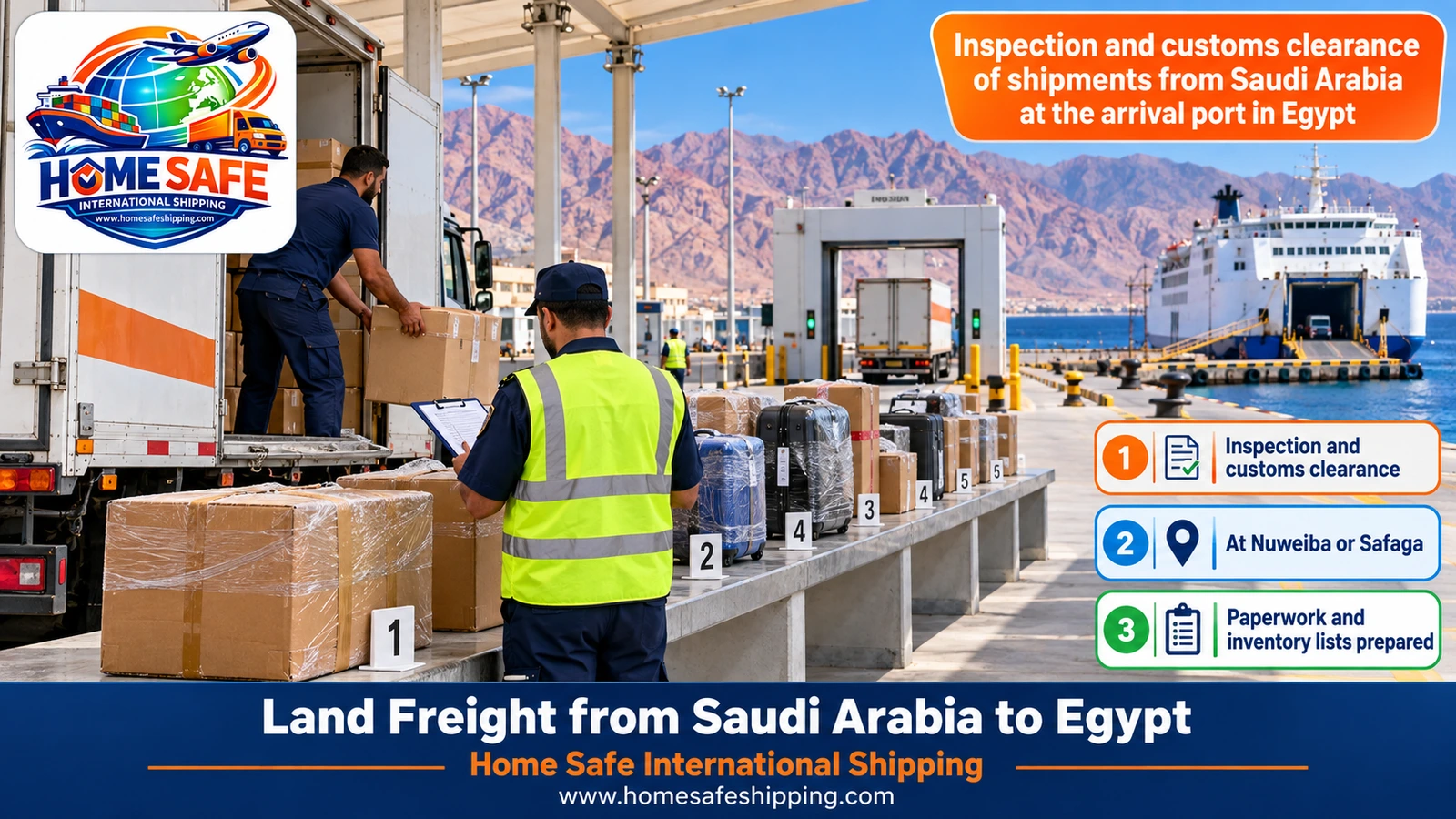
The truck rolls off the ferry into the customs zone of the arrival port, and the most important stage of the journey begins. The clearing agent presents the papers and inventory lists prepared in the Kingdom, and the customs officer matches them against what is on the truck. He may be satisfied with a sample of cartons, or ask for more to be opened if he finds a vague list or an undeclared item.
That is why we insist on a detailed list for every carton and item before loading. A shared truck carries several people’s shipments, and one carton holding something that was not written down can delay everyone. Once the duties are assessed and paid, the papers are stamped and the truck leaves the port.
- What is checked: the identity of sender and consignee, the inventory list, and the number and type of pieces.
- Where officers look hardest: anything that plugs in, goods still boxed as new, and the same item appearing several times over.
- What lengthens inspection: a hidden item, or a list that says “personal effects” with no detail.
- What eases it: numbered cartons, the contents written against each number, and appliances listed as a separate item.
Transit time by land to Egypt, and what lengthens it
The usual door-to-door time is 7 to 15 days. The driving and the sailing themselves take no more than three days; the rest is consolidation, waiting for a ferry, clearance and distribution. Anyone quoting a much shorter time is counting the road alone. Here is how the times compare by method:
| Shipping method | Time to the door | Suits |
|---|---|---|
| Shared truck on the ferry | 7–15 days | Cartons, a room, appliances |
| Dedicated truck on the ferry | 6–10 days | A whole home, or goods that fill a truck |
| Sea container | 12–20 days | Heavy commercial goods |
| Air | 3–6 days | Documents and urgent parcels |
What lengthens the transit time?
- Filling the load: a shared truck does not set off half empty.
- The ferry sailing: missing one means waiting for the next, and a sailing may be cancelled in rough seas.
- Homecoming seasons: before Ramadan and the two Eids and in the summer holiday both ports are crowded.
- Extended inspection: an incomplete list turns a sample check into a full opening.
- A distant governorate: Aswan and Luxor need more days after the warehouse than Cairo.
Times for other destinations are on the transit times page.
The cost of land freight from Saudi Arabia to Egypt
The price is built on the space your shipment takes in the truck, not, in most cases, on its weight. A carton is priced per carton, furniture by volume after dismantling and packing, and commercial goods by the tonne or by the truck. The figures below are our starting prices for shared loads, the same ones used on the page furniture shipping prices from Saudi Arabia to Egypt:
| What you ship | Pricing unit | Price starts from |
|---|---|---|
| Medium carton | Per carton | SAR 140 |
| Large carton | Per carton | SAR 185 |
| Jumbo carton | Per carton | SAR 230 |
| Electrical appliance | Per piece, by size | SAR 92 |
| Complete bedroom | Per room, dismantled and packed | SAR 1,650 |
| Furniture of a three-room flat | Per shipment | SAR 4,150 |
| Commercial goods | Per tonne | SAR 2,580 |
| Cubic metre, and a dedicated truck | Per metre or per truck | Set on request |
| A car crossing on temporary admission | Per car | Set on request |
Prices quoted in the market: little is published about this line, and what there is varies. For clothes and kitchenware a per-kilogram rate from about SAR 3 is mentioned, for a large bedroom about SAR 1,800, for a fridge or washing machine SAR 45 to 70 as carriage, and for air conditioners and televisions higher sums of roughly SAR 350 to 1,200 because they include the expected duties. Most other pages publish no figure at all. So always ask: is the figure to the Egyptian port or to the door, and does it include clearance?
| Factor | How it affects the price |
|---|---|
| Volume after packing | It is the basis of the charge, and dismantling cuts it considerably |
| City of origin | Tabuk and Jeddah are closer to Duba than Riyadh and Dammam |
| Governorate of delivery | Cairo and the Delta are nearer than the far south of Upper Egypt |
| Shared or dedicated | Shared is cheaper; with dedicated you pay for the whole truck |
| Number of appliances | Raises the duties to expect in Egypt |
| Services at home | Dismantling, packing and carrying down from upper floors are separate items |
| Season | Before the Eids and in summer, demand for trucks and ferries rises |
How do you cut the cost?
- Choose a shared load unless your date is tight.
- Dismantle wardrobes and beds: a dismantled piece takes a fraction of its standing volume.
- Fill wardrobe drawers and the washing-machine drum with clothes and linen.
- Leave behind the old heavy piece that costs more to ship than it is worth.
- Team up with a relative or colleague shipping to the same governorate.
- Work out your volume in advance with the CBM calculator, and read the pricing factors.
Shared load or dedicated truck?
The decision depends on the size of your shipment and on your date. Someone with less than half a truck pays, with a dedicated one, for empty space he does not use. Someone with a whole home may find dedicated cheaper and faster, because his customs file is a single one and he waits for nobody:
| Point of comparison | Shared load | Dedicated truck |
|---|---|---|
| Charging | Per carton, per piece or by volume | The full hire of the truck and its ferry passage |
| Departure day | When the load is full | The day you choose |
| Clearance | With other shipments under one declaration | A file in your name alone |
| Delivery in Egypt | From the warehouse by small van | The truck to your address where roads allow, or via the warehouse |
| Best for | Cartons, a room and appliances | A whole home, or commercial goods |
Truck types, capacity and storage before shipping
The vehicle’s capacity decides how many shipments travel together and what each metre in it costs. A larger truck spreads the ferry fare over more cargo, so each shipment’s share falls. We choose the vehicle according to the total gathered in the city and the nature of the goods:
| Vehicle | Approximate capacity | Its use on the Egypt line |
|---|---|---|
| Closed light truck (Dyna) | 20–25 m³ | Collection from homes within the city, and a small dedicated shipment |
| Medium box truck | 35–45 m³ | A medium home or a small shared load |
| Closed trailer | 80–90 m³ | The usual shared load, and two to three homes |
| Curtain-side or flatbed trailer | Up to about 25 tonnes | Palletised goods and equipment |
| Refrigerated truck | Set on request | Foodstuffs that need cooling, by prior arrangement |
If your shipment is ready before the truck’s date, or your travel is delayed, it is kept in our depot, packed and numbered, until loading day. Storage terms and periods are on the storage page.
Shipping furniture, appliances and cartons by land
These three categories make up most of what our trucks carry to Egypt, and each is prepared in a way that suits a long road and a ferry. Furniture is dismantled to reduce its volume, appliances have their moving parts secured, and cartons are filled so that they do not crush under others.
- Bedrooms and wardrobes: dismantled with the panels numbered, and the bag of screws taped to the piece itself. A complete room starts from SAR 1,650.
- Sofas and majlis seating: blankets, bubble wrap and reinforced cardboard corners.
- Fridge and washing machine: unplugged and dried a day before collection, with the washer drum fixed by its transit bolts.
- Split air conditioner: removed by a technician who pumps the gas down into the outdoor unit; both units are wrapped.
- Televisions: in the original box if it survives, otherwise between sheets of foam and wood.
- Cartons: medium from SAR 140, large from SAR 185 and jumbo from SAR 230, each weighing no more than 35 kg.
- Suitcases: wrapped in clear film and given a number on the list like a carton.
Appliances from the Kingdom run in Egypt on roughly the same voltage, 220 V, but the socket shape differs, so you need a simple plug adaptor. The full household service is on the furniture shipping page.
Shipping commercial goods and cars to Egypt
Commercial goods follow the same route but with different papers. They are loaded on pallets in a closed or curtain-side trailer, and the price starts from SAR 2,580 per tonne. The practice in force is that the Egyptian importer pre-registers the shipment with customs and obtains a number for it before it moves, so we coordinate with him before loading and confirm the current requirement. Services for companies are on the commercial shipping page.
Cars are a different matter. A Saudi car normally enters Egypt on temporary admission with its owner under a carnet (triptik), crosses on the same ferry and then returns. Bringing in a used passenger car permanently is restricted in Egypt by strict conditions that change, so we do not promise it and we review your case before any step. Ways of moving cars are on the car shipping page.
Documents required for land freight to Egypt
The papers are few but decisive, and the inventory list matters most. We prepare the list on packing day and ask you to check and sign it. All you need to bring is clear copies of your documents and correct details for the consignee:
| Type of shipment | From the sender in the Kingdom | For the consignee in Egypt |
|---|---|---|
| Cartons, luggage and appliances | Copy of the residence permit or ID and passport, and a detailed inventory list | Name as on the national ID card, address, and an Egyptian mobile number |
| Furniture of someone returning for good | The above, plus the final exit visa | The owner himself, or someone holding his power of attorney |
| Commercial goods | Commercial invoice, packing list, certificate of origin and commercial registration | The importer’s tax and import cards, and the pre-registration number where required |
| A car on temporary admission | Vehicle registration, driving licence and the carnet | The owner travels with the car |
Each document is explained on the shipping documents page.
Egyptian customs duties: what should you expect?
The freight charge is one thing and customs duties are another. We set the first before loading; the second is assessed by Egyptian customs at the arrival port according to the type, value and condition of the items. The regulations there change from time to time, so what we state here is the practice in force, and we confirm the current rule before shipping.
- Used personal effects: clothes, kitchenware and bedding are the easiest items to assess.
- Used furniture: assessed by type and condition; someone returning for good presents proof of residence abroad.
- Appliances: one piece of each type for household use is easier than several identical ones.
- New items in their boxes: treated as imported goods, not as used effects.
- Mobile phones: the practice in force is that a phone arriving from abroad is registered and fees are paid on it, so it is not placed in an unaccompanied shipment.
- Commercial quantities: ten pieces of one item are not personal effects and are cleared as goods.
We go through your list before loading and tell you plainly what is likely to be charged and what is better left out. Clearance procedures in general are on the customs clearance page.
What cannot be shipped by land to Egypt, or is restricted
A shared truck carrying one prohibited item is held in its entirety at the port, so when in doubt we open sealed cartons before accepting them. The table lists the main things we refuse or restrict on this line:
| Item | Status on the Egypt land line |
|---|---|
| Weapons, ammunition and fireworks | Prohibited |
| Flammable materials, gas and paints | Prohibited in a closed truck |
| Medicines | A personal quantity with its prescription only |
| Drones and radio equipment | With a prior permit from the competent authority in Egypt |
| New mobile phones | Not accepted in the shipment; carried by the traveller |
| Gold, cash and official documents | Not shipped; they stay with their owner |
| Perishable foods | Not accepted in a dry truck |
| Zamzam water | Not shipped as cargo |
The general list is on the prohibited items page.
The warehouse in Egypt: unloading the truck and sorting the shipments

After clearance the truck drives from the port to the warehouse, where its doors are opened for the first time since loading in the Kingdom. The contents come off piece by piece, and the number on every carton and item is matched against the inventory list that travelled with the truck. Anything missing or damaged is recorded in a report there and then, not days later.
The shipments are then sorted by city: those for Greater Cairo on one side, those for Alexandria and Beheira on another, and those for the Delta, the Canal and Upper Egypt each in their place. This way every delivery van leaves with the load of a single run, and your shipment does not tour governorates that have nothing to do with it.
- Unloading: warehouse hands unload manually, with trolleys and a forklift for heavy pieces.
- Matching: every number on the list has a label on the piece.
- Sorting: by governorate, then city, then the van’s run.
- Notification: we call the consignee to set the delivery day and confirm the address.
- Holding: if the consignee is not ready, the shipment stays in the warehouse for some days by agreement.
Door distribution in Cairo, Alexandria, the Delta and Upper Egypt
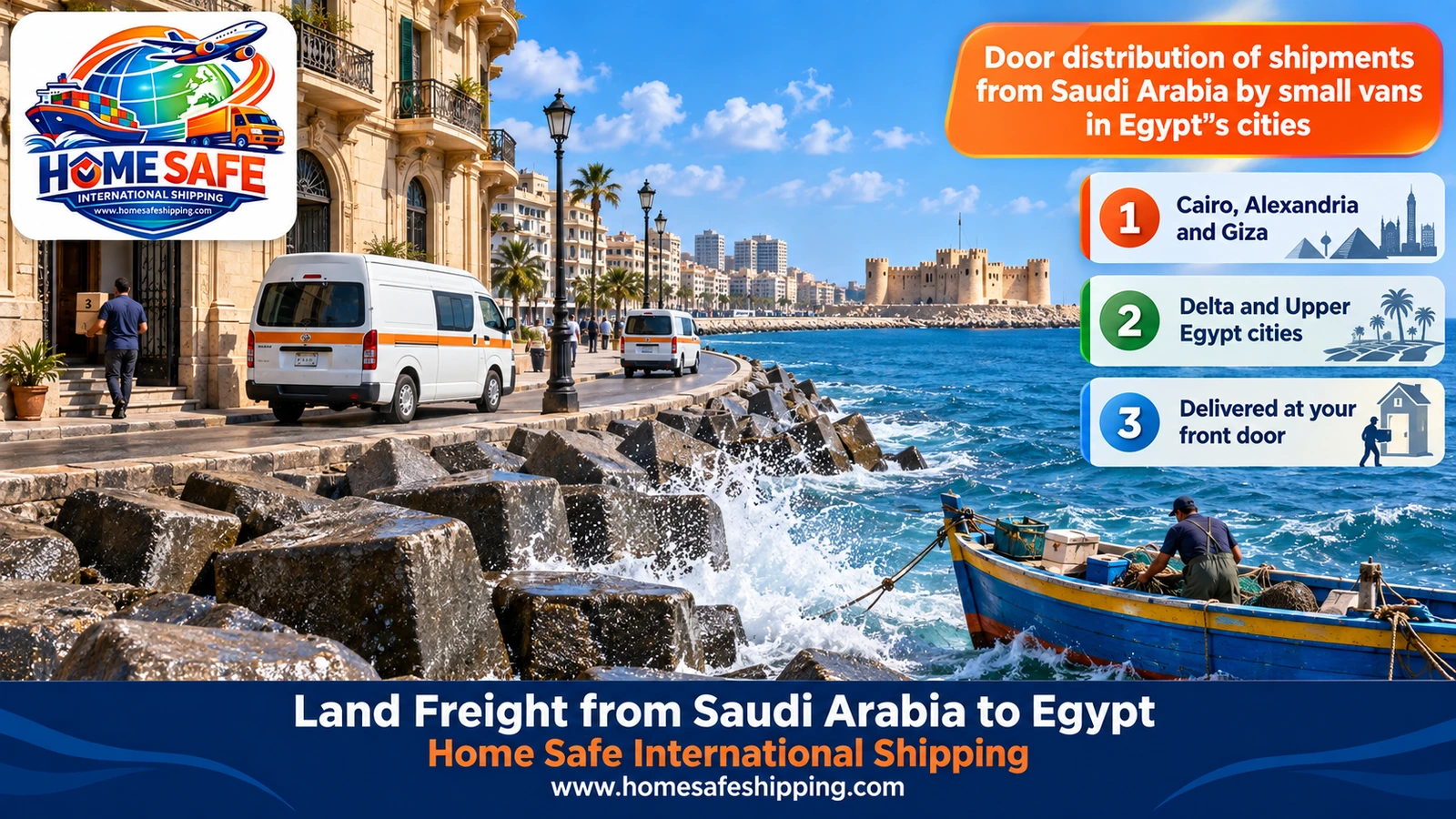
A trailer does not enter the residential streets of Egyptian cities, and many addresses lie in narrow lanes. So the final delivery is made by small vans that leave the warehouse with the load of one city or one run. The courier calls before he arrives, hands over at the door of the home, and the consignee signs after counting the pieces.
| Region | Main cities | After reaching the warehouse |
|---|---|---|
| Greater Cairo | Cairo, Giza, Shubra El-Kheima, 6th of October and Obour | One to two days |
| Alexandria and the coast | Alexandria, Damanhour and Kafr El-Dawwar | 2–3 days |
| The Delta | Tanta, Mansoura, Zagazig, Shibin El-Kom, Kafr El-Sheikh and Damietta | 2–3 days |
| Canal cities | Suez, Ismailia and Port Said | 2–3 days |
| Northern Upper Egypt | Fayoum, Beni Suef and Minya | 2–4 days |
| Upper Egypt | Assiut, Sohag, Qena, Luxor and Aswan | 3–5 days |
Write the address in full: governorate, district or neighbourhood, street and the nearest well-known landmark, together with an Egyptian mobile number that someone answers. Delivery is to the door of the building; carrying items to upper floors and assembling them is agreed before shipping. Destination details are on the shipping to Egypt page, and the full service on door-to-door shipping.
Land, sea or air: which method should you choose?
Choosing the method starts with two questions: how big is your shipment, and how long can you wait? The truck and ferry sit between the two extremes, quicker than a container and far cheaper than a plane. A sea container from Jeddah Islamic Port to Sokhna, Alexandria or Port Said, depending on the line, remains the choice for heavy cargo and large quantities:
| Point of comparison | Land by ferry | Sea by container | Air |
|---|---|---|---|
| Time to the door | 7–15 days | 12–20 days | 3–6 days |
| Charging unit | Carton, volume or tonne | Container or cubic metre | Chargeable kilogram |
| Handling | One loading and one unloading | Loading, lifting, stowing and unstuffing | Weighing, security screening and aircraft loading |
| Smallest shipment | One carton | One cubic metre or more | A document envelope |
| Best for | Furniture, appliances and luggage | Heavy commercial goods | The urgent and the light |
The full picture of the three methods is in the main article shipping from Saudi Arabia to Egypt, and containers are explained on the sea freight page.
Air freight to Egypt: when to keep it for the urgent
A plane brings a parcel to Cairo Airport, or to Borg El Arab Airport near Alexandria, within 3 to 6 days to the door. But it charges by the chargeable kilogram, so it suits neither a bedroom nor a fridge. Use it for what cannot wait two weeks: official papers, personal medicine, a spare part, or a suitcase of clothes travelling ahead of its owner.
- Documents: an envelope starts from SAR 55.
- Parcels: the per-kilogram rate is set on request according to weight and size.
- Chargeable weight: the airline bills whichever is higher, the scale reading or the size-based figure; our volumetric weight calculator shows you which applies.
- What does not fly: loose batteries, perfume in quantity and pressurised sprays.
Many people combine the two: an urgent suitcase by air and the rest of the home by truck. Service details are on the air freight page.
Packing for a long road and a ferry
A land shipment to Egypt covers more than a thousand kilometres of road, hours on a ferry deck that moves with the swell, and then inland roads in Egypt. What protects it is not the word “fragile” on the carton but the way it is packed:
- Double-wall cartons: a thin carton collapses under what is stacked on it in a full trailer.
- No empty space inside: a gap lets the contents shift at every bump, so fill it with paper or clothes.
- Glass and china: each piece wrapped on its own and placed upright, not flat.
- Marble and mirrors: between two wooden boards, and loaded standing on edge.
- Protection from damp: plastic film around mattresses and sofas, because sea air is humid.
- Numbering: a number, a name and a governorate on two faces of every piece, clearly written.
- Heavy at the bottom: books and pans in small cartons, light things in the large ones.
How to pack each category is in the packing guide.
Insurance, tracking and follow-up
Every shipment has a collection receipt with the number of pieces and their numbers, which is your reference from the first day to the delivery signature. We update you at each key stage: the truck setting off, reaching the port, sailing, clearance being completed, arrival at the warehouse and the delivery van going out. The shipment’s status is also available on the shipment tracking page.
Insurance is optional and is calculated as a percentage of the value you declare. It covers loss and damage on the road and the ferry under the policy terms; it does not cover poor packing done by the owner or anything not entered on the list. Alongside it stands the Home Safe guarantee that furniture we pack and move ourselves arrives free of breakage and scratches. Booking and cancellation terms are stated in the booking confirmation. Details are on the cargo insurance page.
Steps of land freight from Saudi Arabia to Egypt
- Preparation: take stock of what you want to ship, and set aside prohibited items and anything not worth its freight.
- Asking for a price: send the list or photos, your city and the governorate of delivery to 0552803439.
- Confirming the booking: you agree the price, what it covers and the collection day.
- Collection: the crew comes to dismantle, pack, number and measure in front of you.
- Inventory list: you check and sign it, and keep a copy with the collection receipt.
- Consolidation and loading: your shipment joins the truck, which heads for Duba and then the ferry.
- Clearance: at Safaga or Nuweiba, and we tell you what duties were assessed.
- Delivery: from the warehouse to the door, where the consignee counts the pieces and signs.
Land freight from Egypt to Saudi Arabia
The line works in both directions. A truck coming from Egypt sails from Safaga or Nuweiba and lands at Duba or Aqaba, is cleared at the Saudi entry point, and continues to your city. Someone coming to work in the Kingdom brings in used belongings with a contents list and a valid residence permit or work visa.
Egyptian commercial goods entering the Kingdom need an invoice and a certificate of origin, plus conformity certificates for the products subject to them. Food and agricultural products carry additional requirements from the competent Saudi authorities. We confirm the current requirement before loading in Egypt.
Recommendations for a safe arrival
- Photograph furniture and appliances before packing, and keep the photos until delivery.
- Give the consignee in Egypt a copy of the inventory list to count against.
- Do not seal a carton before its contents are written on the list.
- Choose a consignee who will really be at the address on the expected arrival days.
- If you are returning for good, arrange to arrive before your shipment or with it.
- Keep the invoices of recent appliances with you, as they may be requested at assessment.
How do you choose a land freight company to Egypt?
Prices look close on the surface; the difference lies in what the price covers and in who receives your shipment on the Egyptian side. Put these questions to whoever you call, and compare the answer with the table:
| Question | A reassuring answer | An answer that calls for caution |
|---|---|---|
| How does the shipment cross the sea? | Names both ports and explains the ferry | “Direct by land” with no mention of the sea |
| Where does the price end? | At the door, with clearance itemised | “You collect from the port” |
| What about Egyptian customs? | Asks for your list, then estimates | “No customs” before seeing the list |
| How long does it take? | A range in days with the causes of delay | “Three days and it is with you” |
| Who delivers in Egypt? | A warehouse, a courier and a follow-up number | Only a driver’s name |
| Is the business registered? | Commercial registration and a stamped receipt | A mobile number and a transfer to a personal account |
Common mistakes in land freight to Egypt
- Comparing two prices, one to the port and one to the door, as if they were alike.
- Hiding an appliance or a phone among clothes, which holds up the whole shared truck.
- Giving a Saudi mobile number for the consignee, so the delivery courier cannot reach him.
- Shipping several identical new appliances as personal effects.
- Using thin grocery cartons for a journey of more than a thousand kilometres.
- Booking in Eid week, when the queue at the ferry is longest.
- Shipping a wardrobe standing and undismantled, and paying freight on its empty space.
Why Home Safe for land freight to Egypt?
A registered establishment
Home Safe Logistics Services Establishment, commercial registration 4030601060.
Stages stated openly
We tell you the port, the line and the time as they are, and update you at every stage.
The list is reviewed first
We read your list before loading and say what to expect at Egyptian customs.
To the door
Collection from your city, and distribution from the warehouse to your governorate.
To book: 0552803439 by call or WhatsApp, from 7 am to 11 pm. Or use the request a quote page.
Related articles and pages
- Shipping from Saudi Arabia to Egypt
- Furniture shipping prices from Saudi Arabia to Egypt
- Riyadh to Egypt shipping company
- Jeddah to Egypt shipping company
- Land freight company in Saudi Arabia
- Land freight
Tags
land freight from Saudi Arabia to Egypt, land shipping from Saudi Arabia to Egypt, land freight to Egypt, land freight prices to Egypt, land freight transit time from Saudi Arabia to Egypt, truck and ferry shipping to Egypt, Duba Safaga ferry, port of Nuweiba, shared load to Egypt, dedicated truck to Egypt, furniture shipping by land to Egypt, shipping electrical appliances to Egypt, shipping cartons to Egypt, customs clearance at Safaga, shipping from Egypt to Saudi Arabia, Home Safe International Shipping
Frequently asked questions about land freight from Saudi Arabia to Egypt
How does land freight from Saudi Arabia to Egypt work when the sea lies between them?
There is no continuous road between the two countries, so the truck crosses the Red Sea on a ferry. Shipments are loaded into a closed truck that drives to the port of Duba, rolls onto the ferry with its load untouched, and rolls off at Safaga or Nuweiba. There it is inspected and cleared, then continues to the warehouse in Egypt, from where the shipments go out to their addresses.
How long does land freight from Saudi Arabia to Egypt take?
Door to door, 7 to 15 days. From Tabuk and Yanbu 6 to 10 days, from Jeddah, Makkah and Madinah 7 to 12 days, from Riyadh and Qassim 9 to 14 days, and from Dammam and Abha 10 to 15 days. The figure includes filling the truck, the ferry sailing, clearance and distribution inside Egypt.
How much does land freight from Saudi Arabia to Egypt cost?
A medium carton starts from SAR 140, a large one from SAR 185 and a jumbo from SAR 230. An electrical appliance starts from SAR 92 per piece, a complete bedroom from SAR 1,650, the furniture of a three-room flat from SAR 4,150, and commercial goods from SAR 2,580 per tonne. The final figure follows measurement and the governorate of delivery. Message us on 0552803439.
Which port does the truck leave from, and where does it land?
The usual departure is the port of Duba in the Tabuk region, and the landing is the port of Safaga on Egypt’s Red Sea coast. There are alternatives depending on the sailing available: from Aqaba in Jordan to Nuweiba in Sinai, or from Jeddah when a suitable sailing exists. We tell you which line your shipment will take when the booking is confirmed.
Is my shipment unloaded at the port before the ferry?
No. The truck boards the ferry closed, exactly as it was loaded at the depot, and leaves it the same way. Cartons and furniture are not moved from one vehicle to another at Duba, nor stacked in a ship’s hold. The first full unloading happens at the warehouse inside Egypt once clearance is finished.
Where is the shipment cleared through customs in Egypt?
At the arrival port itself, Safaga or Nuweiba, while the cargo is still on its truck. The clearing agent goes through the papers and inventory lists with the customs officer, and a sample of the cartons, or more, is opened as the officer sees fit. Once the assessed duties are paid, the truck leaves for the warehouse.
Will I pay Egyptian customs on my used belongings?
That is assessed at inspection according to the type, condition and quantity of the items. Used clothes and kitchenware are the easiest category, electrical and electronic appliances are examined most closely, and a new item in its box is treated differently from a used one. Egyptian rules change, so we go through your list before loading and tell you what to expect.
What is the difference between a shared load and a dedicated truck to Egypt?
In a shared load you share one truck with others and pay only for the volume of your shipment, waiting a few days for the load to fill. With a dedicated truck you book the whole vehicle, so it sets off on the day you choose and is cleared as a single file. Shared suits cartons, a room and appliances; dedicated suits a whole home or goods that fill a truck.
Do you deliver to the door in every governorate?
Yes. Small vans leave the warehouse for Cairo, Giza, Qalyubia and Alexandria, for the towns of the Delta, the Canal and Fayoum, and for Upper Egypt as far as Aswan. The courier calls the consignee on an Egyptian number before arriving. Delivery is to the door of the building, and carrying items to upper floors is agreed in advance.
Which documents are needed for land freight to Egypt?
From the sender, a copy of the residence permit or ID and passport, and a detailed contents list for every carton and item. For the consignee, the name as it appears on the national ID card, the address and an Egyptian mobile number. Someone returning for good adds the final exit visa. Commercial goods need an invoice, packing list, certificate of origin and the importer’s details.
Can I put a new mobile phone or gold inside the cartons?
No. A phone arriving from abroad is subject to a registration and fee system in Egypt, and finding one in an unaccompanied shipment holds up the whole carton. Gold, cash and official papers travel by hand with their owner and never go into a land shipment. Ask us about any item you are unsure of before you seal the carton.
Is land freight better than sea or air to Egypt?
For furniture, appliances and cartons, yes: it is quicker than a container, involves less handling, and is charged by volume rather than by the kilogram. A sea container suits heavy commercial cargo and large quantities. Air suits a document or a light urgent parcel and arrives in 3 to 6 days.
Do you ship cars to Egypt by land?
A Saudi car normally enters Egypt on temporary admission with its owner under a carnet, crossing on the same ferry. Bringing it in permanently to be licensed with Egyptian plates is restricted by conditions that keep changing, and we do not promise it before reviewing your case. Call us with the make of the car, its year of manufacture and the purpose of entry.
How do I follow my shipment while it is on the way?
At collection you receive a shipment number and a receipt stating the number of pieces. We update you at the key stages: the truck leaving the city, reaching Duba, the ferry sailing, clearance being completed, arrival at the warehouse and the delivery van going out. You can also ask at any time on 0552803439 between 7 am and 11 pm.
When should I book to avoid delays?
Book at least two weeks ahead in the busy seasons: the end of the school year and the summer holiday, and the weeks before Ramadan and the two Eids. In those periods many Egyptian residents go home at once, so trucks fill up and the wait at the ferry and at clearance grows. Outside the season a week is enough.
That is the guide — now let us price your shipment
Choose what applies to you and receive a reply with the price, the method and the time.
RoRo, container or sling lift — we recommend what suits your vehicle’s value and its destination.
Get a vehicle priceA full or shared container, or urgent air freight, with packing and clearance.
Get a shipment priceRoutes in the same section
Options related to the same type of service.