Shipping Company from Riyadh to Ivory Coast 0552803439 | Car Shipping, Building Materials and Equipment to Abidjan

Ship building materials, equipment, goods, cars and baggage from Riyadh to Abidjan, Yamoussoukro, Bouaké and San-Pédro. The container goes by truck to Jeddah port and then by sea to the port of Abidjan in 36–50 days door to door, and air freight from King Khalid Airport takes 4–7 days. A saloon car …
Home Safe is a shipping company from Riyadh to Ivory Coast that moves building materials, equipment, commercial goods, cars and baggage in two ways: by sea in containers to the port of Abidjan after trucking them to Jeddah Islamic Port, and by air from King Khalid Airport to Abidjan airport. The two cities are about 5,800 km apart in a straight line, and a container reaches the consignee’s warehouse in 36 to 50 days. A saloon car by sea starts from SAR 2,800 from Jeddah port, an air kilogram from SAR 28, and a small parcel from SAR 110. To book: 0552803439.
In this guide45ShowHide
- Who ships from Riyadh to Ivory Coast, and what do they ship?
- The shipping route from Riyadh to Ivory Coast and its duration
- From Riyadh to the port, then Abidjan in Ivory Coast
- Shipping prices from Riyadh to Ivory Coast
- What is distinctive about shipping from Riyadh?
- Shipping building materials and equipment from Riyadh to Ivory Coast
- A full container or a part load?
- Shipping commercial goods and spare parts
- Car shipping from Riyadh to Abidjan
- From the auction yard to the quay: moving the car inside the Kingdom
- How does a dealer buy at Riyadh auctions for the Abidjan market?
- Personal baggage, parcels and the community’s belongings
- Ivorian customs and the documents required
- The Ivorian compliance file: the tracking note and the certificate of conformity
- What cannot be shipped to Ivory Coast or needs a permit
- Delivery of shipments from Riyadh in Abidjan, Yamoussoukro and Bouaké
- Transit from Abidjan to Mali and Burkina Faso
- Services for individuals, traders and companies
- Air freight from Riyadh to Ivory Coast
- Collection from Riyadh’s districts and nearby towns
- Steps for shipping from Riyadh to Ivory Coast
- Tracking and insurance
- Reverse shipping from Ivory Coast to Riyadh
- Tips before shipping to Ivory Coast
- How do you choose a shipping company from Riyadh to Ivory Coast?
- Common mistakes when shipping from Riyadh to Ivory Coast
- Why Home Safe for shipping from Riyadh to Ivory Coast?
- Related articles and pages
- Tags
- Frequently asked questions about shipping from Riyadh to Ivory Coast
- How much does shipping from Riyadh to Ivory Coast cost?
- How many days does a shipment need from Riyadh to Abidjan?
- Riyadh has no port, so where does the container sail from?
- Does the vessel go from Jeddah to Abidjan directly?
- What is the maximum age of a car I buy at a Riyadh auction to ship to Ivory Coast?
- Do you collect the car from the auction yard or the showroom?
- What is the cargo tracking note that Ivory Coast requires?
- Do building materials need a certificate of conformity?
- How are long aluminium profiles and cable drums shipped?
- Do you deliver to Yamoussoukro and Bouaké, or does delivery end in Abidjan?
- Do you ship through Abidjan to Mali and Burkina Faso?
- How much is an air kilogram from Riyadh to Abidjan?
- Is the furniture of someone returning to Ivory Coast exempt from duties?
- Does Saudi electrical equipment work in Ivory Coast?
- Do you collect from Al-Kharj, Al-Muzahimiyah and the Sudair factories?
Sea route: Riyadh → Jeddah port → Suez Canal → Mediterranean → Gibraltar → Atlantic → Abidjan · Time: 36–50 days by sea, and 4–7 days by air.
In brief
- Methods: sea for containers, cars and equipment, and air for spare parts, parcels and documents.
- Point of exit: Jeddah Islamic Port after a road leg from Riyadh, and King Khalid Airport for air.
- Port of arrival: Abidjan, and San-Pédro for the west of the country.
- Time: 36–50 days for a full container door to door, and 4–7 days by air.
- Starting prices: a saloon car on the sea leg SAR 2,800, each kilogram flown SAR 28, a small parcel SAR 110, a document envelope SAR 83.
- Checked before shipping: the age of the car, the cargo tracking note, and the certificate of conformity for covered items.
- Booking: 0552803439 by call or WhatsApp.
Who ships from Riyadh to Ivory Coast, and what do they ship?
Ivory Coast is the largest of the French-speaking markets of West Africa, with extensive construction activity in Abidjan and the inland cities. Riyadh answers it with what that activity needs: tile, aluminium, cable and pipe factories in its industrial cities, wholesale markets for spare parts, and car auctions. That is why this route is mainly commercial, alongside personal shipments from the Ivorian community and students. These are the groups we serve most:
| Shipper | What they ship | Best method |
|---|---|---|
| The factory and supplier in the industrial cities | Tiles and ceramics, aluminium profiles, cables and pipes | A full 20ft or 40ft container |
| The contractor and project company | Generators, pumps, workshop equipment and scaffolding | A standard, open-top or flat-rack container |
| The spare parts and tyre trader | Car parts and equipment from the wholesale markets | A part load, and air for urgent items |
| The car dealer and auction buyer | Recent cars and light trucks | RoRo, or a container for two cars |
| The Ivorian resident and the returning student | Baggage, appliances, books and gifts | Cartons in a shared container, or air |
| The importer in Mali and Burkina Faso | Transit cargo through Abidjan | A container under a transit document |
The shipping route from Riyadh to Ivory Coast and its duration
The journey begins on land and ends on land, with the sea in between. The container leaves Riyadh for the west coast, then sails north up the Red Sea and through the Suez Canal, crosses the whole Mediterranean to Gibraltar, and then runs south along the West African coast to the Gulf of Guinea. These are its stages for a full container leaving Riyadh:
| Stage | What happens | Usual time |
|---|---|---|
| Loading in Riyadh | Stowing and securing the goods and sealing the container | One to two days |
| The road to Jeddah port | About 950 km by truck via Taif | One to two days |
| Export and waiting for the vessel | The export declaration and handing the container to the shipping line | 3–6 days |
| Sailing | Suez, then the Mediterranean, then the Atlantic, usually with a transhipment port | 25–35 days |
| Clearance in Abidjan | The customs declaration and the review of the tracking note and conformity | 3–7 working days |
| Delivery inside Ivory Coast | From the port to the warehouse or the project site | One to 3 days |
The time changes with what you ship. A small consignment waits for its companions in a shared container, a car follows the RoRo sailing schedule, and an urgent spare part travels by aircraft. The table below brings together the four methods from Riyadh:
| Method | Route | Time from Riyadh | Suits |
|---|---|---|---|
| Full container | Riyadh → Jeddah → Abidjan | 36–50 days | Building materials and bulk goods |
| Sea part load | A shared container consolidated in Jeddah | 41–52 days | Under 15 cubic metres |
| RoRo for cars | A transporter to Jeddah, then a RoRo vessel | 36–50 days | A running car or truck |
| Air | King Khalid Airport → a transit airport → Abidjan | 4–7 days | Spare parts, parcels and documents |
What lengthens the time?
- The connecting vessel: if the container misses its second vessel at the transhipment port it waits for the next one, which can add a week.
- A change of route: some lines occasionally send their vessels round the Cape of Good Hope instead of Suez, which changes the sailing days. We confirm the route of your voyage on the booking day.
- A missing tracking note: Ivorian customs does not open the container’s file before seeing its number.
- A certificate of conformity not yet issued: a covered item that arrives without a certificate is held until its position is settled.
- The cocoa season: in the last months of the year the quays of Abidjan are crowded with exports of the crop.
There is no practical land route between the Kingdom and West Africa, so we do not offer that service. Times for the other destinations are on the transit times page.
From Riyadh to the port, then Abidjan in Ivory Coast
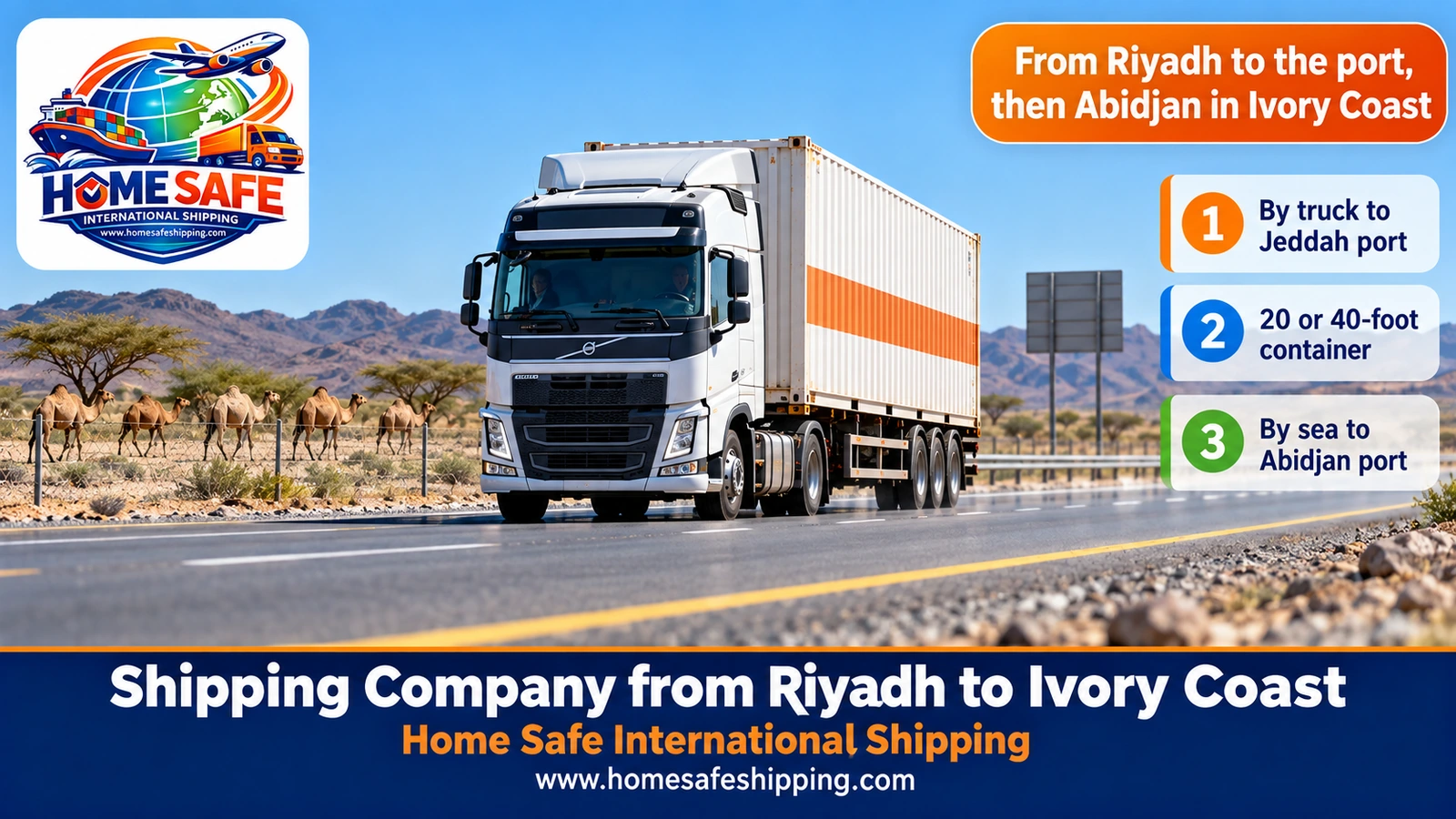
The capital is hundreds of kilometres from the nearest sea, so the first decision in every shipment is: which coast does the container head for? Dammam is nearer to Riyadh, and Jeddah is more than twice as far. But the destination here is West Africa, and the way to it passes through the Suez Canal. A Jeddah vessel starts its voyage in the Red Sea itself, whereas a Dammam vessel leaves through the Strait of Hormuz and rounds Oman and Yemen before reaching the point where the Jeddah vessel began.
That is why our Abidjan containers leave by truck for Jeddah Islamic Port. The container is loaded at your factory or warehouse and closed with a numbered seal whose number is written in the bill of lading, then it mostly travels overnight and reaches the port the next day. The alternative exists for those it suits: the container train from the dry port south of Riyadh to King Abdulaziz Port in Dammam, with the export declaration completed inside Riyadh.
| Comparison | Truck to Jeddah port | Train from the dry port to Dammam |
|---|---|---|
| Distance from Riyadh | About 950 km | About 550 km on the freight line |
| The vessel’s way to Abidjan | North to Suez directly | Round the Arabian Peninsula first |
| Where the export declaration is made | Jeddah port | Riyadh Dry Port |
| Heavy cargo | Axle-weight limits on the road are observed | The railway takes heavy containers easily |
| When we choose it | For most West Africa shipments | When the shipping line has a suitable sailing from Dammam |
In Abidjan the vessel enters through the Vridi Canal into the lagoon on which the port stands, with two container terminals and quays for cars and general cargo. We book the container’s place on the vessel before the truck leaves Riyadh, so that it does not sit overnight in the port yard and run up storage. The service is explained on the sea freight page, and how Jeddah port works in the article International sea freight from Jeddah.
Shipping prices from Riyadh to Ivory Coast
The invoice for this route has four items: the road leg from Riyadh to Jeddah, the sea or air freight, the fees for Ivorian documents such as the tracking note, and then clearance and delivery in Ivory Coast. Some are fixed and we state them now, and some change with the sailing date and the size of the cargo and are worked out on the day of the request. These are the figures our services start from:
| What you ship | Method | Price starts from |
|---|---|---|
| A saloon car | By sea from Jeddah port to Abidjan | SAR 2,800 |
| Spare parts and urgent goods | Air from King Khalid Airport | SAR 28 per kilogram |
| A parcel up to 5 kg | Express | SAR 110 |
| Documents up to one kilogram | Express | SAR 83 |
| A full 20ft or 40ft container | By sea from Jeddah port | Set on request according to the sailing date |
| A part load | Per cubic metre in a shared container | Set on request |
| An open-top or flat-rack container | For equipment and long pieces | Set on request |
| Transport from Riyadh to Jeddah port | A container truck or a car transporter | Set on request |
An example of the air calculation: a workshop in Abidjan is waiting for a hydraulic pump with a chargeable weight of 40 kg. Its freight is 40 × 28, that is from SAR 1,120, and it arrives in a week instead of six weeks.
Market prices for this route are seldom published, and most companies settle for the phrase “call for the price”. What we found published concerns shipping from Gulf ports to Abidjan: between USD 1,300 and 2,000 for a car on RoRo vessels, and between USD 2,200 and 3,800 or more for a car inside a container, with a stated time of 30 to 45 days. These are port-to-port figures that include neither arrival charges nor inland transport, so always compare item by item.
| What sets the price | Its effect on a Riyadh shipment |
|---|---|
| Weight before volume | Tiles and cables use up the container’s payload by weight before they fill it by volume |
| The inland road | 950 km to Jeddah is a separate item, and your share of it falls on scheduled runs |
| The container type | A standard container is cheaper than an open-top or a flat-rack |
| The size of the car | RoRo freight is charged on dimensions, so a 4×4 costs more than a saloon |
| The Ivorian documents | The tracking note and the certificate of conformity carry fees according to the type of shipment |
| The final destination | Abidjan, an inland city, or transit to a neighbouring country |
How do you cut the cost?
- Work out the weight of the tiles before ordering: a 20ft container is enough for a heavy load and its freight is lower than a 40ft.
- Gather your purchases from more than one supplier at our Riyadh warehouse and ship them in one container instead of scattered consignments.
- Finish the conformity inspection at the factory before loading; dealing with its absence in Abidjan costs more and takes longer.
- Put two cars in a 40ft container if you are a dealer, so they share the sea and road freight.
- Send the documents to the clearing agent a week before the vessel arrives, since port storage is charged by the day.
Each factor is explained on the pricing factors page, and the figures for the other cities are in the article Shipping company from Saudi Arabia to Ivory Coast.
What is distinctive about shipping from Riyadh?
A Riyadh shipment to Africa differs from one leaving a coastal city in two respects: the sea is far, so the road leg enters the cost and the timetable, and the source of the goods is near, so they can be loaded straight from the factory gate.
- Loading at the factory: the empty container arrives at the Second Industrial City, Al-Sulay or Sudair and is filled on the dock by forklift.
- Truck hours: entry of large trucks into Riyadh’s districts and main roads is restricted to hours set by the traffic department, so we time loading around them and confirm those in force before the day.
- Consolidation: for a buyer who purchases from the wholesale markets and from two or three factories, we gather the purchases at our warehouse and then stow them in one container.
- Weight on the road: a container loaded with tiles is weighed before it leaves, because exceeding the axle weight stops the truck at the weighbridge.
- Summer heat: paints, adhesives and rubber are loaded in the evening and do not spend the night in a closed container under the sun.
Shipping building materials and equipment from Riyadh to Ivory Coast
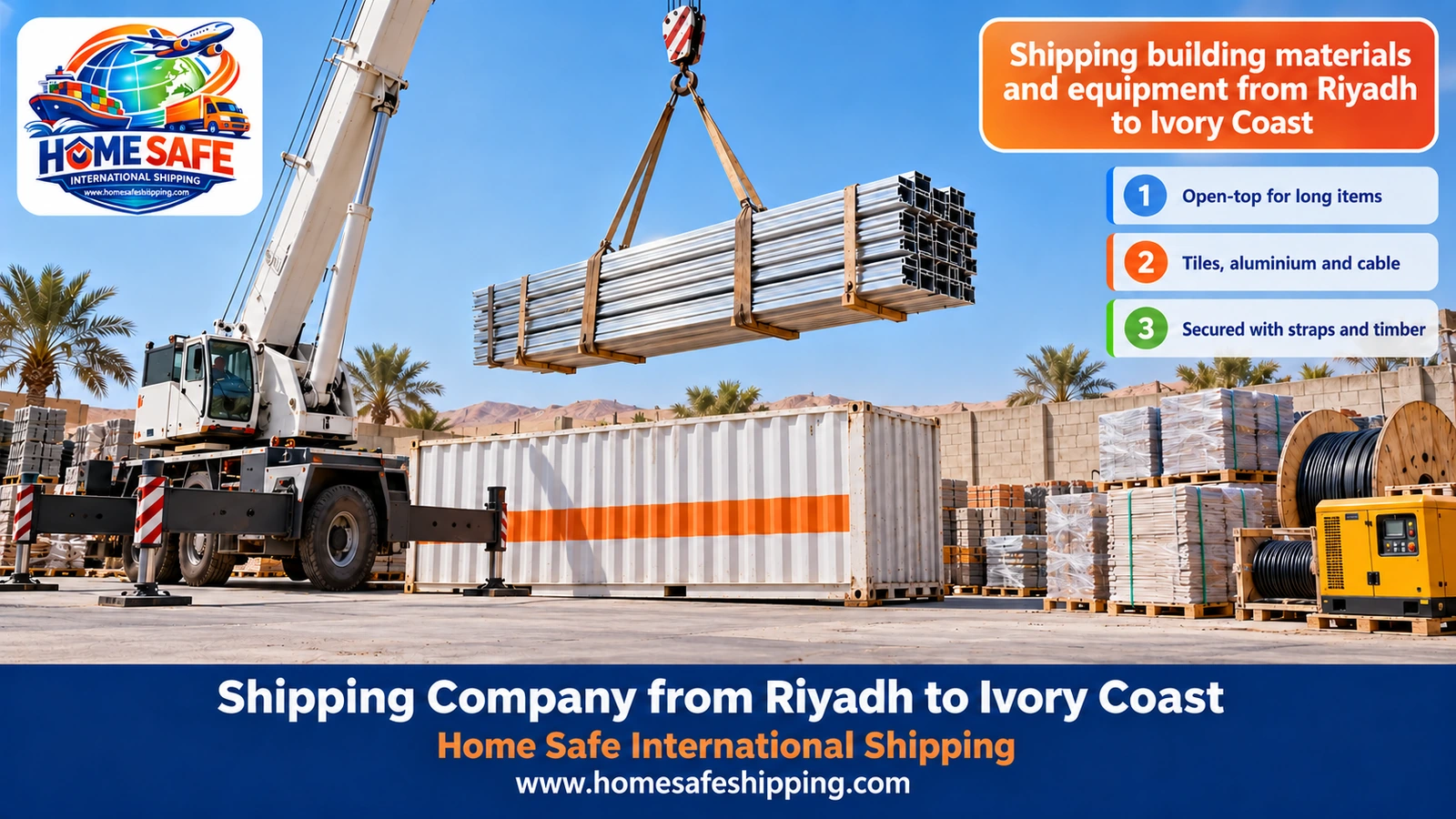
These are the largest shipments on the route by volume and weight. The contractor in Abidjan orders tiles, ceramics and sanitaryware, aluminium profiles for façades and windows, power cables on drums, plastic pipes and insulation. Each item has its own way of stowing, because the container is lifted and set down several times between Riyadh and Abidjan and heels with the vessel for weeks.
| Item | Suitable container | Securing method |
|---|---|---|
| Tiles, ceramics and marble | A standard 20ft, because the weight is reached before the volume | Wrapped and strapped pallets, and timber bracing that closes the gap between them and the door |
| Long aluminium and steel profiles | A 40ft, or an open-top for bundles lowered by crane | Bundles on timber bearers, and lashing straps to the floor rings |
| Cable drums | Standard or open-top depending on the drum diameter | Timber wedges under each drum and straps that stop it rolling |
| Pipes and insulation | A 40ft high-cube, because the volume is reached before the weight | Nested stowage and a net that prevents sliding when the door is opened |
| Generators, pumps and compressors | Standard, or a flat-rack for what exceeds its dimensions | A treated timber base and chains or straps from the lifting points |
The open-top container solves the problem of pieces that will not go through the door: the bundle is lifted by crane and lowered from above, then the roof is covered with a taut tarpaulin. A standard aluminium profile six metres long is slightly longer than the inside of a 20ft container, so its place is a 40ft container. All the timber we use for bearers, wedges and bases is heat-treated and stamped ISPM 15, because untreated wood is rejected at the port of arrival.
For equipment we ask, before pricing, for its weight, dimensions and lifting points, and we drain oils and fuel before loading. Abidjan’s climate is tropical and humid, so we place moisture-absorbing bags in the container and wrap electrical panels separately. Details of the special containers are on the heavy equipment shipping page, and lashing methods on the packing and lashing page.
A full container or a part load?
The question is settled by volume and weight together. Whoever fills half a container or more takes it whole, so it is sealed in Riyadh and opened only in Abidjan. Whoever has a handful of pallets pays only for their volume in a shared container consolidated in Jeddah.
| Comparison | Full container | Part load |
|---|---|---|
| You pay for | The whole container | The cubic metres you occupy |
| Time from Riyadh | 36–50 days | 41–52 days |
| Handling | One seal from the factory to the consignee | Consolidation in Jeddah and sorting in Abidjan |
| Best for | Building materials, equipment and two cars | Spare parts, cartons and anything under 15 cubic metres |
| Price | Set on request according to the sailing date | Set on request per cubic metre |
A 20ft container holds about 28 cubic metres and a 40ft about twice that, while a high-cube adds height, not payload. Estimate the volume of your goods with the CBM calculator, and check the internal dimensions on the container sizes page.
Shipping commercial goods and spare parts
The Ivorian trader who buys in Riyadh usually gathers items from more than one source: Japanese and Korean spare parts and tyres from the wholesale markets, household appliances, plastic products, and dates and packaged foods. Abidjan customs is well organised, works in French and asks for complete papers. So we prepare the shipment file while we are gathering the goods, not after they have sailed.
- The invoice and packing list: in French or accompanied by a translation, with the tariff code, weight and quantity of each item.
- The certificate of origin: issued electronically for a Saudi product and attached to the clearance file.
- Spare parts: sorted by type in numbered cartons, because the blanket description “car parts” opens the door to an arbitrary valuation.
- Foods and dates: a label in French, a clear expiry date and a health certificate.
- Electrical appliances: many are covered by the conformity programme, and the mains frequency in Ivory Coast is 50 hertz.
A regular supplier gets a fixed monthly schedule, one account manager and a volume rate. The service for companies is explained on the commercial shipping page.
Car shipping from Riyadh to Abidjan
Before any talk of the vessel and the price comes one question that settles the deal: how old is the car on the day it berths in Abidjan? Ivory Coast limits the age of imported used vehicles, and a car over the limit is not cleared whatever its condition. These are the limits in force, and we confirm the current one for each vehicle before it is bought:
| Vehicle | Maximum age on arrival |
|---|---|
| Private car and taxi | 5 years |
| Minibuses and light trucks | 7 years |
| Heavy trucks and large buses | 10 years |
Once that condition is met comes the method of shipping. On RoRo vessels the car is driven into the hold, lashed by its wheels and travels completely empty, and the price for a saloon starts from SAR 2,800 from Jeddah port. In a container it is secured with straps on all four wheels and timber chocks and the battery terminal is disconnected; this is the choice for whoever ships two cars together or a car with spare parts. The steering wheel in Ivory Coast is on the left as in the Kingdom, so the car is registered there without modification.
- Saudi export: fines are paid, the plates are surrendered and the export certificate is issued by the traffic department; we complete this with you or under an authorisation.
- An empty cabin: nothing is left in the car except its original equipment, with fuel at the minimum.
- Accompanying spare parts: their place is the container floor outside the car, and they are written in the documents with their descriptions.
- Ivorian charges: customs duty, 18% value added tax and other fees on a value assessed by customs, and we give you an estimate before you buy.
RoRo and container are set side by side on our RoRo car shipping and container car shipping pages; for the rules that apply to every car leaving the Kingdom, read Car shipping from Saudi Arabia.
From the auction yard to the quay: moving the car inside the Kingdom
A car chosen with care to meet Abidjan’s conditions should not be damaged in the easiest stage of the journey. So it is not driven from Riyadh to Jeddah; it is carried on a car transporter and lashed by its chassis or wheels. Its condition is recorded twice: on collection in Riyadh, and on handover to the port.
- Collection: from the auction yard, the showroom or the home, with a copy of the sale contract and the owner’s authorisation.
- The first record: photographs of the four sides, the cabin, the odometer and the chassis number, compared with the auction report.
- The road: scheduled runs to Jeddah that reach it in one to two days.
- The second record: photographs before entering the port, so you hold a record of the condition from Riyadh to Abidjan.
How does a dealer buy at Riyadh auctions for the Abidjan market?
Dealers who work this route regularly do not enter the auction hall without a list. Beforehand they fix the models and years of manufacture that pass the age limit with a comfortable margin, and they work out the cost of the unit landed in Abidjan, not the hammer price alone. We share that calculation with them before the purchase at three points:
- Before the auction: you send the model and year of manufacture, and we check the age limit and give you the freight and a first estimate of the charges.
- When the hammer falls: we collect from the yard the same day or the next and begin the export formalities.
- In the file: the chassis number, year of manufacture and specifications are written as they are on the car, and the value as in the purchase contract.
An example that recurs: two cars side by side at the auction, the first cheaper and four years and ten months old, the second slightly dearer and three years old. The first will pass five years while at sea and be refused on arrival, and the second gets through and sells for more because it is newer. Asking before bidding is what protects the capital.
Personal baggage, parcels and the community’s belongings
Not everything that leaves Riyadh is merchandise. The Ivorian resident who has finished work goes home with household furniture and appliances, the student sends books and clothes, and many send gifts to their families in the festive seasons. These shipments are mostly small, so they travel as cartons in a shared container or by air per kilogram.
- Returning for good: the practice in force is to present the change of residence certificate from the embassy or consulate of one’s country, the passport, and a contents list in French with the value of each item.
- Appliances: a used one is listed with its condition, and a new one comes with its invoice.
- Cartons: five-ply and numbered, each marked with the consignee’s name and Ivorian mobile number.
- An air parcel: from SAR 110 up to 5 kg, and from SAR 28 per kilogram above that.
- What stays with the traveller: cash, gold, original certificates and the passport.
How to prepare the cartons is in the packing guide, and the parcel service is on the parcel shipping page.
Ivorian customs and the documents required
Ivory Coast is a member of the West African Economic and Monetary Union and of the Economic Community of West African States, so it applies the Community’s common external tariff, a set of bands graded by the type of good, together with 18% value added tax and small additional levies. Our part is for the file to arrive from Riyadh complete and matching the goods:
| Type of shipment | Documents | Note |
|---|---|---|
| Building materials and commercial goods | Invoice and packing list in French, origin certificate, bill of lading, the cargo tracking note, plus the conformity certificate for covered lines | The importer opens the advance import declaration on their side |
| Equipment and machinery | The above, with the equipment’s data plate and serial number | Used equipment is stated as used, with its year of manufacture |
| A car | Registration, export certificate, purchase contract, bill of lading and tracking note | The year of manufacture shown in the documents |
| A returnee’s effects | Passport, change of residence certificate, and a contents list in French | Invoices for new appliances |
| A transit shipment | The commercial goods file, with the final country and city in the bill of lading | Cleared in its country of arrival |
Inside the Kingdom we take care of the export declaration and make sure the goods are described in it exactly as on the invoice, word for word. The meaning of each document is on the shipping documents page, and the order of the release steps on the customs clearance page.
The Ivorian compliance file: the tracking note and the certificate of conformity
Two documents that are not required for most of our destinations, which is why a first-time shipper to Abidjan overlooks them. Both are completed before the vessel arrives, not after, and their absence at the port is made good only with a fine and a wait. We build the file on one rule: what is written on paper is what is in the container, with no approximation in the description or the value.
| Document | What it is | When it is completed |
|---|---|---|
| Cargo tracking note | An electronic registration of the sea shipment with the Ivorian shippers’ office | After the bill of lading is issued and before the vessel berths |
| Certificate of conformity | Issued by an approved inspection body for the items covered by the programme | Before sailing, after the goods and their documents are inspected in the Kingdom |
| Advance import declaration | Registered by the Ivorian importer on the single window for trade | Before shipping, with its number stated in the file |
The list of items covered by the conformity programme is wide and is updated; it includes electrical materials, cables, building materials, appliances and chemical products. So we do not rely on an old list; we review the lines of your shipment with the inspection body before loading. And we review the file twice: when preparing it in Riyadh, and before handing over the container in Jeddah.
What cannot be shipped to Ivory Coast or needs a permit
The restrictions here are of two kinds: what Ivory Coast forbids on entry, and what the sea or air carrier refuses because it is dangerous. We check your cargo list against both before the container is closed, because one offending item holds up all the rest.
| Item | Ruling |
|---|---|
| Vehicles over the age limit | Not cleared |
| Medicines | With a licence from the Ivorian health authority, and a personal quantity with a prescription |
| Weapons, ammunition and explosives | Prohibited |
| Counterfeit goods | Confiscated |
| Foods and agricultural products | With health or plant-health certificates |
| Paints, solvents and pressurised cylinders | Dangerous goods shipped by sea with their declaration and labels |
| Lithium batteries and perfumes | Restricted by air, and shipped by sea |
| Untreated wood | Rejected; what is accepted bears the ISPM 15 stamp |
Our prohibited items page carries the wider list. When an item leaves you in doubt, photograph it and describe it to us ahead of loading day.
Delivery of shipments from Riyadh in Abidjan, Yamoussoukro and Bouaké
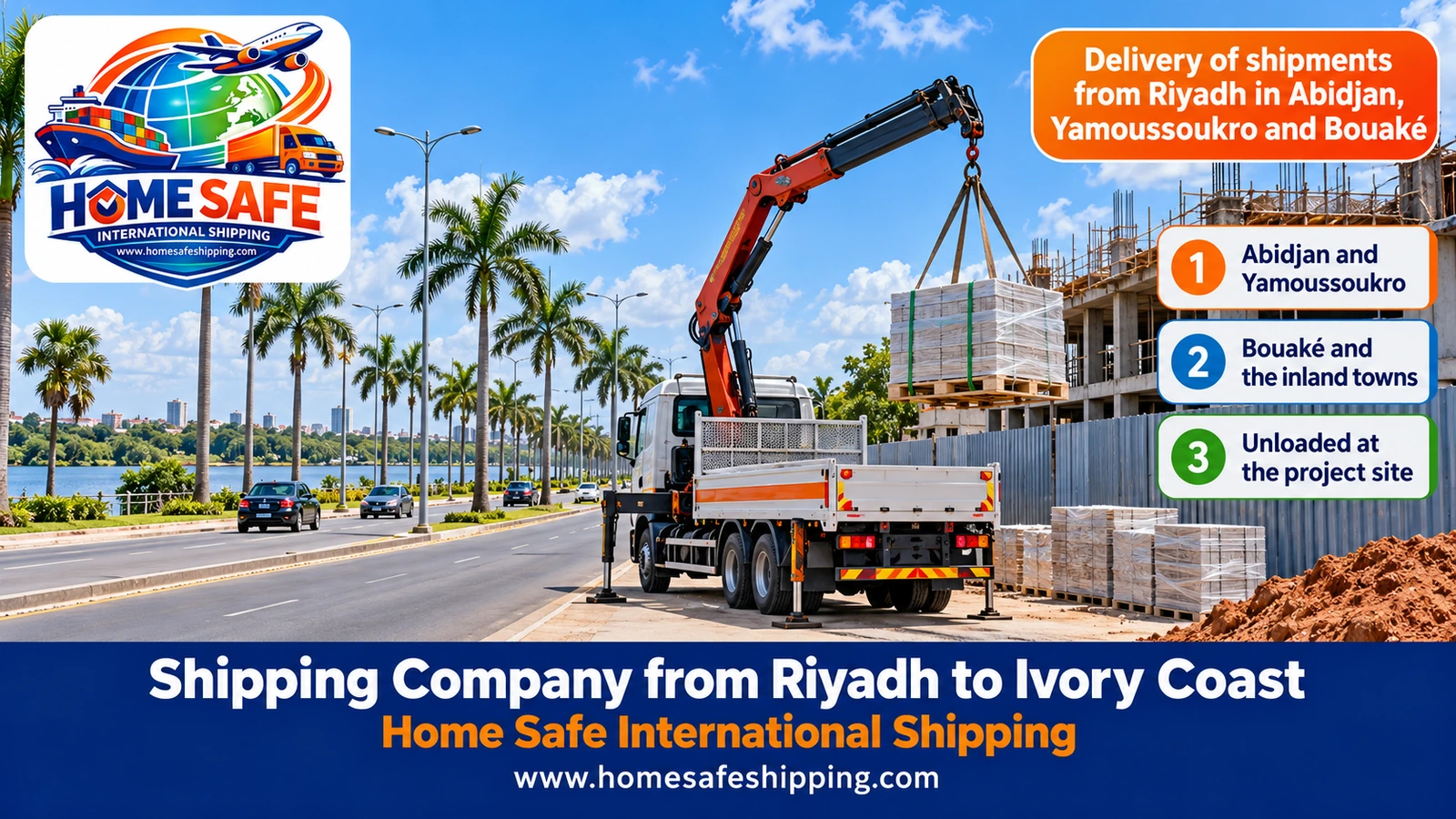
Most of what we ship is received in Abidjan itself, as it is the port and the economic capital and holds the largest markets and warehouses. The rest heads north on the road that passes Yamoussoukro, the political capital, and then Bouaké, the country’s second city. After release the container leaves on a truck for the consignee’s address, or is unpacked at a warehouse near the port and distributed by smaller trucks.
| City | Distance from the port of Abidjan | Delivery note |
|---|---|---|
| Abidjan: Plateau, Cocody, Marcory, Treichville, Yopougon, Adjamé | Within the city | The bridges are congested by day, so we prefer early-morning delivery |
| Yamoussoukro | About 240 km | A motorway from Abidjan |
| Bouaké | About 350 km | A trading centre for the middle and north of the country |
| San-Pédro | About 340 km | It has its own port, chosen when a suitable sailing serves it |
| Daloa | About 400 km | The centre-west, with slower roads in the rainy season |
| Korhogo | About 570 km | The far north, adding one to two days |
Many building-material shipments are delivered to the project site rather than a warehouse. So we ask the consignee before the vessel arrives: is there a crane or a forklift on site? Can an articulated truck reach the gate? If there is no means of unloading we arrange a crane with the truck, or unpack the container in Abidjan and send the goods on smaller open trucks. The destination network is on the shipping destinations page.
Transit from Abidjan to Mali and Burkina Faso
Mali and Burkina Faso are landlocked, and Abidjan is one of the nearest large ports to them. That is why some of our customers in Riyadh ask for the container’s destination to be Bamako or Ouagadougou rather than Abidjan. The condition is that this is known before the bill of lading is issued, because the final destination is written in it and is not easily amended after sailing.
- To Ouagadougou: about 1,150 km from Abidjan, by rail or by truck.
- To Bobo-Dioulasso: about 800 km, on the same railway line.
- To Bamako: about 1,100 km by truck.
- Customs: the container crosses Ivory Coast under a transit document and a guarantee, and its duties are paid in its country of arrival.
- The state of roads and crossings: it changes, so we confirm the available route before booking.
Whoever ships to the neighbouring countries on the same coast will find the details in the article Shipping from Saudi Arabia to Togo.
Services for individuals, traders and companies
There are three kinds of customer on this route, and each measures the service by a different yardstick. The individual wants the cartons to reach the family without complication. The trader wants to know the unit cost before buying. And the company wants a fixed schedule and papers that are not sent back.
| Customer | What they need | What we provide |
|---|---|---|
| Individuals, families and students | Shipping baggage and gifts at a reasonable cost | Collection from home, and shared cartons or air per kilogram |
| Car dealers | A purchase decision built on a number | An age-limit check before bidding, volume rates, and unified follow-up for all units |
| Factories and contracting companies | Repeated shipments for projects with deadlines | A monthly schedule, a tax invoice, an account manager, and delivery at the project site |
Air freight from Riyadh to Ivory Coast

When a machine on a building site in Abidjan stops because a part in it has failed, every day of waiting costs more than the part itself. This is where air freight comes in: the shipment leaves King Khalid Airport in Riyadh, passes through a transit airport in Africa, Europe or the Gulf, arrives at Félix Houphouët-Boigny Airport in Abidjan, and is delivered within 4 to 7 days after clearance. We do not promise a direct flight, as a connection is the norm on this route.
- What it suits: spare parts, electronic boards, samples, documents and light baggage.
- How it is charged: by chargeable weight, meaning whichever is higher of the scale weight and the volume weight; the volumetric weight calculator gives you the figure.
- The price: starts from SAR 28 per kilogram and falls as the weight rises.
- Express: documents from SAR 83, and a parcel up to 5 kg from SAR 110.
- Heavy pieces: anything in which a single piece weighs more than can be carried by hand is secured on a pallet, and we need its dimensions before booking.
- What it does not suit: tiles, cables and cars, whose freight by air is several times that by sea.
A commercial air shipment goes through the same customs, so the invoice is attached to it, and the certificate of conformity if the item is covered. Details of the service are on the air freight page.
Collection from Riyadh’s districts and nearby towns
We collect from wherever the goods are: a factory dock, a trader’s warehouse, an auction yard or a home. And we send what suits the place: a container on a truck for the factory, a closed truck for the warehouse, a car transporter for the yard, and a small vehicle for the household cartons.
| Area | Districts and sites | Typical shipments |
|---|---|---|
| South Riyadh and its industrial east | Second Industrial City, Al-Sulay, Third Industrial City, Al-Aziziyah | Building materials and equipment loaded into containers from the dock |
| Central Riyadh | Al-Batha, Al-Dirah, Al-Marqab, Al-Malaz | Wholesale goods and spare parts, consolidated at our warehouse |
| East Riyadh | Al-Naseem, Al-Rawdah, Al-Yarmouk, Qurtubah | Cars from showrooms and yards, and family baggage |
| North Riyadh | Al-Malqa, Al-Yasmin, Al-Narjis, Hittin, Al-Sahafah | Furniture and baggage of departing residents |
| Nearby towns | Al-Kharj, Al-Muzahimiyah, Huraymila, Sudair, Al-Majmaah | Factory products, with road time added to the loading date |
Send your location on the map and photographs of the goods, and we tell you the suitable vehicle and the arrival time. The cities we serve are on the cities page.
Steps for shipping from Riyadh to Ivory Coast
- You send a description of the shipment, its approximate weight and the consignee’s city, and the year of manufacture if it is a car.
- We check what it requires: the age limit, the certificate of conformity, and any special permit.
- The price reaches you itemised, with the method, the time and what it covers.
- We book a place on the vessel or the aircraft and set the loading day.
- We load at your site, secure the goods, seal the container and photograph it.
- The truck moves to Jeddah port, and the export declaration and bill of lading are issued.
- We obtain the tracking note and send the complete file to the Abidjan clearing agent before the vessel arrives.
- The shipment is cleared and delivered to the address, and the consignee signs the delivery report.
Tracking and insurance
A journey of more than a month with a transhipment port needs unbroken follow-up, especially for a trader who sells the goods in Abidjan before they arrive. Every shipment has one reference number from the loading day in Riyadh until the consignee signs.
- Notifications: when the truck leaves, on entering the port, on sailing, at transhipment, on berthing, on release and on delivery.
- The multi-unit trader: one periodic statement with the position of each car or container and its expected date.
- Insurance: optional, calculated as a percentage of the declared value. We think it should be taken for equipment, cars and tiles.
How to follow up is on the track your shipment page, and the types of cover on the cargo insurance page.
Reverse shipping from Ivory Coast to Riyadh
Demand in this direction is lower, and most of it is the baggage of people returning to the Kingdom, commercial samples and food products. Our agent in Abidjan collects the shipment, and it comes by air to King Khalid Airport or by sea to Jeddah port and then by land to Riyadh.
- Cocoa, coffee and cashew: food products that need the approval of the Kingdom’s food authority before they are shipped.
- Commercial goods: lines that fall under Saudi technical regulations must be entered on SABER ahead of the sailing date.
- Used effects: they enter as personal effects with a contents list.
Tips before shipping to Ivory Coast
- Ask about the age limit before you buy the car, not after you have paid for it.
- Leave a margin of at least a year between the car’s age and the limit, as the journey takes weeks and regulations change.
- Ask the importer for the advance import declaration number before loading.
- Write the invoice and packing list in French from the start.
- Spread tiles over 20ft containers instead of cramming them into a 40ft that exceeds the permitted weight.
- Check the frequency of electric motors, as the Ivorian grid is 50 hertz.
- Avoid having your container arrive at the peak of the cocoa season if your project date allows.
How do you choose a shipping company from Riyadh to Ivory Coast?
The West Africa route does not tolerate trial and error, because a mistake on it shows up six weeks later and thousands of kilometres away. Before you hand over your goods or your car, put these questions and compare the answer:
| What you ask about | A reassuring answer | A worrying answer |
|---|---|---|
| The age of the car | Asks for the year of manufacture before quoting a price | “Ship it and we will see over there” |
| The tracking note | Includes it in the price and sets its date | Does not know it, or leaves it to the consignee |
| Conformity | Asks for the tariff codes and arranges the inspection | “Building materials need nothing” |
| The port | Names the port of exit and the transhipment port | Does not know the vessel’s route |
| After Abidjan | Has a clearing agent there and delivers to the address | Their role ends at sailing |
| Legal standing | Commercial registration, a contract and a receipt | A transfer to a personal account with no paper |
Common mistakes when shipping from Riyadh to Ivory Coast
- Buying a car at auction and then asking about the age limit.
- Counting the car’s age on the shipping day rather than the arrival day.
- Loading the tile container above the weight permitted on the road.
- Shipping items covered by conformity without a certificate.
- Putting spare parts inside the cabin of a car travelling on a RoRo vessel.
- Writing Abidjan as the final destination for goods bound for Bamako.
- Sending the documents to the clearing agent after the vessel has berthed.
Why Home Safe for shipping from Riyadh to Ivory Coast?
A registered establishment
Home Safe Logistics Services Establishment, commercial registration 4030601060.
The age before the bid
We check the car’s eligibility at no charge before you buy it.
From the factory to the site
Loading in Riyadh and unloading at the project site.
A file that passes first time
The tracking note and conformity before the vessel arrives.
To book: 0552803439 by call or WhatsApp, from 7 am to 11 pm. Or from the request a quote page.
Related articles and pages
- Shipping company from Saudi Arabia to Ivory Coast
- Shipping company from Jeddah to Ivory Coast
- Shipping company from Riyadh to Benin
- International shipping company in Riyadh
- Car shipping
- Shipping services
Tags
shipping company from Riyadh to Ivory Coast, shipping from Riyadh to Ivory Coast, shipping from Riyadh to Abidjan, shipping prices from Riyadh to Ivory Coast, car shipping from Riyadh to Ivory Coast, building materials shipping to Ivory Coast, equipment shipping from Riyadh to Abidjan, sea freight to the port of Abidjan, air freight from Riyadh to Abidjan, spare parts shipping to Ivory Coast, container shipping from Riyadh to West Africa, shipping to Côte d’Ivoire, shipping to Yamoussoukro and Bouaké, Ivory Coast cargo tracking note, shipping from Riyadh to Mali and Burkina Faso, Home Safe International Shipping
Frequently asked questions about shipping from Riyadh to Ivory Coast
How much does shipping from Riyadh to Ivory Coast cost?
A saloon car by sea starts from SAR 2,800 counted from Jeddah port, an air kilogram from King Khalid Airport from SAR 28, a parcel of no more than 5 kg from SAR 110 and a document envelope from SAR 83. The figures for a container, a part load and the road leg from Riyadh to the port are set on request, and they reach you the day you send your cargo details to 0552803439.
How many days does a shipment need from Riyadh to Abidjan?
A full container normally reaches the consignee’s warehouse in 36 to 50 days, of which 25 to 35 days are sailing between Jeddah and Abidjan. A part load adds a few days because it waits for the shared container to fill and is then sorted at the arrival warehouse. Air freight takes 4 to 7 days.
Riyadh has no port, so where does the container sail from?
From Jeddah Islamic Port in most cases. The container is loaded at your site and sealed, then the truck carries it about 950 km west to the quay. The alternative is the container train from Riyadh Dry Port to Dammam port, but a Dammam vessel goes round the Arabian Peninsula before heading for Africa, so we choose it only when its schedule serves the shipment.
Does the vessel go from Jeddah to Abidjan directly?
Most liner services move the container to a second vessel at a transhipment port in the Mediterranean or near Gibraltar, and some link the two ports in a single rotation. That is why sailing days vary from one voyage to another, and we tell you the route of the booked voyage and its transhipment port before you pay.
What is the maximum age of a car I buy at a Riyadh auction to ship to Ivory Coast?
The rule in force in Ivory Coast is five years for a used private car, seven for minibuses and light trucks, and ten for heavy trucks. The age is counted on the day the vehicle reaches the port, not the day you buy it, so add the journey time to your sums. Send us the model and year of manufacture before bidding and we confirm the limit in force at no charge.
Do you collect the car from the auction yard or the showroom?
Yes. We need a copy of the sale contract and an authorisation from you, then a car transporter collects it from the yard and photographs it from its four corners with the odometer reading before lifting it. Once the export formalities with the traffic department are finished it moves to Jeddah port on a scheduled run.
What is the cargo tracking note that Ivory Coast requires?
An electronic document registered with the Ivorian shippers’ office for every sea shipment bound for the country’s ports, recording the shipper, the consignee, the goods, their value and the freight. We obtain it after the bill of lading is issued and before the vessel berths, because a container that arrives without it is released only after a fine.
Do building materials need a certificate of conformity?
Many of their categories fall under the Ivorian verification of conformity programme, including electrical materials, cables and building materials. The certificate is issued by an approved inspection body in the Kingdom before sailing, not after. Send us the list of items and their tariff codes and we tell you which are covered, then arrange the inspection date at your factory or warehouse.
How are long aluminium profiles and cable drums shipped?
A profile six metres long does not fit a 20ft container, so it is loaded in a 40ft container or in an open-top container into which the bundles are lowered by crane. Cable drums are stood on their rims, chocked with timber wedges and strapped to the floor rings so that they do not roll as the vessel heels.
Do you deliver to Yamoussoukro and Bouaké, or does delivery end in Abidjan?
We deliver to both cities and to San-Pédro, Daloa and Korhogo. After release at the port of Abidjan the container or the goods travel by truck to the address; Yamoussoukro is about 240 km away and Bouaké about 350 km. If delivery is at a project site, tell us whether it has a crane for unloading.
Do you ship through Abidjan to Mali and Burkina Faso?
Yes. The final destination is stated in the bill of lading from the start, so the container crosses Ivory Coast under a transit document without that country’s duties being paid on it, then continues by truck to Bamako or by rail or truck to Ouagadougou, and is cleared in its country of arrival.
How much is an air kilogram from Riyadh to Abidjan?
It starts from SAR 28 per kilogram of chargeable weight, which is the greater of the actual weight and the volumetric weight, and the rate falls as the shipment gets heavier. Documents by express start from SAR 83, and a parcel up to 5 kg from SAR 110.
Is the furniture of someone returning to Ivory Coast exempt from duties?
The practice in force is that a person moving residence presents the change of residence certificate issued by the embassy or consulate, the passport, and a contents list in French with the value of each item, and the used effects are then treated leniently. New appliances, or those without an invoice, are charged as new goods. We confirm the conditions in force before loading.
Does Saudi electrical equipment work in Ivory Coast?
The voltage is similar in the two countries, but the frequency differs: 60 hertz in the Kingdom and 50 hertz in Ivory Coast. Equipment whose plate reads 50/60 hertz works without modification, while a motor designed for one frequency turns more slowly and overheats. So check the data plate of every pump, compressor and generator before you ship it.
Do you collect from Al-Kharj, Al-Muzahimiyah and the Sudair factories?
Yes. We send the container or the truck to the factory, warehouse or home in Riyadh and around it: Al-Kharj, Diriyah, Al-Muzahimiyah, Huraymila, Sudair and Al-Majmaah. Loading in the industrial cities is done on the factory dock by forklift, and the container is sealed there before it moves.
That is the guide — now let us price your shipment
Choose what applies to you and receive a reply with the price, the method and the time.
RoRo, container or sling lift — we recommend what suits your vehicle’s value and its destination.
Get a vehicle priceA full or shared container, or urgent air freight, with packing and clearance.
Get a shipment priceRoutes in the same section
Options related to the same type of service.