Goods Storage in Jeddah 0552803439 | Receiving, Pallets and Racking, Inventory, Order Picking and Distribution
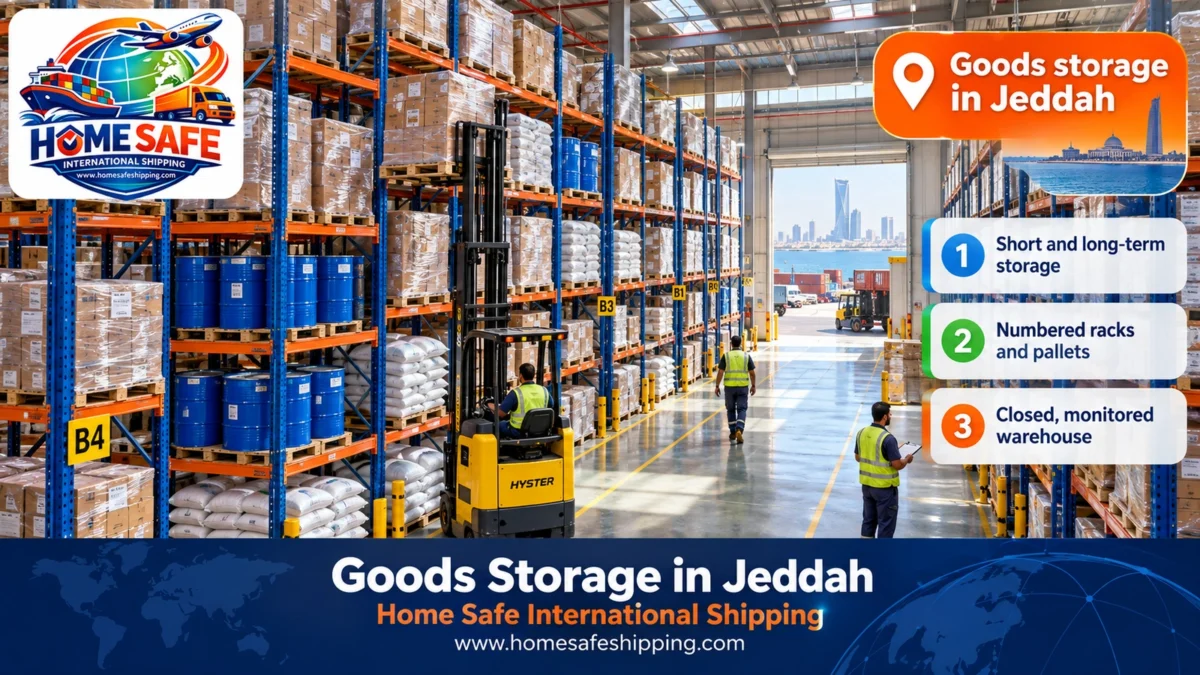
Looking for goods storage in Jeddah without renting a whole warehouse? Home Safe receives your goods from the container or truck, counts them against the list, keeps them on numbered pallets and racking in a closed, monitored warehouse, then picks your orders and distributes them to shops in Jeddah …
Goods storage in Jeddah is a service for the trader, the importer and the online shop owner who wants an orderly place for stock without renting a whole warehouse and hiring staff for it. Home Safe receives the goods from the container or the truck, counts them against the list, keeps them on numbered pallets and racking in a closed, monitored warehouse, then picks orders and distributes them or ships them out of the Kingdom. A dry pallet starts from SAR 37 a month, dedicated space from SAR 11 per square metre a month, and the remaining items are set on request. For enquiries and bookings: 0552803439.
In this guide46ShowHide
- What does goods storage in Jeddah mean?
- Who needs goods storage in Jeddah?
- Why is Jeddah a suitable place for storage?
- Receiving and counting goods at the warehouse dock
- Pallets, racking and stock counts: how are the goods kept?
- Types of storage available by kind of goods
- Short-term and long-term storage: which suits you?
- Goods storage prices in Jeddah
- What determines the price of storage?
- How do you reduce the cost of storage?
- Order picking and distribution to shops in Jeddah
- Storage after import: from the port to the warehouse
- Ordinary storage or a customs bonded zone?
- Storing goods before export by sea and by land
- Air freight from the warehouse through King Abdulaziz Airport
- Uses of storage by sector
- Keeping goods in good condition in Jeddah’s climate
- Security and protection inside the warehouse
- What cannot be stored?
- Insurance on stored goods
- Documents and the booking confirmation
- Moving goods to the warehouse from Jeddah’s districts and surroundings
- Steps for storing goods with Home Safe
- Shared storage or a private warehouse?
- Tips before you send your goods
- How do you choose a warehouse for your goods in Jeddah?
- Common mistakes in storing goods
- Why Home Safe for storing your goods?
- Related articles and pages
- Tags
- Frequently asked questions about goods storage in Jeddah
- How much does goods storage in Jeddah cost?
- What is the difference between goods storage and furniture storage?
- What are the minimum period and the minimum quantity you accept?
- How do I know my stock balance at any time?
- Do you collect the container straight from Jeddah Islamic Port?
- Do you pick orders and deliver them to shops?
- Can foodstuffs or medicines be stored?
- Which goods do you not accept for storage?
- Are the goods insured inside the warehouse?
- What is a bonded zone, and do I need one?
- Do you store goods before export and ship them?
- Can I visit my goods or withdraw part of them?
- How is a pallet counted, and what size is it?
- Which is cheaper: a private warehouse or shared storage?
- Which documents are needed to start storage?
In brief:
- Who it is for: importers, wholesalers and retailers, online shops, small factories and exporters.
- What we do: receiving, counting and matching, then storage on pallets and racking, then stock counts and reports, then order picking and distribution.
- Period: short, in days and weeks, or long on a monthly agreement that renews.
- Prices: a dry pallet from SAR 37 a month, a square metre from SAR 11 a month, with handling and distribution set on request.
- Before export and after import: hauling the container from Jeddah Islamic Port and unloading it, or consolidating purchases and shipping them by sea, air and land.
- What is not stored: hazardous and flammable materials, prohibited items, and anything that spoils quickly outside refrigeration.
- Household furniture: it has its own service, in the article furniture storage company in Jeddah.
What does goods storage in Jeddah mean?
It means placing your commercial goods with a party that runs the warehouse on your behalf. You do not rent a building, buy a forklift or employ a storekeeper. You pay for the space your goods occupy and for the movements you ask for, and you follow your balance through a report. Some people call the service “temporary storage”, because the goods in it are in transit: they come in to go out, not to stay for years.
It is not the same as furniture storage. The furniture of a home is a few pieces belonging to one owner, wrapped and locked in a crate until he returns. Goods are items and counts, arriving in batches and leaving in batches, and their owner asks every week how much of a given item is left. That is why the service here rests on counting, numbering and records more than on the lock. Anyone with household or office furniture will find that service on the storage page.
Who needs goods storage in Jeddah?
Anyone with more goods than space, or with goods that arrived before their place was ready. Some need it for two weeks a year, and some build their whole trade on it. The table shows the cases that contact us most.
| Owner of the goods | Situation | What is needed from the warehouse |
|---|---|---|
| Importer whose container has arrived | The container is at the port and the shop cannot hold it | Haulage, unloading and counting, then withdrawal in batches |
| Wholesaler | Sells to scattered shops in Jeddah and Makkah | Permanent storage, order picking and distribution |
| Online shop owner | The flat has run out of room for cartons | Shelving for small items and daily order picking |
| Seasonal trader | Goods for Ramadan, Hajj and back-to-school | Short storage before the season and quick withdrawal during it |
| Exporter or buyer from abroad | Gathers purchases from several suppliers | Consolidation, packing and loading a container or air pallets |
| Factory or workshop | Raw materials or finished product awaiting delivery | Floor space for heavy pallets |
| Company moving premises or closing a branch | Stock with no home for months | Long storage with periodic counts |
The effect on the business is direct. A trader who stores outside the shop wins back the selling frontage the cartons were eating up. An importer who unloads the container on the day stops paying for its waiting time. An online shop owner who hands picking to someone else is free to market and sell. It is not only a matter of space, but of time returned to you.
Why is Jeddah a suitable place for storage?
Because goods enter and leave the Western Region through Jeddah. It has Jeddah Islamic Port, the Kingdom’s largest port on the Red Sea, and King Abdulaziz International Airport. To its south lies Al-Khumra, where warehouses and logistics yards serving the port are concentrated. From Jeddah, goods are distributed to Makkah, Taif, Madinah and Yanbu within a day’s journey.
| From Jeddah to | Approximate distance | What it means for stock |
|---|---|---|
| Jeddah Islamic Port | Inside the city | The container is hauled and returned empty within the same working day |
| King Abdulaziz Airport | North of the city | Air pallets handed over before the flight cut-off |
| Makkah | About 80 km | Daily distribution, allowing for truck entry hours in the seasons |
| Taif | About 170 km | A return distribution trip within the day |
| Yanbu | About 330 km | Consolidated loads once or twice a week |
| Madinah | About 420 km | A truck arriving the same day or the next morning |
The location inside Jeddah itself counts too. A warehouse close to the port lowers the cost of hauling the container, and one close to the highways shortens distribution time. In the first call we ask where your goods come from and where they go. The answer decides where they are placed and how much you will pay for transport before and after storage.
Receiving and counting goods at the warehouse dock
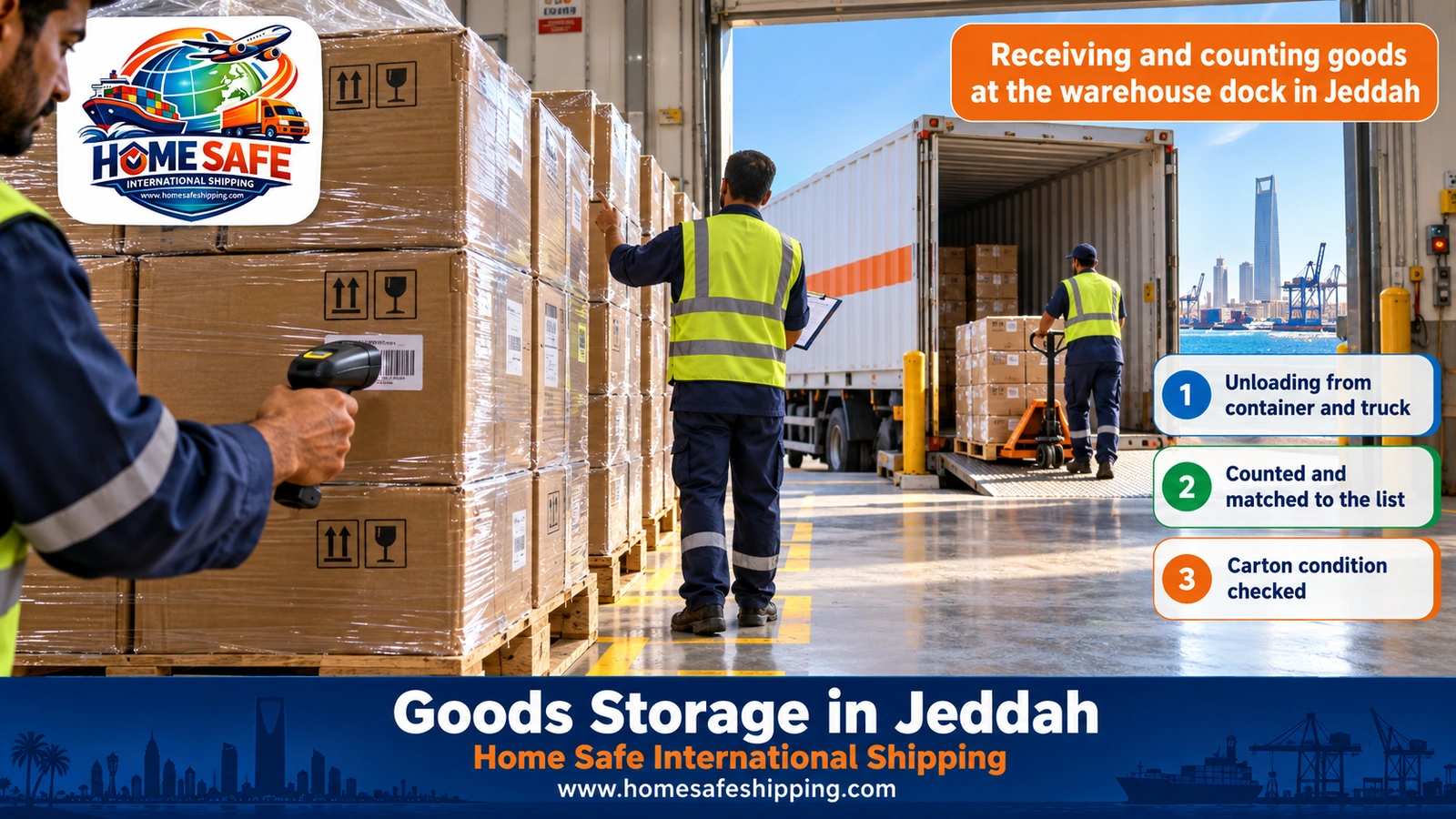
Receiving is the moment the goods pass from the carrier’s custody to ours, so we do not rush it. The container or truck stands at the dock, the seal is opened and its number photographed, then the cartons are unloaded and counted item by item against the packing list. Any carton that is wet, crushed or open is set aside and photographed before it enters stock. When unloading ends, you receive a receiving report showing what actually arrived, not what the invoice says.
| Step | What happens | What you receive |
|---|---|---|
| Before arrival | We receive the packing list and the truck’s time slot and book the dock and labour | Confirmation of the appointment |
| Opening the container | The seal, the container number and the state of the goods as the door opens are photographed | Opening photos |
| Unloading | By hand or by forklift, with loose cartons stacked on pallets | Number of pallets built |
| Counting and matching | Each item is counted and compared with the list | Overages and shortages, if any |
| Condition check | Damaged cartons are set aside and photographed | A statement of damaged goods |
| Put-away | Each pallet is moved to its numbered location, which is recorded | Final receiving report |
The value of this report shows when there is a dispute. If a carton is short, the report signed on the day of unloading, together with the photo of the seal, is what you use to claim against the supplier, the carrier or the insurer. Someone who discovers the shortage a month later has no idea where it was lost. So we send the report on the day of receipt itself and wait for your remarks on it before treating it as final.
Pallets, racking and stock counts: how are the goods kept?
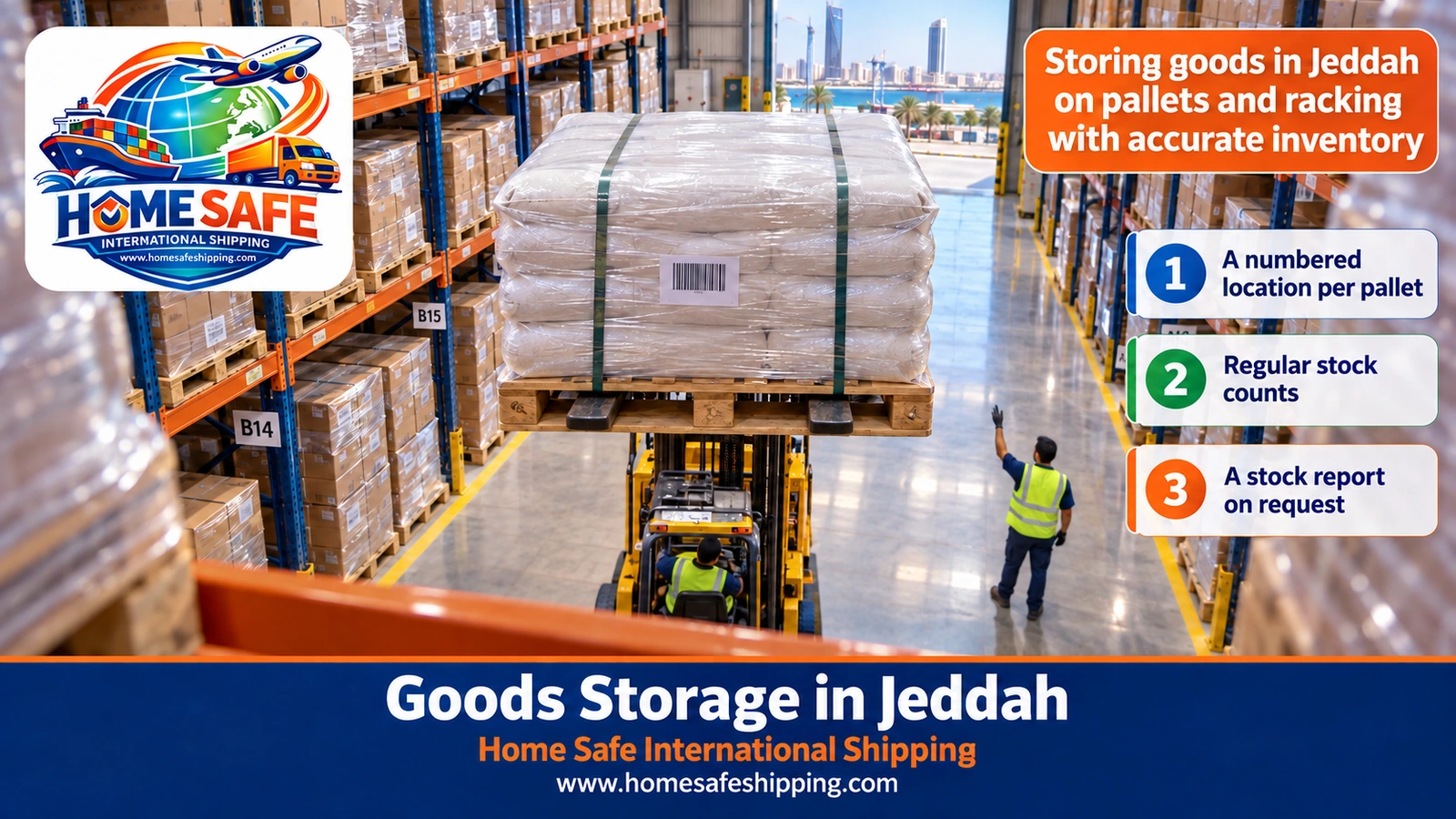
After counting, each pallet takes a location with a number: aisle, bay and level. That number is written in the record beside the item, the quantity and the date of entry. So when you ask for twenty cartons of a particular item, the worker knows where to go without searching the warehouse. Goods with an expiry date leave by earliest expiry, and goods without one leave by earliest entry, unless you ask otherwise.
| Method of keeping | Suits | Note |
|---|---|---|
| Pallet on racking | Uniform cartons withdrawn by the pallet or the carton | Each pallet has its own location reached directly |
| Pallets stacked on the floor | Heavy goods or large quantities of one item | Stacking depends on what the carton can bear |
| Light shelving for pieces | Online shop items and small parts | Withdrawn by the unit, not the carton |
| Dedicated floor space | Equipment, irregular sizes and project cargo | Charged by the square metre |
| Locked cage or room | High-value goods | Access restricted to named persons |
The periodic count is what keeps the record honest. We physically count the stock at agreed intervals, compare it with the book balance and look for the cause of any difference: a pallet put away in the wrong location, or a carton released and not recorded. The stock report reaches you on request and shows, for each item, its balance and what came in and went out during the period. With it you know when to reorder from the supplier before the item runs out on the shelf.
Types of storage available by kind of goods
Not all goods are treated the same way, and choosing the wrong type either spoils them or raises their cost for nothing. Dry cartons do not need refrigeration you would pay for, and chocolate cannot survive a Jeddah summer in an ordinary warehouse. The table sets out the types, with what we provide directly and what we arrange through specialised facilities.
| Type of storage | Examples of goods | How we provide it |
|---|---|---|
| Ordinary dry | Clothing, footwear, household items, stationery and spare parts | In the closed warehouse, on pallets and racking |
| Air-conditioned | Cosmetics, perfumes, electronics and confectionery | Set on request according to available space |
| Chilled and frozen | Dairy, meat, vegetables, medicines and vaccines | Through licensed specialised facilities, on request |
| Open yard | Equipment, building materials and containers | Set on request |
| Bonded storage | Imported goods whose duties are not yet paid | Through operators licensed by the Authority, on request |
| Documents and archives | Company files and archive boxes | In numbered cartons with an index |
When we do not have the type you need, we say so in the first call. We do not put frozen meat in a dry warehouse, nor accept a medicine in a place not licensed for it. What we have, we provide ourselves; what needs a special facility, we coordinate with whoever owns it, and we remain your single point of contact for transport and follow-up.
Short-term and long-term storage: which suits you?
The difference between them lies not in the place but in how the cost is worked out and how the work is done. Short-term storage is mostly movement in and out, so its cost sits in handling more than in rent. Long-term storage is mostly stillness, so its cost sits in the space and in looking after the goods. Many customers start with short-term and move to a monthly agreement once they see that the need is permanent.
| Item | Short term | Long term |
|---|---|---|
| Usual period | From days to a few weeks | Three months and more |
| Example | A container unloaded and distributed, or goods waiting for a sailing date | The stock of a wholesaler or an online shop |
| Charging | By the day or week, with a minimum billing | By the month, with the price reviewed as volume holds steady |
| What matters most | Speed of receiving and release | Periodic counts and protecting the goods from humidity and dust |
| Agreement | A booking confirmation with the expected period | A monthly agreement that renews and ends on notice |
Goods storage prices in Jeddah
The price is built on three things: the space the goods occupy, the period, and the movements you ask for. Space is charged by the pallet or by the metre. Movement means unloading, loading, order picking and distribution. We have set a starting price for the two items that can be priced without seeing the goods, and left the rest to be set once we know their details.
| Item | Price | Note |
|---|---|---|
| Standard pallet, dry goods | Starts from SAR 37 a month | Base of 100 × 120 cm within the agreed height and weight |
| Dedicated floor space | Starts from SAR 11 per square metre a month | With a minimum area written in the booking confirmation |
| Loose cargo by the cubic metre | Set on request | Stacked on pallets and then charged |
| Air-conditioned storage | Set on request | According to the item and the area |
| Chilled or frozen storage | Set on request | In specialised facilities |
| Unloading the container or truck, and loading | Set on request | According to the number of cartons and whether they are palletised |
| Order picking | Set on request | According to the number of orders and the items in each |
| Distribution inside Jeddah | Set on request | According to the district and the size of the order |
| Hauling the container from the port | Set on request | According to its size and the warehouse location |
Prices quoted in the market: what is published on commercial storage in the Kingdom runs at around SAR 40 to 60 per dry pallet a month, and SAR 70 to 120 per chilled or frozen pallet. For space, about SAR 12 per square metre a month is quoted for general warehouses in the major cities, Jeddah among them, or SAR 100 to 150 per metre a year when a whole warehouse is rented, rising in modern warehouses to SAR 150–350. Some pages price by the tonne: about SAR 35 a month for dry, SAR 120 to 180 for chilled and about SAR 250 for frozen. For picking online shop orders, SAR 5 to 20 per order is quoted. Most pages publish no figure at all, or publish one without saying whether it includes handling.
What determines the price of storage?
Two similar figures in two quotes can differ a great deal on the final invoice, because the pallet rate alone does not tell the story. Always ask about the items around it. These are the factors that raise or lower the price, with us and with others.
| Factor | How it affects the price |
|---|---|
| Type of goods | Dry is cheaper than air-conditioned, and air-conditioned cheaper than chilled |
| How they arrive | Loose cartons need labour and stacking, while ready pallets come off by forklift in minutes |
| Pallet height and weight | A tall or heavy pallet takes up more than one location |
| Number of items | A hundred items on ten pallets need more sorting and locations than a single item |
| Movement of the goods | Daily withdrawal by the carton costs more than withdrawing a full pallet each month |
| Period and commitment | A steady volume for months earns a better price than a single week |
| Added services | Labelling, repacking and export packing are charged separately |
How do you reduce the cost of storage?
- Send the goods on pallets: ask the supplier to load the container on wrapped pallets, so that unloading time and its charge both fall.
- Build the pallet up to its limit: two half-full pallets are paid for twice. Combine them into one as long as the carton can bear it.
- Withdraw by the pallet, not the carton: if your customer buys wholesale, make the release order full pallets.
- Clear slow stock: review the stock report every month, and sell at a discount or return whatever has not moved for months instead of paying its rent.
- Combine release orders: five orders for one district on one trip cost less than five trips.
- Commit to a volume: if you know you will occupy thirty pallets for six months, say so at the start so the price is built on it.
Order picking and distribution to shops in Jeddah
Storage is half the service; the other half is for the goods to reach your customer without passing through you. You send the release order with the items, the quantities and the shop’s name and address. The worker pulls the items from their locations and gathers them in the picking area, and a second person checks them against the order before it is closed. They are then loaded on the distribution vehicle in a sequence that matches its route between districts.
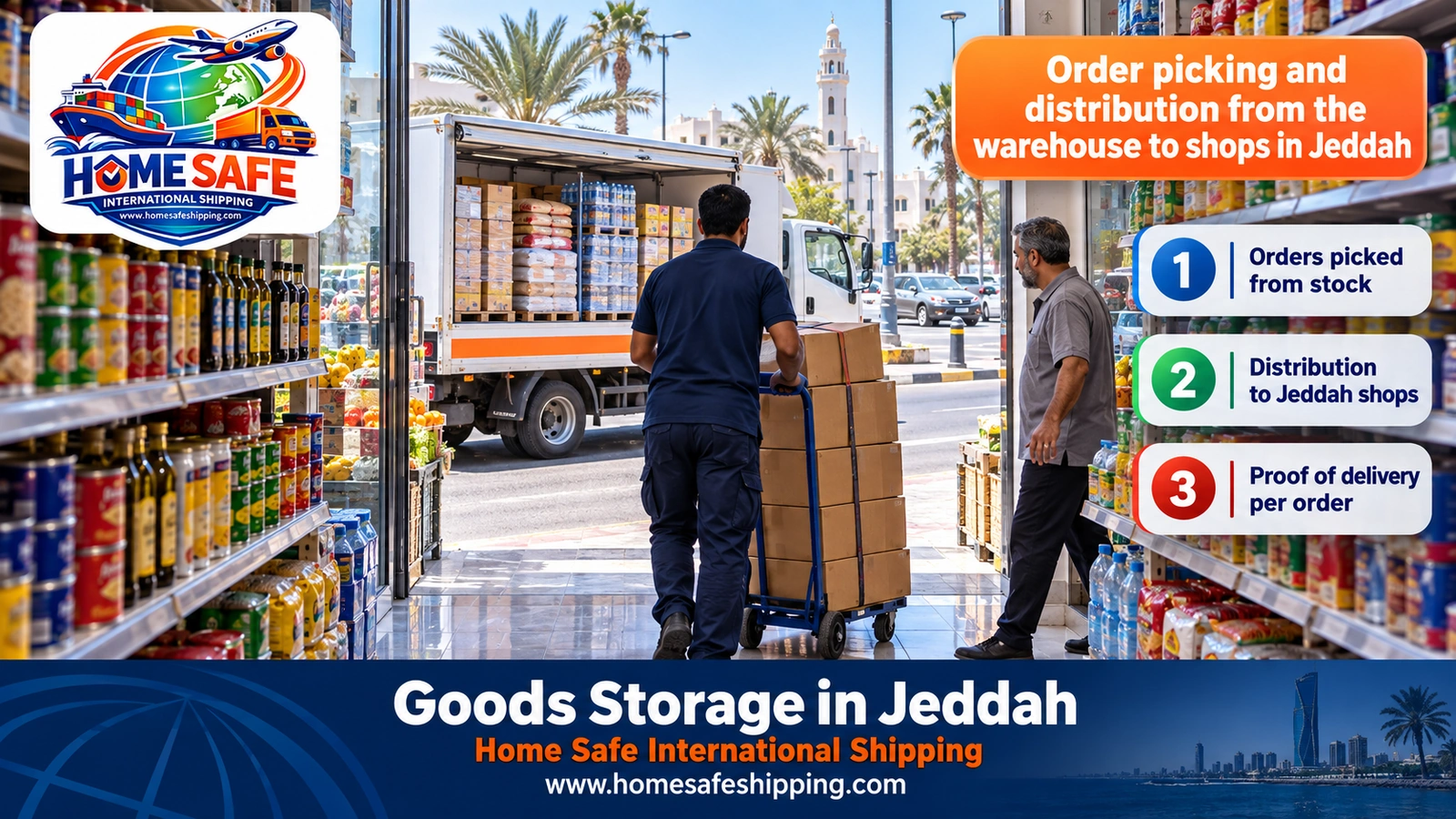
At the shop, the order is counted in front of the receiver, who signs a proof of delivery with name and date, and you receive a photo of it. That signature is what you base your invoice to the customer on, and what settles the matter if he says a week later that a carton never reached him. If the shop refuses part of the order, it comes back to the warehouse and is recorded as a return in your balance, not as the driver’s responsibility.
Online shop owners get another form of the same service. Here the order is one or two pieces rather than a carton. They are pulled from the shelf, packed in an envelope or a box, labelled with the label of the delivery company you use, and handed to its courier. Picking and distribution charges are set on request, since they follow the number of orders a day and the number of items in each order.
Storage after import: from the port to the warehouse
A container that reaches Jeddah Islamic Port has a short free period in the yard, and the container itself has a free period with the shipping line. After those, port storage charges and penalties for late return of the container begin; they are counted by the day and escalate. Someone with no place for the goods pays these charges while looking for a warehouse. The answer is to arrange the warehouse before the vessel arrives, not after.
Our sequence of work is this: you send the arrival notice and the bill of lading, the broker starts the release procedure on the FASAH platform, and the customs duties and value added tax are paid. Once released, the container is hauled to the warehouse, unloaded and returned empty. We arrange clearance through licensed brokers; it is explained on the customs clearance page and in the article customs clearance in Jeddah.
Some new goods are released only with a certificate of conformity through the SABER platform, and some need a permit from their competent authority, such as food, medicines and wireless devices. These matters are checked before shipping from the country of origin, because a container waiting for a certificate at the port pays for every day of waiting. The rules in force change, so we confirm what applies to your item before you ship.
Ordinary storage or a customs bonded zone?
Imported goods have two routes. The first is to be cleared, with duties paid, and then enter an ordinary warehouse, free to be traded in the market. The second is to enter a bonded zone licensed by the Zakat, Tax and Customs Authority, where duties and taxes on them stay suspended until they are withdrawn to the local market or re-exported. Choosing between them is a matter of arithmetic, not of one being better outright.
| Item | Ordinary warehouse after clearance | Customs bonded zone |
|---|---|---|
| Duties and tax | Paid in full on release | Suspended until withdrawal to the market or re-export |
| Suits | Goods for the local market that will sell soon | Goods partly re-exported or withdrawn in batches |
| Permitted operations | Whatever the owner wishes | What the zone’s licence allows, such as sorting, packing and labelling |
| Release | Against a release order from you | Against a customs declaration for each withdrawal |
| Cost | Usually lower | Higher, offset by deferring the duties |
| Period | Open, by your agreement with us | According to the type of licence and its conditions; we confirm what applies before deposit |
An example makes the idea clear: a trader imports a container of household items, sells two thirds in the Kingdom and re-exports one third to a neighbouring country. In an ordinary warehouse he pays duties on the whole container and then claims back what he re-exported. In a bonded zone he pays on the two thirds only, when he withdraws them. We do not operate a bonded zone ourselves, and we arrange this service through licensed operators when it is the best fit for your case.
Storing goods before export by sea and by land
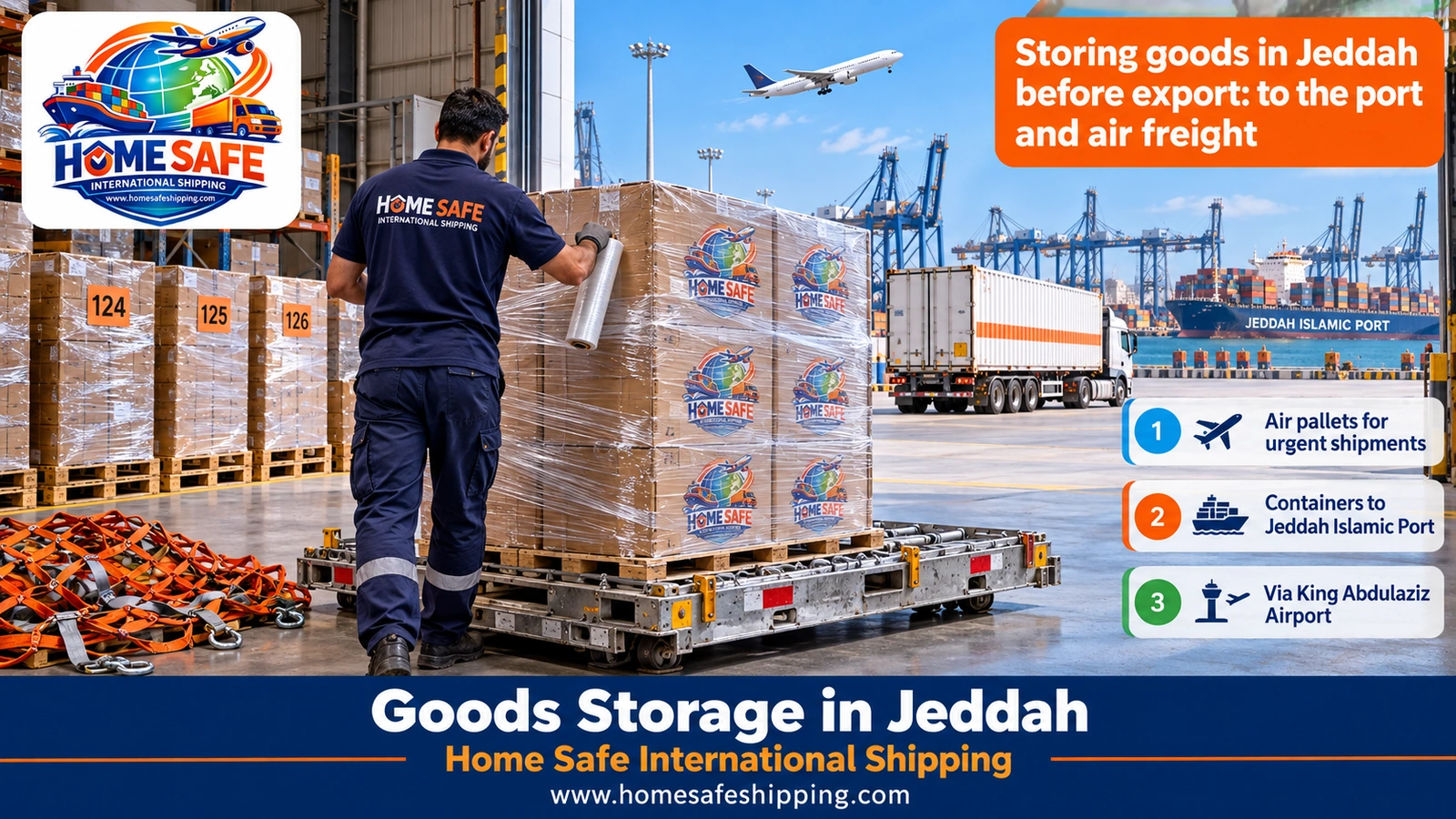
The exporter and the buyer from abroad both need a point where the goods gather before they travel. A trader from Africa or the Gulf buys from ten shops in Jeddah’s markets and cannot send ten shipments. The purchases arrive at the warehouse one after another; each batch is counted against its shop’s invoice and kept until the lot is complete. It is then packed for export, and a single packing list fit for customs is drawn up for it.
Once complete, the goods are loaded into a container, sealed and sent to Jeddah Islamic Port, or take cubic metres in a shared container if they are less than a container load. Shipments bound for the Gulf and Jordan leave in closed trucks. A cubic metre in a shared container starts from SAR 415, a 20ft container from SAR 4,600 to the ports of Turkey and North Africa, and a cubic metre by land to the Gulf from SAR 550. Details are on the sea freight and land freight pages.
The advantage of consolidating in a warehouse is that loading happens once and in order. Heavy items go at the bottom and fragile ones on top, and gaps are filled so that the load does not shift at sea. The container is photographed before it is closed and the seal number recorded. Someone who loads a container from ten places in one day pays for the truck’s waiting time and reaches the port with a load nobody has checked.
Air freight from the warehouse through King Abdulaziz Airport
Whatever cannot wait for the vessel leaves by air. Samples a customer is waiting for, spare parts for a stopped production line, or seasonal goods that are running late. The shipment is prepared in the warehouse on air pallets or in weighed cartons, and its dimensions are measured because airlines charge on volumetric weight when it exceeds the actual weight. It is then handed to the cargo terminal at King Abdulaziz International Airport before the flight cut-off.
| Destination | Air price per kilo | Usual door-to-door time |
|---|---|---|
| Gulf states | Starts from SAR 14 | 1–3 days |
| Europe | Starts from SAR 23 | 3–6 days |
| United Kingdom | Starts from SAR 26 | 3–6 days |
| North and West Africa | Starts from SAR 28 | 3–8 days |
| United States | Starts from SAR 41 | 5–8 days |
| Urgent documents | Starts from SAR 83 per envelope | Depends on the destination |
Storage serves air freight in a way many people overlook: the bulk of the stock stays in Jeddah, and small batches are sent from it by air whenever the customer orders, instead of shipping the whole quantity and storing it in his country. Lithium batteries, perfumes, aerosols and flammable liquids are restricted on aircraft, so we sort them out before weighing. Times are estimates and follow flight schedules and clearance. Details of the service are on the air freight page.
Uses of storage by sector
Every sector asks the warehouse a different question. The food trader asks about temperature and expiry dates, the clothing trader about sizes and colours, and the online shop owner about how many orders are picked in a day. The table sums up what matters to each sector.
| Sector | What it stores | What it asks for most |
|---|---|---|
| Dry foods | Rice, pulses, canned goods, dates and juices | Pallets raised off the floor, release by earliest expiry and separation from detergents |
| Chilled and frozen foods | Dairy, meat and poultry | An unbroken cold chain, in a facility licensed for it |
| Medicines and cosmetics | Medicines, supplements and medical supplies | Controlled, recorded temperature and a licence from the competent authority |
| Retail and clothing | Clothing, footwear, gifts and seasonal goods | Sorting by size and colour, and quick withdrawal on peak days |
| E-commerce | Many small items | Shelving for pieces, daily picking and recording of returns |
| Building materials and equipment | Tiles, sanitary ware and pumps | Floor space and a forklift that can take the weight |
| Spare parts | Car and machinery parts | Precise numbering, since two similar parts are not the same part |
We repeat here something that is often misunderstood. A strong air conditioner is not enough for chilled food and medicines. They have requirements set by the Saudi Food and Drug Authority for the facility and for transport, and they are not accepted in a facility that does not meet them. What we store directly is packaged dry goods. Everything else we coordinate with specialised facilities, and we confirm the rules in force before promising you anything.
Keeping goods in good condition in Jeddah’s climate
Jeddah is a coastal city, hot and humid for most of the year, and that changes the rules of storage there. Cardboard absorbs moisture, softens and collapses under what is above it. Unpainted metal rusts. Fabrics pick up an odour if sealed in plastic while not fully dry. So all goods are raised on pallets and do not touch the floor, a gap is left between them and the walls, and cartons are not stacked higher than the bottom carton can bear.
We ask about your goods before deciding their location. Whatever is affected by heat is placed away from doors and from roofs exposed to the sun. Perfumes and detergents are kept away from foods and fabrics so that their smell does not carry over. A pallet that stays a long time is wrapped in film to protect it from dust. Whatever needs a controlled temperature we do not promise in the dry warehouse; we move it to air-conditioned or chilled storage.
Security and protection inside the warehouse
The security of the goods starts at the door: who enters, when, and with which paper. The warehouse is closed and monitored by cameras, and access to the storage area is limited to those who work in it. A driver who comes to collect waits at the dock and does not wander between the racks. Nothing leaves except against a written release order from the owner of the goods or the person he has authorised.
The second side is fire safety, which is the first reason for refusing hazardous materials: extinguishers and clear exits, no smoking, and separation of items that must not be kept together. The third side is the record. Goods that have a number, a location and a signature at every movement are hard to lose, and if they are lost, it is known when and in whose hands. That is why we treat documentation as part of protection, not as extra paperwork.
What cannot be stored?
Some goods we decline whatever the price, because they put other people’s goods at risk or break the law. Some are accepted on a condition. It is best to state the nature of your goods honestly in the first call, since finding a prohibited item after it has entered means removing it at your expense. The fuller list is on the prohibited items page.
| Item | Ruling | Reason or condition |
|---|---|---|
| Fuel, paints, solvents and gas cylinders | Not accepted | Risk of fire and explosion |
| Hazardous chemicals and concentrated pesticides | Not accepted in the general warehouse | They need a licensed, segregated facility |
| Weapons, ammunition and fireworks | Not accepted | Prohibited by law |
| Drugs, alcohol and anything banned from trade | Not accepted | Prohibited by law |
| Counterfeit goods or goods without proof of ownership | Not accepted | Legal liability for the depositor and the warehouse |
| Fresh and chilled foods | Do not enter the dry warehouse | They need a cold chain |
| Live animals and plants | Not accepted | Not goods for storage |
| Cash, jewellery and precious metals | Not accepted | They belong in bank vaults |
| Lithium batteries in commercial quantities | On a condition | In their original packaging and after being declared |
| Perfumes and aerosols | On a condition | Limited quantities, kept away from sources of heat |
Insurance on stored goods
There is a difference between the warehouse’s liability and insurance on the goods, and many people confuse the two. The warehouse’s liability is limited to what is written in the booking confirmation and relates to what results from its own fault in handling and keeping. Insurance is a policy that covers the value of the goods themselves against named perils, such as fire, theft and water leakage, whatever their cause.
A trader depositing goods worth hundreds of thousands does not rely on the first alone. If you hold a stock insurance policy, ask your insurer whether it covers goods deposited with a third party, and give it the warehouse address. If you hold none, we arrange cover on request, calculated as a percentage of the declared value. The value is proved by invoices, so keep them. It is explained on the cargo insurance page.
Documents and the booking confirmation
The paperwork here is light, but each paper protects you. We ask for what proves who you are and that the goods are yours, and we give you what proves what we received and on which terms. The booking confirmation is the reference for any question: it holds the period, the price, what is included and what is not, the limits of liability and how the agreement ends.
| Document | From | Why |
|---|---|---|
| Commercial registration or freelance document | Customer | Proof of the depositor’s capacity |
| ID and authorisation of the authorised person | Customer | To fix who may order release and collect |
| Packing list or invoice | Customer | To match what arrives at counting |
| Customs declaration after release | Customer or broker | Proof that imported goods entered lawfully |
| Booking confirmation | Home Safe | Period, price and scope of service |
| Receiving report | Home Safe | What actually came in, with its count and condition |
| Release order and proof of delivery | Customer, then receiver | What went out, to whom and when |
Moving goods to the warehouse from Jeddah’s districts and surroundings
Not all goods come from the port. Much of it comes from a shop that has run out of room, from a factory in the industrial city or from a supplier in the downtown markets. We send the vehicle that suits the volume: a small vehicle for a few cartons and a closed truck for pallets. The goods are counted once at loading and a second time on arrival.
| Area | What usually comes from it | Note |
|---|---|---|
| Jeddah Islamic Port and its surroundings | Imported containers | After release, with the container returned empty |
| Al-Khumra and south Jeddah | Goods moved from other warehouses | Mostly ready pallets |
| The industrial city | Finished product and raw materials | Loaded by forklift from the factory dock |
| Al-Balad markets and central Jeddah | Purchases of traders and exporters | Narrow streets that need a small vehicle and early hours |
| Districts of north and east Jeddah | Stock of shops and online shops | Loose cartons stacked on pallets on arrival |
| King Abdulaziz Airport | Inbound air shipments | After release from the cargo terminal |
| Bahrah and Makkah | Goods of the Holy Capital’s traders | Allowing for truck entry hours in the seasons |
| Taif, Rabigh and Thuwal | Consolidated loads | Coordinated on a trip whose date is fixed in advance |
The charge for transport to the warehouse is set on request, according to volume, distance and whether loading labour is needed. Anyone moving goods between Saudi cities before or after storage will find the details in the article domestic shipping company in Saudi Arabia.
Steps for storing goods with Home Safe
- The call: you state the type of goods, their approximate quantity and the expected period, and where they come from and go to.
- Packing list: you send the list or invoice and photos of the cartons, and we work out the number of pallets and locations.
- Price: you receive an itemised price: storage, unloading and whatever picking and distribution you ask for.
- Booking confirmation: it states the period, the price, the scope of service and the name of the person authorised to order release.
- Receiving: unloading, counting, matching and checking, then a receiving report with photos.
- Put-away: each pallet in its numbered location, and the balance in the record.
- Movement: release orders from you, then picking and distribution or shipping, with a proof of delivery for each order.
- Report and close: a stock report on request, and at the end the remaining goods are handed over and the account closed.
Shared storage or a private warehouse?
This is the question of every trader whose stock has grown. A private warehouse gives you full control, but loads you with an annual rent, licences, labour and equipment, whether it is full or half empty. Shared storage turns that fixed cost into a variable one that rises and falls with your stock. That is what is meant by saying that temporary storage cuts additional costs.
| Item | Shared storage by the pallet | Rented private warehouse |
|---|---|---|
| What you pay | For the pallets occupied this month | The rent of the whole building for the year |
| Labour and forklift | Within the handling charge | Yours to hire, buy and maintain |
| Licences and safety | The warehouse operator’s responsibility | Yours |
| Flexibility | Up and down each month | Fixed until the lease ends |
| Control | Through release orders and reports | Direct and complete |
| Suits | Small, medium or seasonal stock | A large volume that is steady all year |
Tips before you send your goods
- Standardise the coding: write the item code on every carton in clear lettering. Trade names alone look alike.
- Send the list ahead of the truck: counting against a ready list is faster and more accurate than counting against the driver’s note.
- Keep items apart when loading: ask the supplier not to mix two items on one pallet.
- State the expiry date: if the goods have a shelf life, write it in the list so that they are released in the right order.
- Name one authorised person: one person sends the release orders, so that instructions do not clash.
- Work out the volume before calling: the CBM calculator gives you a figure to start the conversation with.
How do you choose a warehouse for your goods in Jeddah?
Visit the place if you can; five minutes at the dock say more than a page of advertising. See whether the goods are raised off the floor, whether the aisles are clear and whether the racks carry numbers. Ask about the paperwork you will receive. A warehouse that gives you no receiving report will give you no stock report.
| What to look at | Reassuring sign | Warning sign |
|---|---|---|
| Legal standing | Commercial registration and a known address | A yard with no sign and only a mobile number |
| Receiving | A count, a report and photos | “Unload it and trust us”, with no paper |
| Numbering | A location for every pallet in a record | Customers’ goods mixed together in a corner |
| Pricing | Itemised: storage, handling and distribution | One figure with no word on what it includes |
| Release | Against a written order from the authorised person | Hands over to whoever phones |
| Honesty about limits | Declines what does not suit its warehouse | Accepts everything, chilled and hazardous alike |
Common mistakes in storing goods
- Looking for a warehouse after the container has reached the port, and paying port storage charges during the search.
- Comparing quotes on the pallet rate alone and forgetting the in-and-out charge and the minimum billing.
- Sending the goods without a packing list, then disputing the count weeks later.
- Storing a heat-sensitive item in a dry warehouse to save cost, then losing the whole lot.
- Leaving slow stock for months without review, until its rent exceeds its value.
- Giving release orders by phone from more than one employee, so that the order goes out twice or not at all.
- Relying on the warehouse’s liability alone, with no insurance policy on high-value goods.
Why Home Safe for storing your goods?
Because we are a shipping company before we are a warehouse, so with us the goods do not stop at the door. We collect them from the port, store them, distribute them in Jeddah or ship them out of the Kingdom, and you deal with one party throughout. What we do not have, such as refrigeration and a bonded zone, we name plainly and arrange through those who do, and we do not promise you what we lack.
Registered establishment
Home Safe Logistics Services Est., Commercial Registration 4030601060.
Counting and documentation
A receiving report with photos, a numbered location for every pallet and a stock report on request.
Picking and distribution
Release orders picked and delivered to shops in Jeddah, with a proof of delivery for every order.
Storage linked to shipping
From Jeddah Islamic Port to the warehouse, and from it by sea, air and land to destinations abroad.
To book: 0552803439 by call or WhatsApp, 7 am to 11 pm. Or through the request a quote page.
Related articles and pages
- Logistics services in Saudi Arabia
- International shipping companies in Jeddah
- International sea freight from Jeddah
- Air freight office in Jeddah
- Commercial shipping
- Shipping documents
Tags
goods storage in Jeddah, temporary storage services in Jeddah, storage warehouses in Jeddah, commercial goods storage, goods storage company, pallet storage in Jeddah, goods storage prices in Jeddah, shared storage warehouse, short and long term storage, order picking and distribution in Jeddah, storage for online shop goods, storage before export, storage after import, container unloading and storage in Jeddah, customs bonded zone in Jeddah, inventory management and stock counts
Frequently asked questions about goods storage in Jeddah
How much does goods storage in Jeddah cost?
A standard pallet of dry goods starts from SAR 37 a month, and dedicated floor space starts from SAR 11 per square metre a month. Loose cargo charged by the cubic metre, air-conditioned and chilled storage, and the charges for unloading, loading, order picking and distribution are set on request once we know the quantity, the type of goods and how often they move. Send the packing list to 0552803439 and you receive an itemised price.
What is the difference between goods storage and furniture storage?
Furniture storage serves one household: pieces are dismantled, wrapped and kept until their owner returns. Goods storage serves a business: cartons and pallets come in and go out in batches, every item has a code, a count and a location, and the owner asks for a stock report rather than just a key. Pricing differs as well, since furniture is priced by the space a home takes up, while goods are priced by the pallet or the metre.
What are the minimum period and the minimum quantity you accept?
We accept short storage counted in days and weeks, such as a container unloaded and distributed within a fortnight, and long storage on a monthly agreement that renews. The quantity can start at a few pallets or a limited number of cartons. The minimum billing is written in the booking confirmation, because one pallet for three days is costed differently from fifty pallets for six months.
How do I know my stock balance at any time?
Each pallet is recorded on entry with its item, count and numbered location, and each release is deducted from the balance against a release order from you. Ask for the stock report by WhatsApp or email and you receive a statement of items and quantities, with what came in and what went out. For stock that stays a long time we run a periodic count and reconcile it with the record, and we tell you about any difference before you ask.
Do you collect the container straight from Jeddah Islamic Port?
Yes. Once customs clearance is finished, the container is hauled from the port to the warehouse, unloaded at the dock and the cartons counted against the packing list, then the empty container is returned to the shipping line before its free time runs out. If you have no broker, we arrange clearance through licensed brokers. What matters is that the arrival notice reaches us early, so that port storage charges do not build up.
Do you pick orders and deliver them to shops?
Yes. You send the release order with the items, quantities and the shop’s address; we pull them from their locations, consolidate them and check them against the order, then load them on a distribution vehicle to the shop inside Jeddah. The receiver signs a proof of delivery for every order and you get a photo of it. Picking and distribution charges are set on request according to the number of daily orders, their size and how far the districts are.
Can foodstuffs or medicines be stored?
Packaged dry foods that need no refrigeration are stored in the dry warehouse, away from detergents and perfumes. Chilled and frozen goods, medicines and cosmetics have requirements set by the Saudi Food and Drug Authority and may only be stored in a facility equipped and licensed for them. We arrange that through specialised facilities on request, and we tell you plainly if nothing suitable for your item is available.
Which goods do you not accept for storage?
We do not accept flammable or explosive materials or gas cylinders, hazardous chemicals without a licence and a dedicated facility, weapons and anything prohibited by law, counterfeit goods or goods whose owner holds no document for them, live animals, or cash and jewellery. Perishable goods do not enter the dry warehouse. If you are unsure about an item, ask before you send it.
Are the goods insured inside the warehouse?
The warehouse’s liability and its limits are written in the booking confirmation. Insurance that covers the full value of the goods against fire, theft and damage is a separate policy, built on the value you declare with invoices. Many traders already hold a stock policy that covers their goods wherever they are, so check yours first. If you have none, we arrange cover on request.
What is a bonded zone, and do I need one?
A bonded zone is a warehouse licensed by the Zakat, Tax and Customs Authority in which imported goods stay with duties and taxes suspended until they enter the local market or are re-exported. It helps if you will re-export part of the shipment or draw it down in batches. If all of it is for the local market and will sell soon, clearing it and using ordinary storage is simpler and costs less.
Do you store goods before export and ship them?
Yes, and it is among the things we do most. Your purchases from scattered suppliers in Jeddah arrive at the warehouse, where they are counted, consolidated and packed for export, then leave in a container for Jeddah Islamic Port, on air pallets for King Abdulaziz Airport or in a truck for the Gulf and Jordan. Shared sea freight starts from SAR 415 per cubic metre, and air freight to the Gulf from SAR 14 per kilo.
Can I visit my goods or withdraw part of them?
You can, by prior appointment during working hours, in person or through someone you authorise in writing. A partial withdrawal is made against a release order stating the item and the count; it is deducted from the balance and the rest stays in its location. We do not hand over goods on a call from a number we do not know, nor to a driver who carries no authorisation, and that is for your protection above all.
How is a pallet counted, and what size is it?
The standard pallet in common use in the Kingdom has a base of 100 × 120 cm. One pallet is counted as one location on the rack or the floor as long as it stays within the agreed height and weight. If it is taller or overhangs the base, it is counted as more than one location. Goods that arrive loose without pallets are stacked on pallets and wrapped by us, and the charge for that is set on request.
Which is cheaper: a private warehouse or shared storage?
A private warehouse is an annual rent you pay in full whether it is full or empty, along with labour, a forklift, licences, electricity and guarding. In shared storage you pay only for the pallets you occupy this month. If your stock is below a few hundred pallets, or rises in the seasons and falls afterwards, shared storage is usually cheaper. A private warehouse is worth it when your volume holds steady all year.
Which documents are needed to start storage?
For businesses: a copy of the commercial registration, the details of the person authorised to deliver and collect, and the packing list or invoice showing items and quantities. For imported goods: a copy of the customs declaration after release. For individuals running online shops: a copy of the ID or residence permit and the freelance document or registration if there is one. Then a booking confirmation stating the period, the price and the scope of service.
That is the guide — now let us price your shipment
Choose what applies to you and receive a reply with the price, the method and the time.
RoRo, container or sling lift — we recommend what suits your vehicle’s value and its destination.
Get a vehicle priceA full or shared container, or urgent air freight, with packing and clearance.
Get a shipment priceRoutes in the same section
Options related to the same type of service.