Customs Clearance in Jeddah 0552803439 | Import and Export Release at Jeddah Islamic Port and the Airport, Effects and Cars
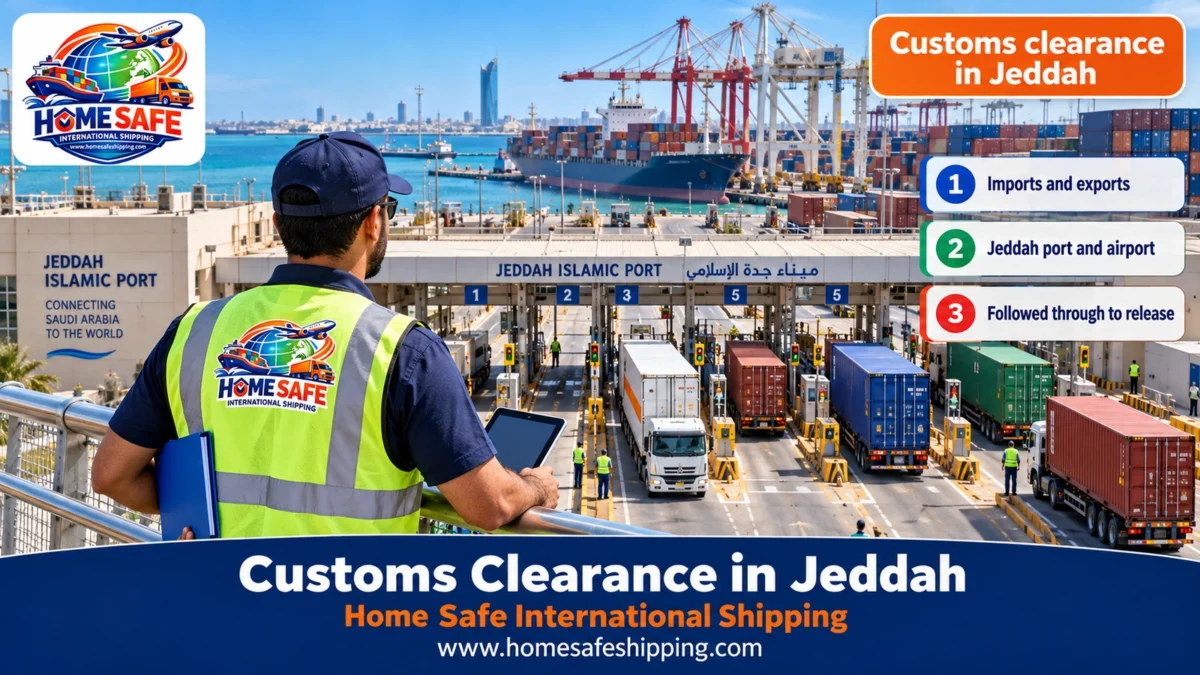
A customs clearance service in Jeddah for imports and exports at Jeddah Islamic Port and King Abdulaziz Airport, handled through licensed brokers and followed up until release and delivery to the door. We review the documents before shipping and clear commercial goods, personal effects, furniture an…
Home Safe’s customs clearance in Jeddah service covers imports and exports at Jeddah Islamic Port and King Abdulaziz International Airport. We review your documents before the shipment moves, the declaration is then submitted through licensed customs brokers, and we follow up until release and delivery to your door. A complete file is usually released within one to three days. Clearance fees start from SAR 275 for a simple shipment, SAR 460 for a medium one and SAR 1,380 for a complex or large one, with government charges added according to the commodity. For enquiries and bookings: 0552803439.
In this guide46ShowHide
- What is customs clearance and who needs it in Jeddah?
- Why correct customs clearance matters for your trade
- Jeddah’s customs gateways: the port and the airport
- The role of the licensed customs broker and the role of Home Safe
- Import clearance at Jeddah Islamic Port: container inspection and collection
- The steps of import customs clearance
- Import documents required
- The FASAH platform and electronic authorisation
- SABER, conformity certificates and the restricting authorities
- Customs duty and value added tax
- Customs clearance prices in Jeddah
- How long customs clearance takes and what lengthens it
- Storage charges and container delay penalties
- Export clearance: export documents and certificates in Jeddah
- Clearing personal effects and household furniture
- Clearing inbound and outbound cars
- Parcels and personal purchases from abroad
- Customs restrictions: prohibited and restricted goods
- Air cargo clearance at King Abdulaziz Airport
- International shipping services from Jeddah: sea, air and land
- Temporary admission, re-export and transit
- After release: transport, storage and delivery to the door
- Common clearance challenges and how we deal with them
- Tracking, insurance and objecting to a customs decision
- Tips to make customs clearance in Jeddah easier
- How do you choose a reliable shipping and customs clearance company?
- Common mistakes in customs clearance
- Why Home Safe for customs clearance in Jeddah?
- Related articles and pages
- Tags
- Frequently asked questions about customs clearance in Jeddah
- How much does customs clearance in Jeddah cost?
- How long does customs clearance take at Jeddah Islamic Port?
- Which documents are needed to clear an import shipment?
- Is Home Safe a licensed customs broker?
- What is the FASAH platform and do I need an account on it?
- How much are customs duty and VAT on imports?
- Are personal effects and used furniture exempt from duty?
- What are the conditions for importing a used car into Saudi Arabia through Jeddah?
- Are duties charged on a small personal parcel arriving from abroad?
- What are storage charges and how do I avoid them?
- What is the difference between import clearance and export clearance?
- Do you clear air shipments at King Abdulaziz Airport?
- What do I do if customs asks for a missing document or reassesses the value?
- Can a shipment be cleared before the vessel arrives?
- Which commodities need a permit before release?
In brief
- Where we clear: Jeddah Islamic Port for containers and cars, and King Abdulaziz Airport for air cargo.
- What we clear: inbound and outbound commercial goods, personal effects and household furniture, and cars.
- How: the declaration is submitted electronically on the FASAH platform by a licensed broker, while we prepare the file and follow it.
- Time: one to three days for a complete file, longer if there is an inspection or a missing document.
- Fees: start from SAR 275 for a simple shipment; government charges are calculated on the commodity and its value.
- Government charges: 5% customs duty on most goods and 15% VAT.
- The key rule: documents and conformity are reviewed before shipping, not after the container arrives.
What is customs clearance and who needs it in Jeddah?
Customs clearance is the set of procedures that settles a shipment’s status with customs so that it is allowed to enter the Kingdom or leave it. It begins with declaring the goods in a customs declaration, passes through document review, classification of the commodity and payment of what is due, and ends with the release permit. Every shipment that crosses the border goes through it, whether it is a trader’s container or a traveller’s carton.
In Jeddah five kinds of people need it: an importer waiting for goods at the port, an exporter sending a product abroad, a family that has returned to the Kingdom or moved to it with its furniture, a buyer who has bought a car abroad, and an individual whose air parcel has been held by customs to complete its details. Each has a different file and different papers, and the sections below go through them.
Why correct customs clearance matters for your trade
A clearance mistake does not show on the broker’s invoice. It shows in storage charges building up on a standing container, in a fine for an inaccurate declaration, and in seasonal goods reaching the market after their season. Good clearance is therefore measured by what did not happen: no extra day at the port, no duty paid unduly, no shipment sent back.
- Saving time: a file reviewed before shipping is released the same day; a file corrected after arrival waits for days.
- Controlling cost: classifying the commodity under its correct heading avoids paying a higher duty and avoids a later claim for the difference.
- Regulatory compliance: an accurate declaration of value and origin protects the business from fines and from tighter scrutiny of its next shipments.
- A clear date: whoever knows when the goods will be released can promise the customer a date that can be kept.
Jeddah’s customs gateways: the port and the airport
Jeddah has two main customs gateways. Jeddah Islamic Port on the Red Sea is the Kingdom’s largest port and the gateway for most of its seaborne imports, with container terminals and berths for cars and general cargo. King Abdulaziz International Airport has a cargo village that receives inbound and outbound air shipments. Land freight has no border post in Jeddah, so its trucks are cleared at the land crossing they pass through.
| Gateway | What is cleared there | What sets it apart |
|---|---|---|
| Jeddah Islamic Port | Full and shared containers, cars, bulk cargo and equipment | Large volumes, and limited free days after which storage is charged |
| King Abdulaziz International Airport | Commercial air cargo, parcels, unaccompanied baggage, samples | A quicker procedure, with storage charged by weight after a short grace period |
| Land crossings outside Jeddah | Trucks from the Gulf, Jordan and elsewhere | Clearance at the border, then transport to Jeddah |
All the gateways are detailed on the ports and gateways page.
The role of the licensed customs broker and the role of Home Safe
Submitting a customs declaration on behalf of others is a licensed profession, practised only by a broker holding a licence from the Zakat, Tax and Customs Authority. Home Safe is a logistics services establishment that carries out clearance through licensed brokers it works with at the port and the airport. You therefore get one continuous service, shipping, clearance and transport, and one person to ask.
| Task | Who does it | What you gain |
|---|---|---|
| Reviewing documents before shipping | The Home Safe team | The mistake is corrected at the supplier, not at the port |
| Setting the tariff heading and estimating duties | The licensed broker with our team | You know what you will pay before the shipment arrives |
| Submitting the declaration on FASAH | The licensed broker, authorised by you | A lawful declaration in your business’s name |
| Attending the inspection if requested | The broker’s representative | The container is opened and closed in front of someone who represents you |
| Following up with the competent authorities | The Home Safe team and the broker | The file does not stall on a missing permit |
| Transport and delivery after release | The Home Safe team | The shipment goes from the gate straight to your warehouse |
Advice is part of the service: before you buy, we tell you whether the commodity is restricted, which certificate it needs and roughly how much duty it carries. The service is explained on the customs clearance page.
Import clearance at Jeddah Islamic Port: container inspection and collection
An inbound container follows a clear path at the port. It is discharged from the vessel to the yard, and the customs risk system decides what happens to its declaration: direct release, document review or inspection. Inspection may be by X-ray with the container closed, or manual, with the box opened and the goods matched against the documents by commodity, quantity and origin. Having the broker’s representative present when it is opened protects your rights if a shortage or damage is found.
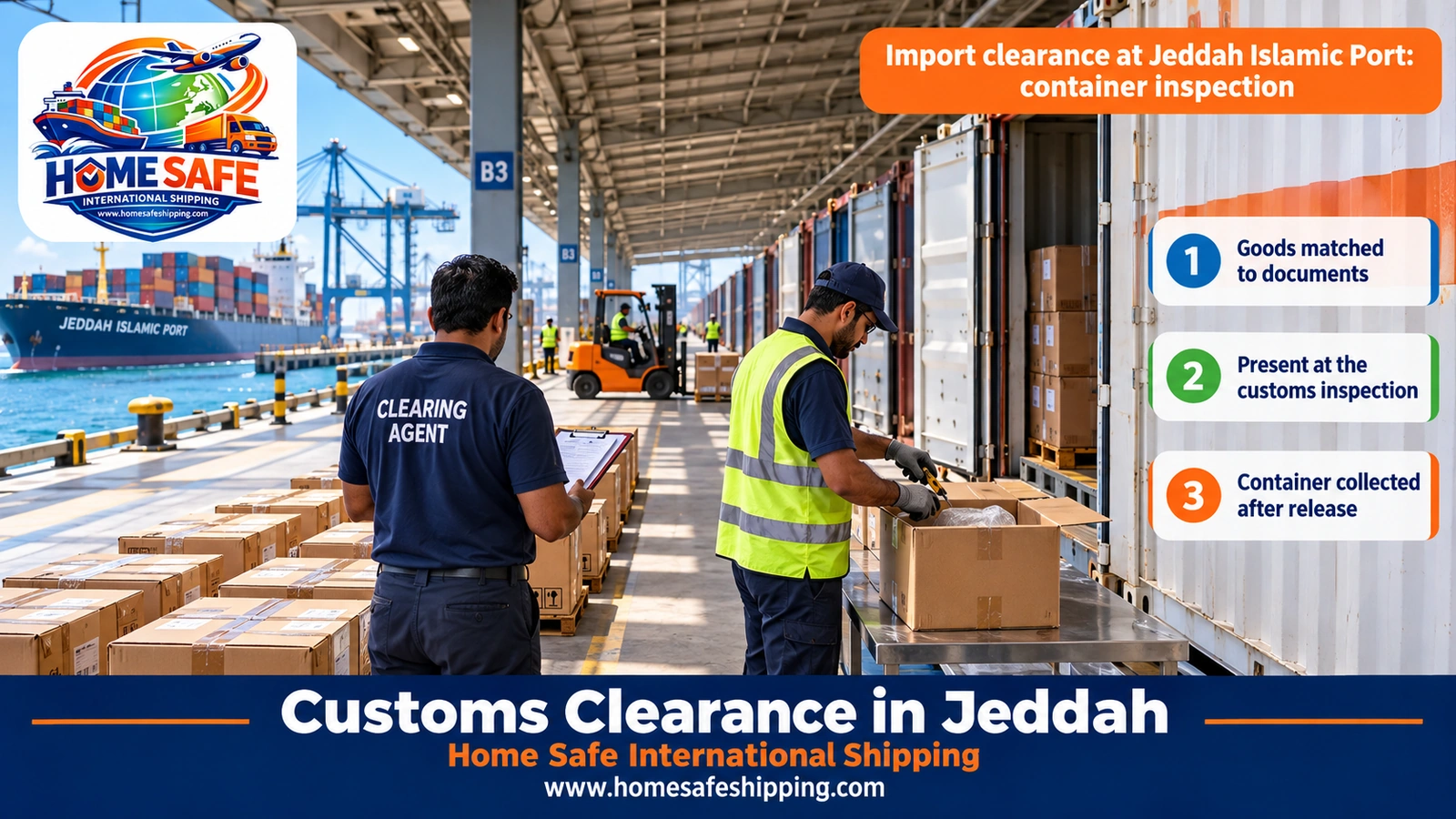
| Stage | What happens | Typical time |
|---|---|---|
| Vessel arrival and container discharge | The vessel is unloaded and the container is logged in the yard | 12–24 hours |
| Direct release | Matching documents and no inspection | One to two days |
| Document review | A clarification or an extra document is requested | 2–4 days |
| Physical inspection or laboratory | The container is opened or a sample is drawn | 5–10 days |
| Collecting the container after release | A truck appointment, then exit through the gate | One to two days |
These are the times people working at the port commonly quote, not a commitment from anyone. After release the container is handed to the truck on a booked appointment, unloaded at your warehouse and returned empty to the shipping line’s depot within its allowance.
The steps of import customs clearance
The order matters as much as the papers themselves. Most of the steps come before the vessel arrives, and what remains after arrival is the shortest part when the earlier work has been done:
- You send copies of the documents: the invoice, packing list and draft bill of lading, on 0552803439, before the supplier ships.
- We review and classify: we match the papers against one another and identify the tariff heading and any certificates or permits the commodity needs.
- Conformity certificates and permits are obtained: through SABER and the competent authorities, while the goods are still with the supplier.
- You authorise the broker: an electronic authorisation on FASAH for businesses, or an authorisation with your ID for a personal shipment.
- The declaration is submitted early: while the vessel is at sea or before the aircraft takes off, with the documents uploaded.
- You pay the duty and VAT: against a SADAD bill in your name, so the amount goes directly to the government body.
- Review and inspection: if an inspection is requested the broker’s representative attends, and if a document is requested it is uploaded the same day.
- Release and delivery: the release is issued, we book the truck appointment and deliver the shipment to your address.
Import documents required
Customs reads the shipment from its papers before seeing it. The rule on which most files fail is consistency: the description, quantity, weight and value on the invoice must agree with the packing list and the bill of lading word for word. A difference in a single word is enough to move a declaration from direct release to inspection.
| Document | Who issues it | What is checked in it |
|---|---|---|
| Commercial invoice | The supplier | A clear description of each item, value and currency, terms of sale, country of origin |
| Packing list | The supplier | The number of packages, their weights and what each contains |
| Certificate of origin | The chamber or competent body in the exporting country | That it agrees with the origin marked on the goods themselves |
| Bill of lading | The shipping line or the airline | The importer’s name as in its registration, the container number and the weight |
| Delivery order | The carrier’s agent in Jeddah | Issued once the carrier’s local charges are settled |
| Conformity certificate | An accepted body through the SABER platform | For products covered by technical regulations |
| Permit from the competent authority | Depends on the commodity | Food, medicines and cosmetics, communications, agriculture and others |
| Commercial registration and tax number | The importer | An activity that matches what is imported |
The goods themselves must carry a permanent, non-removable mark of origin, such as a “Made in” statement engraved or printed on the product. Its absence is a recurring violation, and the remedy is at the supplier before packing. The documents for each type of shipping are on the shipping documents page.
The FASAH platform and electronic authorisation
FASAH is the electronic window where the parties to a shipment meet: customs, the port, the broker, the carrier and the permit-issuing authorities. Through it the declaration is submitted, the documents are uploaded, the charges are paid, the shipment’s status is followed and the truck’s entry appointment to the port is booked. Clearance is no longer a queue at a counter; it is a file that moves on a screen.
A commercial importer registers the business on the platform and then gives the broker a specific electronic authorisation, which can be cancelled at any time. A late authorisation is a well-known reason for a declaration to stall on its first day. The practice currently applied is also that the vessel’s cargo manifest is submitted ahead of arrival by a period set by the Authority, so customs starts studying the shipment before the ship berths. We confirm the procedure in force when we open your file.
SABER, conformity certificates and the restricting authorities
Not every consignment is released on an invoice and a bill of lading. Products covered by Saudi technical regulations, such as electrical appliances, toys, building materials and car spare parts, need two certificates through the SABER platform: a product conformity certificate issued once and valid for a set period, and a shipment certificate issued with each consignment. What no regulation covers usually only needs a self-declaration by the importer on the same platform.
| Commodity | Authority | Required before shipping |
|---|---|---|
| Electrical appliances, toys, building materials, spare parts | The standards organisation through SABER | Product conformity certificate, then shipment certificate |
| Food, medicines, cosmetics, medical devices | Saudi Food and Drug Authority | Registration of the product or the establishment and a release permit |
| Phones, wireless and network devices | Communications, Space and Technology Commission | Type approval of the device |
| Plants, seeds, feed, live animals | Ministry of Environment, Water and Agriculture | Import permit and health certificate |
| Books, printed matter and media material | The media regulator | Content clearance |
| Chemicals and hazardous materials | The competent security and environmental bodies | Prior permit and the material’s safety data |
An importer who ships first and asks about the certificate afterwards pays for the late question in storage charges. The certificate needs test reports from the factory, and a factory is in no hurry once it has been paid for its goods.
Customs duty and value added tax
Two amounts are paid to the state on an inbound shipment. Customs duty is a percentage of the value of the goods plus freight and insurance: 5% for most goods, zero for exempt commodities, and higher for commodities that have a local alternative. Then comes VAT at 15%, calculated on the value after the duty has been added. Some goods, such as tobacco and energy drinks, carry excise tax on top.
| Item | How it is calculated | Example for a shipment worth SAR 100,000 delivered to Jeddah |
|---|---|---|
| Customs duty | 5% of the value including freight and insurance | SAR 5,000 |
| Value added tax | 15% of the value plus the duty | SAR 15,750 |
| Total to the state | Duty plus VAT | SAR 20,750 |
A VAT-registered business recovers import VAT in its return in line with the law. Goods of Gulf origin enter free of customs duty when they meet the rules of origin and travel with a valid certificate, and the same goes for what the Arab trade agreements cover, on their conditions. The certificate of origin may well be the most valuable paper in the file.
Customs clearance prices in Jeddah
A clearance invoice contains what is ours and what belongs to others, and we write each on its own line. The clearance fee is a fixed amount that follows the number of items in the declaration and the follow-up it needs. The rest are amounts paid to customs, the port and the carrier against their own bills, and we add nothing to them.
| Service | Example | Price starts from |
|---|---|---|
| Clearance fee, simple shipment | A declaration of one to three items with no special permits | SAR 275 |
| Clearance fee, medium shipment | Several items, or a conformity certificate to follow up | SAR 460 |
| Clearance fee, complex or large shipment | Several containers, restricted commodities or a lengthy inspection | SAR 1,380 |
| Clearing an inbound or outbound car | Depends on its condition and documents | Set on request |
| Clearing personal effects and household furniture | Depends on volume and whether an exemption applies | Set on request |
| Transport from the port or airport to the address | Depends on the city and the size of the shipment | Set on request |
| Government charges, port and carrier fees | Against their original bills | According to commodity and value |
Prices quoted in the market: what is published about brokers’ fees in the Kingdom puts a simple shipment between SAR 300 and 500, a medium one between SAR 500 and 1,000, and a complex or large one between SAR 1,500 and 3,000, sometimes more. Some offices charge their fee as a percentage of the shipment’s value. Most Jeddah offices publish no figure at all and give the price only by phone. Our prices above sit below the lower end of these ranges.
| Factor | Its effect on cost |
|---|---|
| Number of items in the declaration | Each item is a line to classify and review, so a long declaration costs more |
| Permits and certificates | A restricted commodity needs follow-up with a body other than customs |
| Inspection | Opening and unloading the container for inspection carries handling charges at the port |
| Readiness of documents | An incomplete file turns into days, and days into storage charges |
| Shipping method | A shared container is sorted in a warehouse before your share is cleared |
| Value and heading of the goods | These are the basis of duty and VAT, the largest amount in the file |
How do you cut the cost? Group similar items under as few lines as possible. Ask the supplier for a certificate of origin that earns the exemption if their country is covered by an agreement. Complete conformity before shipping. Collect the container within its free days and return it empty within its allowance. These four save more than the difference between one broker and another. The price components are explained on the pricing factors page.
How long customs clearance takes and what lengthens it
The short answer: one to three days for a complete file. The precise answer depends on the type of shipment and its path through customs: an air shipment is quicker than a container, an export is quicker than an import, and a restricted commodity is slower than the rest.
| Type of shipment | Typical time to release | Note |
|---|---|---|
| Inbound container with matching documents | One to two days | Less when the declaration is filed before arrival |
| Container referred for inspection | 5–10 days | Depends on the type of inspection and the laboratory result |
| Inbound air shipment | The day of arrival or the next day | After the delivery order is issued |
| Outbound shipment | Usually the day the declaration is filed | Before the vessel or flight cut-off |
| Personal effects and furniture | Two to five days | Normally inspected against the inventory |
| Inbound car | 3–7 days | Includes the conformity check |
What lengthens the time? A description that differs between the bill of lading and the invoice, a conformity certificate that has not been issued, an authorisation that has not been activated, a delivery order held by the carrier’s agent over unpaid charges, and a declared value that customs considers below the real one. The peak seasons before Ramadan and Hajj add pressure on the whole port. Transit times by shipping method are compared on the transit times page.
Storage charges and container delay penalties
Time at the port has a price. Every container has a few free days set by the port tariff; once they pass, the daily storage meter starts, and it rises the longer the stay. The shipping line runs another meter on its box: an allowance to take it out of the port and an allowance to return it empty. An importer who budgets for the ocean freight and forgets these two meters is surprised by a bill that was never in the plan.
| Charge | Who applies it | When it starts | How to avoid it |
|---|---|---|---|
| Port storage | The terminal operator | After the free storage days | An early declaration and a truck booked the moment release is issued |
| Container delay inside the port | The shipping line | After its free period | Paying the carrier’s charges and obtaining the delivery order early |
| Late return of the empty container | The shipping line | After the return allowance | Unloading on the day of collection and returning at once |
| Air cargo storage | The cargo village operator | After a short grace period, charged by weight | Clearance on the day of arrival |
The free days and the daily rate change with the tariff and the shipping line, so we state them in the booking confirmation for your own shipment and do not print here a figure that may change.
Export clearance: export documents and certificates in Jeddah
Exporting is lighter on paper than importing, because in principle no customs duty applies to what leaves the Kingdom. Lighter paperwork does not mean none, though. The arrival country decides what the consignee needs in order to clear there, and if a paper is missing the goods are stuck at a distant port, not in Jeddah. That is why we ask about the destination’s requirements before preparing the exit papers.
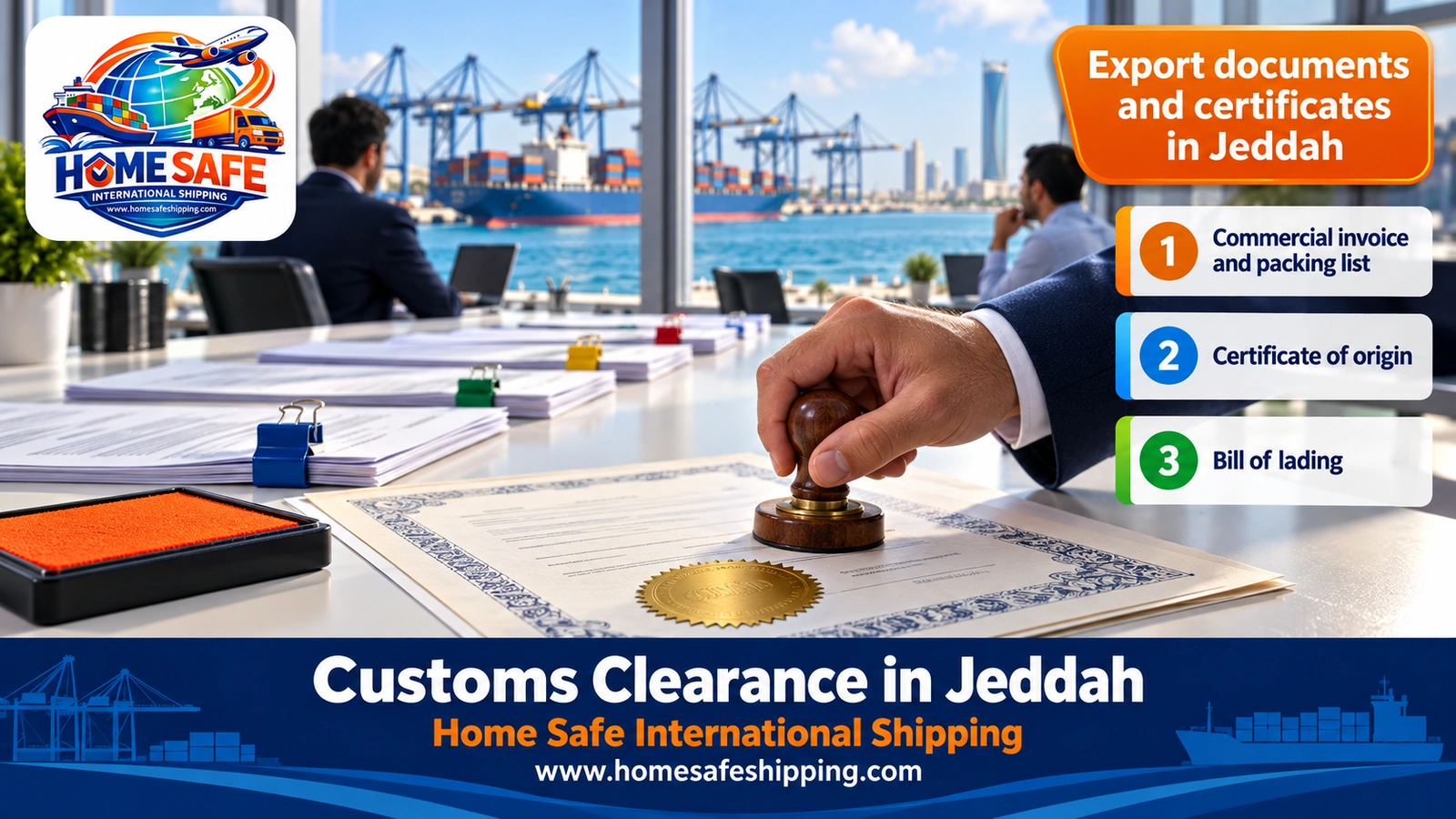
| Document | Its purpose | Note |
|---|---|---|
| Commercial invoice | The basis of customs valuation in the arrival country | With description, value and terms of sale |
| Packing list | Details of packages and weights | Matches the invoice and the bill of lading |
| Certificate of origin | Proof of Saudi origin and access to exemptions | Issued electronically by the competent body |
| Bill of lading | The contract of carriage and title to the goods | Issued after the shipment is loaded |
| Export declaration | The customs exit permit | Filed on FASAH before entry to the port or airport |
| Special certificates | Health, agricultural or conformity certificates the arrival country asks for | Depends on commodity and destination |
Some goods may not be exported or are restricted: state-subsidised goods such as fuel and flour, antiquities, Zamzam water other than the traveller’s dedicated pack, and anything needing its authority’s permit. An exporter needs a commercial registration, whereas an individual exports personal effects on an ID or residence permit. The service for traders is on the commercial shipping page.
Clearing personal effects and household furniture
Someone returning to the Kingdom after years abroad and someone arriving on a work contract ask the same question: do I pay customs on my household furniture? The answer currently applied is that used personal effects and household items are exempt from duty when specific conditions are met. We go through those conditions with you before the container is closed in the country of departure.
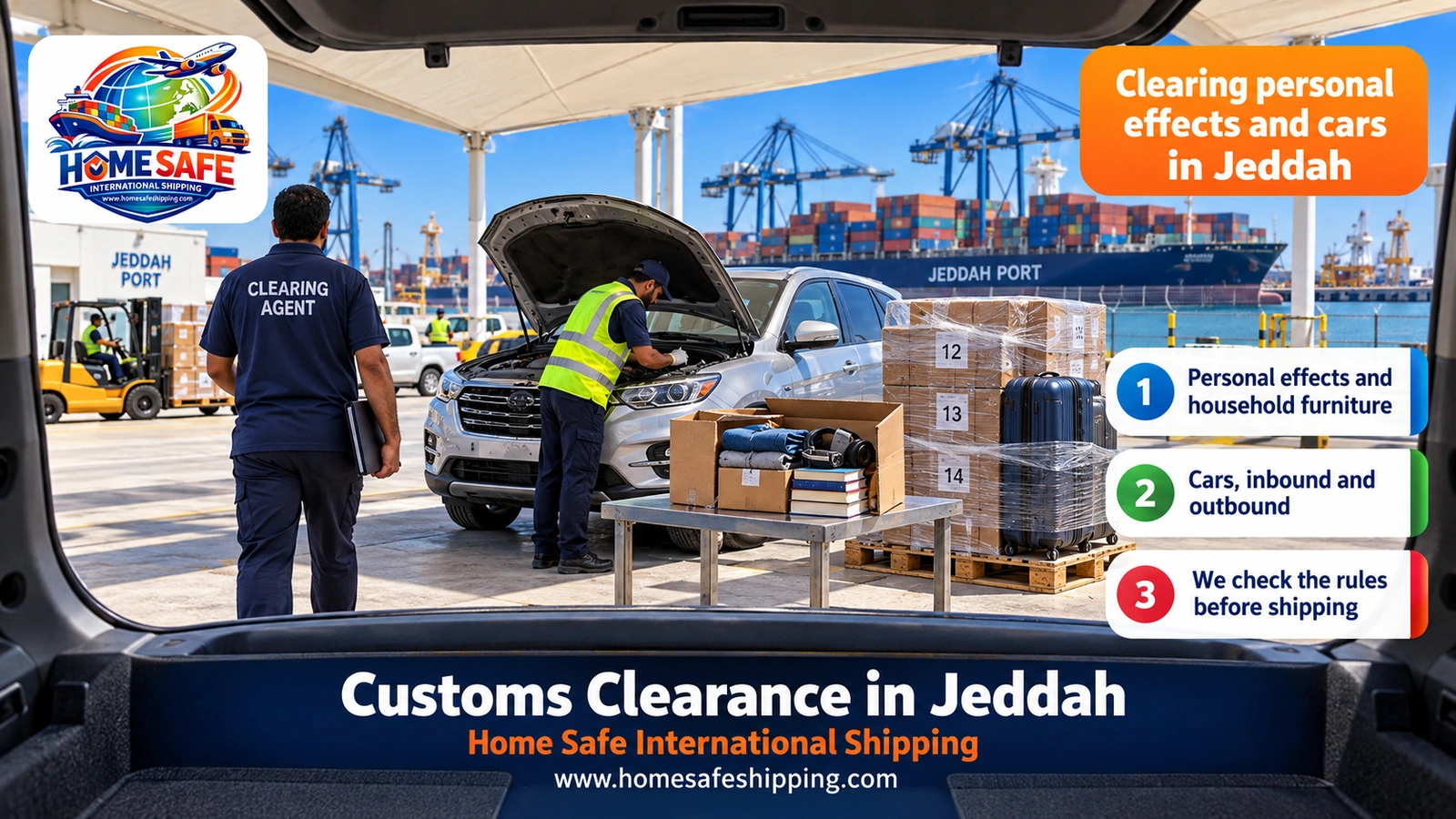
| Condition | Detail |
|---|---|
| Who qualifies | A citizen living abroad on return, and a foreigner arriving to reside in the Kingdom for the first time |
| Condition of the items | Used, and within personal use, not in commercial quantities |
| Where they come from | The owner’s country of residence |
| When they arrive | Within six months of the owner’s arrival |
| What is not covered | Cars, and prohibited and restricted commodities |
| Documents | Passport, ID or residence permit; proof of residence abroad or of first arrival; bill of lading and delivery order; an inventory |
Whatever does not meet the conditions is charged duty and VAT according to its commodity, such as new furniture still in its cartons or an unused appliance. So do not mix new and used in one vague list. Write the inventory item by item and mark anything new, because a clear list shortens the inspection. We confirm the conditions in force before shipping, as they are updated. The service is detailed on the furniture shipping page.
Clearing inbound and outbound cars
A car is the personal shipment with the most conditions, and the costliest mistake is to ship it and then find the Kingdom will not accept it. Our rule is the car’s details first, then the booking. We ask for a copy of the registration, the chassis number, the model year and the specification market, and tell you whether it can enter and roughly what you will pay.
| Item | Car entering the Kingdom | Car leaving the Kingdom |
|---|---|---|
| Age rule | Currently, passenger cars and light trucks no older than five years, heavy trucks no older than ten | Set by the arrival country, not the Kingdom |
| Condition | Left-hand drive, not written off or flood-damaged, not a former taxi or police car | No fines and no outstanding lien |
| Conformity | Certificate of conformity to Saudi specifications and a fuel economy label | Whatever specification the arrival country requires |
| Amounts due | 5% customs duty and 15% VAT on the assessed value | No export duty; fines are settled |
| Documents | Title or purchase invoice, export certificate from the country of origin, bill of lading, owner’s ID | Registration, export plates from the traffic department, owner’s ID, lender’s release |
Customs assesses a used car’s value by its own method, not only by what the purchase invoice says. The conditions above are those currently applied, and we confirm what is in force before shipping. Car shipping methods and prices are on the car shipping page and in the article car shipping from Saudi Arabia.
Parcels and personal purchases from abroad
When you buy from a shop outside the Kingdom, your parcel passes through customs just as a container does, but under a simplified procedure usually handled by the express carrier. The rule currently applied is that a personal shipment whose value together with its freight is below one thousand riyals is exempt from customs duty, while 15% VAT still applies. Anything above that threshold carries both duty and VAT.
A parcel is usually held for one of three reasons: incomplete consignee details, a missing purchase invoice, or a commodity that needs a permit, such as a food supplement, a wireless device or cosmetics in a quantity beyond personal use. If you receive a notice to complete details, send it to us with the invoice and we will guide you to what is required. The parcel service is on the parcel shipping page.
Customs restrictions: prohibited and restricted goods
Restrictions are of two kinds that people confuse. Prohibited goods neither enter nor leave on any paper, and end in confiscation or return with a fine. Restricted goods are allowed on condition of a permit obtained before shipping. The common mistake is to treat a restricted item as ordinary and ship it without its permit, so that at the port it is as good as prohibited until the permit is issued or it is re-exported.
| Category | Examples | Ruling |
|---|---|---|
| Strictly prohibited | Narcotics, alcohol, pork and its products, gambling devices, material contrary to public morals | Not released |
| Counterfeit and fraudulent | Goods with a forged trademark or a false origin | Seized, and the importer is fined |
| Weapons and similar items | Arms and ammunition, drones, eavesdropping devices | Prior security permit, or not released |
| Food, medicines and cosmetics | Food, supplements, medicines, medical devices | Restricted, with the competent authority’s permit |
| Products subject to standards | Electrical appliances, toys, tyres | Restricted, with a conformity certificate |
| Used goods barred from commercial import | Used tyres and some used appliances | We check the commodity before shipping |
The lists are updated, and imports from some countries are restricted at particular times. Someone who imports a material for a factory without asking about its restriction may find it refused at the port because its documents do not meet a regulation issued since the last shipment. The general list is on the prohibited items page.
Air cargo clearance at King Abdulaziz Airport
An air shipment arrives in hours, so there is no sense in it waiting days in a warehouse. At King Abdulaziz International Airport in Jeddah the inbound shipment is moved from the aircraft to the cargo village, the arrival notice is issued, the delivery order is obtained from the airline and the declaration is submitted. When the papers are uploaded before the flight lands, the shipment is released the same day or the next, and we collect it and deliver it to the door.
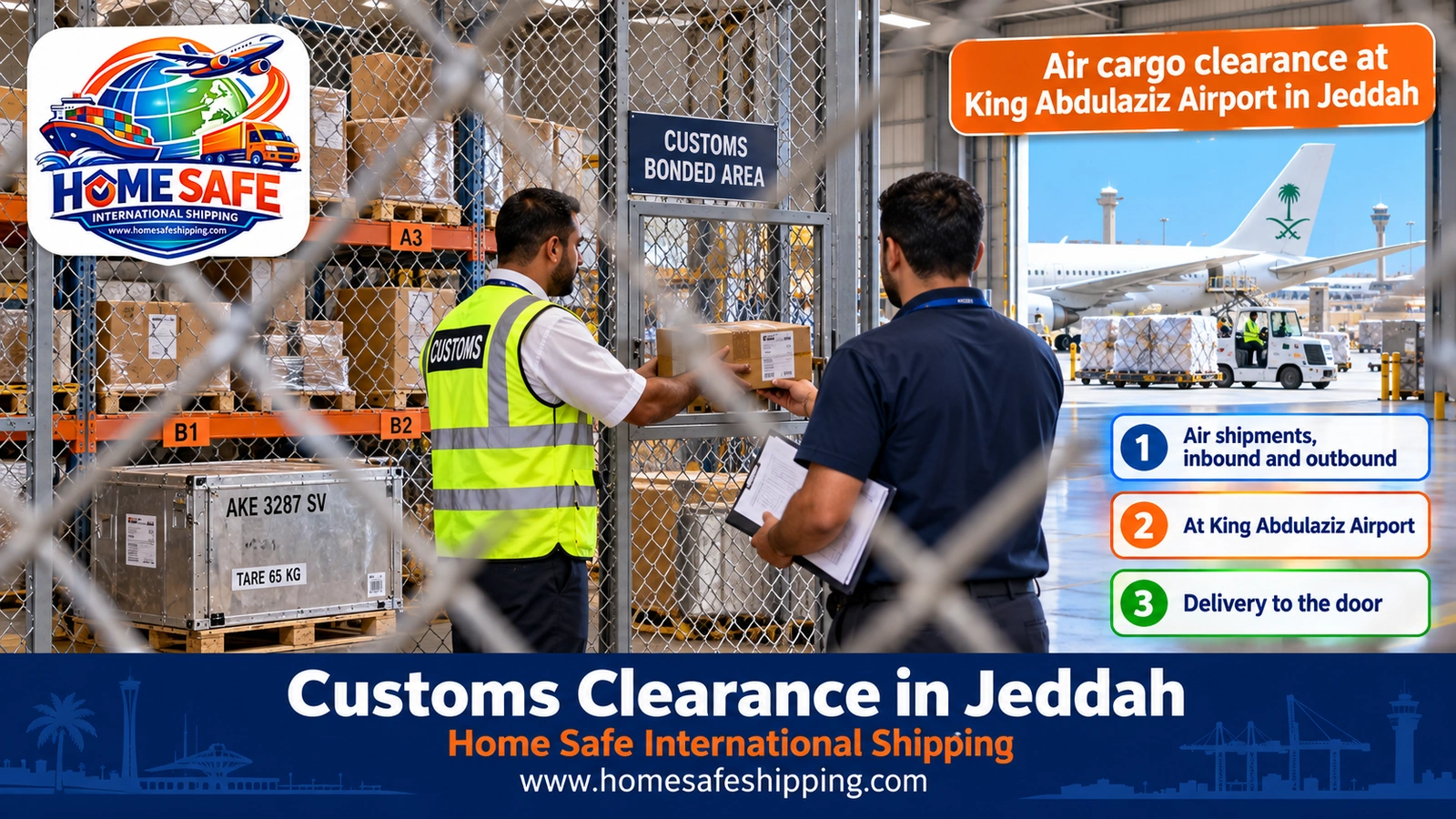
Air differs from sea in three respects. The grace period in the airport warehouse is shorter, and storage after it is charged by weight. Hazardous items such as batteries, perfumes and aerosols have carriage requirements that come before customs. And small shipments and samples have a simplified procedure quicker than a full declaration. For outbound air cargo we hand the shipment to the cargo village before the cut-off, where it is security-screened, its declaration is released and it is loaded.
For those shipping by air from Jeddah with Home Safe, the price starts from SAR 14 per kilogram to nearby destinations and SAR 23 per kilogram to Europe, charged on the greater of actual and volumetric weight. Details are in the article air freight office in Jeddah and on the air freight page.
International shipping services from Jeddah: sea, air and land
Clearance is one link in a chain, and the other links are transport. Whoever takes shipping and clearance from one party is not left standing between a carrier who says it has delivered and a broker who says it has not received. Jeddah brings the three methods together: a port on the Red Sea, an international airport, and roads to the Gulf and the Levant.
| Method | Suits | Where it is cleared | Price starts from |
|---|---|---|---|
| Sea freight | Large quantities, furniture, cars and heavy goods | Jeddah Islamic Port | SAR 4,600 for a 20ft container to nearby ports |
| Air freight | Urgent, valuable and perishable goods | King Abdulaziz Airport | SAR 14 per kilogram |
| Land freight | The Gulf states, Jordan and their neighbours | The land border crossing | SAR 140 per carton |
| Car shipping by sea | A saloon car by RoRo | Jeddah Islamic Port | SAR 2,800 |
Sea is cheaper for large volumes and takes longer, air is quicker and dearer, and land is the most flexible and delivers door to door without changing vehicle. Each method is explained on the sea freight and land freight pages and in the article international shipping services from Jeddah.
Temporary admission, re-export and transit
Not all goods that enter the port are heading for the market. Equipment comes for a project and goes back, samples come for an exhibition, a container passes through Jeddah on its way to another country, and refused goods are re-exported. For these cases there are customs regimes under which duties are suspended against a guarantee, provided the goods leave within their period and in their original state. Choosing the right regime from the start avoids paying a duty that is recovered only with difficulty.
Transit goods are treated differently from imports and have their own documents and route. What is admitted temporarily is followed until its exit is proven, and if it stays beyond its period its duties fall due. We identify the most suitable regime once we know the purpose of the shipment and how long it will stay. For those travelling between countries with their car, see the Triptik carnet page.
After release: transport, storage and delivery to the door
The issue of the release is not the end of the service. The container is still at the port and the meter is running. We book the truck appointment through the platform, take the container out to your warehouse in Jeddah, Makkah or any other city, unload it and return it empty to the shipping line’s depot. An air shipment or a shared-container consignment is delivered by a vehicle sized to it.
If your warehouse is not ready, we store the goods for a short period until they are distributed, which is far cheaper than leaving them at the port. Details are in the article goods storage in Jeddah and on the door-to-door shipping page.
Common clearance challenges and how we deal with them
Every importer has been through at least one of these situations. The difference between a one-day delay and a two-week delay is how quickly the cause is known and whether the paper that solves it is to hand. Here is what recurs at Jeddah port and the airport, and what we do in each case.
| Problem | Its usual cause | The solution |
|---|---|---|
| The declaration was referred for inspection | A difference in description or weight, or a high-risk commodity | Attending the inspection with a detailed packing list and loading photos |
| A conformity certificate was requested | The product is covered by a regulation and was not registered | Obtaining it urgently with the factory’s test reports |
| The value was reassessed | An invoice price below the norm for the commodity | Submitting the purchase contract and proof of the bank transfer |
| The mark of origin is missing | The product has no permanent origin statement | A formal remedy decided by customs, and a warning to the supplier for next time |
| The delivery order was not issued | Unpaid local carrier charges, or an original bill of lading that has not arrived | Early payment and a request for electronic release of the bill of lading |
| A commodity was refused | Prohibited, or not conforming to the standard | Re-exporting it to the supplier within its period |
Tracking, insurance and objecting to a customs decision
The status of the declaration is followed on the platform step by step: submitted, under study, referred for inspection, released. We send you these milestones on WhatsApp without your asking, together with whatever is required of you if anything is. The shipment’s position before arrival is on the shipment tracking page.
Insurance covers the goods in transit, not before customs. It compensates for transport and handling damage, and does not compensate for a duty, a fine or a confiscation. It is worth extending cover beyond discharge to the warehouse door, since inspection and unloading are among the stages with the most handling. The limits of cover are stated in the booking confirmation and explained on the cargo insurance page. If you disagree with customs over a classification or a value, the importer has the right to object through the formal route within its time limit, and we prepare with you the documents that support it.
Tips to make customs clearance in Jeddah easier
- Prepare the papers before shipping: ask the supplier for drafts of the invoice and bill of lading and check them before they are issued as final.
- Know the rules for your commodity: ask about the tariff heading, certificates and permits before you pay for the goods.
- Write the description in plain terms: “spare parts” is not enough. Give the part’s name, its material and its use.
- Declare the real value: an undervalued invoice brings a reassessment, a fine and scrutiny of what follows.
- Plan around the seasons: the weeks before Ramadan and Hajj are the peak, so bring your shipment forward by two or three weeks.
- Keep your phone reachable: a customs request is answered within the hour, and every delay in replying is a day at the port.
- Keep a file for every shipment: the declaration, invoices and payment receipts are asked for in a tax review years later.
How do you choose a reliable shipping and customs clearance company?
Reputation, experience, support and technology are words everyone writes about themselves. What marks out a serious provider is what it asks you in the first call and what it puts in writing before you pay. Try these questions and compare the answers.
| Ask about | A reassuring answer | An answer that calls for caution |
|---|---|---|
| The licence | Names the licensed broker in whose name the declaration is filed | “We know people at customs” |
| The commodity | Asks for the description and photos to identify the heading and certificates | Gives a price without asking what you import |
| Invoice lines | Separates its fee from government charges and port fees | One “all-inclusive” amount with no breakdown |
| Paying the duties | A SADAD bill in your name that you pay, or that it pays and hands you the receipt | A transfer to a personal account |
| The time | Distinguishes a complete file from an inspection case | “Clearance in an hour” for every shipment |
| Follow-up | Sends the declaration’s status from the platform | “We will call you when it is done” |
Be wary of anyone who promises to get round a regulatory requirement. Whoever gets round it for you today leaves you tomorrow facing a fine in your business’s name, not theirs. A wider guide is in the article international shipping companies in Jeddah.
Common mistakes in customs clearance
- Shipping the goods before making sure the commodity is allowed and which certificate it needs.
- Writing the importer’s name on the bill of lading differently from the commercial registration.
- Relying on a summary invoice that says “miscellaneous goods” without listing the items.
- Leaving the broker’s authorisation until the day the vessel arrives.
- Mixing new furniture in its cartons with personal effects for which an exemption is claimed.
- Leaving the container for days after release because the warehouse is not ready.
- Buying a car abroad before checking its age, specification and condition.
Why Home Safe for customs clearance in Jeddah?
A registered establishment
Home Safe Logistics Services Est., commercial registration 4030601060.
Review before shipping
We read your invoice and bill of lading before the goods leave, so the mistake is fixed where it is easy to fix.
Licensed brokers
The declaration is filed by a broker licensed by the Authority, with the fee kept separate from government charges.
From quay to door
Shipping, clearance, transport and storage with one party, at the port and the airport.
To book: 0552803439 by phone or WhatsApp, from 7 am to 11 pm. Or use the request a quote page.
Related articles and pages
- International sea freight from Jeddah
- Logistics services in Saudi Arabia
- Door-to-door shipping company
- Shipping from Turkey to Saudi Arabia and the Gulf
- Storage
- Shipping services
Tags
customs clearance in Jeddah, customs broker Jeddah, customs clearance company in Jeddah, customs clearance office in Jeddah, customs clearance at Jeddah Islamic Port, customs clearance King Abdulaziz Airport, customs clearance prices in Jeddah, container clearance Jeddah, car clearance Jeddah port, personal effects clearance, customs clearance documents, FASAH platform, SABER certificate, customs duties in Saudi Arabia, international shipping and customs clearance in Jeddah, Home Safe International Shipping
Frequently asked questions about customs clearance in Jeddah
How much does customs clearance in Jeddah cost?
The cost has two parts. The first is the clearance fee, which with us starts from SAR 275 for a simple shipment, SAR 460 for a medium one and SAR 1,380 for a complex or large one. The second is money that goes to others: customs duty according to the commodity, 15% VAT, and the port or airport charges. Ask for an estimate for your shipment on 0552803439.
How long does customs clearance take at Jeddah Islamic Port?
A complete file that needs no inspection is usually released within one to two days of the container being discharged. If a document review is requested the time becomes two to four days, and if the shipment is referred for physical inspection or laboratory testing it can reach five to ten days. These are typical times, not a promise, because the decision belongs to customs.
Which documents are needed to clear an import shipment?
The original commercial invoice, the packing list, the certificate of origin, the sea or air bill of lading, and the delivery order from the shipping line’s agent or the airline. A product covered by technical regulations needs a conformity certificate through SABER, and some commodities need a permit from a competent authority. A commercial importer also needs a commercial registration and a tax number.
Is Home Safe a licensed customs broker?
Home Safe is a logistics services establishment with commercial registration 4030601060, and we carry out clearance through customs brokers licensed by the Zakat, Tax and Customs Authority whom we work with at the port and the airport. Our role is to prepare and review the file before shipping, follow the declaration until release, then transport and deliver. You deal with one party from the first document to the warehouse door.
What is the FASAH platform and do I need an account on it?
FASAH is the electronic platform through which customs declarations are submitted, shipments are followed and truck appointments are booked. A commercial importer registers the business on it and then authorises the broker electronically to act in its name. The owner of a personal shipment usually only needs an authorisation with their ID, and we tell you what your case requires.
How much are customs duty and VAT on imports?
Most goods carry a duty of 5% of their value including freight and insurance; some commodities are exempt and some carry a higher rate to protect local products. VAT of 15% is then calculated on the value after the duty is added. The exact rate is set by the commodity’s tariff heading, which we review with you before you ship.
Are personal effects and used furniture exempt from duty?
Yes, under the conditions currently applied: they must be used and within the limits of personal use, coming from their owner’s country of residence; the owner must be a citizen returning from residence abroad or a foreigner arriving to live in the Kingdom for the first time; and they must arrive within six months of the owner’s arrival. A car is not covered by this exemption. We confirm the conditions in force before shipping.
What are the conditions for importing a used car into Saudi Arabia through Jeddah?
The rule currently applied is that a passenger car or light truck must be no more than five years old from its model year, must be left-hand drive, must not be written off, flood-damaged or a former taxi or police car, and must conform to Saudi specifications. It carries 5% duty and 15% VAT. We review the car’s details before it is shipped.
Are duties charged on a small personal parcel arriving from abroad?
A personal shipment whose value together with its freight is below one thousand riyals is exempt from customs duty, as the Authority has explained, but 15% VAT remains due on imports. Anything above that threshold is charged both duty and VAT. The threshold can be revised, so we confirm it when you ask.
What are storage charges and how do I avoid them?
Storage charges are fees the port or airport applies for every day the shipment stays after the free days end. Alongside them is a charge from the shipping line if the empty container is returned late. You avoid them by preparing the file while the vessel is at sea, completing conformity certificates before shipping, and booking the truck the moment release is issued.
What is the difference between import clearance and export clearance?
An import pays duty and VAT and is subject to conformity with standards and to permits from the competent authorities. An export carries no duty in principle and needs an export declaration, an invoice, a packing list and a Saudi certificate of origin where required, with attention to what may not be exported. Exports are usually quicker because the paperwork is lighter.
Do you clear air shipments at King Abdulaziz Airport?
Yes, both inbound and outbound. We receive the arrival notice and the delivery order from the airline, the declaration is submitted through the licensed broker, and we then collect the shipment from the cargo village and deliver it to your address in Jeddah or beyond. An air shipment is usually cleared on the day it arrives or the next day when its paperwork is ready.
What do I do if customs asks for a missing document or reassesses the value?
A missing document is completed and uploaded against the same declaration, and every passing day counts against the free days, so speed here is money. If customs considers the declared value below the real one, it asks for proof such as the purchase contract and evidence of the bank transfer. The importer has the right to object through the formal route, and we prepare the supporting file with you.
Can a shipment be cleared before the vessel arrives?
Yes, and it is what we recommend. The documents are uploaded and the declaration is submitted while the vessel is still at sea, so that when the container is discharged the release decision is ready or close. The condition is that copies of the documents arrive from the supplier early and that the bill of lading matches the invoice in description, weight and quantity.
Which commodities need a permit before release?
Food, medicines, cosmetics and medical devices through the Saudi Food and Drug Authority; wireless communication devices through the communications authority; plants, seeds and animals through the Ministry of Environment, Water and Agriculture; and printed and media material through its regulator. The permit is obtained before shipping, not after arrival.
That is the guide — now let us price your shipment
Choose what applies to you and receive a reply with the price, the method and the time.
RoRo, container or sling lift — we recommend what suits your vehicle’s value and its destination.
Get a vehicle priceA full or shared container, or urgent air freight, with packing and clearance.
Get a shipment priceRoutes in the same section
Options related to the same type of service.