Logistics Services in Saudi Arabia 0552803439 | Warehousing, Land, Sea and Air Transport, Customs Clearance and Car Shipping
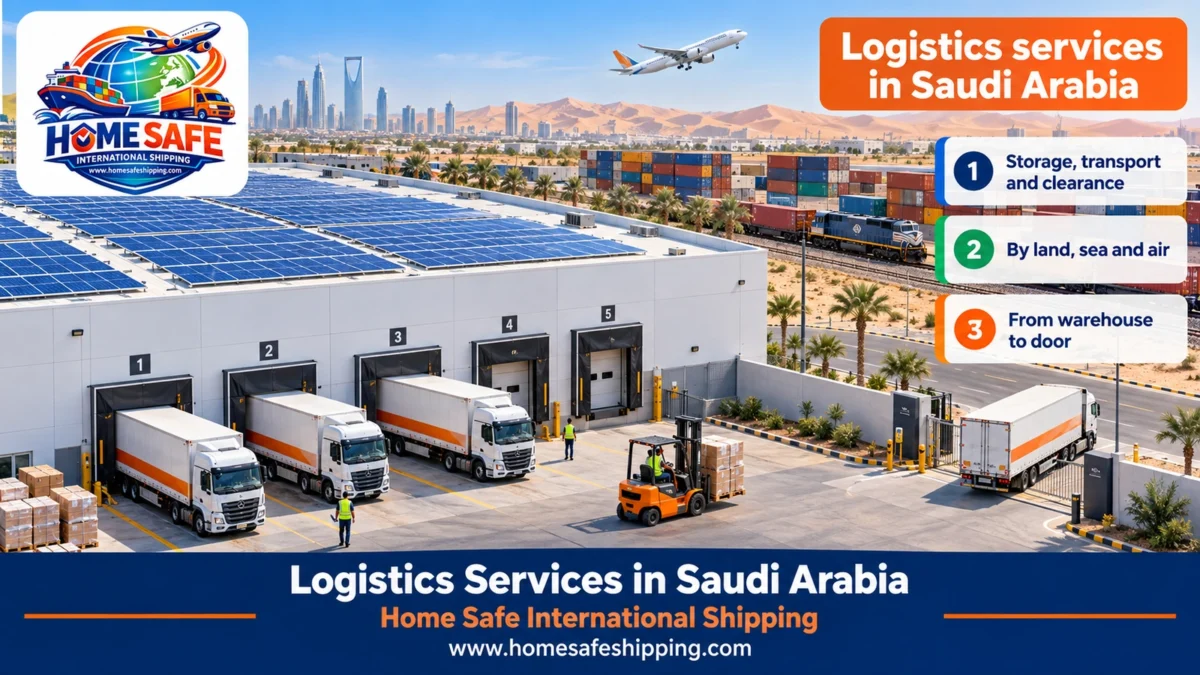
Logistics services in Saudi Arabia for companies, online shops and individuals: goods are stored, counted and picked, then moved by closed trucks to the Gulf and the Levant, in a 20ft or 40ft container or by air, with customs clearance and delivery to the door. A truck reaches the Gulf states in 1 t…
Looking for logistics services in Saudi Arabia that take the goods off your hands from the moment they arrive from the supplier until your customer signs for them? Home Safe is a Saudi establishment in Jeddah that brings the links together under one roof: storage, stock counts and order preparation, land, sea and air transport, customs clearance, and distribution to the door inside the Kingdom and abroad. A pallet in a shared road load starts from SAR 550, a 20ft container from SAR 4,600 and an air kilogram to the Gulf from SAR 14. For bookings and enquiries: 0552803439.
In this guide48ShowHide
- Who needs logistics services in Saudi Arabia?
- What are logistics services and why do they matter to your business?
- The types of logistics services we provide
- Warehousing and inventory management in Saudi Arabia
- Order fulfilment for online shops
- Land, sea and air transport from Saudi Arabia
- Closed trucks for the Gulf, the Levant and Iraq
- Sea freight: a 20ft or 40ft container, or a shared container
- Domestic transport between the Kingdom’s cities
- Customs clearance and documents at Saudi crossings
- What importing into Saudi Arabia requires: conformity, duties and tax
- Prices of logistics services in Saudi Arabia
- What makes up the price of a logistics service?
- How do you cut your logistics cost?
- How long each service takes: from receipt to delivery
- Last-mile distribution and air freight in Saudi Arabia
- Air freight for urgent parcels
- Car and equipment shipping as part of logistics services
- Technology in logistics services: what has really changed?
- Challenges in logistics services: delay and the environmental impact of transport
- Outsourcing models: a third party or a fourth party?
- How do you choose a logistics services company in Saudi Arabia?
- How do you assess your logistics partner’s performance after signing?
- The logistics sector in Saudi Arabia: location, gateways and regulation
- The evolution of logistics services and their current trends
- The effect of better logistics on company performance
- Steps for working with Home Safe
- Insurance, liability and work outside the Kingdom
- Common mistakes when contracting logistics services
- Why Home Safe for logistics services?
- Related articles and pages
- Tags
- Frequently asked questions about logistics services in Saudi Arabia
- What is meant by logistics services?
- Which logistics services does Home Safe provide in Saudi Arabia?
- How much do logistics services in Saudi Arabia cost?
- Do you serve small online shops?
- What is the difference between a 3PL and a 4PL provider?
- Do you have warehouses in every city of the Kingdom?
- How do I follow my stock when I am in another city?
- Who handles customs clearance for my shipment?
- How long does a shipment take from your warehouse to the customer’s door?
- Can I order just one service, such as storage or transport?
- Do you ship refrigerated and dangerous goods?
- Are the goods insured during storage and transport?
- Do you also handle imports into Saudi Arabia?
- Does Home Safe have offices outside the Kingdom?
- How do I start working with you?
Services: storage, transport, clearance, distribution · Modes: closed truck, container, aircraft · Scope: from the warehouse to the door.
In brief
- What we offer: storage, transport, clearance and distribution, together or each service on its own.
- For whom: factories, importers, online shops and contractors, and individuals with large shipments.
- How we move it: closed trucks for the Gulf and the Levant, a 20ft or 40ft container, and air freight for urgent cargo.
- Storage: numbered racks and pallets, stock counts and statements, and orders prepared for dispatch.
- Customs: shipment documents prepared, clearance at crossings and ports through licensed brokers, and follow-up until release.
- Prices: a pallet by road from SAR 550, a container from SAR 4,600 and air from SAR 14 per kilogram.
- Booking: 0552803439 by phone or WhatsApp.
Who needs logistics services in Saudi Arabia?
Any business whose goods move more than the owner’s car can cope with needs someone to take over that movement. The need does not begin with large companies: an online shop that has outgrown its owner’s home, an importer receiving a container every two months and a contractor moving equipment between two projects all ask for the same thing in different sizes. These are the people who call us most:
| Customer | What keeps them busy | The service they start with |
|---|---|---|
| Online shop | Stock piling up and small daily orders | Storage, order fulfilment and distribution |
| Importer or wholesaler | Containers reaching the port that need clearing and a place to go | Clearance, haulage from the port and storage |
| Factory or exporter | Products sold in the Gulf and Arab markets | Closed trucks and export containers |
| Contractor or project company | Equipment and materials moving between sites | Domestic haulage and equipment shipping |
| Company with branches | Regular distribution to showrooms and branches | Distribution between Saudi cities |
| Individual relocating or exporting a car | A household, a car or a lot of luggage | International door-to-door shipping |
What are logistics services and why do they matter to your business?
Logistics services are the management of where goods are, how they move and what is known about them, from the point of production or purchase to the point of use. Three everyday questions sit inside that: where are the goods now, when will they arrive, and what did getting them there cost. A business without a quick answer to all three pays for it in idle stock in one place and empty shelves in another.
Their importance shows in four numbers you can read in your own books: the share of transport and storage in the price of each unit, the percentage of orders that arrived on time, the rate of damage and loss, and the number of days capital sleeps on the shelf. Improving any one of them feeds straight into profit and customer satisfaction, which is why movement has become a management decision rather than a side matter left to the driver.
The types of logistics services we provide
The services are six links that complete one another, and you can take the whole chain or a single link. The table shows what each service includes and where its detailed explanation is:
| Service | What it includes | Details |
|---|---|---|
| Warehousing and inventory management | Receiving, counting, shelving, stock counts and statements | Goods storage in Jeddah |
| Land transport | Full or shared closed trucks to the Gulf, the Levant and Iraq | Land freight company in Saudi Arabia |
| Sea freight | Full and shared containers and RoRo for cars | Sea freight company in Saudi Arabia |
| Air freight | Documents, parcels and urgent cargo | Air freight from Saudi Arabia |
| Customs clearance | Documents, declarations and follow-up until release | Customs clearance in Jeddah |
| Distribution and the last mile | Delivery to branches and customers within and between cities | Domestic shipping company in Saudi Arabia |
What ties the links together is information: one shipment number that follows the goods from the shelf to the door, and one party to ask when something runs late. The full list of services is on the shipping services page.
Warehousing and inventory management in Saudi Arabia
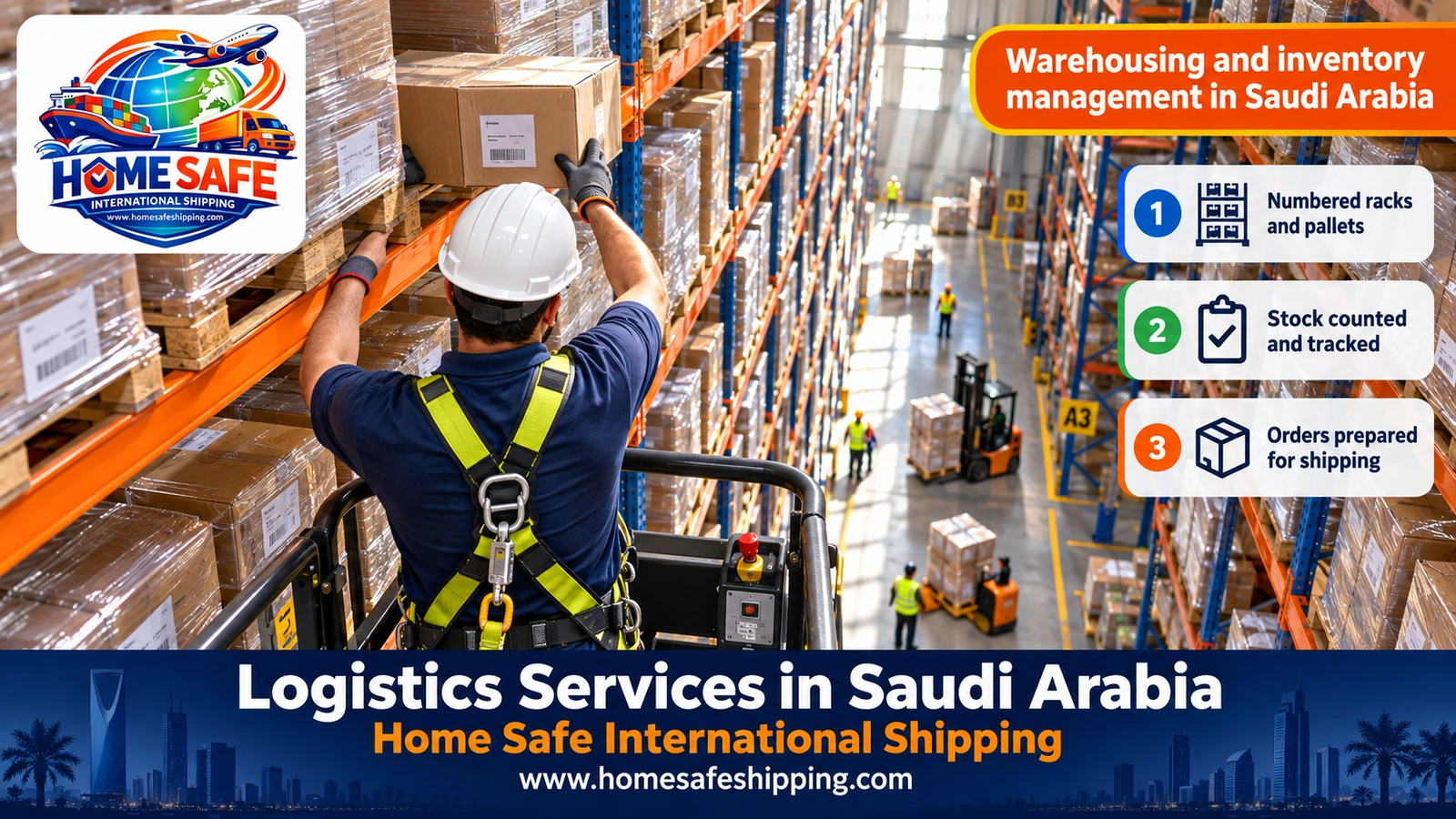
A warehouse is not a place where goods sit until someone asks for them; it is the point where quantities are kept under control. Whatever comes in is counted, checked for visible damage and matched against the supplier’s advice note, then given a position on a numbered rack or pallet, so that at any moment it is known how much of each item is left and where it is. Without that numbering the warehouse becomes one big room in which a carton takes an hour to find.
| Type of storage | Suits | What sets it apart |
|---|---|---|
| Pallet storage | Commercial goods in uniform cartons | Charged by the number of pallets, easy to count and to handle by forklift |
| Shelf storage | Many items in small quantities, such as a shop’s stock | Each item in its own numbered bin, which makes picking easy |
| Floor storage by area | Large pieces that cannot be stacked, such as equipment and furniture | Charged by the square or cubic metre |
| Short storage before shipping | Goods waiting for a vessel or for a truck to fill | Days to weeks, tied to the loading date |
| Storage after import | A cleared container whose owner’s premises are not ready | Stops storage charges at the port |
| Chilled or air-conditioned storage | Food, medicines and cosmetics | Arranged on request according to product and temperature |
Inventory management comes down to three habits: a statement sent to you of receipts, issues and balance; a periodic physical count that matches the shelf against the statement; and an agreed rule for issuing stock. Food and anything with an expiry date leaves earliest-expiry first, and everything else leaves oldest-in first. We set a reorder level with you for each item, so that we alert you before it runs out rather than after.
Our warehouse is in Jeddah, and it serves what comes in through Jeddah Islamic Port and King Abdulaziz Airport and what is distributed in the Western Region. Household furniture storage has its own arrangement and prices in the article on a furniture storage company in Jeddah, and the general service is explained on the storage page.
Order fulfilment for online shops
E-commerce has changed the shape of warehouse work: a warehouse used to send out ten pallets to ten shops, and now it sends out a thousand parcels to a thousand homes. A shop that packs its orders by hand soon reaches the point where packing eats into selling time. That is when it places its stock with someone who receives the order, prepares it and hands it over, leaving the owner free for marketing and the product.
| Stage | What we do | What we need from you |
|---|---|---|
| Receiving | Counting the goods, checking them for visible damage and recording them item by item | Advance notice of what is arriving and in what quantities |
| Shelving | Putting each item in its numbered bin | A clear code for every item, size and colour |
| Taking the order | Receiving the order list before the daily cut-off | A fixed method of sending that we agree on |
| Picking and packing | Gathering the pieces, checking them and packing them appropriately | Packing instructions and branded materials, if any |
| Handover to the carrier | Shipping label and handing the parcel to the courier, or delivering it | The choice of carrier for each area |
| Returns | Receiving the return, inspecting it and reshelving or quarantining it | A clear rule on what may be resold |
Returns are what gets neglected most, and in clothing and footwear they are a permanent part of the job, not an exception. A returned piece that is not inspected and recorded on the day vanishes from the stock while still sitting on the shelf. The fulfilment price is set on request, because it follows the number of orders, the number of pieces per order and the type of packing.
Land, sea and air transport from Saudi Arabia
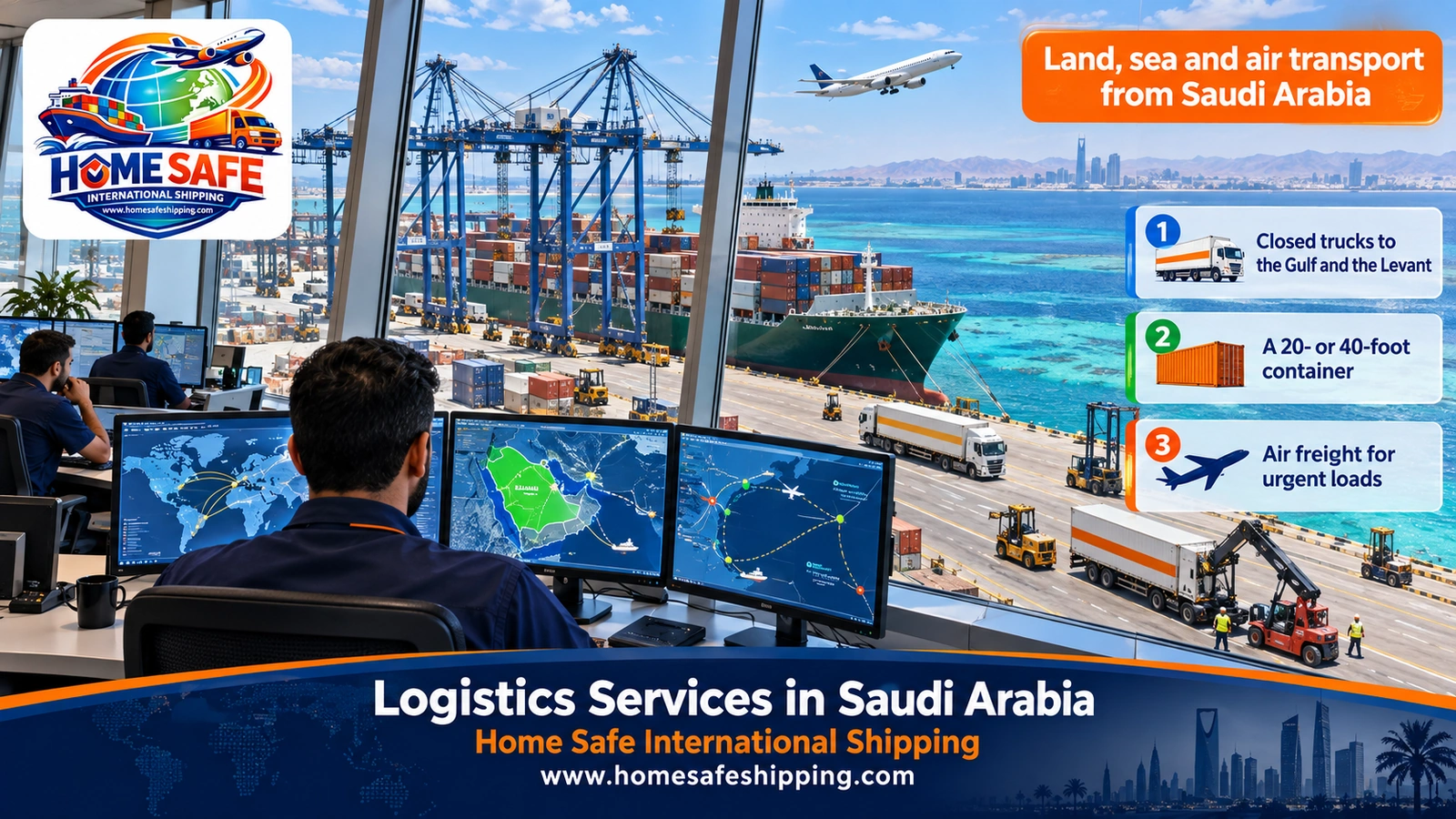
Choosing the mode is a decision between three things: time, cost and the nature of the goods. The truck wins in neighbouring countries because it leaves the warehouse and stops at the door with no port in between. The container wins over long distances and large volumes. The aircraft wins when each day of delay costs more than the difference in the freight.
| Point of comparison | Closed truck | Sea container | Air freight |
|---|---|---|---|
| Best-suited destinations | The Gulf, Jordan, the Levant and Iraq | Turkey, North Africa, Europe, America and Asia | Any destination with a cargo airport |
| Usual time | 1 to 10 days | 3–35 days’ sailing | 1 to 8 days |
| Unit of charge | Carton, cubic metre, pallet or truck | Cubic metre or container | Kilogram |
| Suits | Furniture, general cargo and cars | Large and heavy volumes | Urgent, light and valuable items |
| Example starting price | SAR 550 for a shared pallet | SAR 4,600 for a 20ft container | SAR 14 per kilogram to the Gulf |
Many shipments combine two modes: a container reaches Jeddah port and a truck then distributes it to Riyadh and Qassim, or goods travel by sea while their samples go ahead by air. The fuller comparison is on the shipping methods comparison page.
Closed trucks for the Gulf, the Levant and Iraq
Most exports of small and medium-sized businesses in the Kingdom go to neighbouring countries, and their route is the closed truck. It is loaded at the warehouse or the factory, crosses the land border with its papers and unloads at the consignee’s premises. The exporter has two options: a dedicated truck that leaves when the goods are ready, or a shared load in which only the pallets used are paid for and the truck is waited for until it fills.
| Destination | Crossing | Usual time | Pallet in a shared load |
|---|---|---|---|
| UAE | Batha | 1–6 days | From SAR 740 |
| Kuwait | Khafji or Ar Ruqi | 1–5 days | From SAR 550 |
| Qatar | Salwa | 1–5 days | Set on request |
| Bahrain | King Fahd Causeway | 1 to 7 days | Set on request |
| Jordan | Haditha, Halat Ammar, Durra | 2–7 days | From SAR 550 |
| Iraq | Jadidat Arar | 4–8 days | From SAR 550 |
| Syria and Lebanon | Through Jordan, depending on the state of the crossings | 5–12 days | Set on request |
A carton or parcel in a shared truck to the Gulf states starts from SAR 140, and a cubic metre from SAR 550. The route to Lebanon and Syria is confirmed before every shipment according to the state of the crossings. Country-by-country details are in the article on shipping from Saudi Arabia to the Gulf states and on the land freight page.
Sea freight: a 20ft or 40ft container, or a shared container
Whatever lies beyond the truck’s reach goes in a container. An exporter who fills a box takes it whole, loaded and sealed at the warehouse, while one with a few pallets ships them in a shared container and pays for the cubic metres they occupy. A 20ft container holds about 33 cubic metres and a 40ft container about 67 cubic metres, and each has a weight limit that is checked before heavy goods are loaded.
A 20ft container from Jeddah port to the ports of the Red Sea, the eastern Mediterranean and nearby North Africa starts from SAR 4,600, and a 40ft container to the same ports from SAR 5,200. A cubic metre in a shared container to Turkey, Libya, Tunisia and Algeria starts from SAR 415. Ocean rates move with the market and the season, so the figure you receive carries a written validity period. Haulage from your warehouse to the port is a separate line, set on request according to your city.
Cargo bound for the Mediterranean, Europe and Africa leaves from Jeddah Islamic Port or King Abdullah Port on the Red Sea, and cargo bound for the Gulf, India and East Asia leaves from King Abdulaziz Port in Dammam. Box dimensions are on the container sizes page, and the map of gateways on the ports and gateways page.
Domestic transport between the Kingdom’s cities
Before goods cross a border they usually travel a road inside the Kingdom: from the port to the warehouse, from the warehouse to the branches, and from the factory to the crossing. Distances here are long, with about 950 kilometres between Jeddah and Riyadh and about 400 kilometres between Riyadh and Dammam. Loading is therefore planned so that the truck does not return empty, and that is what makes the difference in the fare.
We move pallets, cartons, furniture and equipment between cities in a dedicated truck or as part of a shared load, and we move cars on carriers. Moving a car from Jeddah to Riyadh starts from SAR 830 on a shared carrier, and the other domestic routes are set on request according to distance and volume.
Customs clearance and documents at Saudi crossings
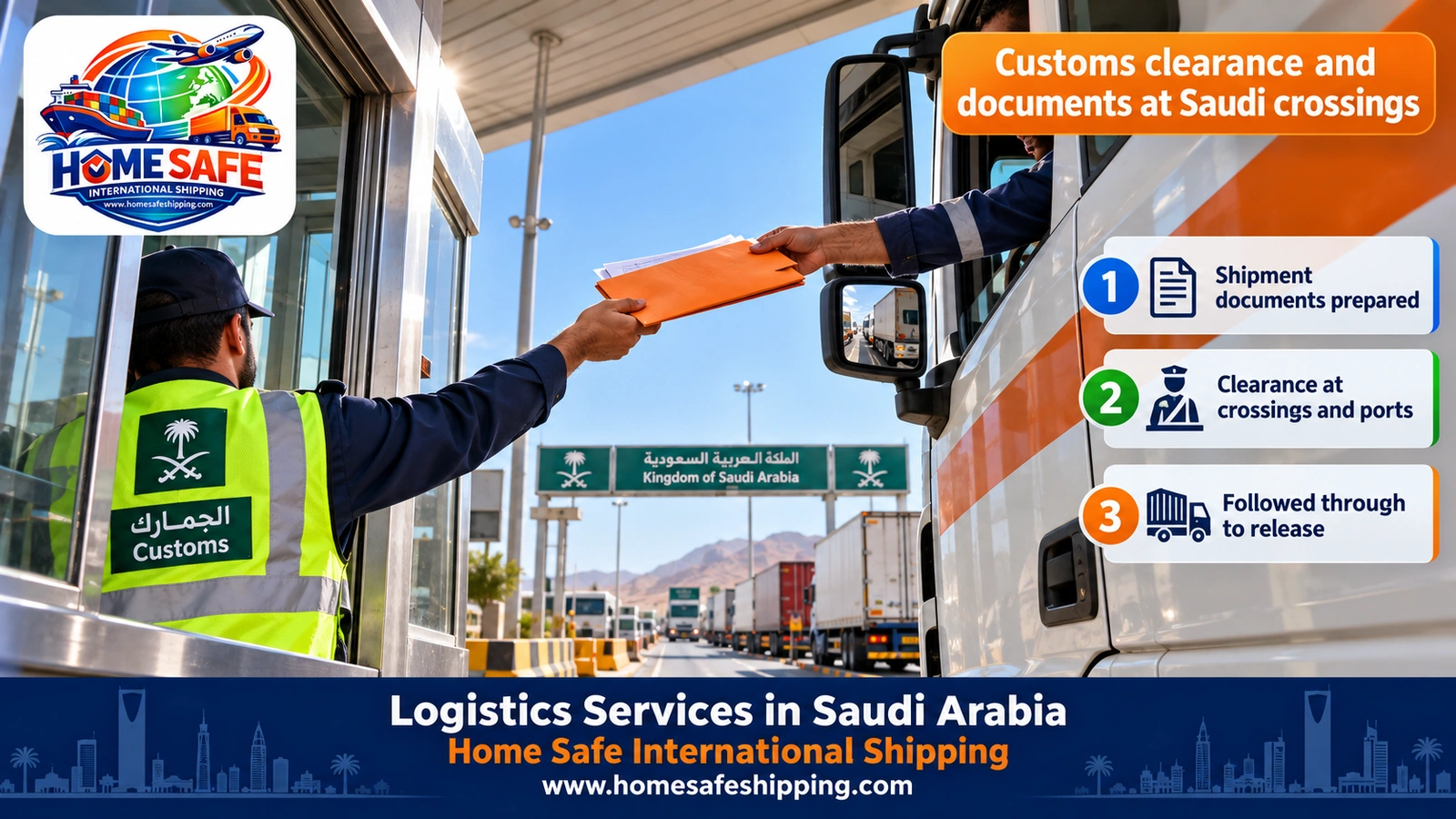
Goods do not pass a land crossing, a seaport or an airport without a customs declaration. The declaration is filed electronically with the Zakat, Tax and Customs Authority through the FASAH platform, and it is filed by a licensed customs broker in the name of the owner of the goods. Our role is to prepare the shipment documents correctly before arrival, arrange the broker, and follow the file until the release is issued and the goods leave the yard.
| Document | Issued by | Why it is required |
|---|---|---|
| Commercial invoice | The seller or exporter | The basis of the value on which duties and tax are calculated |
| Packing list | The seller, or us with the shipper | Shows the contents and weight of each package and the number of pieces |
| Certificate of origin | The competent body in the exporting country | Proves the country of manufacture, on which any exemptions rest |
| Bill of lading or manifest | The shipping line, the airline or the road carrier | The contract of carriage and the receipt for the goods |
| Conformity certificates | An accepted conformity body through the SABER platform | For products covered by Saudi technical regulations |
| Permits from competent authorities | Food and drug, environment and agriculture, or others | For food, medicines, cosmetics and plants |
| Importer’s or exporter’s documents | Commercial registration and tax number, or an ID for an individual | To match the name of the declarant |
The mistake that keeps recurring is a vague description on the invoice: “spare parts” or “supplies” with no detail. The broker needs the item’s name, material and use in order to place it under its correct tariff heading, and a wrong heading means a wrong duty or a reclassification that delays release. The list of documents for each mode is on the shipping documents page, and the service is explained on the customs clearance page.
What importing into Saudi Arabia requires: conformity, duties and tax
Anyone importing for resale passes three gates before the goods are released: technical conformity, customs duty and value added tax. As currently applied, VAT is 15% of the value of the goods plus their duty, and customs duty varies by tariff heading, starting at 5% for many items and rising for others. Because the schedules are amended, we confirm the rate in force for your product before you pay the supplier.
| Requirement | What it is | When it is done |
|---|---|---|
| Product registration and conformity | A product conformity certificate, then a certificate for each consignment through SABER | Before shipping from the supplier’s country |
| Permit from the competent authority | For food, medicines, medical devices and cosmetics | Before shipping |
| Customs declaration | Filed electronically by the broker through FASAH | Before or on arrival of the shipment |
| Duties and tax | Paid electronically to customs | After the declaration is accepted |
| Inspection | By X-ray or by opening, as customs decides | After arrival |
| Truck appointment | Booking a slot to enter the port and collect the container | After release |
Individuals’ used belongings are treated differently and have exemption conditions for those arriving to take up residence and those returning from abroad, so we check the rules in force for each case. The clearance service in Jeddah, with the details of the port and the airport, is in the article on customs clearance in Jeddah.
Prices of logistics services in Saudi Arabia
A logistics service is not bought at a single price but as a list of lines. Some lines have a fixed starting price, which we give here, and others cannot be priced before the volume, the period and the number of movements are known. The following figures are the ones we work with, and each line appears on its own row in the price you receive:
| Service | Unit and destination | Price starts from |
|---|---|---|
| Shared road transport | A carton or parcel to the Gulf states | SAR 140 |
| Shared road transport | A cubic metre to the Gulf states | SAR 550 |
| Shared road transport | A pallet to Jordan, Iraq or Kuwait | SAR 550 |
| Shared road transport | A pallet to the UAE | SAR 740 |
| Sea freight | A 20ft container from Jeddah port to nearby ports | SAR 4,600 |
| Sea freight | A 40ft container to the same ports | SAR 5,200 |
| Shared sea freight | A cubic metre to Turkey and North Africa | SAR 415 |
| Air freight | A kilogram to the Gulf states | SAR 14 |
| Air freight | An envelope of urgent documents | SAR 83 |
| Domestic car transport | From Jeddah to Riyadh on a shared carrier | SAR 830 |
| Car shipping by sea | A saloon by RoRo | SAR 2,800 |
| Commercial goods storage | Per pallet or per metre, monthly | Set on request |
| Order fulfilment and in-city distribution | Per order or per trip | Set on request |
| Customs clearance | Per declaration | Set on request |
Prices quoted in the market: logistics providers in the Kingdom mostly do not publish prices; they refer the enquirer to a calculator or to a quotation request, because the price is built on the customer’s size and activity. What we found published is scarce and general: one small-business guide mentions SAR 150 to 300 for renting a square metre of warehouse space, and a figure like that is of no use until you know whether it is monthly or annual and whether it includes handling, insurance and electricity. So compare offers on matching lines, not on the per-metre figure alone.
What makes up the price of a logistics service?
| Line | How it is charged | What raises or lowers it |
|---|---|---|
| Storage | Per pallet, square metre or cubic metre per month | The period, and whether the goods can be stacked |
| Handling | For each movement in and out | Palletised goods cost less than loose cartons |
| Order fulfilment | Per order, plus each additional piece | The number of items and the type of packing |
| Transport | Per trip, cubic metre, pallet or kilogram | Distance, how full the truck is, and the mode |
| Clearance | Per customs declaration | The number of headings and the permits needed |
| Government charges | Customs duty, tax and port fees | Paid to the authority itself and not part of our fee |
| Insurance | A percentage of the declared value | The type of cover and the nature of the goods |
How do you cut your logistics cost?
- Standardise the packaging: cartons of one size on standard pallets are counted, stacked and loaded in half the time.
- Consolidate shipments: one full truck every fortnight costs less than three half-empty trips.
- Clear out dead stock: an item that has not moved for months pays rent for its space every month.
- Match the mode to the urgency: do not pay air rates for goods that will wait on a shelf for a month.
- Prepare the papers before the goods: a day’s delay at the port costs more than you saved in negotiation.
The factors are explained on the pricing factors page, and the methods are compared on cost in the article on the cheapest international shipping company in Saudi Arabia.
How long each service takes: from receipt to delivery
Time is counted from the first link to the last, not from the moment the truck moves. The table gives the usual time for each service when the paperwork is complete, and we tell you at booking about anything that falls outside it:
| Service | Usual time | What it depends on |
|---|---|---|
| Receiving and shelving goods | On the day of arrival or the next | Advance notice and the number of items |
| Preparing an order and handing it to the carrier | On the day of the order if it arrives before the cut-off | The agreed cut-off time |
| Distribution within the city | The same day or the next | A clear address and a consignee who answers |
| Transport between the main cities | 1 to 3 days | Distance, and a dedicated or shared truck |
| Truck to the Gulf and Jordan | 1 to 7 days | The crossing and how soon the shared load fills |
| Sea container | 3–35 days’ sailing | The arrival port, and a direct or transhipment service |
| Air freight | 1 to 8 days to the address | The destination and the flights available |
| Customs clearance | Hours to a few days | A complete file and the inspection decision |
The times for all destinations are on the expected transit times page.
Last-mile distribution and air freight in Saudi Arabia
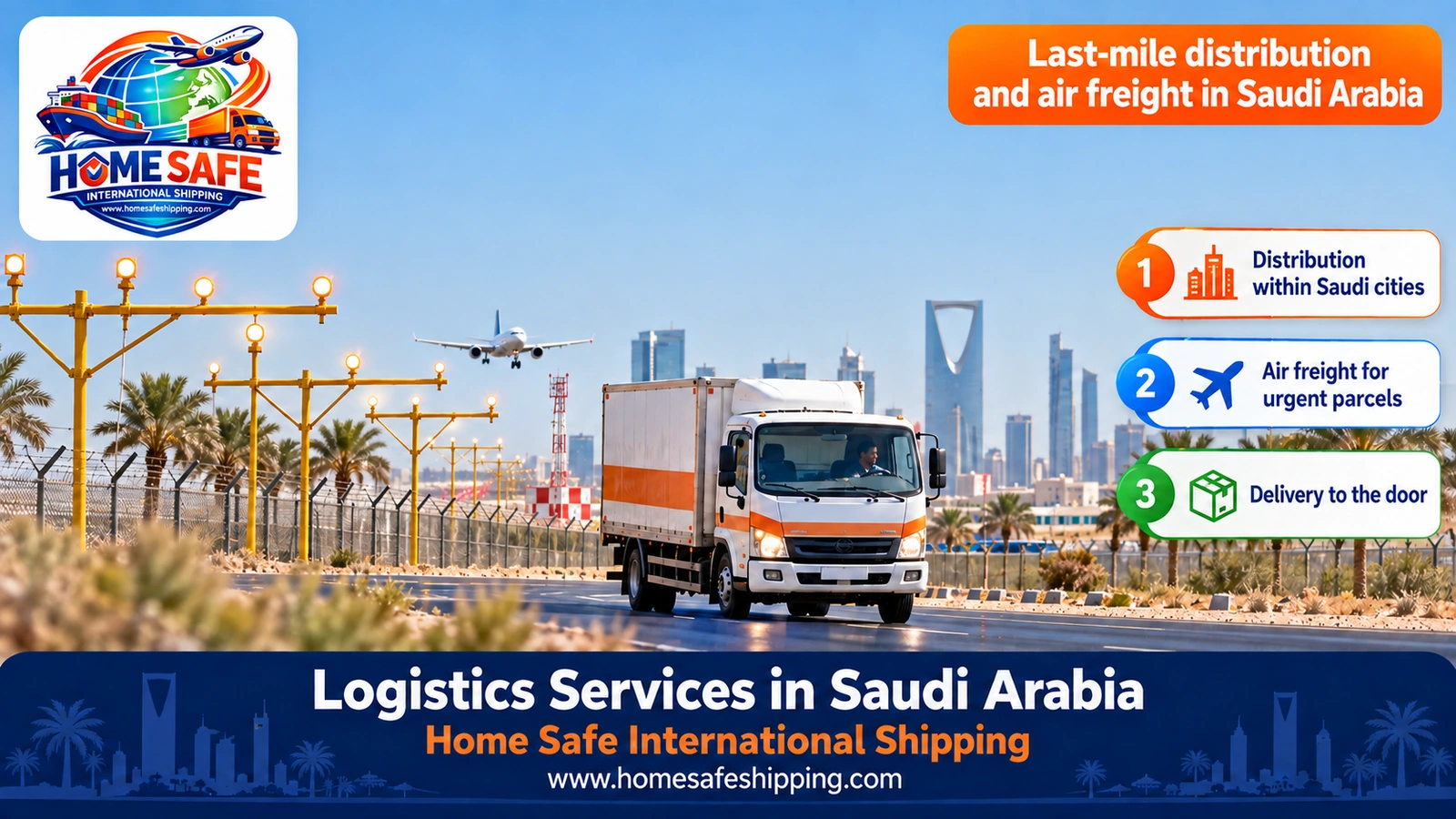
The last mile is the distance between the final warehouse and the consignee’s door, the shortest link in the chain and the most expensive per piece. A truck carrying thirty pallets to a city costs little per pallet, and a van delivering thirty parcels to thirty addresses costs a lot per parcel. That is why distribution inside Saudi cities is run by planning the route before the vehicle leaves: ordering the addresses, calling the consignee and fixing the delivery window.
We distribute from the warehouse to branches, showrooms and customers, and deliver to the door with a signature or a photo as proof of receipt. Whatever cannot be delivered returns to the warehouse with its reason recorded, then goes out again after the consignee has been contacted. We agree with you in advance on the number of attempts and on what happens after them.
Air freight for urgent parcels
When the consignee is in a distant city or outside the Kingdom and time cannot bear the road, the parcel completes its journey by air. A spare part holding up a production line, a sample a customer is waiting for, tender documents with a closing date: the freight on these is measured not by the kilogram but by what their delay would cost. We ship by air from the airports of Riyadh, Jeddah and Dammam and deliver to the address.
| Destination | Price per kilogram starts from | Usual time to the address |
|---|---|---|
| Gulf states | SAR 14 | 1–3 days |
| Europe | SAR 23 | 3–6 days |
| UK | SAR 26 | 3–6 days |
| North and West Africa | SAR 28 | 3–8 days |
| America | SAR 41 | 5–8 days |
| Envelope of urgent documents | SAR 83 | Depends on the destination |
Air freight is charged on the greater of actual and volumetric weight, so a large light carton is paid for by its size. Work out your parcel’s weight with the volumetric weight calculator; the service is explained on the air freight page.
Car and equipment shipping as part of logistics services
A car and a machine are cargo that runs on its own wheels, and they are handled differently from cartons. A car travels inside the Kingdom and to the Gulf on carriers, and goes by sea in two ways: by RoRo, where it is driven onto the vessel uncovered and secured by its wheels, or inside a container, where it is lashed and sealed. Heavy equipment drives onto the RoRo vessel or is lifted onto a flat rack and chained down.
Rental firms, showrooms and contractors order this service in numbers rather than singly: ten cars to a new branch, or two excavators to a project in another city. A saloon by RoRo starts from SAR 2,800. Details are in the article on car shipping from Saudi Arabia and on the heavy equipment shipping page.
Technology in logistics services: what has really changed?
Technology in this field is neither a luxury nor a slogan, and its value is measured by one question: did it cut an error or save time? What matters to the owner of the goods is not the name of the system but being able to see the shipment without calling, and a statement that matches the shelf. These are the main tools and what they do on the ground:
| Tool | What it does in practice | What it means for you |
|---|---|---|
| Warehouse management system | Records every item with its code and position and every movement in and out | A stock statement you can rely on |
| Barcode and scanner | Confirms the piece at picking instead of reading it by eye | Fewer order errors |
| Satellite tracking | Locates the truck or the container on the road | A more accurate arrival time |
| Geographic information systems | Draw the shortest route and the best order of addresses | Faster distribution and less fuel |
| Artificial intelligence | Forecasts demand from sales history and seasons | Stock in line with need |
| Mobile apps and notifications | Tell the consignee the time and take the signature | Fewer failed delivery attempts |
| Government platforms | Customs declaration, certificates and truck appointments online | Faster release and less paper |
A tool is no substitute for discipline: a warehouse system in which quantities are entered two days late is no different from a notebook. So before we start we ask how you want the information to reach you, and we keep to it. How shipments are followed is on the shipment tracking page.
Challenges in logistics services: delay and the environmental impact of transport
Delay is what customers complain about most, and it has recurring causes, most of which can be dealt with before they happen. The second challenge is newer: transport burns fuel, and buyers and regulators are asking about its impact. The practical answer to both is essentially the same, which is for goods to move once, on the right route, in a full truck.
| Cause of delay | How it shows | What prevents it |
|---|---|---|
| Missing or wrong documents | A shipment standing at the crossing or the port | Reviewing the file before loading, not after arrival |
| Waiting for the load to fill | Goods in the consolidation warehouse for days | A dedicated truck for urgent cargo, or early booking |
| Seasonal congestion | Later slots before Ramadan, the Eids and Hajj | Shipping seasonal stock weeks ahead of the peak |
| Incomplete address or a consignee who does not answer | A failed delivery attempt and a return | Confirming the address and phone before the vehicle leaves |
| Weather and road closures | Dust or rain stopping traffic | A time margin in the promise given to the customer |
| Stock that does not match | An order whose piece is not on the shelf | Periodic counts and movements recorded on time |
As for the environmental impact, it is eased by simple decisions before it is eased by new technologies: consolidating shipments, filling the truck in both directions, choosing sea over air for anything not urgent, and packing to the size of the piece with no empty space shipped along with it. These same decisions lower the fare, so here saving and sustainability point in one direction.
Outsourcing models: a third party or a fourth party?
When a business decides not to run its own movements, it chooses between two models. A third-party provider carries out the service with its own warehouse, trucks and staff or with those it contracts. A fourth-party provider manages the whole chain in your name, choosing the operators and monitoring them. Between the two there is a difference in the contract and in whom you hold to account when a mistake occurs.
| Point of comparison | You run it yourself | Third party | Fourth party |
|---|---|---|---|
| Who executes | Your staff, your warehouse and your vehicles | The provider | Several providers managed by one party |
| Cost | Fixed, paid whether you sell or not | Variable with the volume of movement | Variable, plus a management fee |
| Control | Full | Through the contract and the indicators | Through the contract and the reports |
| Suits | Large, steady movement in one city | Most small and medium-sized businesses | Networks spread over several countries |
Home Safe works on the first of the two outsourcing models: we carry out storage, transport and distribution, arrange clearance with licensed brokers, and whatever falls outside the Kingdom is handled by partner agents with whom we coordinate.
How do you choose a logistics services company in Saudi Arabia?
Reputation, price and punctuality are the right headings, but they cannot be tested in a phone call. What can be tested is the way specific questions are answered and what is written in the offer. Ask for the offer in writing with its lines, visit the warehouse if storage is part of the contract, and start with a small shipment before you move your whole stock.
| Ask about | A reassuring sign | A sign that calls for caution |
|---|---|---|
| Legal standing | A commercial registration and a contract in the establishment’s name | A transfer to a personal account with no contract |
| Coverage | States what it carries out itself and what its partners carry out | “We cover the whole world” with no detail |
| Price | Separate lines, with what is not included | One all-in figure with no way of knowing what is in it |
| Stock | A regular statement and a physical count on a known date | “Your goods are safe” with no statement |
| Damage and shortage | Written liability and insurance offered to you | A verbal promise of compensation |
| Communication | A named person who answers and follows up | A general number passing you from one employee to another |
| Leaving the contract | A notice period and a way of handing back the stock | No mention of how the contract ends |
How do you assess your logistics partner’s performance after signing?
- On-time delivery: the share of orders that arrived on the promised day out of all that left.
- Order accuracy: how many orders left with the right item and quantity, with no substitution or shortage.
- Inventory accuracy: the difference between the statement and the physical count in each cycle.
- Damage and loss: its value against the value of what passed through the warehouse and the trucks.
- Response time: how long passes between your question and an answer that contains information rather than a promise to follow up.
Review these figures every month or every quarter with the provider itself, and listen to your customers too, since they are the first to see a mistake. The terms you hold the provider to belong in the contract or the booking confirmation, not in phone calls.
The logistics sector in Saudi Arabia: location, gateways and regulation
The Kingdom lies between three continents, with two coasts on the Red Sea and the Arabian Gulf, land borders with Jordan, Iraq, Kuwait, Qatar, the UAE and Oman, and a causeway to Bahrain. That position lets goods entering through Jeddah Islamic Port reach Gulf markets by truck within days, and makes the Kingdom a transit point and not only a market.
The infrastructure serving this consists of three networks: ports, chief among them Jeddah Islamic and King Abdullah in the west and King Abdulaziz in Dammam in the east; cargo airports in Riyadh, Jeddah and Dammam; and motorways linking the cities to the land crossings, together with a railway connecting Dammam port to the dry port in Riyadh. Regulation is moving towards unification and digitisation: licences for logistics activities are applied for through the Logisti platform, customs declarations through FASAH and conformity certificates through SABER.
The evolution of logistics services and their current trends
Logistics began as the art of supplying armies and caravans: how much a camel carries, where the water is, and when the provisions arrive. With steamships and railways it then became a science of trade between continents. The standard container changed it as nothing had before, once the same box could pass from truck to ship to train without being opened. Today something else drives it: the information that travels ahead of the goods.
Three trends are shaping it now. The first is e-commerce, which shifted the pressure from the port to the front door and made next-day delivery an ordinary expectation. The second is globalisation and the rearrangement that followed it, as companies diversify their suppliers and bring stock closer to their markets so that the closure of one corridor does not stop them. The third is digitisation and sustainability together: devices that read a shipment’s condition and temperature on the road, vehicles that use less fuel, and a growing demand to measure emissions. Whoever prepares for these three is preparing for what comes after them.
The effect of better logistics on company performance
The effect is seen in ordinary cases, not in the stories of giant corporations. A perfume shop used to ship from home; once it placed its stock in a warehouse close to the couriers, an order left on its own day instead of taking two. A tool importer’s container used to sit in the port for a week after every arrival; once the file was prepared while the vessel was at sea, the container left within its free days. A factory used to send a half-empty truck to Kuwait every week, then gathered its orders into one full truck every fortnight.
The common thread is that the improvement needed no large investment, only a better arrangement of the links. The outcome in all three cases is the same: a lower cost per piece, a customer who receives on time, and a business owner who knows where the goods are.
Steps for working with Home Safe
From the first message to the first shipment there are eight steps, and we do not move from one to the next before it is clear:
- You describe your need: the type of goods, their volume, their route and the storage you need, on 0552803439.
- We ask for the details: the number of items, the pace of movement, the destinations, and what your goods require in temperature or permits.
- We propose the services: which links you need, by which mode of transport and through which gateway.
- You receive the price line by line: each service on its own row, with what the price does not include and how long it is valid.
- We agree on the working method: who sends the orders and how, the cut-off time, and the form and timing of the statement.
- We receive the goods: counting, inspection and recording, with a receiving report that you review and approve.
- We carry out and report: storage, transport, clearance or distribution, with an update at every stage.
- We review with you: after the first shipments we look at what ran late and what can be improved.
Insurance, liability and work outside the Kingdom
Goods face three risks: damage in handling, loss on the road, and an incident such as a fire or a rollover. The liability of the carrier and the warehouse for them is limited by regulations and by the contract terms, and in international transport it is calculated on weight or the number of packages, not on value. We therefore recommend insurance on the actual value, with separate policies for transport and for storage, and its terms are stated in the booking confirmation. The types of cover are explained on the cargo insurance page.
Outside the Kingdom we have no offices. Clearance and delivery in the arrival country, and collection from suppliers when importing, are handled by partner agents in that country, while we remain your single point of contact. That is how a shipment reaches the consignee’s door rather than the quayside, as described in the article on a door-to-door shipping company.
Common mistakes when contracting logistics services
- Choosing the provider on the per-metre or per-kilogram price alone, then finding that handling and packing are separate lines.
- Sending goods to the warehouse with no notice and no list, so the stock starts with a difference nobody can trace.
- Leaving items without clear codes, so the wrong size is picked and the order comes back.
- Buying goods abroad before asking about their conformity certificate, so they arrive and are not released.
- Promising the customer a delivery date with no margin for the crossing or the season.
- Settling for the carrier’s limited liability and skipping insurance on expensive goods.
- Contracting without performance indicators, so that six months on nobody knows whether the service is good or not.
Why Home Safe for logistics services?
A registered establishment
Home Safe Logistics Services Establishment, commercial registration 4030601060.
Links under one roof
Storage, transport, clearance and distribution with one tracking number and one point of contact.
Three modes
Closed trucks, containers and air freight, and we propose what suits your goods, not what costs most.
A price line by line
Each service on its own row, with what the price does not include, before the goods move.
To book: 0552803439 by phone or WhatsApp, from 7 am to 11 pm. Or through the request a quote page.
Related articles and pages
- Goods storage in Jeddah
- Customs clearance in Jeddah
- Sea freight company in Saudi Arabia
- Land freight company in Saudi Arabia
- Air freight from Saudi Arabia
- Commercial shipping
Tags
logistics services in Saudi Arabia, logistics services company in Saudi Arabia, logistics companies in Saudi Arabia, logistic services, integrated logistics solutions, logistics services in Jeddah, warehousing and inventory management, goods storage, order fulfilment for online shops, last-mile distribution, land sea and air transport, customs clearance in Saudi Arabia, how to choose a logistics company, third-party logistics provider, car shipping from Saudi Arabia, Home Safe logistics services
Frequently asked questions about logistics services in Saudi Arabia
What is meant by logistics services?
Everything that happens to goods between leaving the factory or supplier and reaching the hands of whoever bought them: receiving, storage, stock counts, order preparation, transport, customs clearance, distribution and returns. Shipping is one part of it, not the whole. Whoever buys a logistics service is really buying a date that is kept and goods that arrive complete, not merely a truck.
Which logistics services does Home Safe provide in Saudi Arabia?
We store goods and furniture, count stock and prepare orders, move cargo by road in closed trucks to the Gulf, Jordan, the Levant and Iraq, by sea in containers from the Kingdom’s ports and by air from its airports, arrange customs clearance through licensed brokers, and distribute inside Saudi cities to the door. You can order the services together or just one of them.
How much do logistics services in Saudi Arabia cost?
There is no single figure, because each service is priced as its own line. Transport has known starting prices: a pallet in a shared road load from SAR 550, a 20ft container from SAR 4,600 and an air kilogram to the Gulf from SAR 14. Commercial storage, order fulfilment, clearance and distribution are set on request once the volume, the period and the number of movements are known.
Do you serve small online shops?
Yes. A shop selling a few dozen orders a week can keep its stock with us in Jeddah: we receive, count and shelve it, then prepare each order and hand it to the courier or deliver it ourselves. Before starting we agree on how orders are sent to us and on the daily cut-off time, so that no order is left for the next day without a reason.
What is the difference between a 3PL and a 4PL provider?
A third-party provider does the work with its own hands: it stores, transports and clears. A fourth-party provider manages and does not necessarily execute: it designs the whole supply chain and supervises several operators on the client’s behalf. A small or medium-sized business is usually well served by one reliable third party, and a fourth party proves its worth when countries, warehouses and carriers multiply.
Do you have warehouses in every city of the Kingdom?
The storage we run ourselves is based in Jeddah. In other cities we arrange storage according to what is available there and tell you its location and terms before any contract, and we do not promise a warehouse we have not seen. Transport and distribution, however, cover every city in the Kingdom, so goods stored in Jeddah reach Riyadh, Dammam and elsewhere by truck.
How do I follow my stock when I am in another city?
Every item entering the warehouse is counted and recorded with its code, quantity and shelf position. You receive a statement of what came in, what went out and what remains at the interval we agree, daily or weekly depending on how fast your goods move. We also run a periodic physical count that matches the shelves against the statement, and report any difference with its cause.
Who handles customs clearance for my shipment?
A licensed customs broker whom we arrange, while we follow the file until release. What is needed from you is correct shipment paperwork: the invoice, the packing list, the certificate of origin and the bill of lading, and for a commercial importer a registration, a tax number and conformity certificates for the items that require them. Duties and tax are paid directly to customs and are not part of our fee.
How long does a shipment take from your warehouse to the customer’s door?
Within the same city, the same working day or the next; between the Kingdom’s main cities, one to three days. To the Gulf states by truck it is 1 to 6 days, and to Jordan 2 to 7 days. An air parcel reaches the Gulf within one to three days. The time grows if a document is missing at the crossing or the consignee cannot be reached.
Can I order just one service, such as storage or transport?
Yes. Many of our customers start with a single service: a container to a port, a truck to Doha, or two months of storage. They add others once they see that keeping them with one party cuts coordination and mistakes. Either way the price is written line by line, so you know what you pay for each service.
Do you ship refrigerated and dangerous goods?
Chilled cargo travels in refrigerated trucks and containers set to a temperature the owner specifies, and we arrange it shipment by shipment once we know the product and the temperature. Dangerous goods are accepted only with full disclosure, a safety data sheet and compliant packaging, and some of them cannot fly at all. Anything that needs a permit from a competent authority does not move before it is issued.
Are the goods insured during storage and transport?
The liability of the carrier and of the warehouse is limited by what regulations and conventions provide and by the contract terms, and it is usually below the value of the goods. We therefore recommend insurance on the actual value, with separate policies for transport and for storage. The type of cover, its rate and its exclusions are all stated in the booking confirmation before the shipment moves.
Do you also handle imports into Saudi Arabia?
Yes. We arrange collection from the supplier abroad through a partner agent in that country, then shipping to Jeddah Islamic Port, Dammam port or one of the airports, then clearance, storage and distribution. Before you buy, we go through what Saudi rules require in conformity and registration, because goods that arrive without their certificate stay in the port at your expense.
Does Home Safe have offices outside the Kingdom?
No. Home Safe is a Saudi establishment based in Jeddah, and whatever is carried out abroad, whether clearance, delivery or collection from suppliers, is handled by partner agents in the arrival country, while we coordinate with them and remain your single point of contact. We give you the agent’s name and details before the shipment arrives.
How do I start working with you?
Send a short description to 0552803439: what the goods are, their volume or number of pallets, from where to where, and whether you need storage and for how long. We come back with the suitable services and with the price and time of each line. The service is available from 7 am to 11 pm, by phone or on WhatsApp.
That is the guide — now let us price your shipment
Choose what applies to you and receive a reply with the price, the method and the time.
RoRo, container or sling lift — we recommend what suits your vehicle’s value and its destination.
Get a vehicle priceA full or shared container, or urgent air freight, with packing and clearance.
Get a shipment priceRoutes in the same section
Options related to the same type of service.