Repatriation of Remains from Jeddah 0552803439 | Office for Returning a Deceased Person Home by Air
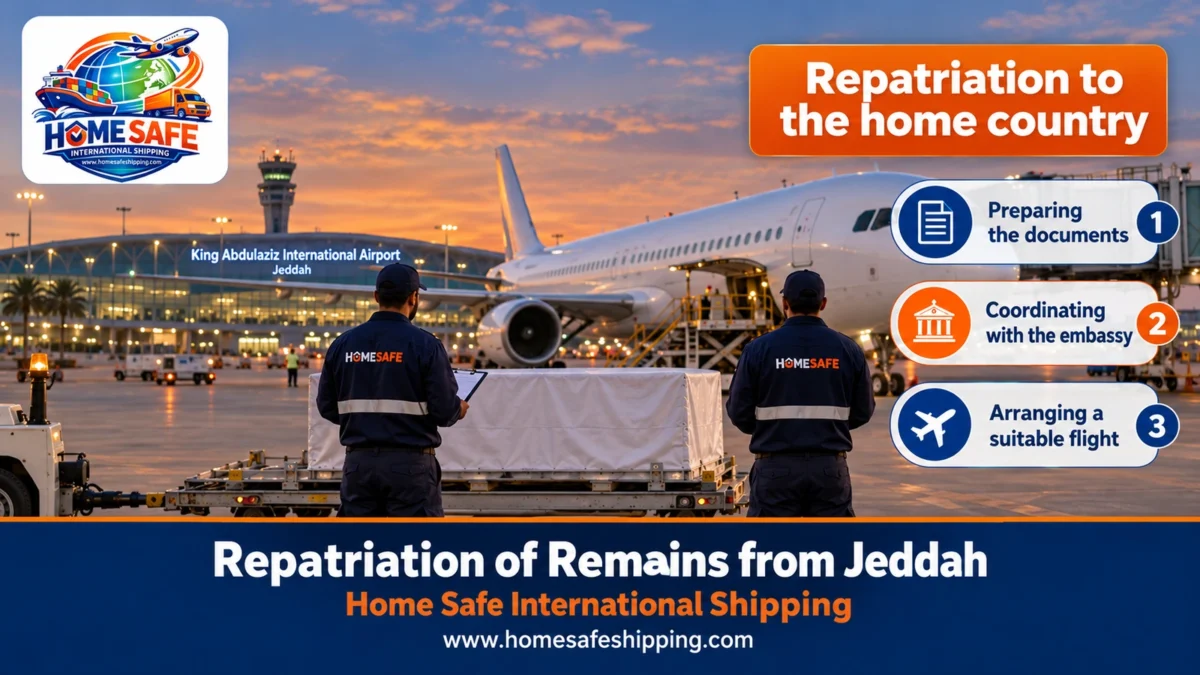
Repatriation of a deceased person’s remains from Jeddah, Makkah and Madinah to their home country by air in 3–7 working days. We coordinate the documents with the family, the sponsor and the embassy, book the earliest flight, take the remains to the airport, and follow up until receipt. We also explain who bears the costs, and the option of burial in the Kingdom.
Home Safe handles the repatriation of a deceased person’s remains from Jeddah to their home country by air: we coordinate the documents with the family, the sponsor and the embassy, book the earliest flight, take the remains to the airport and hand them to the airline. The procedures take 3 to 7 working days for a natural death. To reach us: 0552803439.
In this guide37ShowHide
- What do you do first when a relative dies in Jeddah?
- Documents required to repatriate remains from Saudi Arabia
- Next of kin outside the Kingdom?
- Steps for repatriating remains from Jeddah
- Who does what?
- How long do repatriation procedures take?
- Who bears the cost of repatriating the remains?
- What sets the cost of transporting remains by air?
- Transporting remains by air: Saudia and other airlines
- Transfer from the hospital to Jeddah airport
- Burial in the Kingdom instead of repatriation
- The death of a Hajj or Umrah pilgrim, or a visitor
- Repatriation from Makkah, Madinah, Taif and other cities
- Receipt in the destination country
- Countries we repatriate to
- The deceased’s belongings and dues
- What delays repatriation
- How to choose who handles the repatriation
- Why Home Safe?
- Related pages
- Tags
- Frequently asked questions about repatriating remains from Jeddah
- How long does repatriating remains from Jeddah take?
- Which documents are needed to repatriate remains from Saudi Arabia?
- Who bears the cost of repatriating the remains?
- How much does it cost to transport remains by air?
- Where is the repatriation request submitted?
- Do you transport remains on Saudia?
- Must the remains be embalmed before air transport?
- Can a relative accompany the remains?
- Can the deceased be buried in Saudi Arabia?
- What about a Hajj or Umrah pilgrim who dies in Makkah or Madinah?
- Do you serve Makkah, Madinah and Taif?
- What if the death was caused by an accident?
- What if the sponsor refuses or cannot be found?
- Who receives the remains in the destination country?
- Do you ship the deceased’s belongings to their family?
We know that anyone reading this page is going through a hard time. We have written it clearly and in order: what is needed, in what sequence, who does what, and how long it takes.
In brief
- Method: air freight on a passenger or cargo flight, from King Abdulaziz Airport in Jeddah.
- Time: 3 – 7 working days for a natural death, and longer for accidents.
- Key documents: death certificate, embassy letter, preparation certificate and transport permit.
- Costs: on the employer for a worker under the Labour Law, and on the family or the insurer for others.
- Our role: coordination, booking, transfer to the airport, and follow-up until receipt.
- Contact: 0552803439, call or WhatsApp.
What do you do first when a relative dies in Jeddah?
In the first hours no major decision is asked of you. Five simple things are, and everything else starts from them:
- The death notification: if the death occurred in a hospital, the hospital issues it. If it occurred elsewhere, the Red Crescent and the police are informed.
- Informing the sponsor or employer: they have a part in the documents, and bear the costs if the deceased was their worker.
- Informing the embassy or consulate of the deceased’s country: it issues the no-objection letter and cancels the passport.
- Gathering the deceased’s papers: the passport and iqama, and the ID of the next of kin.
- Calling us: we tell you exactly what your case requires, and in what order.
Whether to repatriate or to bury in the Kingdom is the family’s decision alone. It need not be settled on the first day, but the embassy letter is written accordingly, so it is settled before the letter is requested.
Documents required to repatriate remains from Saudi Arabia
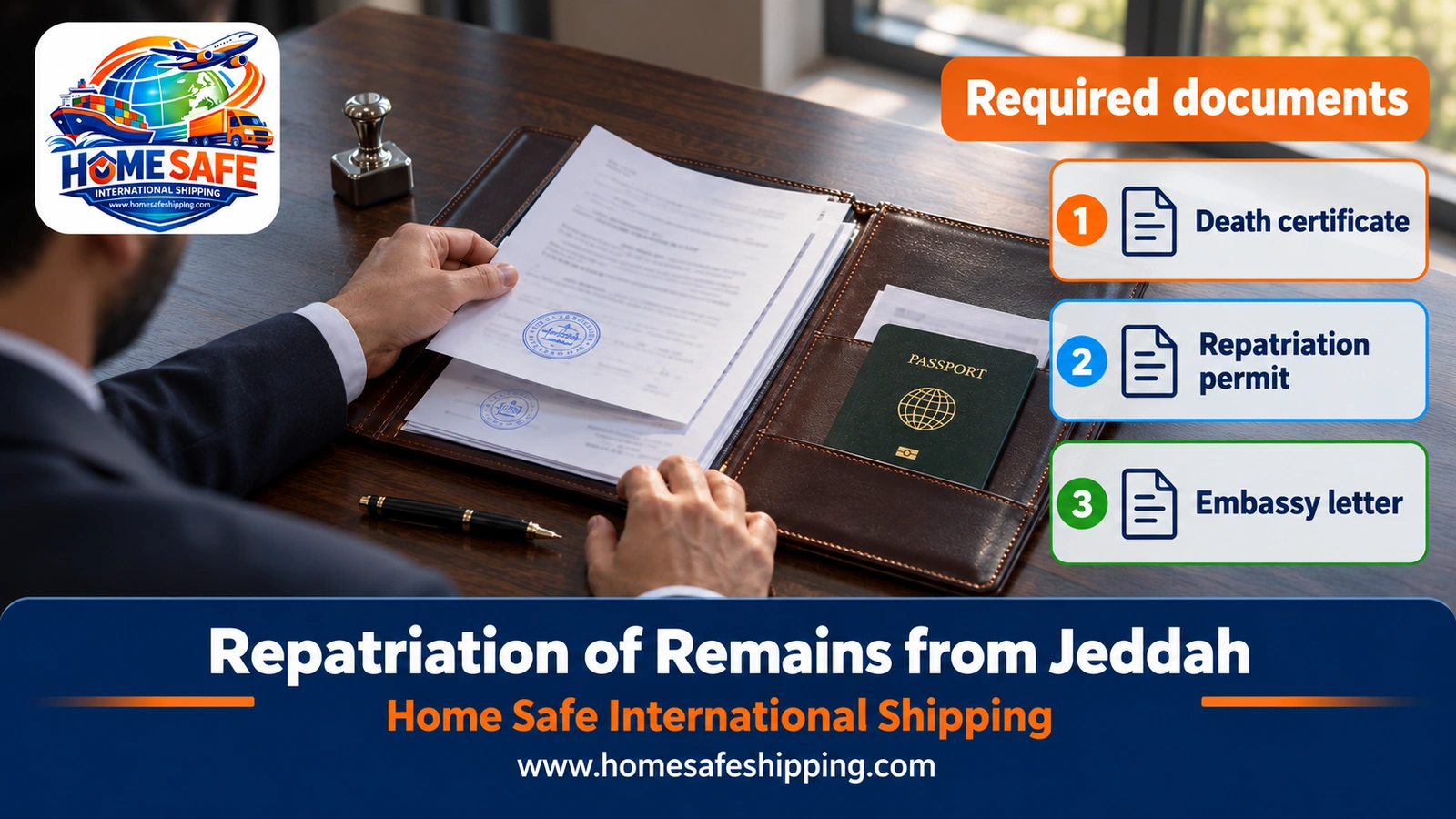
| Document | Issued by |
|---|---|
| Death notification and medical report | The hospital |
| Death certificate | Civil Affairs |
| The deceased’s passport and iqama | Held by the family or the sponsor |
| No-objection letter for moving the remains | The embassy or consulate of the deceased’s country |
| Consent or authorisation of the next of kin | The family, attested |
| Letter from the sponsor or employer | The sponsor |
| Certificate of preparation and freedom from infectious disease | The competent health authority |
| Permit to move the remains out of the Kingdom | The Emirate of the region |
| Police and forensic report | Only for accidents and unnatural deaths |
Note: some countries require the death certificate to be translated and attested, or an additional document from their consulate. We go through the destination country’s requirements with you from the first call.
Next of kin outside the Kingdom?
This is the most common case: the worker is here and the family is at home. The consent is written there and attested by the competent authority, then sent to the embassy here or passed on through their country’s foreign ministry. In it the family names who will receive the remains on arrival, and whom they authorise here to complete the procedures: a relative, a colleague or the sponsor’s representative.
Steps for repatriating remains from Jeddah
- Obtaining the death notification from the hospital, then the death certificate from Civil Affairs.
- The embassy letter: no objection to moving the remains, and cancellation of the deceased’s passport.
- The repatriation request: submitted to the Emirate of the region, with an online service on the national unified platform.
- Preparing the remains at the approved health facility, and issuing the preparation certificate.
- The permit to move the remains out of the Kingdom.
- Booking the earliest flight that reaches the deceased’s country, and confirming it with the airline.
- Transfer to the airport in a dedicated vehicle, and handover at the cargo terminal.
- Informing the family of the flight number, arrival time and the documents for receipt.
Who does what?
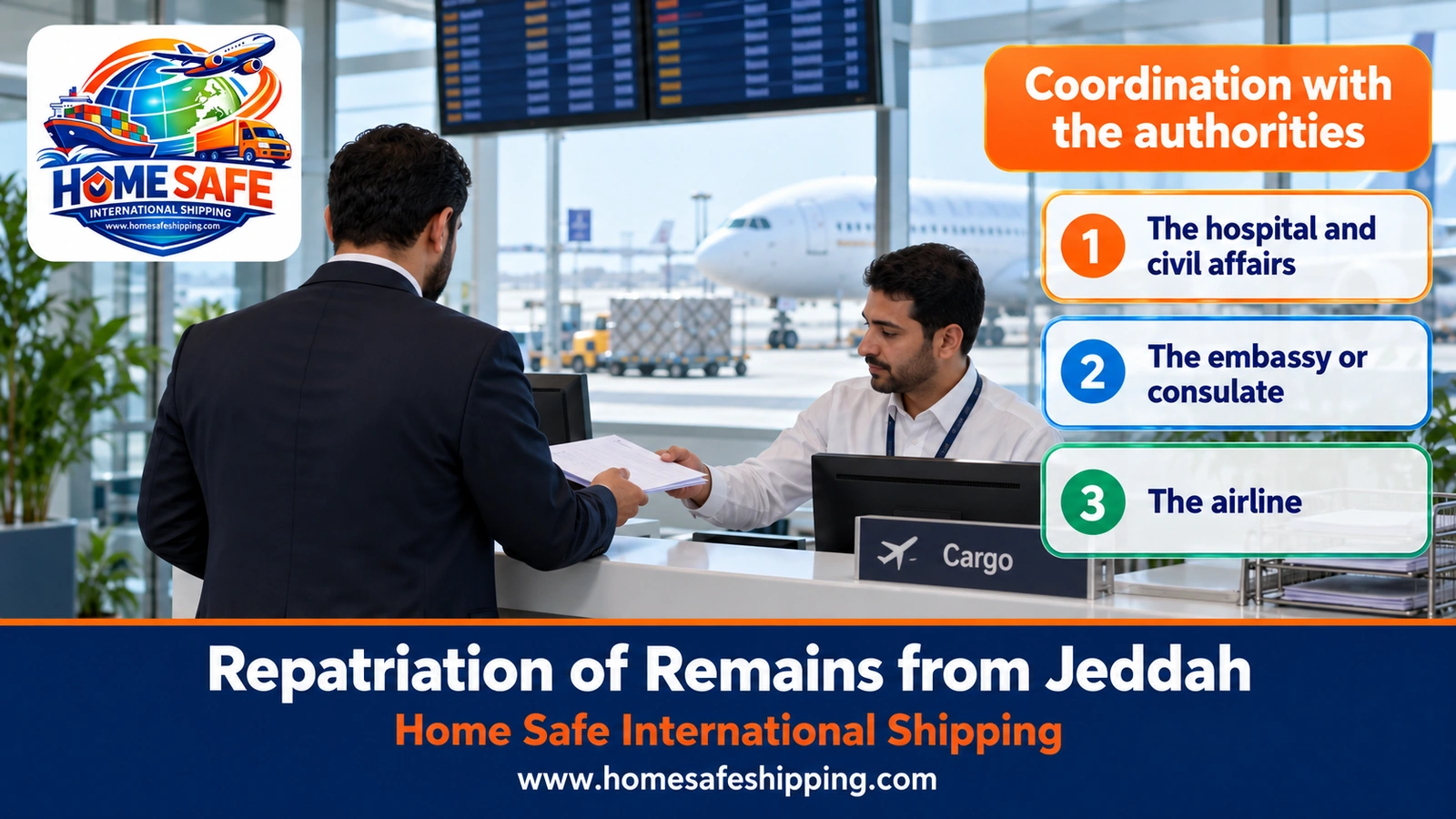
The procedures pass through six bodies, and no single one can complete them all. Most delay comes from each party waiting for another.
| Party | What falls to them |
|---|---|
| The hospital | The death notification, the medical report and keeping the remains |
| Civil Affairs | The death certificate |
| The embassy or consulate | The no-objection letter and cancelling the passport |
| The sponsor or employer | Their letter, bearing the costs where they are liable, and settling the deceased’s dues |
| The family | The decision, the attested consent, and naming the recipient |
| The health authority | Preparation and its certificate |
| The airline | The booking and the conditions of acceptance |
| Home Safe | Ordering the steps, following up between the bodies, booking, transfer to the airport and handover to the carrier |
Some of these steps can only be carried out by a family member or the sponsor in person. We tell you clearly which, and take on whatever can be delegated to us.
How long do repatriation procedures take?
| Case | Usual time | What lengthens it |
|---|---|---|
| Natural death in a hospital | 3 – 7 working days | A delayed letter from the embassy or the sponsor |
| Death outside hospital | 5 – 10 working days | The security authorities’ report |
| Accident or unnatural death | Two weeks or more | Completion of the investigation and the forensic report |
Public holidays and the weekend close government offices and embassies, so they are added to the time. An embassy’s days off may differ from the Kingdom’s. We book the flight after the permit is issued, not before.
Who bears the cost of repatriating the remains?
| The deceased’s status | Who bears it |
|---|---|
| A worker with an employer | The employer, under Article 40 of the Labour Law |
| A worker covered by social insurance | Social insurance if it takes it on, which releases the employer |
| An insured person | The insurer, if the policy provides for return of remains |
| A visitor, or an Umrah or Hajj pilgrim | Visit or Umrah insurance in some cases, otherwise the family |
| A dependant or non-worker | The family |
| Someone without means | Some embassies help their nationals, and some do not |
The law provides that the employer bears the expenses of preparing the worker’s remains and transporting them to the place where the contract was concluded or from which the worker was recruited, unless they are buried in the Kingdom with the family’s consent. So if the deceased was a worker, start with their employer before the family pays anything.
What sets the cost of transporting remains by air?
| Item | What sets it |
|---|---|
| The air freight charge | The destination country and the airline, each of which has its own tariff for remains |
| Preparation and the coffin | According to what the airline and the destination country require |
| Fees and attestations | Translation and attestation of documents where the destination country asks for them |
| Internal transport | From the city of death to the airport |
| The escort’s ticket | If the family wants someone to accompany the remains |
Repatriation to the Indian subcontinent starts from SAR 7,400 including preparation and air freight. For other countries the cost changes with the distance and the carrier, so call 0552803439 and we will give it to you in full and itemised before any step is taken, with no obligation.
Transporting remains by air: Saudia and other airlines
Airlines, Saudia among them, carry remains as special cargo in the aircraft hold, booked in advance through a freight agent. We choose the carrier that reaches the deceased’s country on the earliest flight with the fewest stops.
- Preparation: a medical preparation that preserves the remains for the journey, at the approved health facility, with a certificate issued.
- The coffin: hermetically sealed in line with air transport requirements, inside an outer case.
- Washing and shrouding: carried out for a Muslim before preparation, with the family present if they wish.
- Documents: copies travel with the shipment, and the originals are handed to the recipient or the escort.
- A direct flight: we put it first whenever there is one. A stop lengthens the time and adds handling.
- The escort: a seat is booked on the same flight if the family wishes.
Transfer from the hospital to Jeddah airport
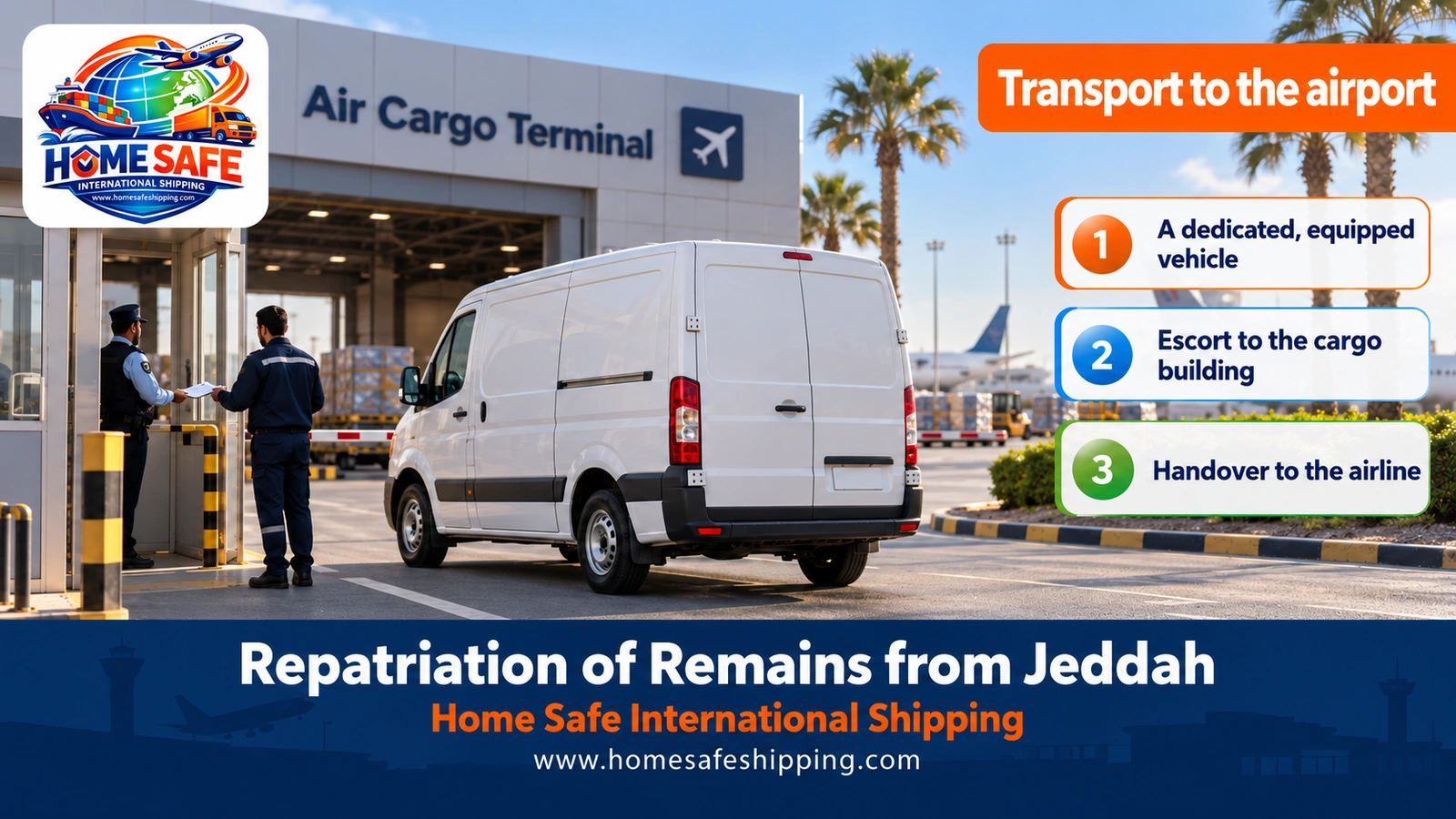
The remains are taken in a dedicated vehicle equipped for the purpose from the hospital mortuary to the cargo terminal at King Abdulaziz Airport, at the time the airline sets before departure. Our staff member stays with them until handover and receipt of the air waybill. If relatives and colleagues wish to pay their respects or pray over the deceased, we arrange that before leaving for the airport.
Burial in the Kingdom instead of repatriation
Repatriation is not the only option. Many Muslim families choose to bury their relative in the Kingdom, particularly in Makkah or Madinah.
| Comparison | Repatriation | Burial in the Kingdom |
|---|---|---|
| Time | 3 – 7 working days or more | One to three days once the papers are complete |
| Cost | Preparation and air freight | Preparing the deceased and taking them to the cemetery is a free municipal service |
| Documents | The embassy’s letter of no objection to transport, and the Emirate’s permit | The family’s attested consent, and the embassy’s letter of no objection to burial |
| The family’s presence | They receive the remains at home | For those able to travel on a visit visa |
We explain both options to you, and the decision is the family’s.
The death of a Hajj or Umrah pilgrim, or a visitor
Someone who dies in Makkah or Madinah as a Hajj or Umrah pilgrim is usually buried where they died, which is what most families choose. Repatriation is possible if the family asks for it.
- The organiser: the Hajj or Umrah company or mission is a party to the procedures in place of a sponsor.
- Insurance: the Umrah or visit insurance policy covers return of remains in some cases, so it is checked first.
- Documents: the passport and visa in place of the iqama, with the rest as above.
- The season: during Hajj the official missions and embassies work with teams in Makkah, so their letter comes faster.
Repatriation from Makkah, Madinah, Taif and other cities
The procedures are completed in the city of death: its hospital, its Civil Affairs office and the Emirate of its region. The remains are then taken to the nearest international airport.
| City of death | Airport |
|---|---|
| Jeddah | King Abdulaziz Airport |
| Makkah and Taif | Jeddah airport, about one to two hours away |
| Madinah and Yanbu | Madinah airport or Jeddah airport, depending on flights |
| Rabigh, Al Lith and Al Qunfudhah | Jeddah airport |
| Other cities | We coordinate case by case, by the nearest airport with a flight |
Receipt in the destination country
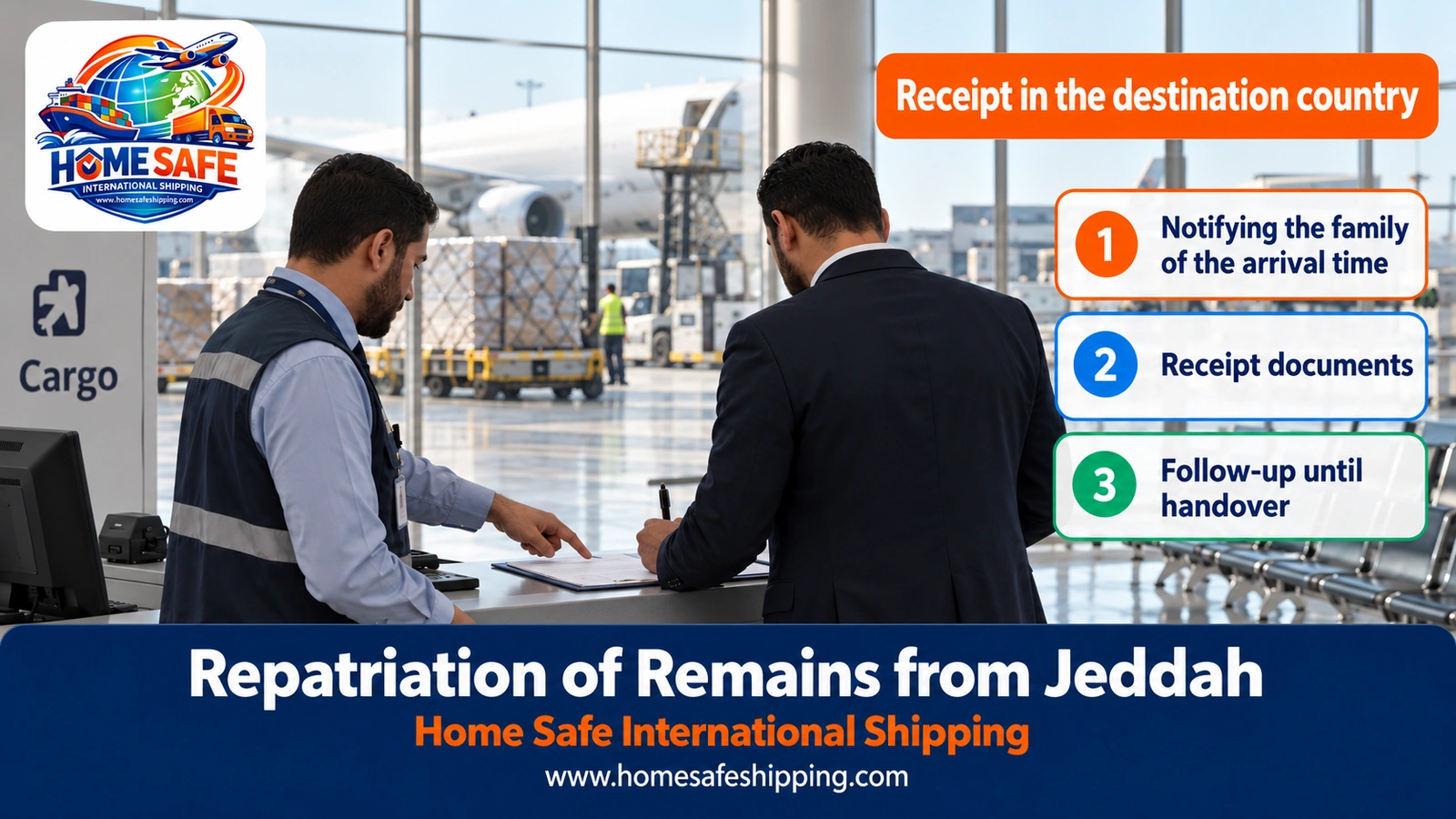
- Before departure: we send the family the flight number, the arrival time and the air waybill number.
- The recipient: a relative or someone they authorise, with their ID and copies of the documents.
- Place of receipt: the cargo terminal at the airport, not the passenger hall.
- The vehicle: arranged by the family or the funeral director there before the flight lands.
- After arrival: we follow up until the family confirms receipt.
Countries we repatriate to
We repatriate to every country served by flights from the Kingdom’s airports. Each country has its consulate’s requirements, which we review in the first call.
| Region | Countries |
|---|---|
| Arab countries | Egypt, Sudan, Jordan, Syria, Lebanon, Yemen, Morocco and Tunisia |
| The Indian subcontinent | India, Pakistan, Bangladesh, Nepal and Sri Lanka |
| East Asia | The Philippines and Indonesia |
| Africa | Ethiopia, Kenya, Uganda and Nigeria |
| Europe and elsewhere | Turkey, the countries of Europe and the Americas |
The deceased’s belongings and dues
After repatriation there remains what families always ask about: the belongings and the dues.
- Belongings: inventoried in the presence of a colleague or the sponsor’s representative, then packed and shipped to the family by air or with consolidated freight.
- Papers and valuables: the phone, watch and money are handed to the embassy or the escort, and are not shipped.
- Dues: wages and the end-of-service award are paid to the heirs through the employer and the embassy.
- Compensation: in work injuries and accidents the heirs have rights that the embassy follows up.
Shipping belongings is covered on the parcel shipping page.
What delays repatriation
- Informing the embassy late: its letter is the first thing asked for, so start with it.
- A name that differs between the passport and the iqama: corrected before any other step.
- Family consent that is not attested: the embassy sends it back.
- A sponsor who is absent or refuses: there is a legal route through the competent authorities and the embassy.
- Booking before the permits are complete: the booking and its fees are lost.
- Outstanding financial claims against the deceased: reviewed with the sponsor and the embassy.
- An expired or lost passport: the embassy issues a replacement document.
How to choose who handles the repatriation
| Criterion | What to ask for | Warning sign |
|---|---|---|
| Legal standing | A commercial registration and a known address | A middleman with a mobile number only |
| Cost | Written and itemised before starting | An advance payment with no statement |
| Clarity | They tell you what they cannot do on your behalf | “We’ll clear everything in a day” |
| Booking | After the permit, with an air waybill number | A booking before the papers are complete |
| Follow-up | One person with you until receipt | You are passed from number to number |
Why Home Safe?
A registered establishment
Home Safe Logistics Services Est., commercial registration 4030601060.
Clarity from the first call
We tell you what is needed and the full cost before any step is taken.
One person following up
A single staff member with you from start to receipt.
Respect and calm
We treat the deceased and their family with the dignity they deserve.
To reach us: 0552803439, call or WhatsApp, from 7 am to 11 pm.
Related pages
Tags
repatriation of remains from Jeddah, repatriation office, returning a deceased person home, transporting remains by air, transporting remains on Saudia, repatriation of remains from Saudi Arabia, procedures for repatriating remains from Saudi Arabia, cost of repatriating remains from Saudi Arabia, repatriation request, repatriation of remains from Saudi Arabia to Europe, repatriation of remains to Egypt, repatriation of remains to India, documents for repatriating remains, burial in Saudi Arabia, Home Safe International Shipping
Frequently asked questions about repatriating remains from Jeddah
How long does repatriating remains from Jeddah take?
3 to 7 working days for a natural death in a hospital. It takes longer for a death outside hospital, and in accidents until the investigation and the forensic report are complete.
Which documents are needed to repatriate remains from Saudi Arabia?
The death certificate, the deceased’s passport and iqama, the no-objection letter from their embassy, the next of kin’s consent, the sponsor’s letter, the preparation certificate, and the permit to move the remains out of the Kingdom.
Who bears the cost of repatriating the remains?
The employer, if the deceased was their worker, under Article 40 of the Labour Law, unless social insurance takes it on. For anyone else, the family or the insurer.
How much does it cost to transport remains by air?
It varies with the destination country and the airline. Repatriation to the Indian subcontinent starts from SAR 7,400 including preparation and freight. Call 0552803439 and we will give you the full cost for your country before any step is taken.
Where is the repatriation request submitted?
To the Emirate of the region, and it has an online service on the national unified platform. The embassy letter and the death certificate come first.
Do you transport remains on Saudia?
Yes, and on other airlines. We choose the carrier that reaches the deceased’s country on the earliest flight with the fewest stops.
Must the remains be embalmed before air transport?
Airlines and most countries require a medical preparation that preserves the remains and a hermetically sealed coffin, with a certificate issued. It is carried out at the approved health facility.
Can a relative accompany the remains?
Yes. A seat is booked for them on the same flight, and they carry the original documents.
Can the deceased be buried in Saudi Arabia?
Yes, with the family’s attested consent and a letter from the embassy stating no objection. It is quicker and costs less, and preparing the deceased and taking them to the cemetery is a free municipal service.
What about a Hajj or Umrah pilgrim who dies in Makkah or Madinah?
Most families choose burial where they died. Repatriation is possible at the family’s request, and Hajj or Umrah insurance covers it in some cases.
Do you serve Makkah, Madinah and Taif?
Yes. The procedures are completed in the city of death, then the remains are taken to Jeddah airport or Madinah airport, depending on flights.
What if the death was caused by an accident?
The police and forensic report are added, and the permit is not issued before the investigation ends. So it takes two weeks or more.
What if the sponsor refuses or cannot be found?
There is a legal route through the embassy and the competent authorities. We explain its steps to the family, and the embassy is a central party in it.
Who receives the remains in the destination country?
A relative or someone they authorise, from the cargo terminal at the airport, with their ID, copies of the documents and the air waybill number.
Do you ship the deceased’s belongings to their family?
Yes. They are inventoried, packed and shipped to the family by air or with consolidated freight, once their dues have been settled with the employer.
That is the guide — now let us price your shipment
Choose what applies to you and receive a reply with the price, the method and the time.
RoRo, container or sling lift — we recommend what suits your vehicle’s value and its destination.
Get a vehicle priceA full or shared container, or urgent air freight, with packing and clearance.
Get a shipment priceRoutes in the same section
Options related to the same type of service.