Shipping Goods from Syria to Saudi Arabia 0552803439 | Road Freight for Foodstuffs, Textiles and Furniture, plus Car Shipping
Shipping goods from Syria to Saudi Arabia by road in closed and refrigerated trucks: from Damascus, Aleppo and Homs through the Nassib crossing and Jordan to the Haditha crossing, then delivery in Riyadh, Jeddah, Dammam and Madinah. A full truck reaches Riyadh in 6–10 days in normal conditions, a sh…
Home Safe handles shipping goods from Syria to Saudi Arabia by road, in closed and refrigerated trucks that cross Jordan and enter the Kingdom at the Haditha crossing. Damascus to Riyadh is about 1,700 km, which a full truck covers door to door in 6–10 days in normal conditions. We carry foodstuffs, textiles, soap and furniture for traders and individuals, and urgent items fly from Damascus International Airport. The price for this direction is set on request; for comparison, our rates on the same road towards Syria start from SAR 370 for a parcel of up to 50 kg and SAR 1,650 for a load of cartons. To book: 0552803439.
In this guide51ShowHide
- Who ships goods from Syria to Saudi Arabia?
- Why should you understand the Syria – Saudi line before you ship?
- The land route from Syria through Jordan to the Haditha crossing
- Transit time from Syria to Saudi Arabia
- What lengthens the transit time?
- Cost of shipping goods from Syria to Saudi Arabia
- What sets the price?
- How do you cut the cost?
- Syrian goods to Saudi Arabia: foodstuffs, textiles, soap and furniture
- Conditions for bringing Syrian foodstuffs into the Kingdom
- Textiles, soap and furniture: conformity before shipping
- The legal side: licences, customs duty and tax
- Full truck or shared load?
- The refrigerated truck and heat-sensitive goods
- Shipping furniture and personal belongings from Syria
- Parcels and gifts from family in Syria
- Car shipping from Syria to Saudi Arabia
- Required documents
- What may not enter the Kingdom
- Collection from Syrian cities
- Delivering goods from Syria in Riyadh, Jeddah, Dammam and Madinah
- Storage and distribution after arrival
- Sea freight from Latakia and Tartus to Jeddah
- Air freight from Damascus to Saudi Arabia
- Choosing the right shipping method
- Steps for shipping goods from Syria to Saudi Arabia
- Tracking and insurance
- Challenges on the Syria – Saudi line and how we deal with them
- Shipping in the opposite direction: from Saudi Arabia to Syria
- Tips for a successful shipment, and reviewing it once it arrives
- How do you choose a company for shipping from Syria to Saudi Arabia?
- Common mistakes when shipping goods from Syria
- Why Home Safe for shipping goods from Syria to Saudi Arabia?
- Related articles and pages
- Tags
- Frequently asked questions about shipping goods from Syria to Saudi Arabia
- How are goods shipped from Syria to Saudi Arabia?
- How long does a shipment take from Damascus to Riyadh?
- How much does shipping goods from Syria to Saudi Arabia cost?
- Which crossing does a truck from Syria use to enter the Kingdom?
- Does the Syrian truck complete the journey into the Kingdom?
- What are the conditions for bringing Syrian foodstuffs into Saudi Arabia?
- Is customs duty paid on goods of Syrian origin?
- Do you ship small quantities for a shop or a restaurant?
- Can laurel soap and olive oil be shipped to Saudi Arabia?
- Do you ship Damascene furniture and mosaic handicrafts?
- Who collects the goods from me in Syria?
- Which documents does a trader need?
- Is there air freight from Syria to Saudi Arabia?
- Can a car be shipped from Syria to Saudi Arabia?
- Do you also ship from Saudi Arabia to Syria?
Route: Damascus, Aleppo or Homs → Nassib – Jaber crossing → Jordan → Al-Omari – Haditha crossing → Riyadh, Jeddah, Dammam and Madinah · Distance: about 1,700 km to Riyadh · Transit: 6–16 days by road, 2–5 days by air.
In brief
- Method: by road in closed or refrigerated trucks, and by air from Damascus for samples and urgent parcels.
- Road: Nassib → Jaber → Jordan → Al-Omari → Haditha crossing.
- Transit: 6–10 days by full truck to Riyadh, and 10–16 days by shared load.
- What is shipped: foodstuffs and preserves, textiles, soap, furniture and personal belongings.
- Food condition: an importer registered with the Saudi Food and Drug Authority, a health certificate and an Arabic label.
- Price: set on request according to the goods, the volume and the two cities.
- Booking: 0552803439 by call or WhatsApp, with delivery to the warehouse or house door.
Who ships goods from Syria to Saudi Arabia?
Demand on this line comes from two sides. The first is commercial: importers, shops and restaurants in the Kingdom selling Levantine products to a large Syrian community and to Saudi customers who know them well. The second is family: relatives sending household provisions and gifts to their children living in the Kingdom, and families moving there with their belongings. Each group has a shipping method that fits its volume and paperwork, summarised in the table:
| Who | What they ship | Best method |
|---|---|---|
| Food importer | Preserves, pickles, olive oil, sweets and spices | Full closed truck, or refrigerated for sensitive lines |
| Levantine grocery shop or restaurant | Dozens of cartons of mixed lines | Shared load |
| Clothing and fabric trader | Ready-made garments, fabrics, towels and bed linen | Closed truck, with the season’s samples by air |
| Furniture and furnishings showroom | Inlaid wooden furniture, mosaic and brassware | Closed truck with crated packing |
| Family moving to live in the Kingdom | Belongings and used furniture | Shared or full, depending on volume |
| Relatives sending to their children | Provisions, gifts and clothes | A parcel in the shared load, or by air |
Why should you understand the Syria – Saudi line before you ship?
Shipping from Syria is not just a move from one city to another. The goods pass through three countries and four border points, under an export regime in one country and a strict import regime in another. Whoever knows these links before buying the goods avoids the most common losses: a product refused at the crossing, or a shipment waiting a week over a missing paper.
- For the trader: knowing the product’s conditions before buying decides whether it can be imported at all, and what it will cost to the shop shelf rather than to the border.
- For the Syrian supplier: preparing the pack, the label and the certificates to Saudi requirements opens a steady market.
- For the individual: knowing what counts as personal belongings and what counts as merchandise protects against duties never budgeted for.
The land route from Syria through Jordan to the Haditha crossing
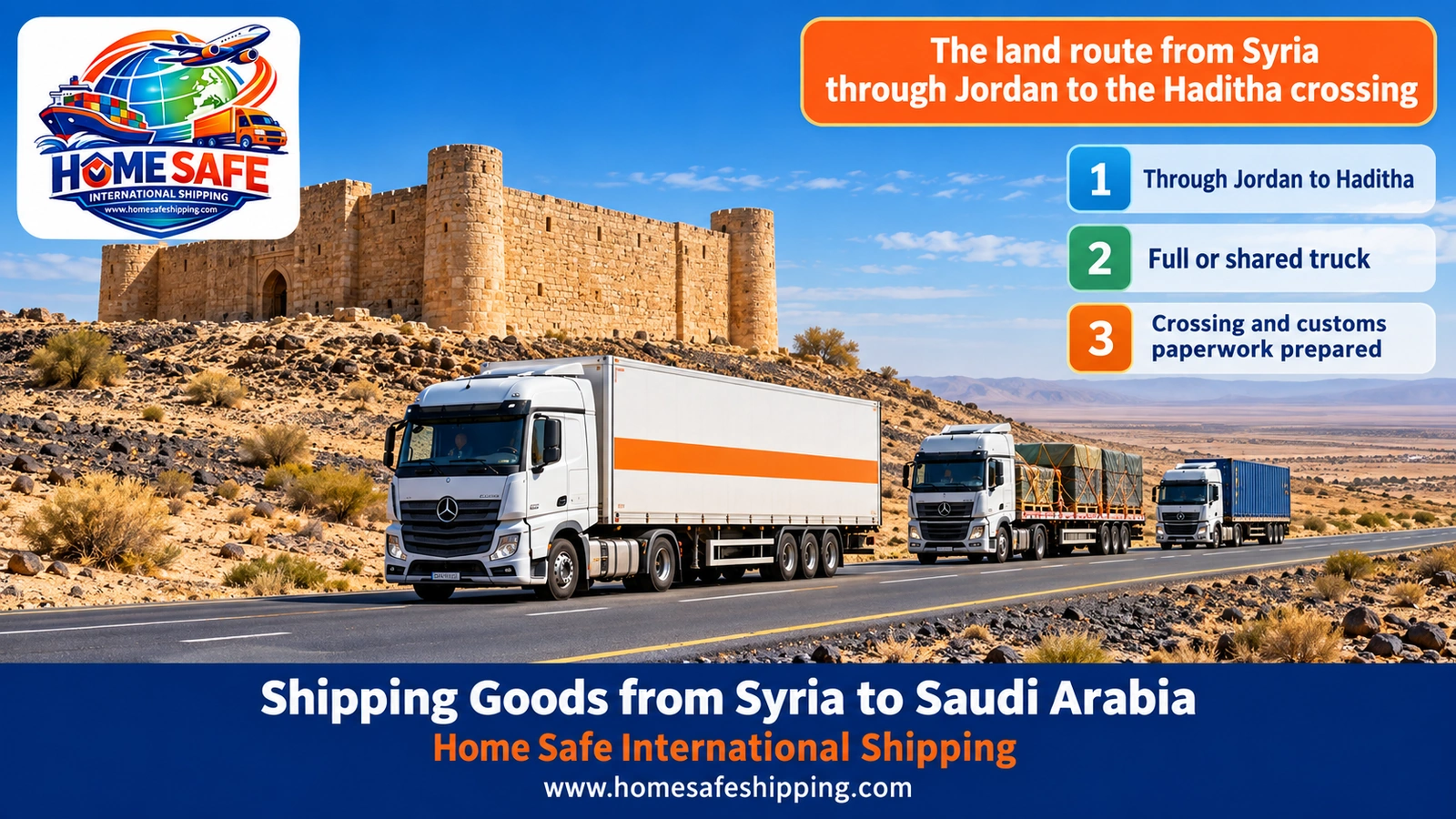
Syria and the Kingdom share no border, so every truck crosses Jordan. The load leaves through the Nassib crossing in Daraa, enters Jordan at Jaber, runs east across it to the Al-Omari post and then enters the Kingdom at the Haditha crossing in Al-Jouf region, about 36 km from Qurayyat. From Haditha the roads branch to the centre, east and west of the Kingdom.
| Stage | Approximate distance | What happens |
|---|---|---|
| Syrian city → Nassib crossing | About 110 km from Damascus, 460 km from Aleppo | Loading and the Syrian export declaration |
| Nassib – Jaber crossing | — | Exit from Syria and entry into Jordan on a transit document |
| Jaber → Al-Omari | About 200 km | Transit across Jordan with no clearance of the goods there |
| Al-Omari – Haditha crossing | — | Exit from Jordan, then Saudi inspection and customs release |
| Haditha → Riyadh | About 1,300 km | Via Al-Jouf, Hail and Qassim |
| Haditha → Dammam | About 1,600 km | By the northern road or via Riyadh |
| Haditha → Madinah and Jeddah | About 1,100 km and 1,500 km | Via Tabuk |
Shipments bound for the west of the Kingdom may take another road inside Jordan: from Jaber south to Mudawwara, then the Halat Ammar crossing north of Tabuk. We choose the crossing by the delivery city and the truck’s load. Conditions at the crossings on this line change: the same truck may complete the trip, or the load may be transferred at one of the crossings to another truck. So we confirm the available route and the arrangement in force before loading day, and prepare the transit and customs papers accordingly. The crossings are explained on the ports and gateways page.
Transit time from Syria to Saudi Arabia
Driving time itself is short: three days are enough to cover the road from Damascus to Riyadh. The rest goes on loading, the two border points, release and distribution. Transit is therefore counted door to door and given as a range, not a single figure:
| Method | Door-to-door time | Suits |
|---|---|---|
| Full closed truck | 6–10 days to Riyadh | One trader’s cargo, or a household’s furniture |
| Refrigerated truck | 6–10 days, given priority at inspection where possible | Heat-sensitive food |
| Shared load | 10–16 days | Cartons, parcels and shop quantities |
| Sea container | 15–25 days to Jeddah, depending on the available service | Heavy loads that are not urgent |
| Air from Damascus | 2–5 days | Samples and urgent parcels |
Add one day for Dammam, and one to two days for Jeddah and Madinah when the truck enters at Haditha. These times are for normal conditions; in congested seasons, queues at the crossing have been recorded that lasted many days.
What lengthens the transit time?
- Waiting at Jaber and Al-Omari: the truck queue grows in the fruit and vegetable season and before Ramadan and the Eids.
- A missing certificate: a food consignment without a health certificate, or with a non-Arabic label, stops at Haditha.
- Sampling: laboratory testing of some foods adds days before release.
- Load transfer: unloading the goods and reloading them onto a second truck at the crossing takes a day or more.
- Filling the shared truck: a shared truck does not move until it is full.
Cost of shipping goods from Syria to Saudi Arabia
We do not publish a fixed price for this direction, and we say so plainly. Truck hire from Syria shifts with the season, the exchange rate, transit fees and the waiting days expected at the crossing, and any fixed figure would be wrong within weeks. The price is therefore set on request once the goods, the volume and the two cities are known. The last column of the table gives our published rates on the same road in the opposite direction, to give you a sense of scale, not a promised price:
| Shipment | How it is charged | Price from Syria to the Kingdom | For comparison: from the Kingdom to Syria starts from |
|---|---|---|---|
| Personal parcels up to 50 kg | Per parcel | Set on request | SAR 370 |
| Cartons and luggage, 1–5 m³ | Per cubic metre | Set on request | SAR 1,650 |
| Small flat’s furniture, 25–35 m³ | By volume | Set on request | SAR 3,700 |
| Large flat’s furniture, 40–60 m³ | Per truck | Set on request | SAR 6,000 |
| Full truck of commercial cargo | Per truck and its type | Set on request | Set on request |
| 20ft container between Latakia and Jeddah | Per container | Set on request | SAR 4,600 |
| Air between Damascus and the Kingdom | On chargeable weight | Set on request | SAR 14 per kilogram |
Market prices for this direction are rarely published, and we found no office advertising a fixed tariff for it. Syrian exporters have been quoted as saying that hire of a refrigerated truck loaded with fruit and vegetables for Gulf markets ran at around USD 4,000 in normal conditions and reached about USD 8,000 when trucks piled up at the crossing. That gap shows why each request is priced at its own time. Send your shipment details to 0552803439 and you get the price the same day.
What sets the price?
| Factor | Effect |
|---|---|
| Volume and weight | They fix the truck size or your share of it. Work out the volume with the CBM calculator |
| Truck type | Refrigerated costs more than closed, because the cooling runs throughout the waiting days |
| Collection city in Syria | Damascus and Daraa are nearest to Nassib; Aleppo and the coast are farther |
| Delivery city | Riyadh and Qassim are nearest; Jeddah and Dammam are farther |
| State of the crossing | Waiting days are part of the truck hire |
| Duty and tax | Paid to Saudi customs, outside the transport charge |
How do you cut the cost?
- Gather your purchases at one supplier or one warehouse: one collection is cheaper than three.
- Ship dry goods with dry goods: a single carton that needs cooling lifts a whole truck to the refrigerated rate.
- Ask for the authenticated certificate of origin: it may exempt a product of Arab origin from customs duty.
- Shrink the empty space: cartons of one size stack with no air you are paying to move.
- Book outside the peaks: the weeks before Ramadan and the summer fruit season bring higher demand for trucks.
Syrian goods to Saudi Arabia: foodstuffs, textiles, soap and furniture
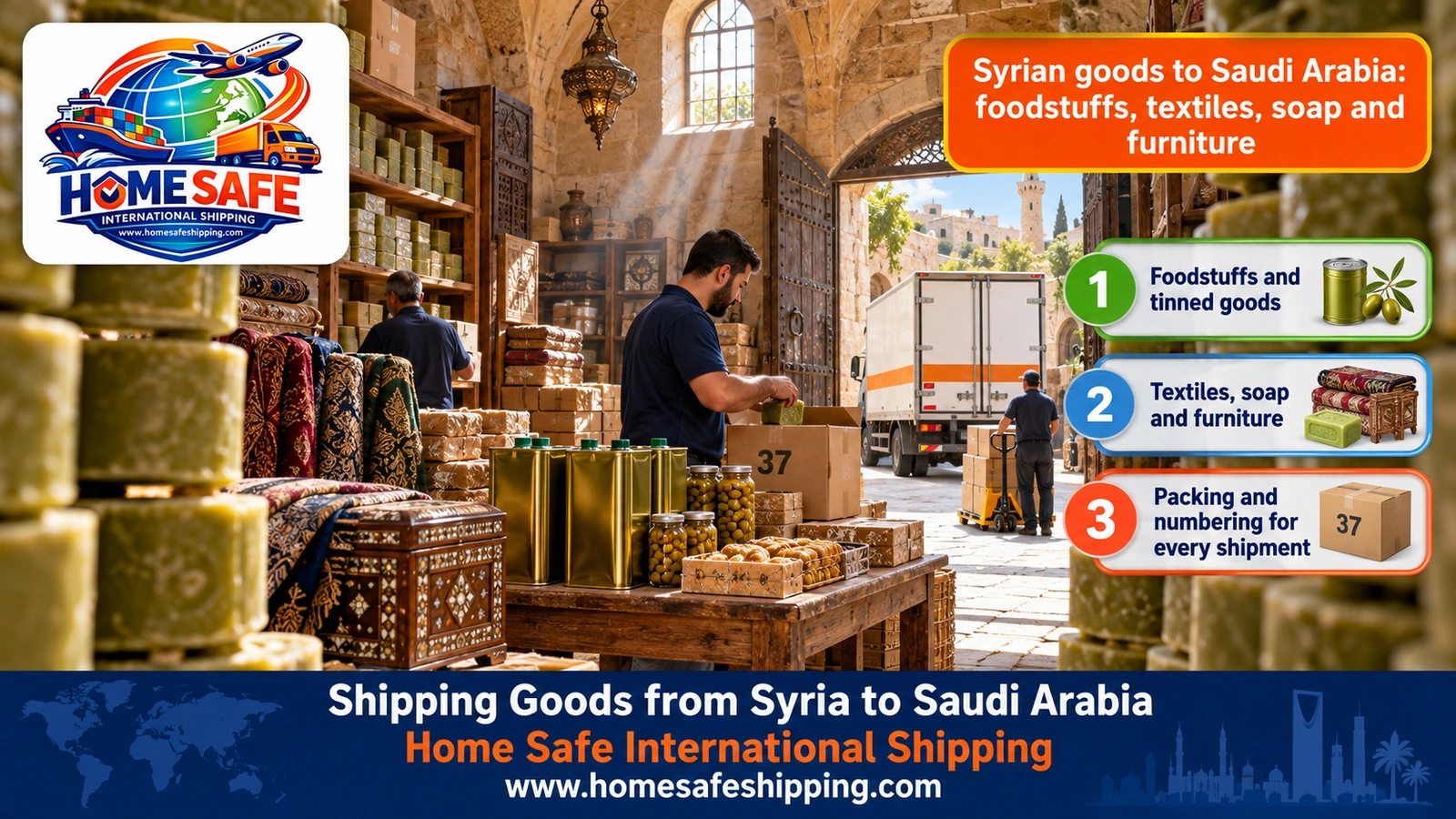
What moves from Syria to the Kingdom falls into four main groups. Food is the largest by volume and the strictest in its conditions, then textiles and garments, then soap and traditional care products, then furniture and handicrafts. Each group has its own packing and its own regulator in the Kingdom. Our rule is the same for all of them: packing that withstands a second unloading and loading on the way, and a number on every carton that matches the packing list.
| Group | Examples | Packing | Authority concerned in the Kingdom |
|---|---|---|---|
| Dry and preserved foodstuffs | Pickles, makdous, jams, pomegranate molasses, za’atar, spices, bulgur and freekeh, Levantine sweets | Reinforced cartons on pallets, with dividers for glass | Saudi Food and Drug Authority |
| Olive oil | Tins and glass bottles | Upright, never inverted, with a liner that absorbs leaks | Saudi Food and Drug Authority |
| Fresh fruit and vegetables | According to season | Refrigerated truck with a temperature log | Plant health certificate, and whatever the authorities allow at the time of shipping |
| Textiles and garments | Ready-made garments, fabrics, towels, bed linen | Pressed bales or cartons lined with plastic | Conformity through the SABER platform |
| Soap and care products | Aleppo laurel soap, olive-oil soap | Dry, ventilated cartons kept away from food | Saudi Food and Drug Authority, cosmetics sector |
| Furniture and handicrafts | Mother-of-pearl inlaid furniture, mosaic, brassware, brocade | Piece by piece, with valuable items in timber crates | Customs, and conformity where required |
Food and soap are never loaded side by side, since the scent of laurel passes into the next carton. Liquids go at the bottom of the load and on pallets, so that one leak does not spoil what lies beneath. Details of our service for traders are on the commercial shipping page.
Conditions for bringing Syrian foodstuffs into the Kingdom
Food is what gets refused most often at the crossing, and the reasons are known in advance. The Saudi Food and Drug Authority is the body that releases a food consignment, and it looks at three things: who the importer is, what the product is, and whether this consignment’s papers are complete. The rules in force are as follows, and we confirm what applies to your product before shipping:
- The importer: a Saudi business with a commercial registration, registered with the Authority, with its products registered in the Authority’s electronic system.
- Consignment documents: a commercial invoice, a packing list, a certificate of origin and a health certificate issued by the competent body in the country of origin.
- The label: in Arabic on every pack: product name, ingredients, net weight, country of origin, production and expiry dates, and storage conditions.
- Shelf life: what remains of it on arrival must be sufficient for the type of product.
- Additives: colours and preservatives must be among those permitted in Saudi and Gulf standards.
- Testing: a sample may be drawn for the laboratory, and the consignment is not released until the result is out.
- Halal certificate: for products containing ingredients of animal origin.
A home-made product not packed in a licensed factory is unfit for commercial import, however good it is. Home-made makdous and jam enter only in small personal quantities, in a family parcel and not in a shop’s shipment.
Textiles, soap and furniture: conformity before shipping
New non-food goods imported for sale go through the SABER platform. The importer registers the product on the platform and obtains a conformity certificate for the product, then a certificate for each consignment; without them the release is not completed. Textiles and garments have a technical regulation that requires a fixed label on the item stating fibre composition, country of manufacture and care instructions. A piece sold in a Damascus market with no label therefore needs one before it is loaded.
Traditional soap is classed as a care product, is listed with the Saudi Food and Drug Authority before commercial import, and has its ingredients written in Arabic. For new wooden furniture, the product line is checked in SABER before purchase, as some lines fall under a technical regulation and for others a supplier’s declaration is enough. These requirements are updated, so we review your product’s line with the customs broker before you pay for the goods. Items entering for personal use in non-commercial quantities are not asked for this.
The legal side: licences, customs duty and tax
The legal side of a shipment is split between two countries. In Syria the exporter needs a commercial registration and an export declaration, and a certificate of origin from the chamber of commerce or industry. In the Kingdom the importer needs a commercial registration covering import, and an account on the FASAH platform through which customs declarations are filed. The table sums up what is paid and what is required on entry:
| Item | Rule in force |
|---|---|
| Customs duty | According to the product’s tariff line, ranging for most goods between 5% and 15% of the value |
| Goods of Arab origin | May be exempt from duty under the Greater Arab Free Trade Area with an authenticated certificate of origin; we confirm that it applies to your product |
| Value added tax | 15% on the value including duty and freight |
| Personal belongings and used furniture | Exempt for a person arriving to take up residence, on conditions, and inspected at the crossing |
| Restricted products | Need a permit from their authority: food and drug, agriculture or communications |
| Safety | No flammable materials are loaded with general cargo, and the load is secured with straps |
Clearance in the Kingdom is carried out through licensed customs brokers with whom we arrange the work, and the importer pays the duty and tax directly to customs. The service is explained on the customs clearance page and in the article on customs clearance in Jeddah.
Full truck or shared load?
The choice between them is a matter of volume and time. Whoever fills more than half a truck finds the full truck cheaper and faster, and whoever ships less pays only for a share in the shared load. With food there is a third consideration: a full truck is cleared on a single declaration, so your product is not held up by a sample drawn from another trader’s goods.
| Point of comparison | Full truck | Shared load |
|---|---|---|
| Charging | Hire of the whole truck | Per cubic metre or per pallet |
| Departure | On loading day | Once the truck is full |
| Transit to Riyadh | 6–10 days | 10–16 days |
| Clearance | One declaration in one importer’s name | Several declarations in one truck |
| Handling | Loaded and unloaded once where possible | Sorted in the warehouse on arrival |
| Suits | An importer, or a whole household’s furniture | A shop, a restaurant, family parcels |
The refrigerated truck and heat-sensitive goods
The road runs through the Syrian steppe and the north of the Kingdom, and in summer the heat inside a closed box exceeds what many products can bear. Ghee-based sweets, chocolate, cheese and dairy, and fresh fruit and vegetables travel in a refrigerated truck set to the temperature the product needs, with readings logged throughout the trip. Preserves, oil and dry pulses are fine in a closed truck.
The real danger to chilled cargo is waiting, not distance. A truck standing for days in the queue at the crossing burns its fuel on cooling, and fresh produce loses part of its life each day. So we ask about the state of the crossing before loading any perishable line, and we put loading back two days if the queue is long rather than let the goods stand in the sun. Fruit and vegetables in particular may have conditions attached, or a given item may be stopped from entering by a decision, so they are not loaded before the permission is confirmed.
Shipping furniture and personal belongings from Syria
Not everything that comes from Syria is merchandise for sale. Many families join a breadwinner living in the Kingdom and bring their belongings and some of their furniture, and others buy a Damascene sitting-room set or an inlaid dining suite for their home in Riyadh or Jeddah. Belongings and used furniture of a person arriving to take up residence are exempt from duty on conditions set by customs, chiefly that they are for personal use and in the quantities of one household, and they are inspected at the crossing. A newly bought piece is treated according to its value.
- Inlaid furniture: soft paper over the mother-of-pearl, then foam, then corrugated cardboard, with corner protectors.
- Mosaic and wooden boxes: each piece in its own carton, with no weight placed on top.
- Brassware and blown glass: padded timber crates.
- Carpets and brocade: rolled, never folded, and wrapped in moisture-proof plastic.
- Belongings: numbered cartons and a contents list in the owner’s name as in the passport.
Packing methods are set out in detail on the packing guide page, and our furniture service on the furniture shipping page.
Parcels and gifts from family in Syria
The family parcel is the simplest shipment on this line: two or three cartons of household provisions, clothes and gifts. It travels in the shared load and is delivered to the son’s or daughter’s address in the Kingdom. It enters as personal belongings as long as the quantities are family-sized and not repeated: ten kilograms of za’atar is a gift, and two hundred kilograms is merchandise.
- What works: za’atar, spices, nuts, dry sweets, clothes, embroidery and soap in small quantities.
- What is not advised: dairy, cheese and cooked food, which cannot stand the days on the road.
- Liquids: oil and molasses in tight containers inside a sealed bag, then a carton.
- Medicines: personal quantities with a prescription only, and some need a permit.
- Address: the consignee’s name, Saudi mobile number, city and district on every carton.
Details of the service are on the parcel shipping page.
Car shipping from Syria to Saudi Arabia
This is the least requested service on the line, and its conditions rule out most requests before they begin. The rule in force in the Kingdom is that an imported passenger car must be no older than five years from its year of manufacture, left-hand drive and compliant with Saudi specifications, and must not be damaged by a serious accident or flooding or have been used as a taxi or police car. Customs duty and value added tax are paid on it. A car that meets the conditions travels on a car carrier along the same land route, and its price is set on request. Send the make and year of manufacture to 0552803439 and we check whether it is admissible before any booking. Transport methods are on the car shipping page.
Required documents
A missing paper costs more than any line on the invoice, because its price is days of waiting at the crossing. We review a copy of the documents before loading, not after, and match the invoice against the packing list and the numbers written on the cartons.
| Type of shipment | On the Syrian side | On the Saudi side |
|---|---|---|
| General commercial goods | Commercial invoice, packing list, authenticated certificate of origin, export declaration | Importer’s commercial registration, FASAH account, authorisation for the broker |
| Foodstuffs | The above, plus a health certificate, and a halal certificate where required | Registration of the importer and the products with the Saudi Food and Drug Authority |
| Textiles, new furniture and soap | The above, plus test reports if requested | SABER conformity certificate, or listing of the product with the Authority |
| Belongings and used furniture | Detailed contents list and a copy of the owner’s passport | Residence permit or visa, and the delivery address |
| Family parcels | Sender’s ID and a contents list | Consignee’s name, ID and mobile number |
Each document is explained on the shipping documents page.
What may not enter the Kingdom
The Kingdom’s prohibited list is stricter than those of neighbouring countries, and some things sold freely in Syria never get in. We go through the contents list item by item before loading and take out what will not be accepted, because one prohibited item stops the whole truck.
| Item | Ruling |
|---|---|
| Alcoholic drinks and anything containing alcohol, pork and its derivatives | Prohibited |
| Narcotics and narcotic pills | Prohibited, with severe penalties |
| Tobacco and molasses tobacco in quantity | Restricted and subject to excise tax |
| Medicines | Personal quantities with a prescription; commercial with a Food and Drug Authority permit |
| Weapons, their parts and fireworks | Prohibited |
| Radio and tracking devices and drones | With a licence from the competent authority |
| Seeds, seedlings and plants | With an agricultural permit and a plant health certificate |
| Antiquities | May not leave Syria and are not shipped |
The full list is on the prohibited items page.
Collection from Syrian cities
Home Safe is a Saudi establishment, and what happens inside Syria is handled by partner agents we work with there: collection from the factory, warehouse or home, loading and the export declaration. Our team in the Kingdom manages and follows the shipment and handles the import side and delivery. A full truck is loaded directly at the supplier’s address, and small quantities are gathered at the consolidation warehouse and then leave on the shared truck.
| Area | Distance from the Nassib crossing | What is usually shipped from it |
|---|---|---|
| Damascus and its countryside | About 110 km | Food and sweets, garments, furniture and handicrafts |
| Daraa and Sweida | 15–60 km | Farm produce and olive oil |
| Homs and Hama | 270–320 km | Food, sweets and assorted manufactures |
| Aleppo | About 460 km | Textiles and garments, laurel soap, za’atar and pistachios |
| Idlib | About 430 km | Olive oil and dried figs |
| Latakia and Tartus | About 450 km | Citrus and olive oil, and containers through the two ports |
Collection from Aleppo and the coast adds one to two days to the transit time and is part of the price.
Delivering goods from Syria in Riyadh, Jeddah, Dammam and Madinah
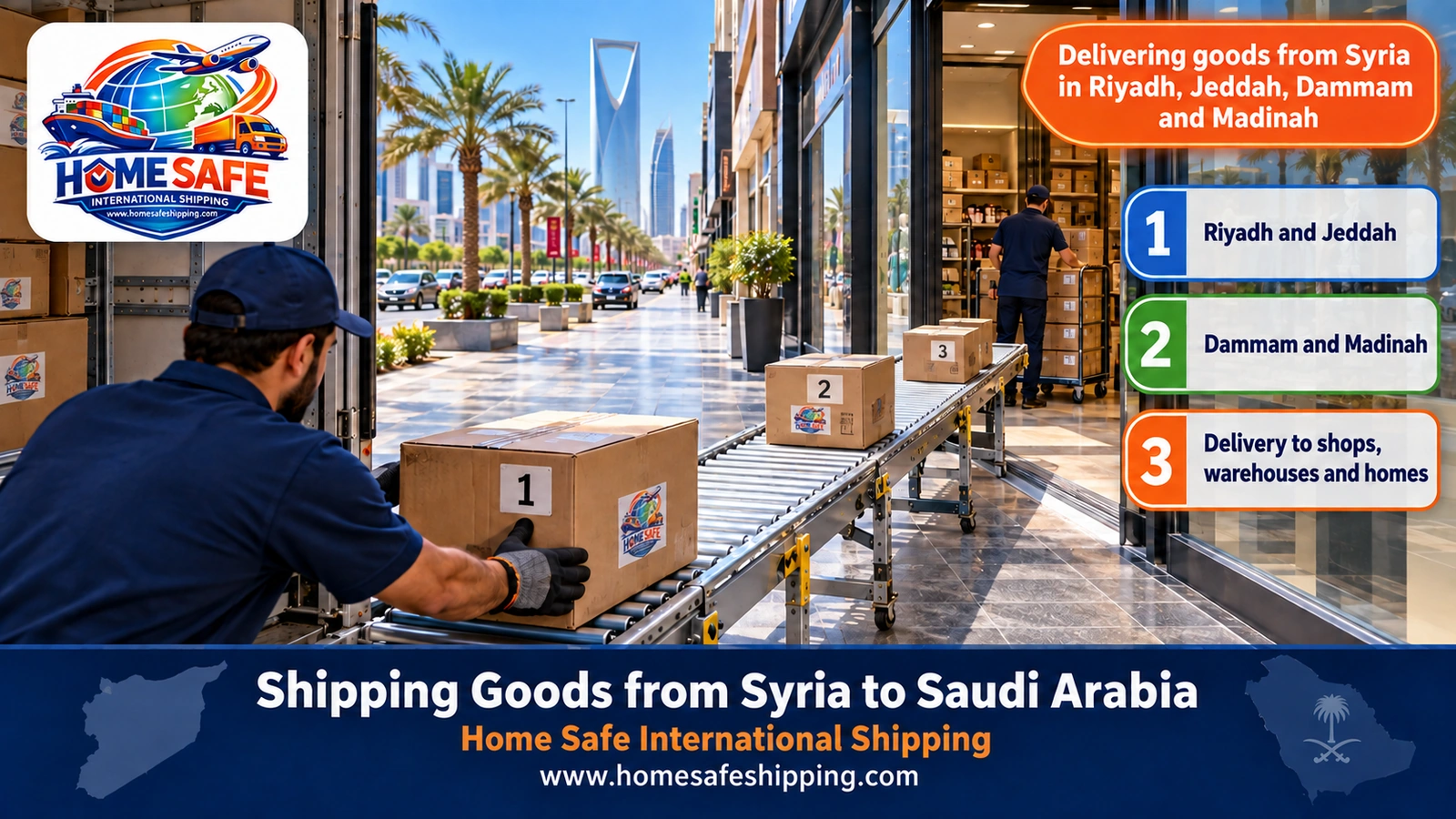
After release at the crossing, a full truck heads straight for the consignee’s address. A shared load arrives at the sorting warehouse and is distributed from there by smaller vehicles to shops, warehouses and homes. Delivery is to the door: the warehouse door by forklift or by hand, the shop door in the hours the district allows, and the house door on the floor you live on.
| City | Approximate distance from Haditha | Where we deliver |
|---|---|---|
| Riyadh | About 1,300 km | Warehouses in the south and east of the city, shops in Batha and Olaya, and residential districts |
| Jeddah | About 1,500 km | Warehouses in south Jeddah, the Balad markets and shops in the northern districts |
| Dammam and Khobar | About 1,600 km | The industrial area and warehouses, and shops in Khobar and Dhahran |
| Madinah | About 1,100 km | Shops and restaurants outside the central area, and residential districts |
| Makkah and Taif | With the Jeddah truck | By distribution vehicle, in the hours permitted for trucks |
| Qassim, Hail, Tabuk and Al-Jouf | On the truck’s road | Dropped on the way, before the big cities |
Entry of large trucks into the centres of Riyadh, Jeddah, Makkah and Madinah is limited to hours set by the traffic departments, so we move the load onto smaller vehicles where needed. Our service is on the door-to-door page, and the cities covered on the cities page.
Storage and distribution after arrival
A trader who imports a truckload does not sell it all on the day it arrives, which is why storage is part of the shipment’s arithmetic from the start. The goods are unloaded into a warehouse, counted and matched against the packing list, then issued in batches to branches or customers. Food is stored away from soap and detergents, and chilled lines in cold rooms.
Whoever ships for more than one city saves by distributing off the truck: the Qassim share is dropped on the way, then the Riyadh share, and the rest carries on. The storage service is on the storage page, and its price is set on request according to duration and volume.
Sea freight from Latakia and Tartus to Jeddah
The sea is not the usual way on this line, but it is a real option for heavy loads whose owner is in no hurry. The container is loaded at the port of Latakia or Tartus, passes through the Suez Canal to Jeddah Islamic Port and arrives in 15–25 days, depending on the available service and whether it is direct or with transhipment. It suits marble and stone, dry foodstuffs in large quantities and anything delivered in the west of the Kingdom. The regularity of services between the two ports and Jeddah changes, so we confirm the available service and its price on request. For anything delivered in Riyadh or Dammam, the road truck is faster and involves less handling. Details are on the sea freight page.
Air freight from Damascus to Saudi Arabia
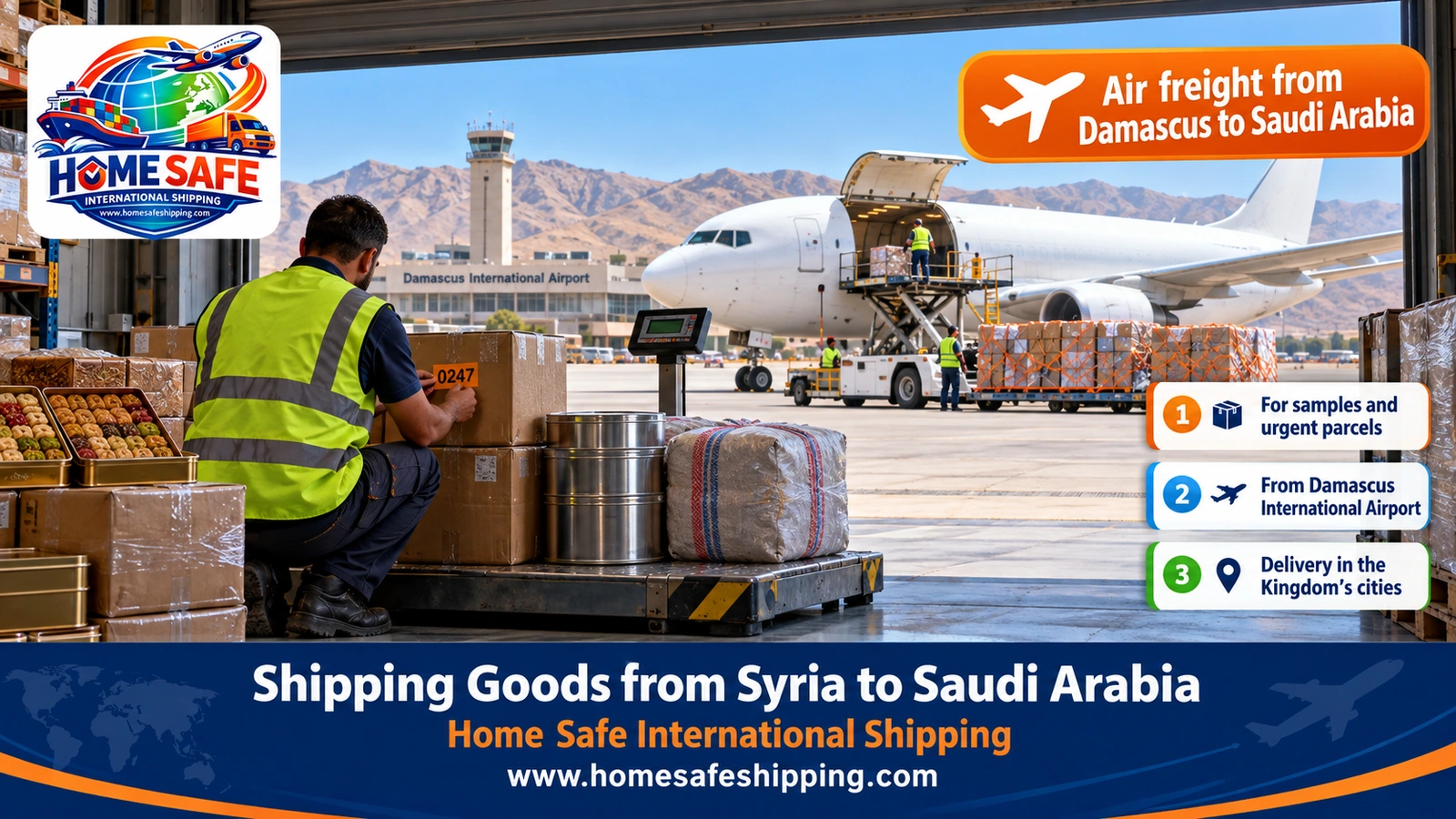
Air freight serves whatever cannot wait at the crossing. Damascus International Airport has direct flights to Riyadh, Jeddah and Dammam; the shipment travels in the hold of a passenger aircraft or on a cargo flight, as available, and reaches the consignee’s door within 2–5 days after clearance. A trader uses it for the season’s samples before ordering the truck, and for a line that has run out on the shelf and cannot wait two weeks.
| Item | Detail |
|---|---|
| What it suits | Garment and fabric samples, documents, urgent parcels, spare parts, fine sweets in small quantities |
| What it does not suit | Furniture, heavy goods and liquids in quantity |
| Departure airport | Damascus International Airport, and from Aleppo subject to available flights |
| Arrival airports | Riyadh, Jeddah and Dammam, then road distribution to other cities |
| Charging | On chargeable weight: the greater of actual weight and volumetric weight |
| Price | Set on request; for comparison, our rate from the Kingdom to Damascus starts from SAR 14 per kilogram |
| What does not fly | Loose batteries, aerosols, and perfumes and essential oils in quantity |
Food sent by air for sale is subject to the same conditions: a registered importer, a health certificate and an Arabic label. Work out volumetric weight with the volumetric weight calculator; the service is on the air freight page.
Choosing the right shipping method
The method is chosen from three questions: how much time there is, what the goods weigh and measure, and whether they need special handling. The common mistake is to pick the cheapest on paper and then pay the difference in spoiled goods or a missed season. The table matches each case with its method:
| Your case | Method | Reason |
|---|---|---|
| Seasonal goods that fill a truck | Full closed truck | Leaves on loading day and clears on one declaration |
| Shop quantities of dry lines | Shared load | You pay only for your volume |
| Ghee-based sweets or fresh produce | Refrigerated truck | Heat, not distance, is the danger |
| Samples, or a line that has run out | Air from Damascus | Days, not weeks |
| Marble or a heavy load for Jeddah | Sea container | Great weight is cheaper by sea |
| Belongings of a family arriving to live | Shared load, or a full truck for a whole household | By volume, after the inventory |
A broader comparison of methods is on the shipping methods comparison page, and our road service on the land freight page.
Steps for shipping goods from Syria to Saudi Arabia
The order matters as much as the steps themselves. Most problems come from a trader who bought the goods and then asked about their conditions; the right way is to ask first.
- You send us the product in detail and its quantity, the supplier’s city in Syria and the delivery city in the Kingdom.
- We review the product’s conditions in the Kingdom: whether it can be imported, which certificates it needs and in whose name it is cleared.
- You receive the price, the expected transit time and the state of the crossing in the week of your request.
- The supplier prepares the invoice, packing list, certificate of origin and health certificate, and we review the copies.
- The partner agent collects the goods; they are packed, numbered and loaded, and the truck is sealed.
- Exit through Nassib and transit across Jordan on the transit document.
- Inspection and release at the Haditha crossing, and payment of duty and tax.
- Delivery to the address, with the cartons checked against the list before signing.
Tracking and insurance
On a road that takes the truck through three countries, knowing the loading day and the arrival day is not enough. We update you at every point: the truck leaving the warehouse, reaching Nassib, crossing Jaber, its turn at Al-Omari, entering Haditha, the release being issued, and then the delivery appointment. If it stops in the queue at the crossing, you know the same day, with the reason. Details are on the shipment tracking page.
Insurance is optional, and we recommend it for commercial goods on this line in particular, because the load may be unloaded and reloaded more than once. It is calculated as a percentage of the value declared on the invoice and covers loss and damage in transit under the policy terms. What it usually does not cover: food spoiling because of a customs delay, and inadequate packing by the supplier. Booking and cancellation terms are stated in the booking confirmation. Details are on the cargo insurance page.
Challenges on the Syria – Saudi line and how we deal with them
We do not describe this line as easy. It has real obstacles known to everyone who has shipped on it, and they are dealt with by preparation, not promises. The table lists each obstacle and what we do about it:
| Challenge | Its effect | What we do |
|---|---|---|
| Heavy procedures | Four border points and three customs regimes | Documents reviewed before loading, and a broker at each end |
| Exchange-rate swings | The collection charge inside Syria changes | A price in riyals valid for a period stated in the booking confirmation |
| Changing state of the crossings | Waiting, load transfer, or a product being stopped | The arrangement in force confirmed before loading day |
| Road conditions | Late collection from some areas | Collection through agents who know their area, and consolidation in a secure warehouse |
| Strict Saudi import rules | A non-compliant product refused | Conditions reviewed before purchase, not after |
| Summer heat | Damage to sensitive food | A refrigerated truck, or loading postponed |
The strategy that ties all this together comes down to three things: plan early, stay in touch, and assume nothing. Rules at the three sets of crossings change, so what held for your last shipment may not hold for this one.
Shipping in the opposite direction: from Saudi Arabia to Syria
The same road works towards Syria, and traffic on it is heavier today because Syrian families living in the Kingdom are returning. We ship returnees’ furniture, luggage, appliances, solar-power equipment, parcels and cargo to Damascus, Aleppo and the other governorates. A shared shipment of cartons starts from SAR 1,650, and a small flat’s furniture from SAR 3,700. Each city has its own guide: shipping company from Jeddah to Syria, furniture moving from Riyadh to Syria and furniture moving from Dammam to Syria. Whoever ships regularly in both directions benefits from a truck that does not return empty.
Tips for a successful shipment, and reviewing it once it arrives
The tips below sum up what recurs on this line, followed by a short checklist for reviewing your shipment when it arrives, so that the next one goes better.
- Start with a small trial shipment: two or three lines in a shared load reveal every release requirement before you fill a truck.
- Ask the supplier for a picture of the label before printing: correcting the Arabic label at the factory is cheaper than sticking it on at the crossing.
- Write the true value on the invoice: a low value delays release and saves nothing.
- Photograph the load before the truck is sealed: the pictures are your reference if a carton is short or damaged.
- Leave a margin before the season: Ramadan stock is loaded weeks ahead, not days.
When you take delivery, review three things. The documents: were they all accepted first time, or was a paper requested that was not ready? The cost: did it stay within what you calculated, and where did it rise? And the experience: did the goods arrive intact and within the estimated time, and what would you change? Write the answers down; they are your guide for the next shipment.
How do you choose a company for shipping from Syria to Saudi Arabia?
Reading reviews and comparing prices both help, but they are not enough on a line like this. Ask the company specific questions about your product and about the crossing, and judge it by its answers:
| What you ask about | Reassuring sign | Warning sign |
|---|---|---|
| Commercial registration | A registration number that can be verified | A page and a mobile number only |
| Your product’s conditions | Asks about the importer and certificates before the price | “We ship everything” |
| State of the crossing | Tells you the arrangement in force this week | A fixed, guaranteed transit time |
| Price | Itemised: collection, transport, transit, clearance, delivery | One figure with no breakdown |
| The Syrian end | Explains who collects and who exports | Vagueness about who carries the goods |
| Delivery | To the warehouse or house door | “Collect from the freight yard” |
Common mistakes when shipping goods from Syria
- Buying food from an unlicensed workshop and then trying to import it for sale.
- A label with no expiry date, or in a language other than Arabic.
- Shipping commercial goods in the name of an individual with no registration and no listing with the Authority.
- Placing soap and detergents on top of food cartons.
- Loading ghee-based sweets in a closed truck in summer.
- Relying on a previous shipment’s transit time without asking about the crossing today.
- Neglecting the authenticated certificate of origin, then paying a duty that could have been waived.
Why Home Safe for shipping goods from Syria to Saudi Arabia?
A registered establishment
Home Safe Logistics Services Establishment, commercial registration 4030601060.
We check the product before you buy
Food and conformity conditions are examined before you pay the supplier.
One party for both countries
Partner agents in Syria, and a team in the Kingdom managing the shipment to the door.
Straight talk on time and price
We confirm the state of the crossing first, and give no figure we cannot honour.
To book: 0552803439 by call or WhatsApp, from 7 am to 11 pm. Or through the request a quote page.
Related articles and pages
- Shipping to Syria
- Shipping company from Jeddah to Syria
- Shipping goods from Egypt to Saudi Arabia
- Shipping from Turkey to Saudi Arabia and the Gulf
- Land freight company in Saudi Arabia
- Commercial shipping
Tags
shipping goods from Syria to Saudi Arabia, shipping from Syria to Saudi Arabia, shipping goods from Syria, shipping company from Syria to Saudi Arabia, land freight from Syria to Saudi Arabia, shipping from Damascus to Riyadh, shipping from Damascus to Jeddah, shipping from Aleppo to Saudi Arabia, importing foodstuffs from Syria, shipping Syrian products to Saudi Arabia, Haditha crossing, Nassib Jaber crossing, air freight from Damascus to Saudi Arabia, furniture shipping from Syria to Saudi Arabia, shipping prices from Syria to Saudi Arabia, Home Safe international shipping
Frequently asked questions about shipping goods from Syria to Saudi Arabia
How are goods shipped from Syria to Saudi Arabia?
The main method is by road. The cargo is loaded into a closed or refrigerated truck in Damascus, Aleppo or Homs, leaves through the Nassib crossing into Jordan’s Jaber crossing, crosses Jordan to the Al-Omari post and enters the Kingdom at the Haditha crossing near Qurayyat. After customs release it continues to Riyadh, Jeddah, Dammam or Madinah. Light, urgent items fly from Damascus International Airport.
How long does a shipment take from Damascus to Riyadh?
A full truck reaches Riyadh 6–10 days after loading in normal conditions, and a shared load takes 10–16 days because it waits for the truck to fill and is then sorted on arrival. An air parcel arrives in 2–5 days. Waiting days at the two border points are what move these figures, so we give you an updated estimate on the day you book.
How much does shipping goods from Syria to Saudi Arabia cost?
The price for this direction is set on request, because the collection charge inside Syria, the transit fees and the waiting days at the crossing change from week to week. For comparison, our published rates on the same road from the Kingdom to Syria start from SAR 370 for parcels of up to 50 kg, SAR 1,650 for a load of cartons and SAR 14 per kilo by air. Send the goods, the volume and the two cities and you get the price the same day.
Which crossing does a truck from Syria use to enter the Kingdom?
The Haditha crossing in Al-Jouf region, the largest land crossing between the Kingdom and Jordan, facing the Al-Omari post. It lies about 36 km from Qurayyat. Shipments bound for the west of the Kingdom may enter through the Halat Ammar crossing north of Tabuk when that suits the truck’s route better, and we fix the crossing when the trip is arranged.
Does the Syrian truck complete the journey into the Kingdom?
That depends on the arrangement in force on the day of shipping. In some periods the same truck crosses with a visa for its driver, and in others the load is transferred at the border to a second truck. We confirm the available arrangement before loading, and we pack the goods on the assumption that they may be unloaded and reloaded once on the way.
What are the conditions for bringing Syrian foodstuffs into Saudi Arabia?
Commercial food enters in the name of a Saudi importer registered with the Saudi Food and Drug Authority, with products registered there too. Each consignment carries an invoice, a packing list, a certificate of origin and a health certificate from the country of origin. The pack bears an Arabic label showing the ingredients and the production and expiry dates. A sample may be drawn for testing before release.
Is customs duty paid on goods of Syrian origin?
Commercial goods are subject to customs duty according to their tariff line, and to value added tax at 15%. Products of Arab origin may be exempt from customs duty under the Greater Arab Free Trade Area when accompanied by an authenticated certificate of origin proving it, while the tax still applies. We confirm what applies to your product with the customs broker before shipping.
Do you ship small quantities for a shop or a restaurant?
Yes, in a shared load. You pay only for the volume your goods occupy, and they travel with other traders’ shipments to the same city. This method suits Levantine grocery shops and restaurants that order dozens of cartons rather than a whole truck, and it takes a few days longer than a dedicated truck.
Can laurel soap and olive oil be shipped to Saudi Arabia?
Yes, on conditions. Olive oil is food, so it enters with a health certificate, an Arabic label and a registered importer. Laurel soap is treated as a cosmetic and personal-care product, so it is listed with the Saudi Food and Drug Authority before commercial import. Small personal quantities for family use are treated as belongings, and we review the quantity with you before loading.
Do you ship Damascene furniture and mosaic handicrafts?
Yes. Mother-of-pearl inlaid furniture and wooden mosaic are wrapped piece by piece in soft paper, then foam and cardboard, and valuable pieces are crated in timber. The invoice records the type of wood and the number of pieces. Old antiquities are not shipped, as taking them out of Syria is prohibited.
Who collects the goods from me in Syria?
Home Safe is a Saudi establishment based in Jeddah. Collection, loading and export formalities inside Syria are handled by partner agents we work with there, and our team in the Kingdom manages and follows the shipment from booking to delivery. You deal with one number: 0552803439.
Which documents does a trader need?
A detailed commercial invoice, a packing list, an authenticated certificate of origin and the Syrian export declaration. On the Saudi side: the importer’s commercial registration covering import activity, and registration on the FASAH platform. A health certificate is added for food, and a SABER conformity certificate for products covered by technical regulations.
Is there air freight from Syria to Saudi Arabia?
Yes. Damascus International Airport has direct flights to Riyadh, Jeddah and Dammam, which carry trade samples, documents, urgent parcels and spare parts. A shipment normally reaches the consignee’s door within 2–5 days. The price is calculated on chargeable weight and set on request.
Can a car be shipped from Syria to Saudi Arabia?
Importing used cars into the Kingdom is restricted: the rule in force is that a passenger car must be no older than five years, left-hand drive, compliant with Saudi specifications and not damaged by a serious accident or flooding. Most cars registered in Syria do not meet these conditions. Send the make and year of manufacture and we check whether it is admissible before any booking.
Do you also ship from Saudi Arabia to Syria?
Yes, the line works in both directions. We ship returnees’ furniture, luggage, parcels and cargo from Riyadh, Jeddah and Dammam to Damascus, Aleppo and the other governorates. The details and prices for each city are in our articles on shipping from Jeddah, Riyadh and Dammam to Syria.
That is the guide — now let us price your shipment
Choose what applies to you and receive a reply with the price, the method and the time.
RoRo, container or sling lift — we recommend what suits your vehicle’s value and its destination.
Get a vehicle priceA full or shared container, or urgent air freight, with packing and clearance.
Get a shipment priceRoutes in the same section
Options related to the same type of service.