
Shipping Goods from Egypt to Saudi Arabia 0552803439 | Ferry Trucks, Containers and Air to Your Warehouse, plus Car Shipping

We ship Egyptian goods from Cairo, Alexandria, Damietta and the industrial cities to Riyadh, Jeddah, Dammam and Madinah: foodstuffs, furniture, marble and textiles. The truck crosses the Red Sea by ferry from Safaga to Duba and arrives in 7–15 days, a sea container takes 12–20 days, and samples fly …
Home Safe’s service for shipping goods from Egypt to Saudi Arabia moves your cargo from the supplier’s door in Egypt to your shop or warehouse in the Kingdom. The most used route is a truck that boards the ferry at the port of Safaga and lands at the port of Duba, taking 7 to 15 days. Heavy cargo comes in a sea container to Jeddah Islamic Port, and samples fly from Cairo airport. The price for this direction is set on request; as a guide, our rates on the same line in the opposite direction start from SAR 140 a carton and SAR 2,580 a tonne of goods. To book: 0552803439.
In this guide44ShowHide
- What does shipping goods from Egypt to Saudi Arabia involve?
- Who ships from Egypt to Saudi Arabia, and what?
- The three shipping methods, and when to avoid land freight
- The truck-and-ferry route, stage by stage
- The Red Sea ferry: from the port of Safaga to the port of Duba
- Transit time from Egypt to Saudi Arabia, and what lengthens it
- The cost of shipping goods from Egypt to Saudi Arabia
- The Egyptian goods shipped most: foodstuffs, furniture, marble and textiles
- Packing and strapping for export: how are the goods prepared?
- A full truck or groupage?
- Sea freight by container from Sokhna and Alexandria to Jeddah
- Collection from Egypt’s cities and industrial zones
- Export procedures in Egypt and the documents required
- Saudi customs: duty, tax and conformity
- What may not enter the Kingdom from Egypt, or is restricted
- Delivery in Riyadh, Jeddah, Dammam and Madinah
- Personal effects and furniture for people moving to the Kingdom
- Car shipping from Egypt to Saudi Arabia
- Air freight from Cairo to Saudi Arabia
- Cargo insurance: types, requirements and what to do about damage
- Tracking, dealing with delay, and what has changed in the service
- Steps for shipping your goods from Egypt to Saudi Arabia
- The opposite direction: shipping from Saudi Arabia to Egypt
- How do you choose a shipping company from Egypt to Saudi Arabia?
- Common mistakes when shipping from Egypt to Saudi Arabia
- Why Home Safe for shipping your goods from Egypt?
- Related articles and pages
- Tags
- Frequently asked questions about shipping goods from Egypt to Saudi Arabia
- How are goods shipped from Egypt to Saudi Arabia?
- How long does a shipment from Egypt take to reach my warehouse in the Kingdom?
- How much does shipping goods from Egypt to Saudi Arabia cost?
- Which port does the truck sail from, and where does it land in the Kingdom?
- Do Egyptian goods pay customs duty in Saudi Arabia?
- Which documents does a commercial shipment from Egypt need?
- Do you collect the goods from the factory or supplier inside Egypt?
- Which Egyptian goods are shipped most to the Kingdom?
- Do I need a SABER certificate for every product coming from Egypt?
- Can fresh fruit and vegetables travel by truck?
- When is sea freight better than the ferry?
- Can samples be flown from Cairo to Riyadh or Jeddah?
- Can I ship my personal effects from Egypt to the Kingdom?
- Do you ship a car from Egypt to Saudi Arabia?
- What should I do if the goods arrive short or damaged?
Route: collection from the supplier in Egypt → port of Safaga → ferry across the Red Sea → port of Duba and clearance → road to your city → delivery to the shop or warehouse · Time: 7–15 days.
In brief
- Methods: ferry, sea and air; we choose by weight and deadline.
- What is shipped: foodstuffs, furniture, marble, textiles, building materials and personal effects.
- Ferry line: the whole truck from the port of Safaga to the port of Duba, about 8 hours at sea.
- Time: 7–15 days by ferry, 12–20 days by container, 3–6 days by air.
- Delivery: to the door in Riyadh, Jeddah, Dammam, Madinah and the other cities.
- Price: set on request once the item, weight and delivery city are known.
- Booking: 0552803439, call or WhatsApp.
What does shipping goods from Egypt to Saudi Arabia involve?
It means moving an Egyptian product or personal belongings from an address in Egypt to an address in the Kingdom, with everything in between: collection, packing, export formalities, the Red Sea crossing, clearance and delivery. A sea with no bridge lies between the two countries, so every shipment crosses it on a ferry, a container ship or an aircraft. Anyone who tells you “direct by road” means a truck that covers part of the journey on a ferry deck.
Egypt is one of the Kingdom’s largest Arab suppliers, so the line is busy all year with trucks of fruit and vegetables, furniture and building materials. That helps you in two ways: sailings are frequent, and the people working the line know what customs ask for on both sides.
Understanding the journey before you book saves time and money. If you know the realistic transit time, you promise your customer a date you can keep. If you know what the price covers, a port fee or clearance charge does not surprise you. And if your papers are ready before loading, your goods do not sit in the customs yard paying for every day.
Who ships from Egypt to Saudi Arabia, and what?
Most customers on this line are Saudi traders and importers buying from Egyptian factories and farms. Alongside them are Egyptian residents bringing furniture or belongings from home, and Egyptian companies supplying projects inside the Kingdom. The table shows what suits each of them:
| Shipper | What they usually ship | Best method |
|---|---|---|
| Food and vegetable importer | Citrus, onions, potatoes, frozen goods, cheeses | Refrigerated truck on the ferry |
| Furniture or furnishings showroom owner | Bedrooms, sofa sets, carpets, curtains | A full closed truck or groupage space |
| Contractor or building-materials trader | Marble, granite, ceramics, sanitary ware | Sea container to Jeddah |
| Clothing and textile trader | Cotton clothing, towels, bed linen | Groupage by the carton; samples by air |
| Online shop | Small repeat parcels | Air, or a weekly groupage |
| Resident arriving for work | Used belongings and household furniture | Groupage by volume on the ferry |
The three shipping methods, and when to avoid land freight
You have three options, and none is always the best. The ferry sits between speed and cost, the container is cheaper for heavy weight, and the aircraft is faster and dearer. The comparison below sums up the differences a trader asks about before deciding:
| Point of comparison | Truck on the ferry | Sea container | Air from Cairo |
|---|---|---|---|
| Time to the door | 7–15 days | 12–20 days | 3–6 days |
| Unit of charge | Truck, tonne or volume | Container or cubic metre | Chargeable kilogram |
| Point of entry | Port of Duba | Jeddah Islamic Port | Riyadh or Jeddah airport |
| Smallest shipment accepted | A carton or a pallet | One cubic metre and up | An envelope or a sample |
| What it carries best | Food, furniture and textiles | Marble, building materials and equipment | Samples and urgent parcels |
Land freight by ferry does not suit everything. Avoid it in three cases: perishable goods with no refrigerated truck booked for them, a small high-value parcel such as delicate electronic parts, and an order with a deadline that cannot wait a week. In the last two cases the aircraft is safer. Avoid it too in the peak weeks before Ramadan and Hajj if your deadline is tight, when the queue at both ports grows.
The truck-and-ferry route, stage by stage
The journey has seven stages, and most of the days go on preparation and waiting, not on driving. The drive in Egypt, the sailing and the drive in the Kingdom together take no more than three or four days. The rest is loading, formalities, the ferry queue and clearance:
| Stage | What happens | Usual time |
|---|---|---|
| 1. Collection from the supplier | Counting, weighing, packing and loading onto the truck | 1–2 days |
| 2. Road to Safaga | From Cairo and the Delta along the Red Sea road; from Upper Egypt via Qena | One day |
| 3. Export at the Egyptian port | Customs declaration, inspection and a booked place on the ferry | 1–3 days |
| 4. The ferry | The truck rolls on with its load and sails to Duba | About 8 hours |
| 5. Clearance at Duba | Import declaration, inspection and payment of the tax | 1–3 days |
| 6. Road inside the Kingdom | From Duba to the delivery city | 1–3 days |
| 7. Delivery | Unloading at the shop or warehouse and signing the note | One day |
With groupage, a few days are added before stage two until the truck’s load is complete at the agent’s warehouse. A full truck moves on the day your goods are ready.
The Red Sea ferry: from the port of Safaga to the port of Duba

The port of Safaga, south of Hurghada, is the gateway for Egypt’s overland exports to the Kingdom. Trucks line up in its yard once the export papers are done, then drive up the stern ramp one after another and have their wheels lashed to the vehicle deck. The whole truck travels as it is, so the goods are not unloaded on the quay or moved into a hold. About eight hours later it rolls off at the port of Duba on the coast of the Tabuk region.
That is what makes the ferry suitable for vegetables, furniture and glass: less handling and less time at sea. There are other routes we turn to when the usual line is disrupted or congested:
| Route | Point of entry to the Kingdom | When it is used |
|---|---|---|
| Safaga → Duba | Port of Duba, Tabuk region | The usual line for most trucks |
| Nuweiba → Aqaba, then by road | Durra crossing near Haql | For cargo from Sinai and the Canal zone, or when Safaga is congested |
| Sokhna or Alexandria → Jeddah | Jeddah Islamic Port | For containers and heavy cargo |
| Cairo airport → Riyadh or Jeddah | The airport cargo village | For samples and urgent items |
Ferry times and frequency change with the season, the state of the sea and the operators’ decisions, so we quote no fixed timetable. The arrangements for the truck itself change as well: the Egyptian truck may continue to your city, or the load may be transferred at Duba to a Saudi truck, depending on the practice in force on arrival. We confirm the line and the arrangement in effect before loading.
Transit time from Egypt to Saudi Arabia, and what lengthens it
The time depends on the delivery city more than on the loading city, because Duba is in the far north-west and the Kingdom is large. Tabuk is two hours from the port; Dammam is on the other side of the country. These are the truck-and-ferry times from the supplier’s door to yours:
| Delivery city | Approximate distance from Duba | Time to the door |
|---|---|---|
| Tabuk | About 180 km | 6–10 days |
| Madinah | About 650 km | 7–12 days |
| Jeddah and Makkah | About 800–900 km | 7–12 days |
| Buraidah and Unaizah | About 1,100 km | 9–14 days |
| Riyadh | About 1,450 km | 9–14 days |
| Abha and Khamis Mushait | About 1,450 km | 10–15 days |
| Dammam, Khobar and Jubail | About 1,850 km | 10–15 days |
What lengthens the time?
- The export season: at the height of the citrus and onion season, refrigerated trucks crowd the ferry.
- A missing paper: an unauthenticated certificate of origin, or an invoice that does not match the packing list, stops the file.
- Laboratory testing: a food sample drawn for analysis waits days for its result.
- The state of the sea: strong winds postpone the sailing by a day or more.
- Ramadan and Hajj: more travellers use the line and the queue at both ports grows.
Times for the other lines are on the transit times page.
The cost of shipping goods from Egypt to Saudi Arabia
We do not publish a fixed figure for this direction. The hire of a truck leaving Egypt rises in the agricultural export season and falls after it, and the ferry fare moves with it. The price is therefore set on request for each shipment. To give you an idea of the level, here are our published rates on the same line in the opposite direction, as they appear on the page furniture shipping prices from Saudi Arabia to Egypt:
| What you ship | From Egypt to Saudi Arabia | As a guide: our rate from Saudi Arabia to Egypt |
|---|---|---|
| Commercial goods by the tonne | Set on request | Starts from SAR 2,580 |
| Medium carton | Set on request | Starts from SAR 140 |
| Large carton | Set on request | Starts from SAR 185 |
| Jumbo carton | Set on request | Starts from SAR 230 |
| Dismantled bedroom | Set on request | Starts from SAR 1,650 |
| Furniture of a three-room flat | Set on request | Starts from SAR 4,150 |
| Document envelope or small parcel by air | Set on request | Starts from SAR 55 |
| Full truck, refrigerated truck and container | Set on request | Set on request |
Prices quoted in the market: those who write about shipping from Egypt to the Kingdom give times but no figures, and settle for saying that land freight is “charged by the kilo” and sea freight is “the cheapest for quantities”. What is actually published is little: a figure for economy air freight starting from about SAR 70 for the first 20 kilograms and then SAR 6 for each extra kilogram, and express-courier offers for a small parcel between SAR 60 and SAR 130. So when a quote reaches you, ask: does it include clearance in the Kingdom? Is it charged on actual or volumetric weight? Is packing inside the figure?
| Factor | Its effect on the price |
|---|---|
| Type of goods | Chilled costs more than dry, and fragile items need packing that adds volume |
| Weight and volume | Marble is charged by weight, furniture by the space it takes in the truck |
| Delivery city | Tabuk and Madinah are nearer to Duba than Riyadh and Dammam |
| Season | The peak of farm exports raises truck hire and the ferry fare |
| Full or groupage | Groupage splits the hire; with a full truck you pay for the whole vehicle |
| Terms of sale | Ex-works leaves you paying the inland haulage in Egypt |
| Certificates and tests | SABER and food certificates carry fees separate from the freight |
How do you cut the cost?
- Combine your orders from several suppliers into one shipment instead of three small ones.
- Ship outside the peak of the farm season if your goods are not affected by storage.
- Send the heavy part by sea and only the urgent part by ferry.
- Ask the supplier for an authenticated certificate of origin; without it you lose the duty exemption.
- Stack cartons on pallets of one size so you do not pay for empty space.
- Estimate the volume beforehand with the CBM calculator, and read the pricing factors.
The Egyptian goods shipped most: foodstuffs, furniture, marble and textiles
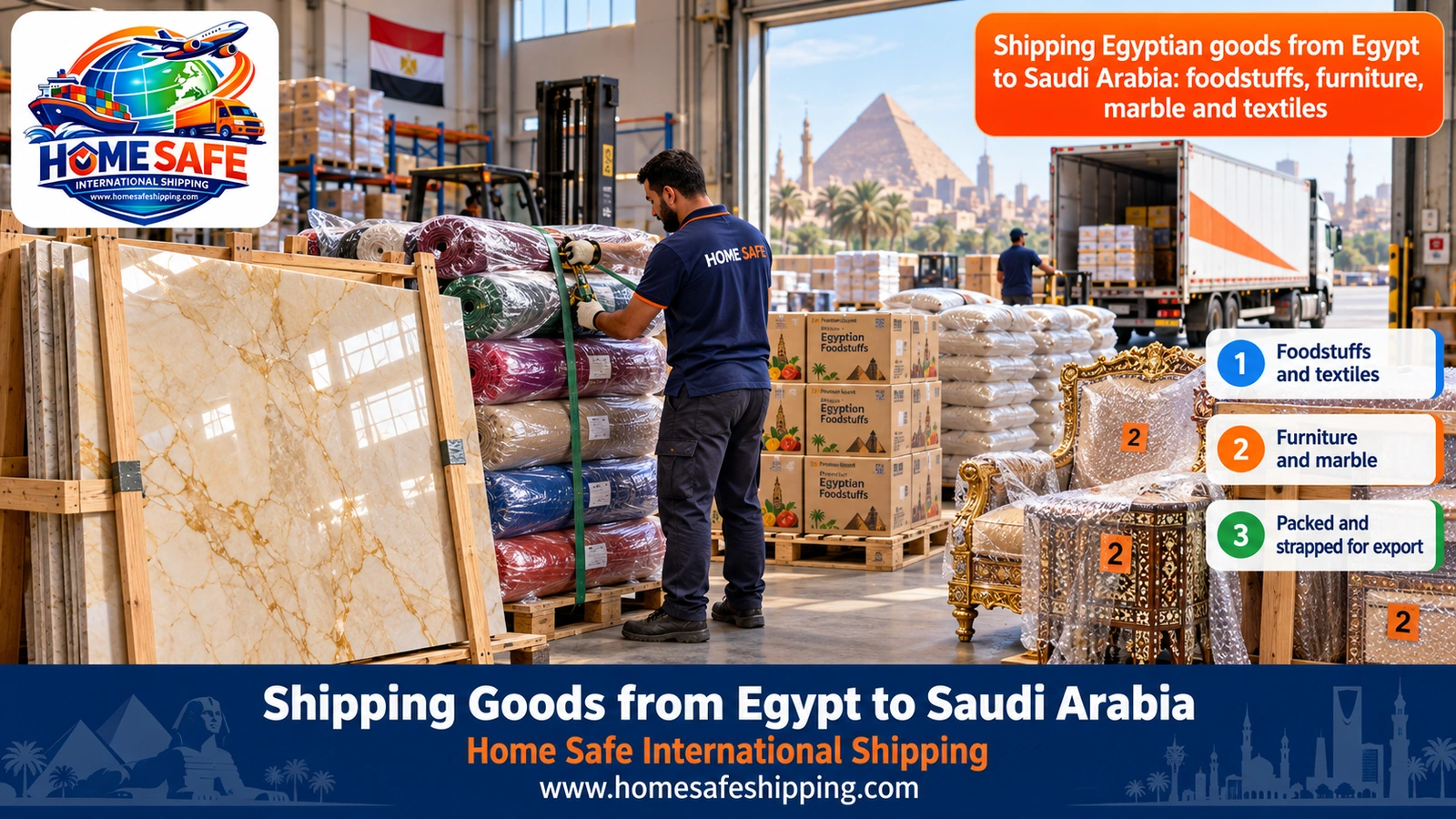
Four kinds of goods fill most of the trucks and containers coming from Egypt, and each behaves differently in transport. Food is ruled by time and temperature. Furniture is ruled by volume and the fear of scratches. Marble is ruled by weight and breakage. Textiles are the easiest, but they suffer from damp and are subject to conformity requirements.
| Item | Examples | How it is prepared for travel | Usual method |
|---|---|---|---|
| Fresh and frozen food | Oranges, onions, potatoes, frozen vegetables | Ventilated cartons on pallets, controlled cooling | Refrigerated truck on the ferry |
| Dry and processed food | Pickles, tinned cheeses, pasta, juices | Wrapped pallets and an Arabic label | Dry truck or container |
| Furniture and furnishings | Damietta bedrooms, sofa sets, carpets | Dismantling, blankets, cardboard corners and wooden crates | Closed truck |
| Marble and granite | Slabs, cut tiles and worked pieces | Wooden cases and A-frame stands | 20ft container |
| Textiles and clothing | Cottons, towels, bed linen | Pressed bales or cartons with a moisture-proof bag | Groupage; samples by air |
| Building and industrial materials | Ceramics, sanitary ware, paper, aluminium | Pallets strapped with bands and edge protectors | Container or curtain-sided truck |
The Kingdom requires the pack to show the country of origin clearly, and a food product to carry its production and expiry dates and its ingredients in Arabic. So go over the product label with the supplier before it is printed, not after the truck reaches the port. The full service for businesses is on the commercial shipping page.
Packing and strapping for export: how are the goods prepared?
Goods leaving a factory in Egypt travel a long desert road, then a ferry deck that rolls with the waves, then hundreds of kilometres inside the Kingdom. Packing meant for the local market is not enough for that journey. Good strapping protects the goods and shortens the inspection, because an officer counts tidy pallets faster than scattered cartons.
- Pallets: treated and stamped wood; raw timber may be refused on entry.
- Stacking: cartons tight with no overhang beyond the pallet edge, wrapped in clear film from base to top.
- Strapping: bands and strong cardboard corners on all four edges.
- Fragile items: glass, china and worked copperware in padded wooden crates.
- Marble: slabs standing on edge with spacers between them, not laid flat on one another.
- Furniture: whatever can be dismantled is dismantled, and glossy surfaces get foam before the blanket.
- Marks: the importer’s name, the pallet number and the carton count on two visible sides.
Securing the load inside the truck is part of the packing, since an unlashed pallet slides at the first bend. Lashing and stowage are explained on the packing and lashing page.
A full truck or groupage?
Choosing between them is a simple sum: how much of the truck do your goods fill, and can you wait for others? A regular importer who orders a truck every fortnight books it whole. A shop owner who orders twenty cartons shares with others and pays only for his space.
| Point of comparison | Full truck | Groupage |
|---|---|---|
| Suitable load | 10 tonnes and more, or goods that fill the body | A few cartons and pallets |
| Departure | The day the goods are ready | When the load is complete at the agent’s warehouse |
| Customs declaration | One declaration in your name | A declaration for each importer in the truck |
| Delivery | The truck goes straight to your warehouse | Distribution from our warehouse in a smaller vehicle |
| Charging | Hire of the vehicle and the ferry | By the tonne, the volume or the carton |
Chilled goods are not grouped with dry ones and have their own truck booked. And if your goods arrive before your shop is ready, we hold them for some days by agreement. The terms are on the storage page.
Sea freight by container from Sokhna and Alexandria to Jeddah
The container is a different route from the ferry. The goods are stuffed into a container at the factory or in the port yard, lifted onto a container ship, and landed at Jeddah Islamic Port. The port of Sokhna on the Gulf of Suez is the Egyptian port nearest to Jeddah, while cargo from Alexandria and the Delta leaves from the port of Alexandria through the Suez Canal. Door to door it takes 12 to 20 days depending on the line and the sailing date.
- Full container: 20ft for marble and heavy tiles, 40ft for furniture and bulky light goods.
- Part load: by the cubic metre for anyone with less than a container, combined with other cargo.
- Reefer container: for frozen goods and food that can stand a longer time than the ferry.
- Arrival port: Jeddah for the western region; cargo for Riyadh and the Eastern Province is hauled by road after release.
- Price: set on request, because it moves with the shipping lines’ rates.
We do not promise a direct service every week, as some services call at an intermediate port. We confirm the available line and its date when you book. The service is explained on the sea freight page and the sizes under container sizes.
Collection from Egypt’s cities and industrial zones
Collection inside Egypt is carried out by our partner agents there, not by staff of ours. Home Safe is a Saudi establishment based in Jeddah, and its part on the Egyptian side is coordination, follow-up and checking the papers. The agent sends the truck to the door of the factory or store, counts the goods with the supplier, and handles the export formalities. These are the main loading areas and what leaves them:
| Area | What is usually loaded there | Usual exit point |
|---|---|---|
| Greater Cairo, Obour and 10th of Ramadan | Processed food, textiles and household goods | Safaga, or Sokhna for containers |
| Shaq El-Thoban | Marble and granite | Sokhna by container |
| 6th of October and Giza | Food, paper and engineering products | Safaga or Sokhna |
| Damietta | Furniture and joinery | Safaga by closed truck |
| El-Mahalla El-Kubra, Tanta and Mansoura | Cottons and furnishings | Safaga or Alexandria |
| Alexandria and Borg El Arab | Textiles, chemicals and food | Port of Alexandria or Safaga |
| Ismailia, Beheira and Nubaria | Citrus, vegetables and fruit | Safaga by refrigerated truck |
| Upper Egypt: Minya, Assiut and Qena | Onions, garlic, marble and crops | Safaga via the Qena road |
Give us the supplier’s name and address and the number of the person in charge of the store, and we arrange the loading day with him and tell you when the truck leaves.
Export procedures in Egypt and the documents required
The papers are half the shipment. Sound goods with an incomplete file stand in the yard, and ordinary goods with a complete file cross the same day. The rule is that the invoice, the packing list and the certificate of origin match in description, count and weight, and that the importer’s name is written as it appears in his commercial registration.
| Document | Who issues it | Note |
|---|---|---|
| Commercial invoice | The Egyptian supplier | With the true value, the terms of sale and the country of origin |
| Packing list | The supplier | Number of packages and net and gross weight for each item |
| Certificate of origin | The competent body in Egypt | Authenticated; it is the condition for the duty exemption |
| Transport document | The carrier | Road consignment note, bill of lading or air waybill, by method |
| Health or phytosanitary certificate | The Egyptian agricultural and veterinary bodies | For food, crops and animal products |
| Conformity certificate | An accepted body through SABER | For products covered by the technical regulations |
| Insurance policy | The insurer | Optional, and required under some terms of sale |
| Commercial registration and tax number | The Saudi importer | With the authorisation of the customs broker |
In clearance the work is shared among four parties:
- The Egyptian supplier: the invoice, the packing list, his registration as an exporter and readying the goods.
- The partner agent in Egypt: collection, the export customs declaration and booking the ferry or the ship.
- The licensed broker in the Kingdom: filing the import declaration electronically and following the release.
- Home Safe: reviewing the file before loading, then haulage from the port and delivery.
Egyptian export procedures change from time to time, so we go over the current requirements with the agent before every shipment. Each paper is explained on the shipping documents page.
Saudi customs: duty, tax and conformity
What you pay on entry to the Kingdom is three things separate from the freight: customs duty, value added tax, and port and clearance charges. Egyptian goods have an advantage on the first. Under the practice in force, goods of Arab origin that meet the rules of origin are exempt from customs duty within the Greater Arab Free Trade Area, on an authenticated certificate of origin. We confirm what applies to your item before shipping.
| Item | Practice in force | What we point out |
|---|---|---|
| Customs duty | Exemption for goods of Egyptian origin with a certificate of origin; 5% for most items without it | Some items carry a higher rate to protect local products |
| Value added tax | 15% on the value of imports | Due even when the duty is exempt |
| Conformity | A certificate through SABER for products under the technical regulations | Obtained while the goods are with the supplier, not after arrival |
| Food, cosmetics and medicines | Requirements of the Saudi Food and Drug Authority | A sample may be drawn for the laboratory before release |
| Farm products | Phytosanitary certificate and inspection on entry | Some items are restricted seasonally |
| Customs declaration | Filed electronically on the FASAH platform by a licensed broker | It can be filed before the shipment arrives |
We do not present ourselves as a customs broker: the declaration is filed by a licensed broker while we prepare and follow the file. Importers whose goods enter through Jeddah will find the details on the page customs clearance in Jeddah, and the general explanation on the customs clearance page.
What may not enter the Kingdom from Egypt, or is restricted
A prohibited item does not harm its owner alone. In a groupage truck, one offending carton holds up the cargo of ten importers. So we ask about the contents of every package before accepting it and decline what is not allowed:
| Item | Status on entry to the Kingdom |
|---|---|
| Alcoholic drinks and narcotics | Prohibited |
| Pork and pork products | Prohibited |
| Weapons, ammunition and fireworks | Prohibited unless licensed by the competent body |
| Medicines | A personal quantity with its prescription; commercial with the Authority’s permission |
| E-cigarettes and tobacco in quantity | Restricted, and subject to excise tax |
| Radio equipment and drones | With a prior permit |
| Books and printed matter in commercial quantities | Referred to the competent body |
| Plants, seeds and seedlings | With an agricultural permit and a phytosanitary certificate |
| Egyptian antiquities and heritage pieces | Cannot leave Egypt in the first place |
The general list is on the prohibited items page.
Delivery in Riyadh, Jeddah, Dammam and Madinah

After release the goods head for your city, and delivery is at the door of the shop or warehouse, not in the port yard. A full truck goes straight to your address where traffic rules allow. Groupage shipments are sorted and then distributed in smaller vehicles that can enter markets and commercial districts. We agree the unloading hour with you, because large trucks may enter city centres only at set times.
| City | Where we usually deliver | Note |
|---|---|---|
| Riyadh | Wholesale markets and warehouses in the south and east of the city | Articulated trucks enter during the permitted hours |
| Jeddah | The Balad markets and warehouses in the south of the city | The big city nearest to sea containers |
| Dammam and Khobar | Warehouses and industrial cities | The farthest destination from Duba, so the time is longer |
| Madinah | Shops and warehouses outside the central area | Entry to the central area is by small vehicle at set hours |
| Makkah | Shops, hotels and warehouses | Truck restrictions tighten in Ramadan and Hajj |
| Tabuk | Shops and farms | The city nearest to the port of Duba |
| Buraidah, Hail, Abha and Jazan | According to the importer’s address | By the regional truck or distribution from the nearest city |
For the delivery, have a place ready for unloading and labourers or a forklift if the goods are on pallets, and count the packages before signing. The full service is on the door-to-door shipping page.
Personal effects and furniture for people moving to the Kingdom
Not everything that comes from Egypt is goods for sale. Many residents bring the furniture of a home, or cartons of clothes, books and kitchenware, and these take the same route on the ferry as groupage. Under the practice in force, used personal effects and household furniture of someone arriving to live there are exempt within limits assessed by customs at inspection, and we confirm what applies before shipping.
- Papers: a copy of the passport, the work visa or residence permit, and a detailed contents list with each carton’s number.
- What is treated as goods: new boxed items, and identical pieces in numbers that do not fit one household.
- Appliances: the voltage in the two countries is close, but the socket differs, so you need a plug adaptor.
- What stays with you: gold, cash and original certificates never go in an unaccompanied shipment.
Car shipping from Egypt to Saudi Arabia
A car crosses the Red Sea in two ways that are treated differently. The first is temporary entry: the traveller drives his car to Safaga, boards the ferry with it and enters the Kingdom on a carnet, then takes it back before the period ends. The second is permanent import, which is restricted. Under the practice in force a passenger car must be no more than five years old from its year of manufacture, must be left-hand drive, and must meet Saudi specifications, and it pays customs duty and value added tax.
So we do not book for a car before seeing its registration and year of manufacture and knowing why it is entering. The price is set on request. Ways of moving vehicles are on the car shipping page.
Air freight from Cairo to Saudi Arabia
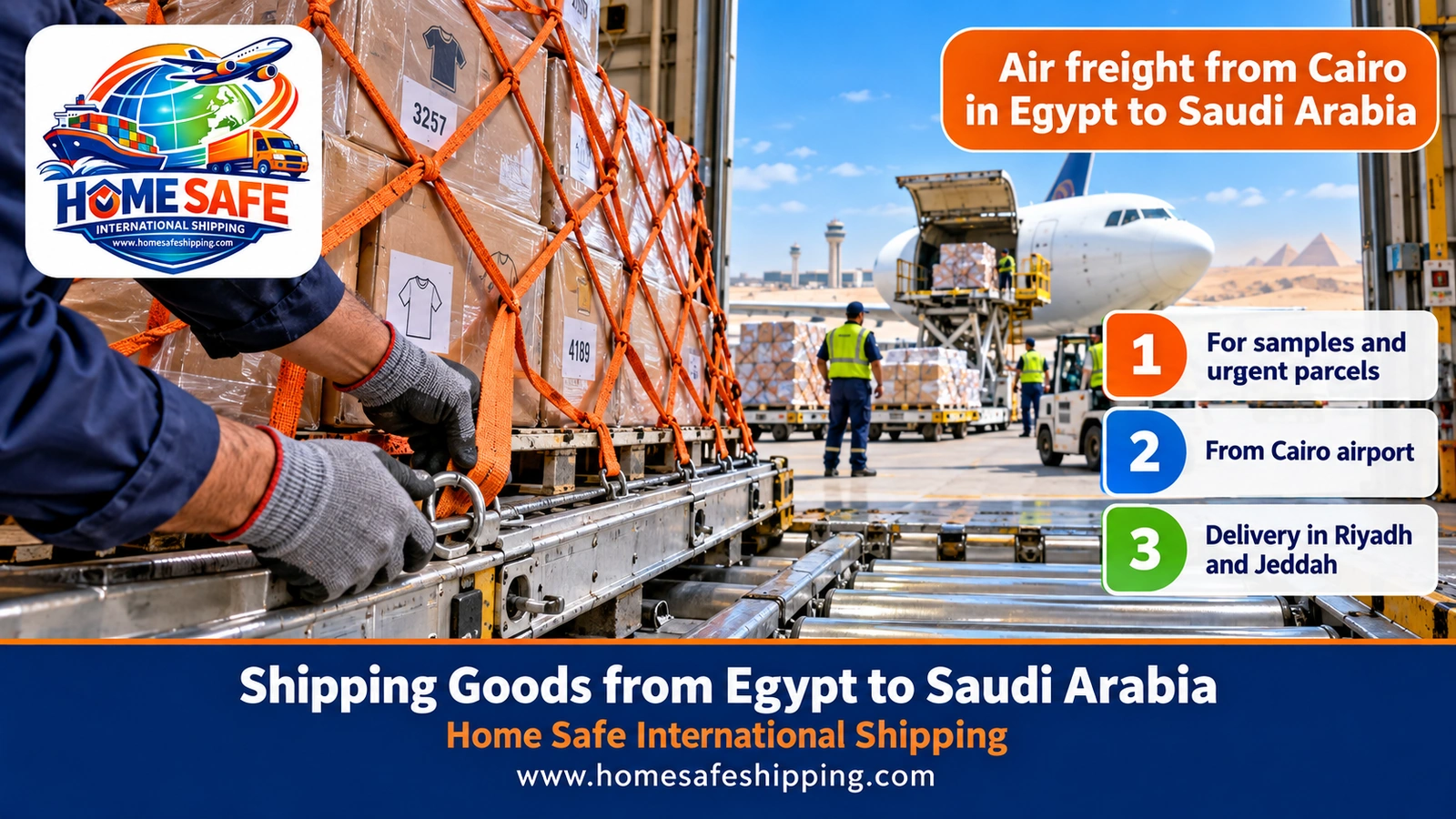
The aircraft is for samples and urgent parcels, not for heavy cargo. The shipment is handed to our agent in Cairo, goes through security screening and weighing at Cairo International Airport, and flies to Riyadh or Jeddah. Flights between Cairo and these two cities are many, and the flight itself is two to three hours. After release at the cargo village it is delivered to the door within 3 to 6 days of collection.
- What it suits: fabric and marble samples before a contract, spare parts, documents, and light orders for online shops.
- Charging: by chargeable weight, the greater of actual and volumetric weight.
- Price: the price per kilogram from Cairo is set on request according to weight and item.
- What does not fly: flammable liquids, loose batteries and pressurised containers.
- Other cities: Dammam and Madinah are served by a direct flight when one is available, or by road from Riyadh or Jeddah.
A sample flown ahead of the order settles the buying decision before you pay for a full truck. Work out the chargeable weight with the volumetric weight calculator; the service is detailed on the air freight page.
Cargo insurance: types, requirements and what to do about damage
Insurance is optional, but worth considering when the goods are worth more than you can afford to lose. It is a contract between you and an insurer, and our part is arranging it and preparing its papers. The cover differs by type:
| Type of cover | What it includes | Who it suits |
|---|---|---|
| All risks | Loss and damage from external causes throughout the journey, with written exclusions | Furniture, glass, appliances and high-value goods |
| Named perils | Specified accidents: overturning, fire, sinking or collision | Marble, building materials and bulk goods |
| Carrier’s liability | A minimum fixed by the transport document, usually below the value of the goods | Not to be relied on alone |
The insurer asks for an exact description of the goods, their invoice value, and the means of transport and its route. The policy does not cover poor packing or anything not on the list. If there is damage: write the remark on the delivery note, photograph the package before and after opening it, report it the same day, then submit the claim with the invoice and the photographs. The time limit and conditions are written in the policy. Details are on the cargo insurance page.
Tracking, dealing with delay, and what has changed in the service
At loading you receive a shipment number and a copy of the collection note, and we tell you at the milestones: the truck leaving the factory, entering Safaga, the ferry sailing, landing at Duba, the release being issued, and the delivery appointment. You can follow the status on the shipment tracking page or simply ask us.
If the shipment is late, the first things to ask about are the reason and the new date, not compensation. Most delays have a specific cause that can be dealt with: a paper to complete, a ferry to wait for, or a sample in the laboratory. Tell your customer the revised date at once; plain news is easier on him than waiting with none. Whatever obligations follow from a delay are written in the booking confirmation.
The line has changed in recent years in the importer’s favour. The Saudi customs declaration is filed electronically before the shipment arrives, conformity certificates are issued from one platform, and truck appointments at the ports are booked in advance. The result is that a complete file is released faster than before, and a mistake in a paper shows up before loading, not after.
Steps for shipping your goods from Egypt to Saudi Arabia
- Send the details: type of goods, weight, number of packages, the supplier’s address and the delivery city to 0552803439.
- Item review: we identify its tariff line and the certificates it needs before you pay the supplier.
- Method and price: ferry, container or air, with a statement of what the figure includes and what it does not.
- Preparing the file: invoice, packing list, certificate of origin, and conformity or health certificates.
- Collection in Egypt: the partner agent counts the goods with the supplier and loads them.
- Export and crossing: the export declaration at the Egyptian port, then the ferry, ship or aircraft.
- Release in the Kingdom: the licensed broker files the declaration, and the tax and any charges are paid.
- Delivery: unloading at your shop or warehouse, counting the packages and signing the note.
The opposite direction: shipping from Saudi Arabia to Egypt
The same line works in reverse, and that is the direction we serve directly from the Kingdom’s cities. The truck is loaded in Riyadh, Jeddah or Dammam, boards the ferry at Duba, is cleared at Safaga, and the shipments are then distributed to the Egyptian governorates within 7 to 15 days. A medium carton on it starts from SAR 140, and a bedroom from SAR 1,650.
The main article for that direction is shipping from Saudi Arabia to Egypt, the truck and ferry are explained in detail in land freight from Saudi Arabia to Egypt, and the destination page is shipping to Egypt.
How do you choose a shipping company from Egypt to Saudi Arabia?
Reputation, experience and cost are three sound criteria, but they are general. It is more useful to ask specific questions and judge the answer. A company that knows the line answers with the names of ports and documents; one that does not answers with promises:
| Question | An answer that shows knowledge | An answer that calls for caution |
|---|---|---|
| Who collects from the supplier in Egypt? | A named agent with an address and a number | “We have people there” |
| Where do the goods enter the Kingdom? | Names the port or the airport | “It will reach you, that is all” |
| Does the price include clearance and tax? | Breaks it down item by item | One figure with no breakdown |
| Which certificates does my item need? | Asks about the tariff line, then answers | “Everything gets in” |
| Who files the customs declaration? | A licensed broker authorised by you | Does not know, or avoids the question |
| Is the establishment registered? | Commercial registration and a stamped note | A transfer to a personal account |
For a wider comparison of road carriers, see the page land freight company in Saudi Arabia.
Common mistakes when shipping from Egypt to Saudi Arabia
- Paying the supplier before making sure the item may enter the Kingdom and which certificates it needs.
- Shipping the goods without an authenticated certificate of origin, and paying a duty that could have been avoided.
- Writing a value below the real one on the invoice, so that it is reassessed and a fine may follow.
- Printing a food label without Arabic details or a clear expiry date.
- Loading pallets made of untreated wood.
- Mixing chilled goods with dry ones in one truck to save on the hire.
- Promising the customer a date worked out from driving days alone, without clearance.
Why Home Safe for shipping your goods from Egypt?
A registered establishment
Home Safe Logistics Services Establishment, commercial registration 4030601060.
Clear about roles
We tell you what we carry out ourselves in the Kingdom and what the partner agent carries out in Egypt.
The file before the truck
We review the item and its certificates before loading, so the problem is not discovered at the port.
To the warehouse door
Haulage from Duba, Jeddah or the airport, and delivery in your city at an agreed time.
To book: 0552803439, call or WhatsApp, from 7 am to 11 pm. Or use the request a quote page.
Related articles and pages
- Shipping from Saudi Arabia to Egypt
- Land freight from Saudi Arabia to Egypt
- Furniture shipping prices from Saudi Arabia to Egypt
- Shipping goods from Syria to Saudi Arabia
- Shipping from Turkey to Saudi Arabia and the Gulf
- Land freight
Tags
shipping goods from Egypt to Saudi Arabia, shipping from Egypt to Saudi Arabia, shipping company from Egypt to Saudi Arabia, land freight from Egypt to Saudi Arabia, sea freight from Egypt to Jeddah, air freight from Cairo to Riyadh, Safaga Duba ferry, shipping prices from Egypt to Saudi Arabia, transit time from Egypt to Saudi Arabia, importing from Egypt to Saudi Arabia, furniture shipping from Egypt to Saudi Arabia, household goods shipping from Egypt to Saudi Arabia, marble shipping from Egypt, foodstuffs shipping from Egypt, customs clearance for goods from Egypt, Home Safe international shipping
Frequently asked questions about shipping goods from Egypt to Saudi Arabia
How are goods shipped from Egypt to Saudi Arabia?
In three ways. The first is a truck loaded in Egypt that boards the ferry at the port of Safaga, lands at the port of Duba and drives on to your city. The second is a sea container from Sokhna or Alexandria to Jeddah Islamic Port. The third is a flight from Cairo airport for samples and urgent parcels. We choose the method with you according to the weight of the goods and your deadline.
How long does a shipment from Egypt take to reach my warehouse in the Kingdom?
By truck and ferry, 7 to 15 days from the supplier’s door to yours: shortest to Tabuk, Madinah and Jeddah, longest to Dammam. By sea container, 12 to 20 days. By air, 3 to 6 days. These are usual times; port congestion in the busy seasons and a missing paper in the file make them longer.
How much does shipping goods from Egypt to Saudi Arabia cost?
The price for this direction is set on request, because the hire of a truck leaving Egypt moves with the agricultural export season. As a guide, our published rates on the same line from Saudi Arabia to Egypt start from SAR 2,580 a tonne and SAR 140 for a medium carton. Send the type of goods, the weight and the delivery city to 0552803439 and you will get the figure.
Which port does the truck sail from, and where does it land in the Kingdom?
The usual line runs from the port of Safaga on Egypt’s Red Sea coast to the port of Duba in the Tabuk region, a crossing of about eight hours. The alternative is from Nuweiba in Sinai to Aqaba, then into the Kingdom through the Durra crossing near Haql. We confirm the line in operation when the booking is fixed, as ferry timetables are not constant.
Do Egyptian goods pay customs duty in Saudi Arabia?
Under the practice in force, goods of Egyptian origin that meet the Arab rules of origin are exempt from customs duty, provided an authenticated certificate of origin travels with the shipment. The 15% value added tax remains due on imports. Goods that cannot prove their origin are charged the duty set for their tariff line, which is 5% for most items.
Which documents does a commercial shipment from Egypt need?
A commercial invoice, a packing list, a certificate of origin and the transport document, together with the export customs declaration in Egypt. In the Kingdom, the importer’s commercial registration and tax number, and a conformity certificate through SABER for products covered by the technical regulations. Foodstuffs and farm produce need a health or agricultural certificate from the competent Egyptian body.
Do you collect the goods from the factory or supplier inside Egypt?
Yes, through our partner agents in Egypt. Home Safe is a Saudi establishment based in Jeddah, and the collection from the supplier, the export formalities and the loading at the Egyptian port are carried out by the partner agent under our team’s follow-up. We handle everything after Duba or Jeddah: clearance, haulage and delivery to the door of your shop or warehouse.
Which Egyptian goods are shipped most to the Kingdom?
Foodstuffs first: citrus, onions, potatoes, frozen vegetables, cheeses and pickles. Then Damietta furniture and furnishings, cut marble and granite, and textiles, cotton clothing and carpets. Building materials, paper, aluminium products and copperware are shipped too. Each item has its own packing method and entry requirement, which we explain before loading.
Do I need a SABER certificate for every product coming from Egypt?
No. SABER is required for products covered by the Saudi technical regulations, such as electrical appliances, textiles, building materials and toys. Food, medicines and cosmetics go through the Saudi Food and Drug Authority instead. We check the tariff line of your item and tell you which certificate it needs before it leaves the factory.
Can fresh fruit and vegetables travel by truck?
They travel in a refrigerated truck arranged in advance, not in a dry one. They need a phytosanitary certificate from Egypt and are inspected on entry by the competent Saudi bodies. Some farm products are subject to requirements or restrictions that change from one season to the next, so we confirm the position of your crop before harvesting and packing.
When is sea freight better than the ferry?
When the goods are heavy or bulky and no near deadline presses: marble, granite, tiles, building materials, paper and equipment. A container carries more weight at a lower cost per tonne and lands at Jeddah Islamic Port, close to the markets of the western region. The ferry is better for anything needed within a week or two and for chilled food.
Can samples be flown from Cairo to Riyadh or Jeddah?
Yes. A sample or urgent parcel leaves from Cairo airport and is delivered in Riyadh or Jeddah within 3 to 6 days to the door. It is charged by chargeable weight, the greater of actual and volumetric weight. The price per kilogram is set on request according to the weight and the type of item.
Can I ship my personal effects from Egypt to the Kingdom?
Yes. Someone arriving to work or live there ships used belongings and furniture with a contents list and a copy of the passport and the visa or residence permit. Under the practice in force, used personal effects and household furniture are exempt within limits assessed by customs, and we confirm what applies before shipping. New boxed items and repeated quantities are treated as goods.
Do you ship a car from Egypt to Saudi Arabia?
An Egyptian car usually enters the Kingdom temporarily with its owner on a carnet and crosses on the ferry. Permanent import is another matter: under the practice in force a passenger car must be no more than five years old and must meet Saudi specifications, and it pays duty and tax. We review the car’s details before arranging anything and promise nothing we have not checked.
What should I do if the goods arrive short or damaged?
Do not sign for them before counting. Note the shortage or damage on the delivery note, photograph it with the driver present, and tell us the same day on 0552803439. The claim is then submitted to the insurer if the shipment is insured, with the invoice, the packing list and the photographs. The conditions and time limit for a claim are written in the insurance policy.
That is the guide — now let us price your shipment
Choose what applies to you and receive a reply with the price, the method and the time.
RoRo, container or sling lift — we recommend what suits your vehicle’s value and its destination.
Get a vehicle priceA full or shared container, or urgent air freight, with packing and clearance.
Get a shipment priceRoutes in the same section
Options related to the same type of service.