Shipping Company from Saudi Arabia to Tunisia 0552803439 | Car Shipping, Containers, Furniture and Parcels by Sea and Air

Ship your furniture, car, goods and parcels from Riyadh, Jeddah, Makkah, Madinah, Dammam and the other Saudi cities to Tunis, Sfax, Sousse, Bizerte and Kairouan. By sea from Jeddah port to the port of Rades in 20–35 days for a full container, and by air to Tunis-Carthage airport in 3–7 days. A carto…
Home Safe is a shipping company from Saudi Arabia to Tunisia that moves furniture, cars, goods and parcels from every city in the Kingdom to Tunis, Sfax, Sousse, Bizerte and Kairouan. The route is essentially a sea route: the container sails from Jeddah Islamic Port to the port of Rades and arrives door to door within 20 to 35 days, and alongside it air freight arrives within 3 to 7 days. A carton starts from SAR 140, a cubic metre from SAR 415, and a 20ft container from SAR 4,600. To book: 0552803439.
In this guide46ShowHide
- Who ships from Saudi Arabia to Tunisia, and what do they ship?
- Shipping services from Saudi Arabia to Tunisia
- Shipping methods from Saudi Arabia to Tunisia and how long each takes
- Shipping prices from Saudi Arabia to Tunisia
- Shipping to Tunisia from the cities of the Kingdom
- Sea freight from Saudi Arabia to Tunisia: full container or shared?
- Which Saudi port does the container sail from, and how does it get there from Riyadh?
- Shipping furniture and luggage from Saudi Arabia to Tunisia
- Returning to Tunisia for good: the furniture exemption and the FCR tax privilege
- Car shipping from Saudi Arabia to Tunisia
- Car documents: the Saudi side and the Tunisian side
- The car’s journey from Saudi Arabia to the Tunisian registration card in nine steps
- Luxury cars and heavy equipment to Tunisia
- Shipping parcels and personal effects to Tunisia
- Shipping commercial goods from Saudi Arabia to Tunisia
- Documents and clearance at Tunisian customs
- What cannot be shipped to Tunisia, or needs a licence
- The Tunisian ports and cities we deliver to
- Air freight from Saudi Arabia to Tunisia
- Is there land freight from Saudi Arabia to Tunisia?
- Serving individuals and companies: door to door and storage
- Steps for shipping from Saudi Arabia to Tunisia
- Tracking and insurance on the Tunisia route
- Shipping from Tunisia to Saudi Arabia
- Tips before shipping from Saudi Arabia to Tunisia
- How do you choose a shipping company from Saudi Arabia to Tunisia?
- Common mistakes when shipping from Saudi Arabia to Tunisia
- Why Home Safe for shipping from Saudi Arabia to Tunisia?
- Related articles and pages
- Tags
- Frequently asked questions about shipping from Saudi Arabia to Tunisia
- How much does shipping from Saudi Arabia to Tunisia cost?
- How long does shipping from Saudi Arabia to Tunisia take?
- What is the best way to ship from Saudi Arabia to Tunisia?
- Is there land freight from Saudi Arabia to Tunisia?
- Can I ship household furniture from Saudi Arabia to Tunisia?
- Does Home Safe ship cars to Tunisia?
- What are the FCR conditions for importing a car into Tunisia?
- Is the price calculated by weight or by volume?
- Which Tunisian port does the shipment arrive at?
- Can commercial goods be shipped from Saudi Arabia to Tunisia?
- Is packing necessary before shipping to Tunisia?
- Who pays customs duties in Tunisia?
- Must the owner be present for clearance in Tunisia?
- Do you collect from any Saudi city?
- Do you ship from Tunisia to Saudi Arabia?
The sea route: from your city to Jeddah port, north up the Red Sea, through the Suez Canal, then west across the Mediterranean to the port of Rades · Expected time: full container 20–35 days, consolidated freight 30–45 days, air 3–7 days.
In brief
- Methods: sea for furniture, cars and cargo, and air for urgent parcels and documents. We do not rely on a land route to Tunisia.
- Port of departure: Jeddah Islamic Port for most shipments, because it lies directly on the Suez Canal route.
- Port of arrival: Rades near the capital for containers, and Sfax, Sousse and Bizerte depending on the consignee’s city.
- Starting prices: SAR 140 for a single carton and SAR 415 for each cubic metre by sea. A bedroom starts from SAR 1,650, and shipping a small car from SAR 3,220.
- Containers: a 20ft from SAR 4,600 and a 40ft from SAR 5,200 from Jeddah port, full or shared.
- Returning for good: we go through the furniture exemption and the FCR car regime with you before loading.
- Booking: 0552803439 by phone or WhatsApp.
Who ships from Saudi Arabia to Tunisia, and what do they ship?
Most of the demand on this route comes from Tunisians working in the Kingdom: doctors, nurses, engineers, teachers, and hotel and restaurant staff. Some go home for good with a whole household and a car, and some send their families cartons every season. Added to them are Tunisian Umrah and Hajj pilgrims, and traders who buy in the Kingdom’s markets. Each of them has a method that suits the shipment:
| Shipper | What they ship | Most suitable method |
|---|---|---|
| A Tunisian family returning for good | Household furniture and appliances, sometimes with the car | A 20ft or 40ft container |
| An employee whose contract has ended | Personal effects, cartons and a few appliances | A shared container, by the cubic metre |
| A resident sending to family | Gifts, clothes, perfumes and dates | Consolidated freight by the carton, or air |
| An Umrah or Hajj pilgrim | Excess bags and purchases | Air, or consolidated for those in no hurry |
| A trader or shop owner | Clothing, housewares, spare parts and dates | A full container or a part load |
| A company or contractor | Equipment, machinery and utility vehicles | RoRo or a flat-rack container |
Shipping services from Saudi Arabia to Tunisia
We offer four main services on this route, and all of them start at the sender’s door in the Kingdom and end at the consignee’s address in Tunisia. We always begin with two questions: what are you shipping, and when do you want it to arrive? The answers settle the service before the price.
- Sea freight: for furniture, cars, appliances, equipment and bulky cargo, in a full or shared container.
- Air freight: for parcels, documents, trade samples, spare parts and any light shipment that cannot wait.
- Furniture shipping: dismantling and packing bedrooms, sitting rooms, kitchens, appliances, glass, mattresses and decor, then inventory and loading.
- Car shipping: RoRo or container, with the Saudi export papers and follow-up of the customs file in Tunisia.
Alongside the four are supporting services ordered with them: storage before shipping, insurance, clearance, and delivery to the door. You will find them together on the services page.
Shipping methods from Saudi Arabia to Tunisia and how long each takes
There are two practical ways to reach Tunisia from the Kingdom: sea and air. Sea is far cheaper per cubic metre and takes longer; air is faster and dearer and cannot take large volumes. The times in the table run from the day of collection in the Kingdom to delivery in Tunisia, not sailing days alone:
| Method | Route | Approximate time | Best for |
|---|---|---|---|
| Sea, full container | Jeddah port → Suez Canal → port of Rades | 20–35 days | A whole home, a car, or wholesale goods |
| Sea, consolidated in a shared container | The same route, after shipments are grouped | 30–45 days | Cartons, a few pieces of furniture and small cargo |
| RoRo for vehicles | A car carrier to a Tunisian port | 20–35 days | Running cars, light trucks and buses |
| Air | Jeddah, Riyadh or Dammam airport → Tunis-Carthage airport | 3–7 days | Parcels, documents, samples and spare parts |
Why does the sea journey reach three weeks or more when the distance is not great? Because sailing days are only part of the time, and because many shipping lines do not sail to Rades directly but move the container onto a smaller vessel at a hub port in the Mediterranean. This is how the days of a full container leaving Jeddah are spread:
| Stage | What happens | Usual time |
|---|---|---|
| Packing and loading | Dismantling, packing, numbering and inventory at your address | One day, two for a large home |
| The road to the port | A closed truck or container truck to the quay at Jeddah | Hours from Makkah and Jeddah, one to two days from Riyadh and the Eastern Province |
| Export formalities | The export declaration, then waiting for the booked vessel | 2–5 days |
| Sailing | The Red Sea, then Suez, then the Mediterranean, usually with transhipment | 12–22 days |
| Tunisian customs | Declaration, inspection, and settlement of duties or the exemption | 3–7 days if the file is complete |
| Delivery inside Tunisia | From Rades to the capital or the coastal and inland cities | One to three days |
What lengthens the time?
- Transhipment: changing vessels at an intermediate port can add days if the container misses the next ship.
- Filling the shared container: your small shipment waits for other people’s until the container is full.
- Leaving from Dammam: the ship sails round the Arabian Peninsula before it reaches the Red Sea, so the voyage grows by a week or more.
- Congestion at Rades: the port receives most of Tunisia’s containers, and waiting hours stretch in peak seasons.
- The owner’s absence: personal effects and a car are not normally cleared without him or a power of attorney.
- The diaspora’s return season: in summer the whole route is crowded, from booking to delivery.
Sea and air are weighed against each other in general terms on the shipping methods comparison page, while the transit times page lists how long the other countries take.
Shipping prices from Saudi Arabia to Tunisia
The price of shipping to Tunisia is the sum of three items: moving the shipment from your city to the port or airport, then the ship’s or aircraft’s freight, then whatever services you ask for in Tunisia, such as clearance and delivery. So we give you the price itemised once we know the volume and the two cities. The figures below are where our services start, and the container freight in them is calculated from Jeddah port:
| What you ship | Method | Price starts from |
|---|---|---|
| Carton | Consolidated sea freight | SAR 140 |
| Cubic metre | Shared container | SAR 415 |
| Heavy goods by weight | Consolidated sea freight | SAR 9.2 a kilogram |
| Small load | Minimum sea shipment | SAR 1,380 |
| Bedroom | Part load | SAR 1,650 |
| Small car | RoRo or shared container | SAR 3,220 |
| 20ft container | Full container from Jeddah port | SAR 4,600 |
| 40ft container | Full container from Jeddah port | SAR 5,200 |
| Air freight | From Jeddah, Riyadh and Dammam airports | SAR 28 a kilogram |
| Documents | Express | SAR 83 |
| Heavy equipment and utility vehicles | RoRo or flat-rack container | Set on request by dimensions and weight |
The prices circulating in the market on the Tunisia route are higher than this table for most items. A kilogram of air freight is offered at SAR 30 to 45 by some offices and SAR 45 to 60 by others. A kilogram of sea freight runs between SAR 10 and SAR 20, and a tonne of goods by sea between SAR 10,000 and SAR 15,000. A hundred kilograms by air comes to SAR 3,000 to 4,500. With international express couriers, a document envelope starts at roughly SAR 290 and a small parcel at roughly SAR 520. Container freight itself shifts from month to month with the shipping lines, so we fix it for you on the day you book. The detail is in the article on container shipping prices from Jeddah.
| What sets the price | Its effect |
|---|---|
| The shipping method | A kilogram by air costs several times what it costs by sea |
| Volume and weight | Cubic metres or container size by sea, chargeable weight by air. Estimate your volume with the CBM calculator |
| The collection city in the Kingdom | Riyadh, the Eastern Province and the south carry a long road leg to Jeddah |
| The consignee’s city in Tunisia | Tunis, Nabeul and Bizerte are near Rades; Gabes, Medenine and Tozeur are further and cost more to deliver |
| The status of the shipment | Personal effects under a final-return exemption, an ordinary import, or commercial goods with their invoices |
| Packing and services | Wooden crates, dismantling and assembly, storage and insurance are separate items |
| The season | The summer of the diaspora’s return and the weeks before Ramadan and the Eids bring higher demand and prices |
How do you lower the cost?
- Do not book a full container for a shipment under 12 cubic metres; a shared container is cheaper for it.
- Leave behind cheap, bulky pieces, since shipping them may cost more than buying them in Tunisia.
- Book a month before summer; June and July prices are not spring prices.
- Put the car and the furniture in a single 40ft container if you are returning for good.
- Have the customs papers ready before the ship arrives, because every day’s delay at Rades carries storage charges.
Every pricing item is explained on the pricing factors page.
Shipping to Tunisia from the cities of the Kingdom
Collection is available from every Saudi city, and what changes from one city to another is the length of the road to Jeddah port and the nearest international airport. The western cities reach the quay within hours. Shipments from the central, northern and southern cities spend a day or two on the road. The Eastern Province is far from Jeddah and close to the port of Dammam, but sailing from there to the Mediterranean takes longer. Here is a summary for each city, with its detailed article where there is one:
| Collection city | Port and airport used | Distance to Jeddah port | Door-to-door time by sea | Detailed article |
|---|---|---|---|---|
| Jeddah | Jeddah Islamic Port and King Abdulaziz Airport | Within the city | 20–35 days | Shipping company from Jeddah to Tunisia |
| Riyadh | Jeddah port and King Khalid Airport | About 950 km | 24–40 days | Shipping company from Riyadh to Tunisia |
| Makkah | Jeddah’s port and airport, as Makkah has neither | About 80 km | 20–35 days | Served from Jeddah |
| Madinah | Jeddah port, or Yanbu when a sailing is available there; Madinah or Jeddah airport | About 420 km, and 220 km to Yanbu | 20–35 days | Served by the Madinah–Jeddah runs |
| Dammam, Khobar, Dhahran, Jubail and Al-Ahsa | Jeddah port by road, or King Abdulaziz Port in Dammam; King Fahd Airport | About 1,350 km | 24–40 days via Jeddah, longer from Dammam | International shipping company in Dammam |
| Taif | Jeddah’s port and airport | About 170 km | 20–35 days | Served from Jeddah |
| Qassim and Hail | Jeddah port; Riyadh or Jeddah airport | About 900 km from Buraydah, 850 km from Hail | 24–40 days | Grouped with the Riyadh or Madinah runs |
| Tabuk | Jeddah port and Jeddah airport | About 1,000 km | 24–40 days | Carried down the coast road to Jeddah |
| Abha, Khamis Mushait, Jazan and Najran | Jeddah’s port and airport | About 700 km from Abha | 22–38 days | Closed truck to Jeddah |
Sea prices do not change with the name of the city, because the ship is the same and the port is the same. The whole difference is in the inland transport item that comes before the quay. This is where prices start in the Kingdom’s main cities:
| Collection city | Cubic metre | Bedroom | 20ft container from Jeddah port | Inland transport to the port |
|---|---|---|---|---|
| Jeddah, Makkah and Taif | From SAR 415 | From SAR 1,650 | From SAR 4,600 | Short, and included in the lowest prices |
| Madinah and Yanbu | From SAR 415 | From SAR 1,650 | From SAR 4,600 | Set on request by load |
| Riyadh and Qassim | From SAR 415 | From SAR 1,650 | From SAR 4,600 | Set on request; it is the largest added item |
| Dammam, Khobar and Al-Ahsa | From SAR 415 | From SAR 1,650 | From SAR 4,600 | Set on request, and compared with sailing from Dammam |
| Abha, Jazan, Tabuk and Hail | From SAR 415 | From SAR 1,650 | From SAR 4,600 | Set on request by distance |
The two holy cities have a point of their own about loading: large trucks enter the central areas of Makkah and Madinah only at hours set by the traffic department, tighter in Ramadan and the Hajj season, so we check the hours in force before loading day. Makkah’s hillside districts with narrow streets are served by a small vehicle that shuttles the goods to the truck. Zamzam water is not shipped with the belongings. All the cities we collect from are on the cities page.
Sea freight from Saudi Arabia to Tunisia: full container or shared?
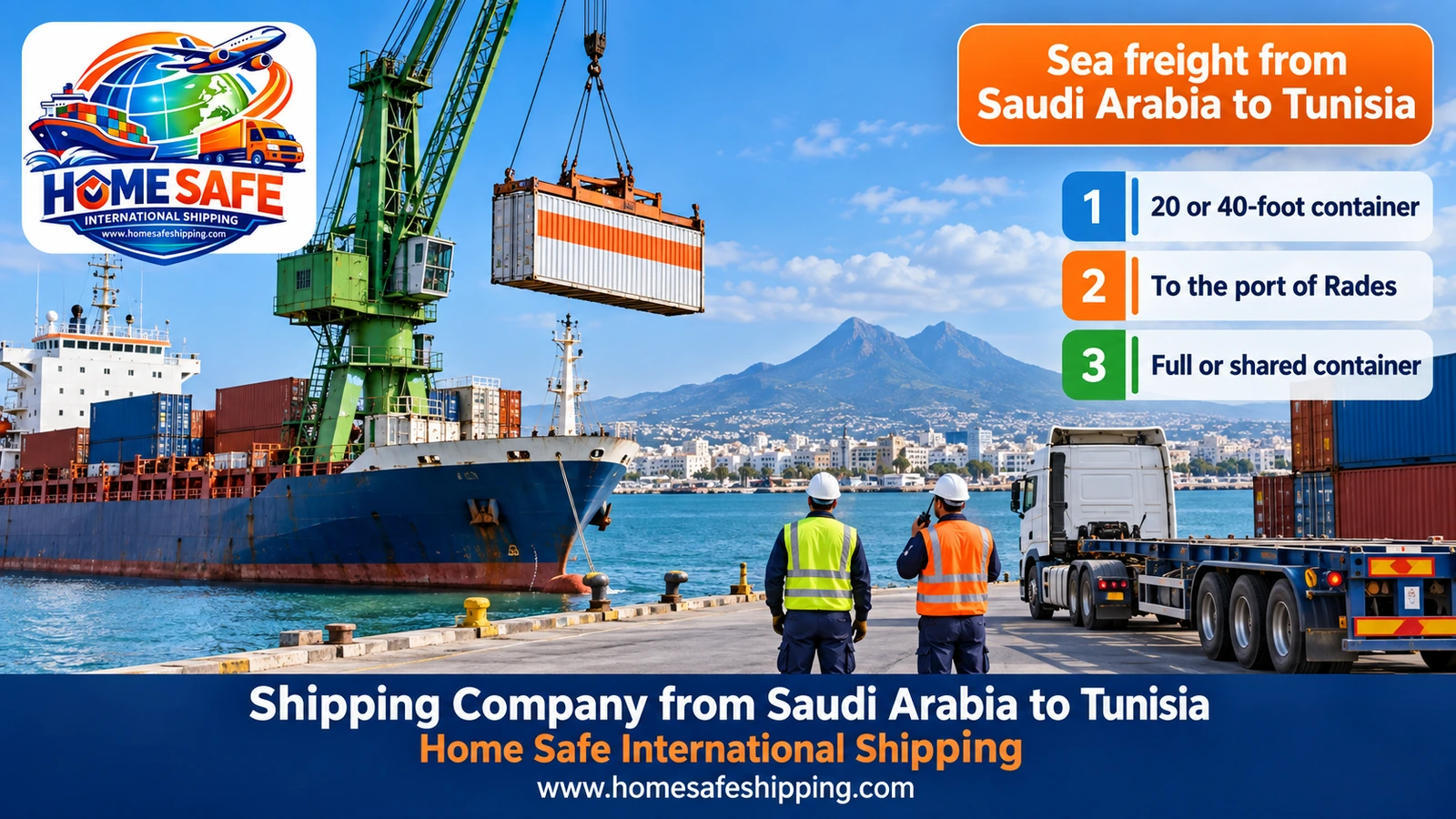
Sea freight is the way most shipments bound for Tunisia travel, and it comes in two forms: a full container to yourself, or space in a shared container that you pay for by the cubic metre. The container is loaded at Jeddah Islamic Port, passes through the Suez Canal, and is discharged at the port of Rades on the Gulf of Tunis. The two forms differ in price, time and degree of protection:
| Comparison | Full container | Shared container |
|---|---|---|
| What you pay for | The container by size, 20ft or 40ft | The cubic metres your shipment occupies |
| Door-to-door time | 20–35 days | 30–45 days |
| Who opens it | Sealed in front of you and opened in Tunisia at inspection | Unloaded at the consolidation warehouse and the shipments sorted |
| Clearance | One file in your name | Each shipment has its file, and all are held up if one is late |
| For whom | A whole home, a car with furniture, or a trader’s goods | Cartons, a room or two, or a trial consignment |
| Price starts from | SAR 4,600 for a 20ft container from Jeddah port | SAR 415 a cubic metre |
To choose between them, estimate your volume first. A 20ft container holds about 28 cubic metres, which is the furniture of a two- to three-room flat. A 40ft container holds about 58 cubic metres, so it carries a whole house or a car with furniture behind it. If your shipment is 5 cubic metres, the shared container is your choice without hesitation. If it approaches 12 to 14 cubic metres, ask us for both prices, because the full container comes close in cost and involves less handling. Dimensions are on the container sizes page and the service on the sea freight page.
When do you choose sea freight to Tunisia?
- When you are moving the contents of a whole house or villa.
- When you are shipping one car or more.
- When the commercial goods are in large quantities.
- When you have many appliances, pieces of equipment and cartons together.
- When waiting a month or a little more does you no harm.
Which Saudi port does the container sail from, and how does it get there from Riyadh?
It sails from Jeddah Islamic Port in most cases, whatever your city. The reason is geography: Jeddah is on the Red Sea, and a ship from it heads north to the Suez Canal and then the Mediterranean. King Abdulaziz Port in Dammam is on the Arabian Gulf, and a ship from it leaves through the Strait of Hormuz and goes right round the Arabian Peninsula before entering the Red Sea at Bab al-Mandab.
| Comparison | Jeddah Islamic Port | King Abdulaziz Port, Dammam |
|---|---|---|
| Sea | The Red Sea | The Arabian Gulf |
| The way to Tunisia | Straight north to Suez | Hormuz, then the Arabian Sea, then Bab al-Mandab, then Suez |
| Effect on the time | The shortest | Adds a week or more |
| Cities it serves | The western, central, northern and southern regions | The Eastern Province when the cargo is heavy and not urgent |
Riyadh is an inland city with no seaport, so its container has two ways to the sea. The first is a container truck to Jeddah port, about 950 km away, which is what we usually choose because it shortens the voyage. The second is Riyadh Dry Port, which is linked by rail to the port of Dammam and suits cases where the shipping line’s schedule from Dammam is convenient and a longer voyage does you no harm. We tell you the port, the vessel’s name and its date before loading day. The ports we work from are on the ports and gateways page.
Shipping furniture and luggage from Saudi Arabia to Tunisia
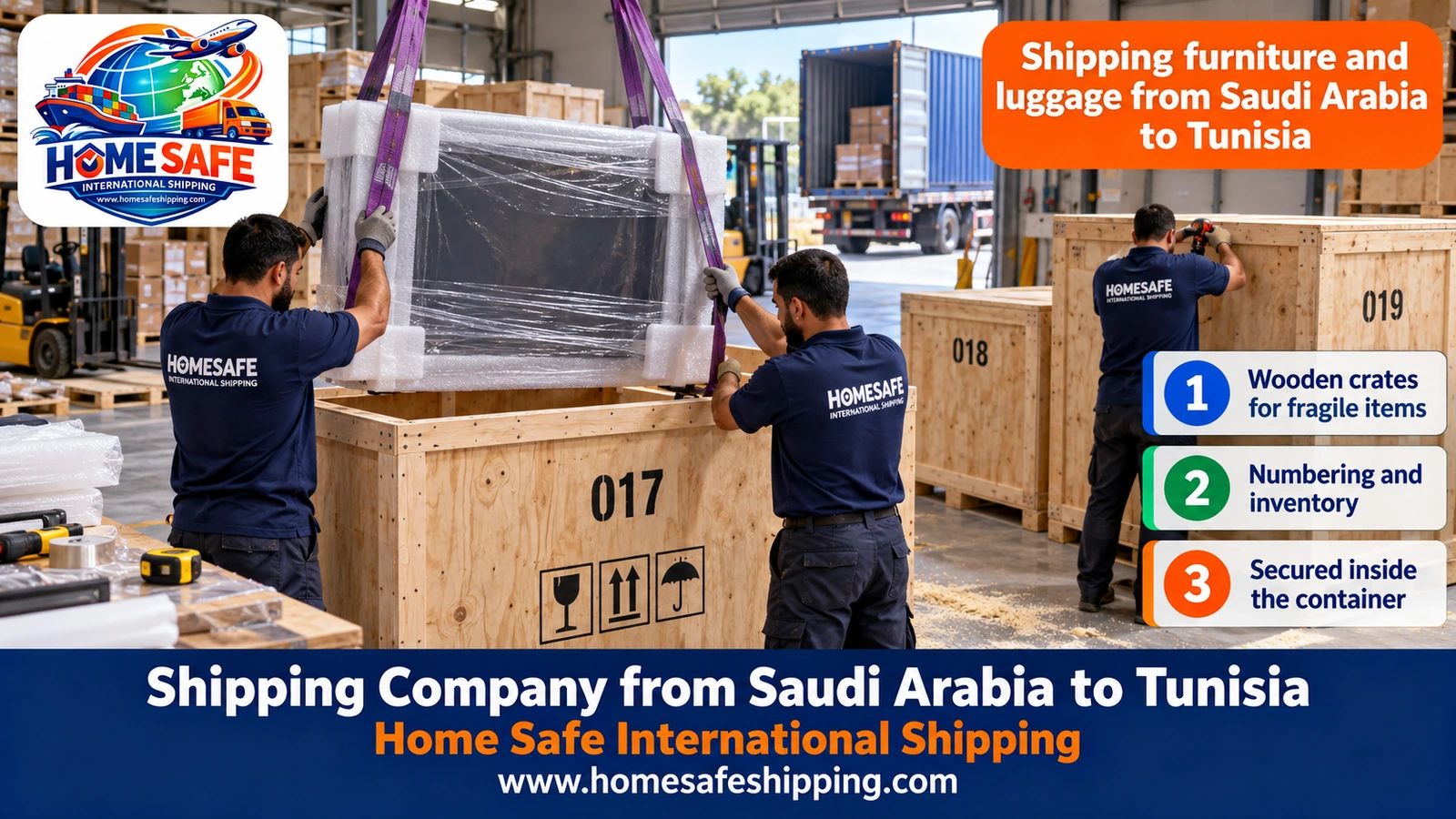
Household furniture goes to Tunisia by sea, in a full container if it is the whole home or by the cubic metre if the pieces are few, and a bedroom starts from SAR 1,650. Furniture is a difficult cargo because it is a mixture: wood that reacts to damp, glass that breaks, appliances with electronic boards, upholstery that absorbs smells, and ornaments that cannot be replaced. Each of these is prepared in its own way before it enters the container.
- Sorting: we go through the home with you room by room, separate what is shipped from what is sold or left, and mark the sensitive pieces.
- Dismantling: wardrobes, beds and dining tables are taken apart, and each piece’s screws are kept in a bag bearing its number.
- Wooden crates: for screens, large mirrors, marble tops, chandeliers and ornaments, built to the size of the piece.
- Packing: blankets and foam roll for wood, bubble wrap for glass, and double-wall cartons for appliances and crockery.
- Numbering and inventory: a number on every piece and carton, and a list stating what is in each carton, which is the one presented to customs.
- Securing inside the container: heavy pieces on the floor, straps tying the rows to the container walls, and gaps filled so that nothing moves as the ship rolls.
A warning before you fill the cartons: do not put glass, a screen or an ornament in the same carton as heavy items such as metal pots and books. Separate the fragile pieces, wrap each in its own layers, and write “fragile” and the name of the room on the carton. Do not put liquids or food inside furniture cartons either, because one leak spoils everything around it for a month at sea.
It helps to know two things about Tunisia before you decide which appliances to ship. The supply there is 230 volts as in the Kingdom, but the sockets take two round pins, so you will need plug adaptors or new plugs. And customs normally asks for electrical appliances to be listed with their make, model and serial number. Packing methods are in the packing guide, load securing on the packing and lashing page, and the full service on the furniture shipping page.
Returning to Tunisia for good: the furniture exemption and the FCR tax privilege
A Tunisian returning for good from the Kingdom has customs privileges on his belongings and his car, and they are what makes shipping the home and the car together worthwhile. But the privilege is conditional, and its conditions are amended in the finance laws from one year to the next. So we set out here what is applied in outline, and we confirm what is in force with customs before you load or buy a car.
| Item | As currently applied |
|---|---|
| Who benefits | A Tunisian national aged 18 at final return who has not used the regime before |
| Residence abroad | At least two years before returning, with stays in Tunisia of no more than 183 days a year |
| Belongings and furniture | Used personal effects and household furniture within a value ceiling set by customs, and normally one of each appliance |
| Age of the car | No more than five years, counted from the date of first registration, not from the model year |
| Weight of the car | A gross weight of no more than 3.5 tonnes, whether a passenger or a utility vehicle |
| Form of the privilege | Total exemption with a restriction on selling the car, or partial exemption on payment of a reduced share of the duties |
| Number of cars | One car per beneficiary; the rule on members of the same family benefiting was amended recently, so we check its current wording |
| Papers for the application | The privilege application, the certificate of non-benefit, and proof of residence abroad such as the passport, entry and exit stamps and the employment contract |
What trips up returnees most is working out the car’s age. A car whose model year looks within the limit may have been first registered months earlier, and so falls outside the privilege on arrival. The age is also judged on the day of actual import, not the day the ship leaves Jeddah. So send us the date of first registration, the engine size and the weight, and how long you have lived in the Kingdom, before you pay for the car or book it a place.
Car shipping from Saudi Arabia to Tunisia
A car travels to Tunisia by sea under one of three systems: a dedicated container, RoRo, or a shared container, and shipping a small car starts from SAR 3,220. This route differs from others in that most cars shipped on it belong to returning Tunisians using the FCR regime, so they are recent cars that matter a great deal to their owners. That is why most of them lean towards a container.
| System | How it works | Suits | What is required |
|---|---|---|---|
| Dedicated container | The car alone in a sealed 20ft container, or two cars in a 40ft, held by straps and chocks under the wheels | Recent and luxury cars, and a returnee’s car with his furniture | The highest price; declared belongings on the list are allowed with it |
| RoRo | The car is driven into the hold of a vehicle carrier and lashed there, then driven off at the Tunisian port | Ordinary cars, light trucks and buses | A running engine, and the car handed over empty of any belongings |
| Shared container | Cars of several customers in one 40ft container, with the freight divided among them | Mid-value cars | Waiting until the number of cars is complete |
Before handing the car over, prepare five things: photograph it from all four sides and inside, take your belongings out, leave a quarter of a tank or less, check the tyre pressure and the battery, and put its papers in one folder. The two systems are compared on the RoRo car shipping and container car shipping pages, and the service is on the car shipping page.
Car documents: the Saudi side and the Tunisian side
The car’s file on this route is two files. The first is completed in the Kingdom before the car boards the ship, and the second is presented by its owner to Tunisian customs when it arrives. Any gap in the first stops it leaving, and any gap in the second keeps it in the yard at Rades at the owner’s expense. We review both with you before booking:
| Paper | Side | Why it is required |
|---|---|---|
| The vehicle registration, or a notarised purchase contract with the showroom invoice | Saudi | They prove ownership, and Tunisian customs scrutinises the title and its date |
| The export certificate and export plates | Saudi | Issued by the traffic department after the car is struck off its records and fines are paid |
| The original invoice and the certificate of origin | Saudi | They carry the model, year of manufacture, chassis number and value, on which the customs valuation rests |
| The first registration document | Tunisian | It proves the date of first registration, from which the car’s age is counted |
| The sender’s ID and residence permit, and the consignee’s passport and national identity card | Both sides | To match the name on the bill of lading and in the customs file |
| The bill of lading | Issued after loading | The title for collecting the car at the Tunisian port |
| The privilege application, certificate of non-benefit and proof of residence abroad | Tunisian, for an FCR beneficiary | They open the tax-privilege file |
| The photographed condition report | Prepared at collection | Photos and video of the body, cabin and odometer; the reference for any insurance claim |
Anyone importing a car outside the FCR regime pays full duties and taxes calculated on its value and engine size, and they are high enough to make this a commercial path rather than a personal one. The general explanation is in the car shipping guide.
The car’s journey from Saudi Arabia to the Tunisian registration card in nine steps
Between your first call and the day the car drives out on Tunisian plates there are nine stops. Some are with us in the Kingdom, some with our agent in Tunisia, and the last is with the car’s owner himself:
- Matching: we check the date of first registration, the weight, the engine size and the owner’s position under FCR before any payment.
- Collection: a car transporter takes it from Riyadh, Jeddah, Dammam, Makkah, Madinah or elsewhere, after a photographed inspection.
- Export: the plates are surrendered and the export certificate obtained from the traffic department.
- Loading: securing in the container or boarding the RoRo vessel at Jeddah port, then issue of the bill of lading.
- Sailing: the Red Sea, Suez and the Mediterranean, while you follow the ship by the container number.
- Arrival: the ship berths at Rades or La Goulette, and our agent takes the file and lodges the customs declaration.
- The customs file: for an FCR beneficiary the privilege papers are completed, and for others the duties payable are assessed.
- Technical inspection: the car is weighed and inspected under the Tunisian procedure.
- Registration: settlement of the remaining fees, then the registration card and Tunisian plates.
The cost of the car until it runs in Tunisia has six items, and knowing what governs each shows you where to save:
| Item | What governs it | Where to save |
|---|---|---|
| The transporter inside the Kingdom | How far the car’s city is from Jeddah port | Deliver it to Jeddah yourself if you are near |
| Sea freight | The system, the car’s dimensions and the season | A shared container or RoRo for an ordinary car, and booking before summer |
| Export papers | Traffic department formalities and the bill of lading | Included in the all-in service rather than done piecemeal |
| Tunisian customs | The FCR privilege or an ordinary import at full duties | Check your entitlement before buying; it is the largest item |
| Port and clearance | Handling, storage charges and the agent’s fees | A file ready before the ship berths |
| Marine insurance | The car’s value and the type of cover | A small premium we do not advise dropping for a valuable car |
Luxury cars and heavy equipment to Tunisia
A luxury or sports car is shipped in a container of its own and is not grouped with others. We cover its corners, mirrors and seat upholstery, tie it down by the wheels with padded straps that do not touch the paint, and have it driven into the container by a driver who knows low-slung bodies. We insure it at its market value and document its condition twice: at collection and after securing.
Trucks, buses, tractors and project equipment go by RoRo vessel, or on flat-rack containers if their dimensions exceed an ordinary container. With these we start by studying the weight, the dimensions and the lifting points. Utility vehicles have import rules in Tunisia that differ from those for passenger cars, and a returnee with a project has privileges on his equipment under their own conditions, so we review the applicable regime before pricing. Details are on the heavy equipment shipping page and in the article on car shipping from Saudi Arabia.
Shipping parcels and personal effects to Tunisia
Those who ship neither a home nor a car mostly ship cartons: clothes, gifts, perfumes, dates, kitchenware and children’s toys. These shipments have two routes. Consolidated sea freight from SAR 140 a carton, arriving within 30 to 45 days; and air from SAR 28 a kilogram, arriving within days. A Tunisian pilgrim whose bags exceed the aircraft allowance hands us the excess at his hotel in Makkah, Madinah or Jeddah.
- Carton size: a medium double-wall carton of no more than 30 kg, which is safer in handling than a large overloaded one.
- The address: the consignee’s name as on his identity card, the governorate, delegation and district, and a Tunisian phone number.
- The contents list: what is in each carton and its approximate value, honestly and without generalities such as “miscellaneous items”.
- Quantities: anything beyond personal use of a single item is treated by customs as commercial goods.
- What not to pack: medicines without a prescription, flammable liquids, and Tunisian banknotes.
Details are on the parcel shipping page.
Shipping commercial goods from Saudi Arabia to Tunisia
We ship for Tunisian shop owners and importers what they buy in the Kingdom: clothing, abayas and accessories, housewares, appliances, spare parts, dates, seasonal products and equipment. The method follows three things: the quantity of the goods, their value, and when you need them. Commercial goods differ from personal effects in that customs treats them by their invoices, and some products are subject to technical control on import.
| Product | Shipping method | What it needs |
|---|---|---|
| Clothing, abayas and fabrics | Cartons or bales in a shared container | A packing list by count and weight, and origin labels on the items |
| Dates | A dry container, or a refrigerated one in summer | A health certificate, certificate of origin, and production and expiry dates |
| Housewares and plastics | A full container or by the cubic metre | An invoice itemised by product |
| Appliances and electronics | Sea with moisture-proof packing, or air for high value | Models on the invoice, and conformity to standards if requested |
| Spare parts | Air for urgent items, sea for quantities | Part numbers and country of manufacture |
| Perfumes and cosmetics | Usually sea, and air with restrictions | Ingredient details, and the shipping classification if alcohol-based |
| Equipment and machinery | A full or flat-rack container | A technical catalogue, invoice and certificate of origin |
What does a commercial shipment need?
- A precise description of the goods, the number of cartons and their weight.
- A commercial invoice and packing list in the name of the Tunisian importer with his tax identification number.
- A certificate of origin, and whatever health or technical certificates the product requires.
- Packing suited to the product: pallets for heavy items and reinforced cartons for fragile ones.
- A clear decision: an economy shipment by sea, or an urgent one by air.
We gather a trader’s purchases from several suppliers in Riyadh, Jeddah and Dammam in one warehouse, and they all leave in one container under one file. Details are on the commercial shipping page.
Documents and clearance at Tunisian customs
The papers differ with what you ship, but the rule behind them is one: the consignee’s name on the bill of lading matches his passport letter for letter, and the contents list matches what is actually in the container. When the ship arrives, our agent lodges the customs declaration, the container is inspected, the duties are settled or the exemption applied, and the release order is issued. These are the papers for each kind:
| Kind of shipment | Documents | Note |
|---|---|---|
| Furniture and effects of a returning Tunisian | Passport, national identity cards of both spouses, a detailed contents list, proof of residence abroad, and the bill of lading | Appliances are listed by make, model and serial number, and the owner attends clearance |
| Effects of a foreigner moving to work in Tunisia | Passport, residence permit, work permit, contents list and bill of lading | Normally admitted as a temporary import and re-exported on departure |
| Commercial goods | Commercial invoice, packing list, certificate of origin and bill of lading | Some products are subject to technical control or prior licensing |
| Car | As set out in the car table above | Its details are stamped in the owner’s passport on entry |
| Parcels and gifts | Sender’s and consignee’s details, and a description of the contents and their value | Within the limits of personal use |
To estimate volume and packing before any paperwork, it is enough to send us photos of the shipment or a description of it. The general list is on the shipping documents page, and the procedures are explained on the customs clearance page.
What cannot be shipped to Tunisia, or needs a licence
Tunisia has items that are banned outright and items that enter under licence or in limited quantity. A mistake here does not cost the item alone; the whole container may be held until the matter is decided. If you are unsure about an item, mention it to us before packing.
| Item | Ruling |
|---|---|
| Narcotics and psychotropic substances | Prohibited |
| Weapons, ammunition and explosives | Prohibited |
| Indecent material | Prohibited |
| Tunisian banknotes | Not shipped; the dinar may be neither imported nor exported |
| Counterfeit goods | Seized |
| Drones and radio equipment | With prior licence from the competent authority |
| Medicines | With a prescription and in personal-use quantity |
| Plants and seeds | With a phytosanitary certificate |
| Foodstuffs | With health certificates and an expiry date |
| Tobacco and perfumes | In reasonable quantities for personal use |
| Batteries, liquids and pressurised containers | Restricted in air freight |
The general list of what we do not ship is on the prohibited items page.
The Tunisian ports and cities we deliver to

We deliver in Tunis, Sfax, Sousse, Bizerte, Kairouan and the rest of the governorates, and the order is always the same: clearance at the port, then delivery by road to the address. Most containers enter through the port of Rades, about ten kilometres from the centre of the capital, which receives containers and RoRo vessels. The country has other ports that we use when they are nearer the consignee and a line calls there:
| Port | What it receives | Cities it serves |
|---|---|---|
| Rades | Containers and RoRo vessels; the leading container port | Greater Tunis, Nabeul and Zaghouan, and the rest of the country by road |
| La Goulette | Passenger ships and the cars accompanying them | The capital and its suburbs |
| Sfax | General cargo and containers | Sfax, Sidi Bouzid and Gafsa |
| Sousse | General cargo | Sousse, Monastir, Mahdia and Kairouan |
| Bizerte | General and bulk cargo | Bizerte, Beja and Jendouba |
| Gabes and Zarzis | Industrial and general cargo | Gabes, Medenine and Tataouine |
After release the shipment is loaded onto a Tunisian truck for the destination city. These are the approximate distances from the capital, which decide the delivery day and its cost:
| Region | Cities | Approximate distance from the capital |
|---|---|---|
| Greater Tunis | Tunis, Ariana, Ben Arous and Manouba | Within the area |
| The north | Bizerte, Nabeul, Beja, Jendouba and El Kef | From 65 km to about 175 km |
| The Sahel | Sousse, Monastir and Mahdia | From 140 km to about 205 km |
| The centre | Kairouan, Sidi Bouzid and Kasserine | From 160 km to about 290 km |
| Sfax | Sfax and its delegations | About 270 km |
| The south | Gabes, Medenine, Djerba, Tataouine, Gafsa and Tozeur | From 340 km to more than 500 km |
Delivery to the south and the interior is agreed at booking, according to the load and whether a truck can reach the address. If the consignee needs a little time before taking delivery, we hold the shipment with our agent for a few days.
Air freight from Saudi Arabia to Tunisia

Air freight cuts weeks down to days: 3 to 7 days to the consignee’s address, from SAR 28 a kilogram, with documents from SAR 83. It is the route for urgent parcels, official documents, trade samples, spare parts and small appliances. The shipment arrives at Tunis-Carthage airport, where customs release takes place, and is then delivered to any governorate. There are direct flights between Jeddah and Tunis taking about five hours, while from Riyadh and Dammam the shipment usually passes through a transit point.
| Departure airport | Cities it serves | Nature of the flight |
|---|---|---|
| King Abdulaziz International, Jeddah | Jeddah, Makkah and Taif, and Madinah when no suitable flight leaves its own airport | Usually direct to Tunis-Carthage |
| King Khalid International, Riyadh | Riyadh, Qassim and Hail | Through a transit point or via Jeddah |
| King Fahd International, Dammam | Dammam, Khobar, Jubail and Al-Ahsa | Through a transit point |
| Prince Mohammad bin Abdulaziz, Madinah | Madinah and its surroundings | From Madinah airport or via Jeddah |
- Chargeable weight: the actual weight is compared with the volumetric weight and the greater is taken. Volumetric weight is length × width × height in centimetres divided by 6000, and the volumetric weight calculator works it out for you.
- Packing: a carton sized to its contents with no spare space, because every extra centimetre in the dimensions enters the calculation.
- Restricted by air: lithium batteries, perfumes, aerosols and liquids; we move whatever is not accepted to sea freight.
- Delivery: at Tunis-Carthage airport for those collecting in person, or to the consignee’s address after release.
- What it does not suit: household furniture, cars and heavy goods, whose cost by air cannot be justified.
Details are on the air freight page and in the article on the air freight office in Jeddah.
Is there land freight from Saudi Arabia to Tunisia?
We do not offer it as a dependable route. A truck that wants to reach Tunisia overland has to cross the Red Sea by ferry, then the whole of Egypt, then the length of Libya, then the Tunisian border at Ras Jedir. That means three borders, thousands of kilometres, and formalities whose duration nobody can commit to. What the market offers as “land freight to Tunisia” in one to two weeks is something we cannot guarantee, so we make no promise on it. Sea for volume and air for urgency cover every shipment between them. Land freight to the destinations it does suit is explained on the land freight page.
Serving individuals and companies: door to door and storage
An individual wants to hand over his belongings at home and have his family receive them in Tunisia without visiting a port or a customs office. A company wants a fixed schedule, clear invoices and an agreed price. We serve both in the same way: one team collects, packs, completes the export and books the ship or aircraft, and an agent in Tunisia clears, delivers and checks the pieces against the list at handover.
Returnees’ dates rarely line up: the lease on the flat in the Kingdom ends on one date, the house in Tunisia is ready on another, and the ship has its own. So we store the furniture after packing in a closed warehouse until a sailing that fits your arrival in Tunisia, and the container arrives while you are there to attend clearance. The two services are explained on the door-to-door shipping and storage pages.
Steps for shipping from Saudi Arabia to Tunisia
- Send the details: your city, the kind of shipment, its approximate volume or weight with photos, and the Tunisian governorate it is going to.
- Choose the method: we suggest sea or air according to time, cost and the nature of the contents, and you receive the price itemised.
- Fix the date: the collection day, the name of the vessel or flight, and photos of your passport and residence papers.
- Sorting and packing: the team comes to your address, sorts, dismantles, packs, numbers and writes the list.
- Export: the shipment is moved to Jeddah port or the airport and the export declaration is lodged.
- Sailing and follow-up: you receive the container or bill of lading number, and an update at each stop.
- Customs: our agent lodges the declaration, and you or your representative attend the inspection.
- Delivery: transport to the address, unloading, and a check against the list before signing.
Tracking and insurance on the Tunisia route
After loading you receive the container number and the bill of lading number, and with them you can see on the shipping line’s website where the ship is and when it is expected. On this route there is one stop customers often ask about: the transhipment port. When the container shows as “discharged” at a port other than Rades, that is part of the journey and not a mistake, and we tell you the name of the second vessel and its date.
- Updates: a message on sailing from Jeddah, at transhipment, on berthing at Rades, at the release order, and when the truck leaves for delivery. How to track is on the track your shipment page.
- Photos: we photograph the pieces before packing, the container after loading, and the seal with its number.
- Insurance: optional, with a premium calculated as a share of the declared value. We advise it for every container holding a whole home or a car, because the container is handled twice on the way. It is explained on the cargo insurance page.
- On opening: if you find damage, photograph it before moving the piece and record it on the delivery note.
Shipping from Tunisia to Saudi Arabia
The route works in both directions. A Tunisian who has come to work in the Kingdom ships his belongings from his home in Tunisia, and a Saudi trader imports olive oil, dates, ceramics and traditional products. Our agent collects and packs the shipment, and it is loaded at Rades for Jeddah port or at Tunis-Carthage airport for the Kingdom’s airports. We then handle its release by Saudi customs and its transport to Riyadh, Jeddah, Dammam or elsewhere. Imported foodstuffs need health certificates and registration with the competent authority in the Kingdom, so we review their file before they are loaded.
Tips before shipping from Saudi Arabia to Tunisia
- Write the contents list before loading day, not after; amending it later is difficult.
- Use sea for your furniture, car and large goods, and air for your urgent parcels and documents.
- Separate what breaks from what is heavy, and do not fill the space in a glass carton with metal tools.
- Keep liquids and perishable food away from furniture cartons.
- Write the consignee’s name, governorate, delegation and phone number clearly on every carton.
- Photograph the furniture and the car before handover, and keep the photos until you take delivery in Tunisia.
- Carry your passport and original residence papers with you on the plane; do not put them in the container.
To be sure you have forgotten nothing, go through the list with our staff member on survey day; he knows what customs at Rades asks about.
How do you choose a shipping company from Saudi Arabia to Tunisia?
Price is the first thing people ask about and should be the last thing to decide on. Tunisia is a destination with its own customs system, vocabulary and deadlines, and a company that does not know them leaves you alone in front of customs. These six signs separate those who know the route from those who sell a promise:
| What to ask about | A reassuring sign | A warning sign |
|---|---|---|
| Legal standing | A commercial registration and a known address | A WhatsApp number with no business name |
| Knowledge of the Tunisian system | Asks how long you have lived abroad and when your car was registered | “Everything gets in without problems” |
| Route and time | Mentions transhipment and gives a time with a margin | “Ten days by sea” or “guaranteed land freight” |
| Price | Items: inland transport, sea freight, clearance and delivery | A single figure with no clear end point |
| The agent in Tunisia | A named agent who clears at Rades and delivers | “You collect from the port yourself” |
| Documentation | A bill of lading in your name, a numbered list and photos | A receipt with no details |
Common mistakes when shipping from Saudi Arabia to Tunisia
- Buying a car before checking its date of first registration and your entitlement to the privilege.
- The container reaching Rades while its owner is still in the Kingdom, so storage charges pile up.
- Writing “personal effects” on the list instead of detailing what is in each carton.
- Shipping more than one of the same appliance among final-return belongings.
- Comparing a price that ends at the port of Rades with one that reaches the front door.
- Relying on a promise of fast land freight and then losing the season.
- Packing appliances in their old cartons with no protection against damp.
Why Home Safe for shipping from Saudi Arabia to Tunisia?
Because the Tunisia route needs someone who knows both ends: Jeddah port and its sailing dates on one side, and Tunisian customs and the final-return conditions on the other. We review your position before you load, name the vessel and the port for you, and stay with you until the container is opened in front of your house.
Registered establishment
Home Safe Logistics Services Est., commercial registration 4030601060.
By sea and air
A full or shared container to Rades, and air freight to Tunis-Carthage.
A review before shipping
The furniture exemption and FCR conditions are checked with you before loading.
To the consignee’s door
Customs clearance, then delivery to Tunis, Sfax, Sousse and the other governorates.
To book: 0552803439 by phone or WhatsApp, from 7 am to 11 pm. Or use the request a quote page.
Related articles and pages
- Shipping company from Jeddah to Tunisia
- Shipping company from Riyadh to Tunisia
- Shipping company from Saudi Arabia to Libya
- Cargo shipping from Jeddah to Morocco
- International sea freight from Jeddah
- Shipping destinations
Tags
shipping company from Saudi Arabia to Tunisia, shipping from Saudi Arabia to Tunisia, shipping prices from Saudi Arabia to Tunisia, car shipping from Saudi Arabia to Tunisia, sea freight from Saudi Arabia to Tunisia, air freight from Saudi Arabia to Tunisia, furniture shipping from Saudi Arabia to Tunisia, container shipping to the port of Rades, shipping from Jeddah to Tunisia, shipping from Riyadh to Tunisia, shipping from Dammam to Tunisia, parcel shipping to Tunisia, cargo shipping to Tunisia, FCR regime for cars, shipping final-return belongings to Tunisia, door-to-door shipping to Tunisia
Frequently asked questions about shipping from Saudi Arabia to Tunisia
How much does shipping from Saudi Arabia to Tunisia cost?
The figure follows the kind of shipment and its size. The smallest thing we ship is a single carton in consolidated freight, from SAR 140. A cubic metre in a shared container is from SAR 415, a bedroom from SAR 1,650, and a small car from SAR 3,220. A full container from Jeddah port starts from SAR 4,600 for a 20ft and SAR 5,200 for a 40ft. Air freight is from SAR 28 a kilogram. Call 0552803439 for an itemised price for your own shipment.
How long does shipping from Saudi Arabia to Tunisia take?
A full container needs 20 to 35 days door to door when it leaves from Jeddah, Makkah or Madinah, and 24 to 40 days from Riyadh and the cities far from the Red Sea. A consolidated shipment takes 30 to 45 days because it waits for the container to fill. Air freight takes 3 to 7 days including clearance.
What is the best way to ship from Saudi Arabia to Tunisia?
No single method fits every shipment. Household furniture, a car and wholesale goods belong on a ship, because the cost per cubic metre there is far lower. A light parcel, a document, a trade sample or a spare part belongs on an aircraft, because a few days are enough for it.
Is there land freight from Saudi Arabia to Tunisia?
We do not rely on it. Between the two countries lie the Red Sea, then Egypt and Libya, and an overland crossing of three borders has neither a dependable duration nor dependable procedures. So we send large volumes by sea and urgent items by air.
Can I ship household furniture from Saudi Arabia to Tunisia?
Yes, and it is among the most requested services on this route. A whole home is loaded into a 20ft or 40ft container, while a few pieces travel in a shared container and are charged by the cubic metre from SAR 415. We pack wood, glass and appliances to withstand the damp of the sea.
Does Home Safe ship cars to Tunisia?
Yes, by RoRo or in a dedicated or shared container, and shipping a small car starts from SAR 3,220. Before booking, though, we review the owner’s position under the FCR tax-privilege regime and the car’s date of first registration, because its acceptance by Tunisian customs depends on both.
What are the FCR conditions for importing a car into Tunisia?
As currently applied, the beneficiary must be a Tunisian aged 18 or over who has lived abroad for at least two years and has not used the privilege before. The car must be no more than five years old, counted from the date of its first registration, with a gross weight of no more than 3.5 tonnes. These conditions are amended in the finance laws, so we confirm what is in force before shipping.
Is the price calculated by weight or by volume?
By sea the charge is by volume: a cubic metre in a shared container, or a container by its size. By air it is by weight, but a large light parcel is charged on its volumetric weight, which is its dimensions in centimetres multiplied together and divided by 6000.
Which Tunisian port does the shipment arrive at?
Containers usually arrive at the port of Rades on the Gulf of Tunis, the country’s leading container port and close to the capital. Depending on the consignee’s city and the kind of cargo, arrival may instead be at Sfax, Sousse or Bizerte.
Can commercial goods be shipped from Saudi Arabia to Tunisia?
Yes, in a full container, by the cubic metre, or by air when urgent. They need a commercial invoice, a packing list and a certificate of origin, and some products are subject in Tunisia to technical control on import or to prior licensing, so we check the product before it leaves the supplier’s warehouse.
Is packing necessary before shipping to Tunisia?
Yes, and we do not accept a sea shipment in ordinary household wrapping. The container is lifted by crane more than once and may be moved from one ship to another at an intermediate port, and moisture condenses inside it. Glass, screens and ornaments therefore go into wooden crates, and every piece is numbered and listed.
Who pays customs duties in Tunisia?
The consignee in Tunisia pays them, unless he holds the final-return exemption and meets its conditions. Our agent lodges the customs declaration, attends the inspection, and tells the consignee the expected amount before payment.
Must the owner be present for clearance in Tunisia?
For personal effects, furniture and cars, the owner is normally required to attend with his passport, or someone acting for him under a notarised power of attorney. That is why we coordinate the container’s arrival with your own arrival in Tunisia.
Do you collect from any Saudi city?
Yes. Riyadh, Jeddah, Makkah, Madinah, Dammam, Khobar, Taif, Qassim, Tabuk, Abha, Jazan, Hail, Najran and Al-Ahsa are all on the collection schedule, and the shipment is moved from them by closed truck to the port or airport.
Do you ship from Tunisia to Saudi Arabia?
Yes. Our agent takes in the shipment in Tunisia and loads it at the port of Rades or Tunis-Carthage airport; it arrives at Jeddah port or one of the Kingdom’s airports, and we then clear it and deliver it to your city.
That is the guide — now let us price your shipment
Choose what applies to you and receive a reply with the price, the method and the time.
RoRo, container or sling lift — we recommend what suits your vehicle’s value and its destination.
Get a vehicle priceA full or shared container, or urgent air freight, with packing and clearance.
Get a shipment priceRoutes in the same section
Options related to the same type of service.