
Air Freight vs Sea Freight from Jeddah 0552803439 | Cost and Transit Compared for Parcels, Furniture and Car Shipping

Shipping from Jeddah and unsure whether to choose the aircraft or the ship? Air freight leaves King Abdulaziz airport, arrives within one to 8 days and is charged per kilogram, while sea freight leaves Jeddah Islamic Port, arrives within one to 6 weeks and is charged per cubic metre or per container. A kilogram by air starts from SAR 14 to the Gulf and SAR 23 to Europe, a cubic metre by sea from SAR 415, a 20ft container from SAR 4,600 and a car by RoRo from SAR 2,800.
Air freight vs sea freight from Jeddah comes down to one sentence: the aircraft is faster and charged per kilogram, while the ship is cheaper for large, heavy loads and charged per cubic metre or per container. An air shipment leaves King Abdulaziz International Airport and arrives within one to 8 days depending on the destination; a sea shipment leaves Jeddah Islamic Port and needs one to 6 weeks. At Home Safe a kilogram by air starts from SAR 14 to the Gulf and SAR 23 to Europe, a cubic metre by sea starts from SAR 415, and a 20ft container from SAR 4,600. This page sets the two methods side by side so that you can choose with the facts in hand. For advice on your shipment: 0552803439.
In this guide45ShowHide
- What is the difference between air and sea freight from Jeddah, in one table?
- Who asks about the difference, and what suits each of them?
- Air freight from King Abdulaziz airport in Jeddah: speed
- Sea freight from Jeddah Islamic Port: volume and load
- Transit time: days in the air, weeks at sea
- Where does the time go with each method?
- Cost: the kilogram by air and the cubic metre by sea
- Volumetric weight: why the aircraft charges for air and the ship does not
- The break-even point: at what weight does the balance tip?
- Worked examples from Jeddah shipments
- What moves the price, and what is quoted in the market?
- Which Jeddah shipments suit air freight and which suit sea freight
- Furniture: why does it go by sea in most cases?
- Cars: by sea on RoRo or in a container, and by air in rare cases
- Parcels, luggage and pilgrims’ gifts: the aircraft’s territory
- Commercial goods: a trader’s sums are not an individual’s
- What the ship accepts and the aircraft does not
- Documents and customs: what is alike and what differs
- Risks and packing: sea humidity and air handling
- Tracking and insurance with both methods
- Combining air and sea freight from Jeddah: the urgent part by air, the rest by sea
- Road freight: the third option for the Gulf and Jordan
- From Jeddah’s districts to the airport or the port
- Decision checklist: seven questions that settle the choice
- The steps of shipping with us by either method
- Common mistakes when choosing between air and sea
- Why Home Safe for comparing air and sea freight from Jeddah?
- Related articles and pages
- Tags
- Frequently asked questions about air freight vs sea freight from Jeddah
- What is the difference between air and sea freight from Jeddah, in brief?
- Which is cheaper from Jeddah: air freight or sea freight?
- How long does sea freight from Jeddah take compared with air?
- I only have four suitcases; should I send them by sea to save money?
- Can I send my household furniture by air if I am in a hurry?
- How is the price worked out for air freight, and how for sea freight?
- What does the break-even point between air and sea mean?
- Is a car shipped from Jeddah by air or by sea?
- What will a ship accept that an aircraft will not?
- Is sea freight less safe for the goods?
- Can I split my shipment between air and sea?
- Is there sea freight from Jeddah to the Gulf states?
- Do air freight documents differ from sea freight documents?
- Which is better for a trader importing or exporting through Jeddah?
- How do I find the right method for my shipment without doing the sums myself?
In brief
- Speed: air takes one to 8 days, sea takes one to 6 weeks.
- Pricing unit: the kilogram of chargeable weight by air; the cubic metre or the container by sea.
- Air prices: from SAR 14 to the Gulf, 23 to Europe, 26 to the UK, 28 to North Africa and 41 to the USA.
- Sea prices: a cubic metre from SAR 415, a 20ft container from SAR 4,600, a car by RoRo from SAR 2,800.
- For air: parcels, luggage, samples, documents and anything with a deadline.
- For sea: a whole household of furniture, cars, and goods by the pallet and the tonne.
- The middle way: the urgent part by air and the rest by sea, coordinated as one, on 0552803439.
What is the difference between air and sea freight from Jeddah, in one table?
Jeddah is one of the few cities where both options sit inside the city limits: an international airport to the north and, on the coast, the largest port in the Kingdom. A sender here does not choose by proximity but by the shipment itself. The table below gathers the points of comparison our customers ask about, from speed to environmental impact, and the sections after it explain each row.
| Point of comparison | Air freight | Sea freight |
|---|---|---|
| Exit point from Jeddah | King Abdulaziz International Airport | Jeddah Islamic Port |
| Door-to-door time | One to 8 days | One to 6 weeks, longer for distant ports |
| Pricing basis | The kilogram of chargeable weight | The cubic metre in a shared container, or the hire of a full container |
| Effect of volume on price | Large: a cubic metre is charged as at least 167 kg | It is the basis: you pay for space, and weight is not counted up to one tonne per cubic metre |
| Smallest shipment accepted | A document envelope | About one cubic metre in a shared container |
| Size and weight limits | Restricted by the hold door and the aircraft’s payload | Generous: a 20ft or 40ft container, and flat racks for equipment |
| What it usually carries | Parcels, luggage, samples, documents, light high-value goods | Furniture, cars, palletised goods, machinery, building materials |
| Dangerous goods | Tight restrictions; some are banned from passenger aircraft | Accepted with a declaration and packing under the maritime rules |
| Transport document | Air waybill | Bill of lading |
| Main risks | Fast handling and pressure in a confined space | Humidity, motion and a long voyage, with repeated handling in shared containers |
| Schedule regularity | Daily flights to most destinations | Weekly or fortnightly sailings, affected by port congestion |
| Tracking | By air waybill number, with frequent updates | By container or bill of lading number, with updates at ports |
| Emissions per kilogram | The highest of any transport mode | The lowest, by a factor of many |
Neither method wins on every row. Air wins on time, regularity and small shipments; sea wins on price, volume and the range of what it carries. A comparison that also includes the road truck is on the shipping methods comparison page.
Who asks about the difference, and what suits each of them?
The question is the same but the people asking it differ. A resident whose contract in Jeddah has ended is thinking about a whole home, an Umrah pilgrim about two extra suitcases, and a trader about an empty shelf waiting for stock. Each gets a different answer. The table summarises what we usually suggest before we have seen the details of the shipment.
| Sender | What they ship | Usual method | Reason |
|---|---|---|---|
| Resident returning home for good | Furniture, appliances and cartons | Sea, with urgent cartons by air | Large volume, and the date is arranged in advance |
| Umrah or Hajj pilgrim, or visitor | Suitcases, gifts and dates | Air | Small weight, and they want it there when they get back |
| Scholarship student | Books, clothes and personal effects | Air below roughly 200 kg, sea above it | The sea minimum is higher than the air charge for light loads |
| Car owner | An ordinary or luxury car | Sea, by RoRo or container | Air for cars is a costly exception |
| Online shop | Parcels for customers | Air | The customer will not wait a month |
| Factory or importer | Pallets and containers | Sea, with air for samples and spare parts | The cost per item decides |
Air freight from King Abdulaziz airport in Jeddah: speed
What you buy from the aircraft is days. The shipment is collected from your home or office, weighed, measured and X-ray screened in the cargo building, then loaded into the hold of a passenger aircraft or onto a freighter. Many flights leave King Abdulaziz airport every day for the Gulf, the Levant, Africa, Europe and Asia, so a shipment does not wait long for its place. Most of what flies from Jeddah is parcels, luggage, commercial samples and documents.
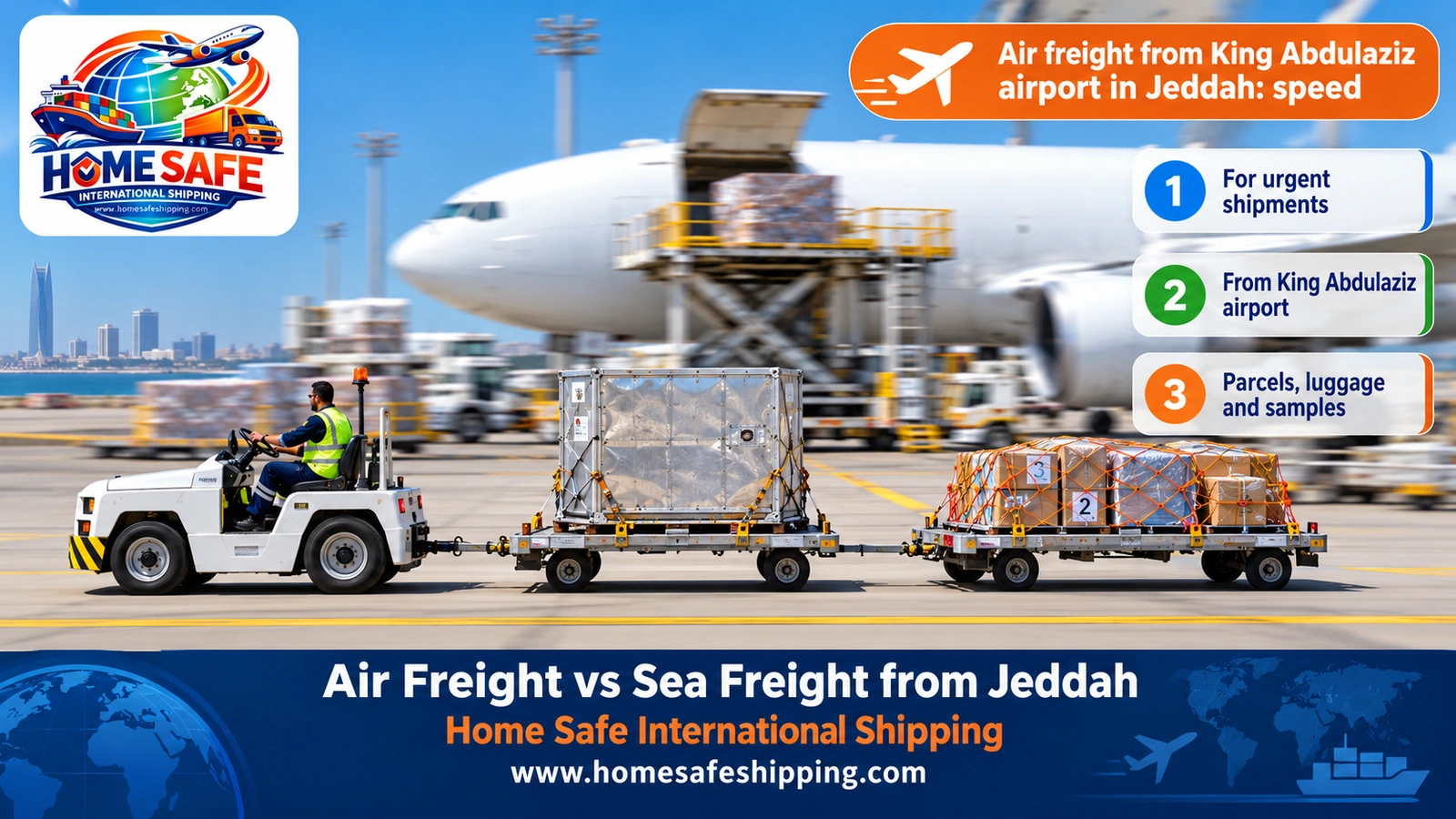
- It arrives quickly: the Gulf in one to 3 days, Europe in 3 to 6 days and the USA in 5 to 8 days.
- It accepts small items: an envelope of documents flies from SAR 83, and a parcel weighing no more than 5 kg bound for Turkey or Europe from SAR 110.
- It is handled little: from the warehouse to the aircraft to the arrival warehouse, so there are fewer chances of breakage or loss.
- Its schedules are regular: if a shipment misses one flight, it catches the next the same day or the day after.
- It costs more: it is charged per kilogram, and a bulky parcel is charged on its volume.
- Its capacity is limited: a very long or very heavy piece may not fit the hold of a passenger aircraft and needs a freighter.
Air therefore suits anyone with a deadline: a wedding, the start of a term, an exhibition, a spare part that has stopped a production line, or medicine for a patient. The whole service is explained in the article air freight office in Jeddah and on the air freight page.
Sea freight from Jeddah Islamic Port: volume and load
What you buy from the ship is space. Jeddah Islamic Port is the Kingdom’s largest, with container terminals and berths for general cargo and vehicles, and from it shipping lines sail to the ports of the Red Sea, the Mediterranean, Europe, Africa and America. A container does not ask what your furniture weighs or how bulky it is, as long as it fits, so you can ship an entire home in it for less than the cost of flying a few hundred kilograms.
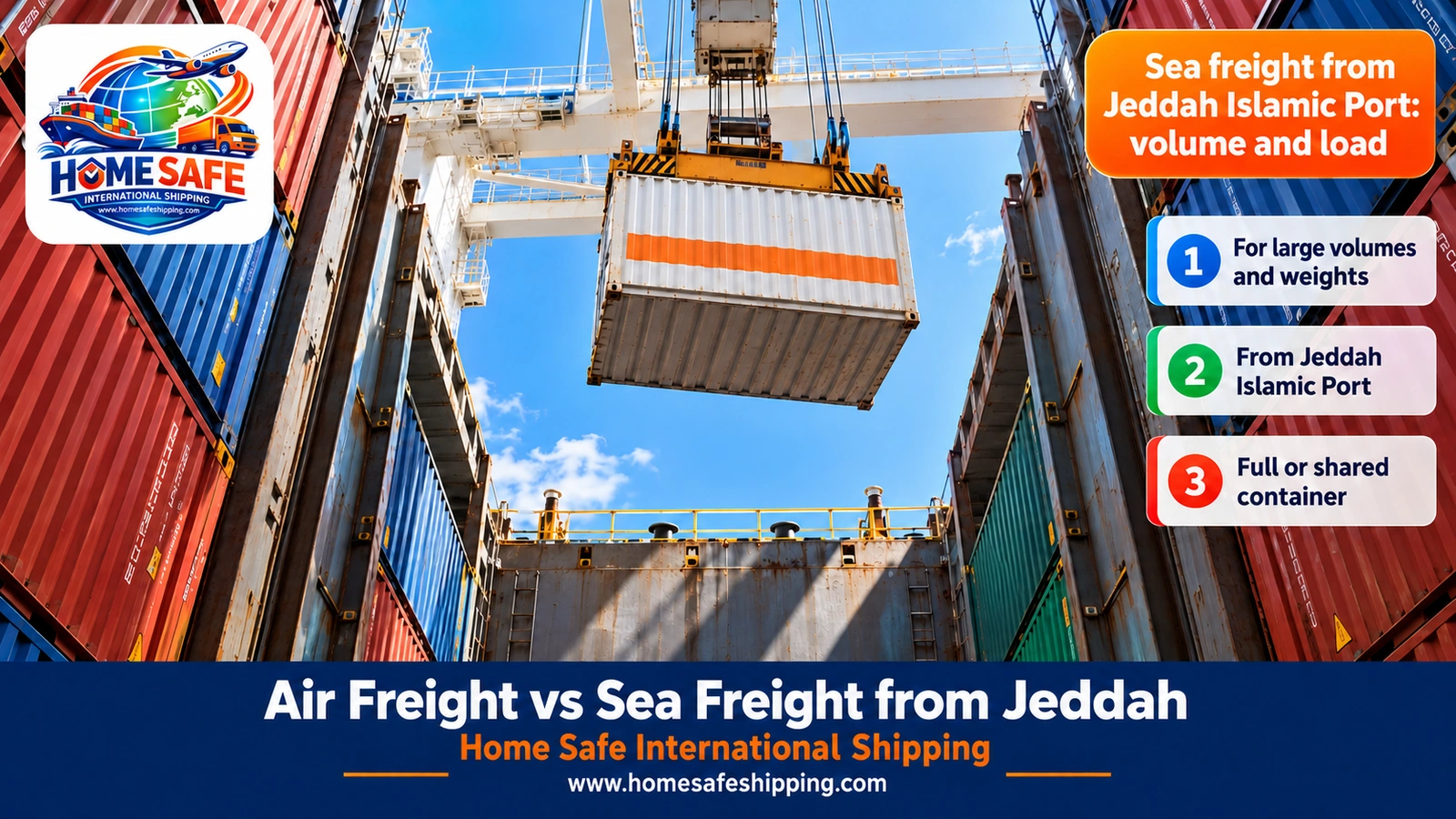
Sea freight from Jeddah offers two ways of using containers, and a third for cars. Choosing between a full and a shared container is a matter of volume, not of quality.
| Method | What it is | Who it suits | Price starts from |
|---|---|---|---|
| Full 20ft container | A container to yourself, holding about 33 cubic metres | A flat of two to three rooms, or one trader’s goods | SAR 4,600 to Red Sea and eastern Mediterranean ports |
| Full 40ft container | Twice the length, holding about 67 cubic metres | A large home, or furniture together with a car | SAR 5,200 to the same ports |
| Shared container | You pay only for the cubic metres you occupy | Cartons, luggage and a few pieces of furniture | SAR 415 per cubic metre to Turkey, Libya, Tunisia and Algeria |
| RoRo for cars | The car is driven into the vessel | An ordinary car in running order | SAR 2,800 for a saloon |
In return the sea asks for patience. The container closes days before sailing, the vessel calls at ports along the way, and unloading and clearance at the port of arrival take their time. Details of the lines and ports are in the article international sea freight from Jeddah and on the sea freight page, and container dimensions are on the container sizes page.
Transit time: days in the air, weeks at sea
The difference in time is the first thing that settles the choice. The figures below are the usual ones from Jeddah: the air time runs from the sender’s door to the consignee’s door, and the sea time is the sailing from port to port, to which the days before sailing and after arrival are added. We do not give them as a promise, since a congested port or a delayed flight changes them, and we tell you the expected time for your shipment when you book.
| Destination | Air, door to door | Sea: sailing time from Jeddah |
|---|---|---|
| The Gulf states | 1–3 days | Impractical from Jeddah; the alternative is a road truck |
| Turkey and the eastern Mediterranean | 2–4 days | 5–10 days |
| Southern Europe: Genoa, Marseille and Barcelona | 3–6 days | 8–14 days |
| North Africa: Libya, Tunisia, Algeria and Morocco | 2–7 days | 10–20 days |
| Northern Europe and the UK | 3–6 days | 14–22 days |
| North America | 5–8 days | 25–40 days |
An example makes this clearer: a sea shipment to Mersin in Turkey sails for a week to ten days, yet reaches the consignee’s door 18 to 28 days after it was collected in Jeddah. The difference went on packing, waiting for the vessel, unloading, clearance and distribution. Times for all destinations are on the transit times page.
Where does the time go with each method?
The flight from Jeddah to London takes hours, and the shipment needs days. The sailing to Genoa takes two weeks, and the container needs a month. The real duration is a chain of links, and the transport itself is only one of them.
| Stage | In air freight | In sea freight |
|---|---|---|
| Collection and packing | Usually on the day of collection | One to 3 days to dismantle, pack and load furniture |
| Waiting to depart | The first flight with space, within a day or two | Until the container cut-off before sailing; a shared one until it is full |
| The journey | Hours, or a day if the shipment passes through a transit airport | From 3 days for nearby ports to 40 days for distant ones |
| Unloading and clearance | One to 3 days | Several days; a shared container is unpacked in a warehouse first |
| Delivery to the door | A day or two | A day to several days, depending on how far the city is from the port |
What lengthens the time is much the same for both methods, and most of it lies with the sender and the consignee rather than the carrier:
- A missing paper: a contents list with no values, or a consignee name that does not match their ID.
- A vague description: the words “personal effects” on twenty cartons invite all of them to be opened.
- An absent consignee: a shipment that has arrived with nobody answering, so storage charges begin.
Cost: the kilogram by air and the cubic metre by sea
You cannot compare one figure with the other directly, because the unit is different. The aircraft prices by the kilogram, and the ship by the cubic metre or the container. The table sets our starting prices from Jeddah for both methods to the same destinations; all are transport charges from which a quotation starts, and they exclude the destination country’s customs duty and tax.
| Destination | Air: a kilogram starts from | Sea starts from |
|---|---|---|
| The Gulf states | SAR 14 | Not offered from Jeddah; road freight from SAR 140 per carton |
| Turkey | SAR 17 once the weight reaches 300 kg; a 50 kg shipment from SAR 1,100 | SAR 415 per cubic metre, and SAR 4,600 for a 20ft container |
| Libya, Tunisia and Algeria | SAR 28 | SAR 415 per cubic metre, and SAR 4,600 for a 20ft container |
| Morocco | SAR 28 | SAR 780 per cubic metre with a minimum of SAR 1,000, and SAR 7,800 for a 20ft container |
| European countries | SAR 23 | SAR 5,500 for furniture in a shared container, and SAR 11,000 for a whole-home container |
| The UK | SAR 26 | SAR 5,500 for furniture in a shared container, and SAR 11,000 for a whole-home container |
| The USA | SAR 41 | SAR 2,750 for furniture in a shared container, and SAR 7,800 for a container |
| Saloon car | Set on request | SAR 2,800 by RoRo |
| Document envelope | SAR 83 | Not shipped by sea |
Sea rates change from week to week with the shipping lines, and air rates change with the seasons and the fuel surcharge, so the figure for your shipment is fixed on the day of booking. The price per kilogram and its weight bands are covered in the article air freight price per kilo from Saudi Arabia, and container rates in the article container shipping prices from Jeddah.
Volumetric weight: why the aircraft charges for air and the ship does not
This is the most important difference overlooked by anyone comparing on price alone. By air you are charged on the greater of the scale weight and the volumetric weight, which equals length × width × height in centimetres divided by 6000. It means a cubic metre is never charged as less than 167 kg, however light it is. In a shared sea container the rule is reversed: you pay per cubic metre, and weight only enters the calculation if it exceeds one tonne per cubic metre. Bulky cargo is penalised by air and forgiven by sea.
| Shipment | Volume | Scale weight | Charged by air on | Charged by sea on |
|---|---|---|---|---|
| Box of metal spare parts | 0.1 cubic metre | 80 kg | 80 kg | The minimum charge |
| Ten cartons of clothes | 1 cubic metre | 90 kg | 167 kg | One cubic metre |
| Three-seater sofa, packed | 2 cubic metres | 60 kg | 334 kg | Two cubic metres |
| Pallet of tiles | 1 cubic metre | 900 kg | 900 kg | One cubic metre |
| Furniture of a small flat | 8 cubic metres | 600 kg | 1,336 kg | 8 cubic metres |
The sofa is the clearest case: sixty kilograms on the scale and more than three hundred on the aircraft’s invoice. To work out your shipment before calling, use the volumetric weight calculator for air and the CBM calculator for sea.
The break-even point: at what weight does the balance tip?
Sea freight has a minimum it never goes below, because issuing the bill of lading, port charges and clearance are paid in full even for a single carton. Air freight has a price that climbs with every kilogram. At a certain weight the two lines meet, and that is the break-even point: below it the aircraft is both cheaper and faster, and above it the ship starts to save money. The sum is a simple division: the lowest sea charge over the air price per kilogram.
| Destination | A kilogram by air | Lowest sea charge | Approximate break-even point |
|---|---|---|---|
| European countries | SAR 23 | SAR 5,500 | About 240 kg |
| The UK | SAR 26 | SAR 5,500 | About 210 kg |
| The USA | SAR 41 | SAR 2,750 | About 67 kg |
| Morocco | SAR 28 | SAR 1,000 | About 36 kg |
| Turkey | A 5–20 kg parcel from SAR 200 | SAR 415 per cubic metre | Between 20 and 50 kg |
| Libya, Tunisia and Algeria | SAR 28 | SAR 415 per cubic metre | About 15 kg |
The weights in the last column are chargeable weights, not scale weights, so bulky cargo reaches the point sooner than you would expect. They are worked out on starting prices and move whenever prices move. One rule stays fixed: the point tells you where the sums are equal, not what a month of waiting is worth to you.
Worked examples from Jeddah shipments
Bare figures are not enough, so here are shipments of the kind we collect every week from Jeddah’s districts, priced both ways on the same starting prices. The air charge is the chargeable weight multiplied by the destination’s price per kilogram, and the sea charge is the starting price for shared-container freight or the container rate.
| Shipment | Destination | By air, from | By sea, from | Best fit |
|---|---|---|---|---|
| Suitcase, 23 kg | Europe | SAR 529 | SAR 5,500 | Air |
| Student’s luggage, 100 kg | The UK | SAR 2,600 | SAR 5,500 | Air |
| Carton of gifts, 20 kg | Morocco | SAR 560 | SAR 1,000 | Air |
| Luggage, 50 kg | The USA | SAR 2,050 | SAR 2,750 | Air |
| Cartons, 300 kg in two cubic metres | Turkey | SAR 5,100 | SAR 830 | Sea, unless you are in a hurry |
| Three cubic metres, charged as 501 kg | Tunisia | SAR 14,028 | SAR 1,245 | Sea |
| Flat furniture, 8 cubic metres, charged as 1,336 kg | Europe | SAR 30,728 | SAR 5,500 | Sea |
| Whole home, 30 cubic metres, charged as 5,010 kg | Europe | SAR 115,230 | SAR 11,000 | Sea |
| Saloon car | A port served by RoRo | Set on request | SAR 2,800 | Sea |
Look at the flat row and the student’s luggage row together. The destination is much the same and the price per kilogram is close, yet the results are completely opposite. The whole difference is volume. That is why we do not answer “which is cheaper” before we know what is in the shipment and how much room it takes.
What moves the price, and what is quoted in the market?
Each method has its own drivers. By air the invoice is pushed up by volume before weight, by the season and by surplus timber in the packing, while each higher weight band brings the price per kilogram down. By sea it is pushed up by the number of cubic metres in a shared container, by peak seasons and by the consignee’s distance from the port, and neither weight nor heavy packing changes anything inside your own full container.
Prices quoted in the market: few offices publish their prices, and what we found in shipping guides puts an international air kilogram at roughly SAR 15 to 30 with no destination named, describes air in general as four to five times dearer than sea, and some published comparisons go as far as saying a kilogram of shared-container sea freight is eight to twelve times cheaper. The same comparisons place the break-even point at 100 to 200 kg for dense cargo and around 500 kg for light cargo. These are general ratios from global routes; what matters to you is the price on your own route on the day you ship. The parts that make up a price are explained on the pricing factors page.
Which Jeddah shipments suit air freight and which suit sea freight
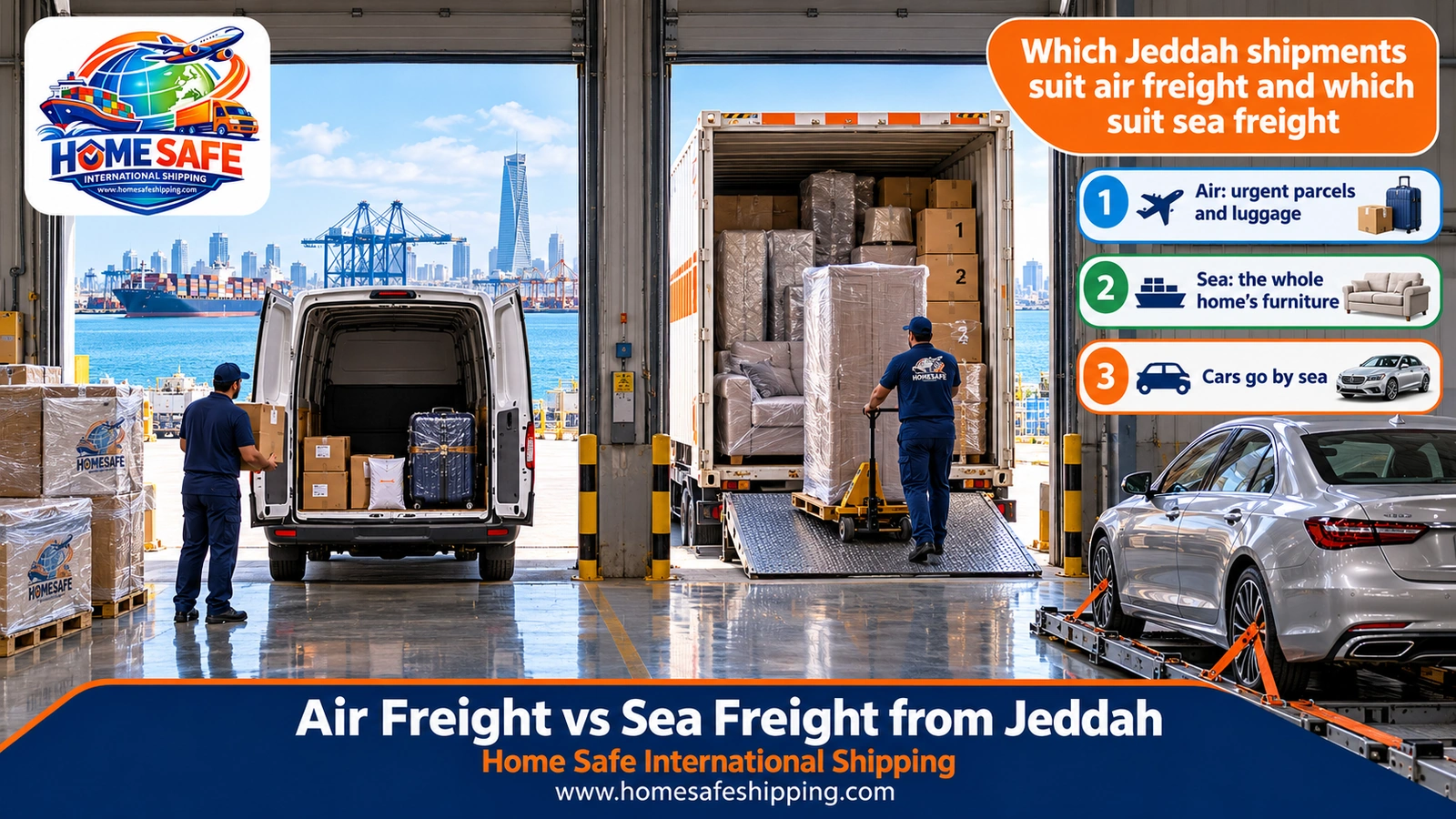
After time and price comes the practical question: what is in the shipment? Some items leave no doubt about their route, and some could go either way and are settled by the date. The rule we work to is simple: urgent parcels and luggage by air, a whole household of furniture by sea, and cars by sea.
| Item | Best method | Why |
|---|---|---|
| Documents, contracts and certificates | Express air | Almost no weight, and their value lies in arriving |
| Suitcases and personal luggage | Air | Below the break-even point for most destinations |
| Dates, gifts and commercial samples | Air | Small weight, and some have a shelf life or a show date |
| Electronics, fashion and spare parts | Usually air | Light and valuable, so each item’s share of the freight is small |
| Household furniture and appliances | Sea | Large volume, charged by air at several times its weight |
| Cars and motorcycles | Sea, by RoRo or container | The air charge for them is a costly exception |
| Building materials, machinery and equipment | Sea | Heavy and cheap for their weight, and some exceed an aircraft hold |
| Liquid perfumes, batteries and chemicals | Sea, declared | Restricted by air or banned from passenger aircraft |
| Medicines and fresh food | Chilled air | They cannot survive weeks of voyage |
For an item that falls in the middle, such as cartons weighing between 150 and 300 kg, we price both methods and put the two figures and the two durations in front of you. Often the answer is to split the shipment rather than choose a single route for it.
Furniture: why does it go by sea in most cases?
Furniture is the worst cargo for an aircraft and the best for a container. A bedroom, once dismantled and packed, takes up cubic metres and weighs a few hundred kilograms, so by air it is charged on its volume. In a container its weight is not even asked about.
That is why we ship the furniture of residents leaving Jeddah by sea: a full container for those with a home, and a shared one for those with a room or two. Shared-container furniture to Europe and the UK starts from SAR 5,500, a whole-home container from SAR 11,000, and a 20ft container to eastern Mediterranean ports from SAR 4,600. The exception is a single valuable piece, a painting or a musical instrument its owner wants quickly, for which a timber crate is built and it flies. The service is covered in the article international furniture moving in Jeddah and on the furniture shipping page.
Cars: by sea on RoRo or in a container, and by air in rare cases
A car weighs one and a half to two and a half tonnes and takes up a whole pallet position in a freighter’s hold. Its air charge is worked out from its weight, dimensions, the route and the space available, and is set on request; in every case it is several times the sea charge. That is why cars leave Jeddah by sea with rare exceptions.
- RoRo: the car is driven up the vessel’s ramp and lashed by its wheels on the car deck; it is not covered and nothing is left inside it, and a saloon starts from SAR 2,800.
- Container: the car is secured inside a closed container, which suits luxury, classic and non-running cars, and anyone wishing to ship belongings with it where the destination country allows.
- Air: for a racing car with a date to meet, a show car, or a rare car whose owner does not want it at sea for weeks.
More important than the shipping method is to ask first: will the destination country accept my car? Every country has limits on a car’s age, specification and taxes, and we go through the rules in force with you before booking. Details are on the car shipping and RoRo car shipping pages.
Parcels, luggage and pilgrims’ gifts: the aircraft’s territory
Jeddah is the gateway to the Two Holy Mosques, and much of what we ship from it is suitcases and gifts for Umrah pilgrims, Hajj pilgrims and visitors whose purchases have outgrown their ticket allowance. The sea does not suit them: the shipment is small, and its owner wants to find it when they get home. So we collect from the hotel or residence, weigh and pack, and the shipment flies in their name to their address.
Anyone carrying a single extra suitcase may find it cheaper to buy excess baggage on their ticket, and we tell them so. Anything beyond one or two suitcases, or anything sent without a traveller, belongs with air freight by the kilogram. Madinah dates, dry oud fragrances, carpets and clothes can all be shipped; Zamzam water is not shipped as cargo. The parcel service is on the parcel shipping page, and the most urgent items are covered in the article express international shipping.
Commercial goods: a trader’s sums are not an individual’s
An individual asks: how much do I pay? A trader asks: how much does freight add to the cost of each item, and what does waiting for it cost me? Goods of high value and low weight can bear the aircraft, because each item’s share of the freight is a few riyals. Heavy goods on a thin margin cannot, unless the empty shelf loses more each day than the difference in freight.
One line in the sum is often forgotten: tied-up money. Goods that spend a month at sea are capital that is not working, and they call for a larger safety stock in the warehouse. The practice of many importers is the main quantity in a container planned six to eight weeks ahead, and a small share by air when a new product is launched or a popular one runs out. The service for companies is on the commercial shipping page.
What the ship accepts and the aircraft does not
Aviation safety rules are stricter than those of the sea, because a small fire in a hold ten kilometres up is not like a fire in a container on a ship’s deck. Much of what is refused by air therefore travels by sea with a suitable declaration and packing. Some items are banned by both. The table lists what we are asked about most often from Jeddah.
| Item | By air | By sea |
|---|---|---|
| Liquid perfumes and oud oil blended with alcohol | As declared dangerous goods only, in limited quantities | Shipped declared |
| Loose lithium batteries and power banks | Not loaded on passenger aircraft | Shipped declared and packed to the rules |
| Devices with the battery inside | Accepted subject to packing and quantity conditions | Accepted |
| Paints, aerosols and strong cleaning agents | Heavily restricted | Shipped declared |
| Pieces taller than about 160 cm | Usually do not fit a passenger aircraft’s hold and need a freighter | Fit a container up to its door height, and above that go on a flat rack |
| Machinery and equipment by the tonne | Possible on freighters at a high charge | Their usual route |
| Weapons, narcotics, cash, raw gold and Zamzam water | Not carried in our shipments | Not carried in our shipments |
Every destination country adds its own list to these rules, covering medicines, foodstuffs, wireless devices and more. Tell us about anything you are unsure of before the carton is sealed, not after it has been opened at customs. The general list is on the prohibited items page.
Documents and customs: what is alike and what differs
The sender’s papers are much the same for both methods; the difference lies in the transport document and the way goods are released. Customs in the destination country make no distinction in duty between what came by air and what came by sea, since duty depends on the item and its value. In many countries, however, the freight charge forms part of the value on which duty is calculated, so an air shipment may be assessed on a slightly higher value.
| Item | Air | Sea |
|---|---|---|
| Transport document | Air waybill, non-negotiable; the shipment is released to the consignee named on it | Bill of lading, which may be a document of title presented in the original or released electronically |
| Invoice or contents list | Required, with value and description | Required, with value and description |
| Packing list | With the number of packages, their weights and dimensions | With the number of pieces and carton numbers, itemised for furniture |
| Export declaration from Jeddah | At the airport customs | At the port customs |
| Clearance in the destination country | Usually faster, and simplified for low values in some countries | With a full import declaration, and the owner or an agent present for personal effects in some countries |
| Additional papers | Dangerous goods declaration where needed | The car’s registration and export papers, and proof of residence for relief on personal effects |
Relief from duty on returning residents’ used furniture applies in many countries, under conditions that differ and change, so we confirm what is in force in your country before shipping. Templates are on the shipping documents page, and release procedures on the customs clearance page.
Risks and packing: sea humidity and air handling
The two shipments are not packed in the same way. A container crosses different climates over weeks, so water vapour condenses on the inside of its walls at night and reaches timber, fabric and cardboard unless they are protected. The vessel rolls, so every unsecured piece shifts thousands of times before arrival. An aircraft’s journey lasts hours, and its risk lies in fast handling and parcels stacked on one another.
- For sea: moisture-absorbing bags inside the container, wrapping that lets timber breathe, everything completely dry before loading, and lashing with straps and bracing with the gaps filled.
- For air: a sturdy double-wall carton with padding at the impact points, without surplus timber adding weight you pay for.
- For both: numbered cartons matching the contents list, and photographs before sealing.
Packing methods are illustrated on the packing guide page.
Tracking and insurance with both methods
An air shipment is followed by its air waybill number, and its updates come within hours of each other: collected, departed, arrived, released. A sea shipment is followed by the container or bill of lading number, and its updates are spaced out by the nature of the voyage: loaded on the vessel, sailed, called at a transhipment port, arrived. We send you every change on WhatsApp without your asking.
Insurance is optional with both methods and offered on request, calculated on the declared value. We recommend it more strongly for sea, because the voyage is longer and the handling greater, and because maritime rules make cargo owners bear a share of the loss if part of the cargo is sacrificed to save the vessel. The terms are on the shipment tracking and cargo insurance pages.
Combining air and sea freight from Jeddah: the urgent part by air, the rest by sea
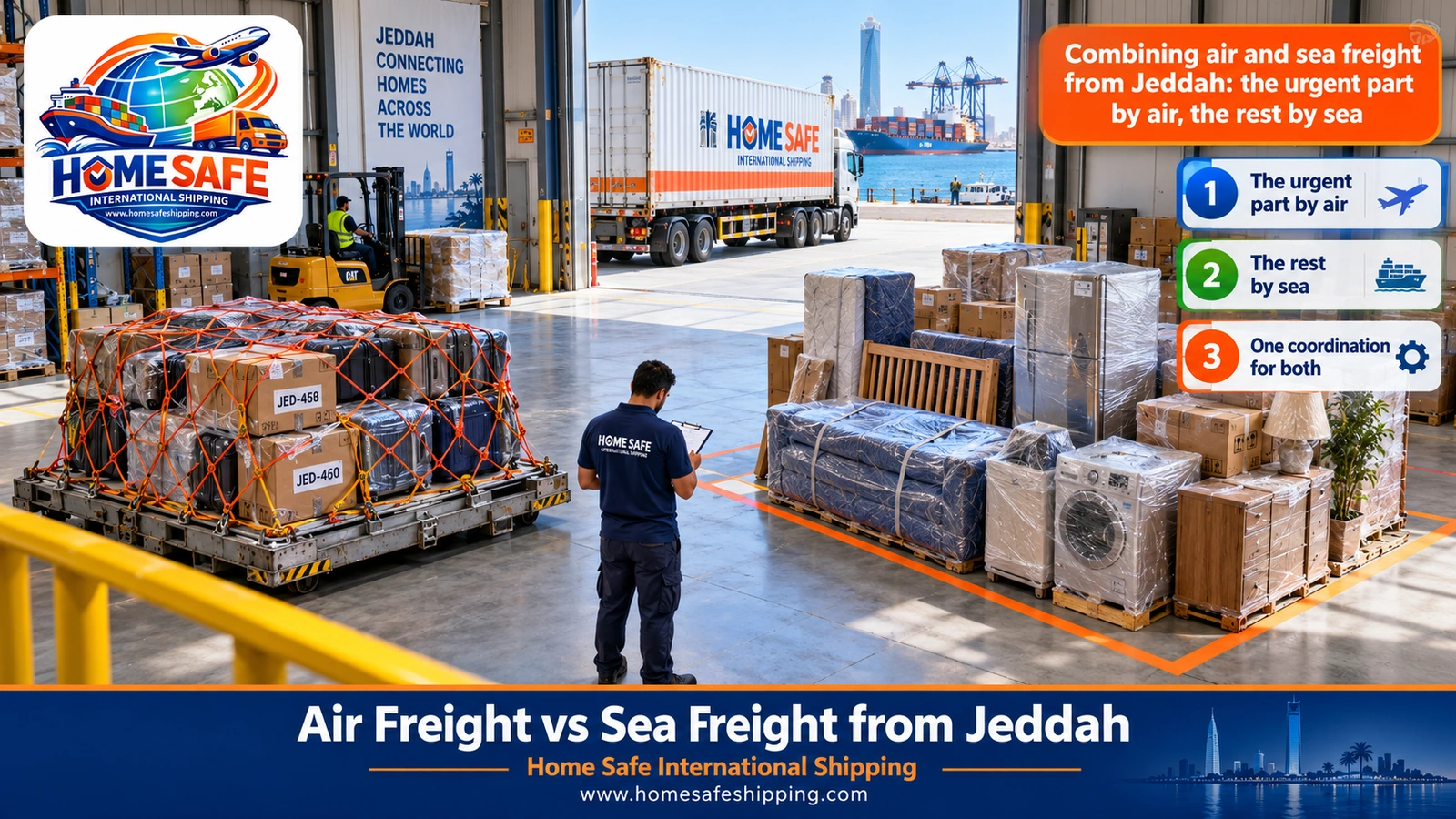
Our most satisfied customers are those who did not choose between the two methods but divided their shipment between them. The idea is that every home and every order has a small part needed at once and a large part that can wait. The first flies and the second sails, and you pay the air rate only for the kilograms that deserve it.
| Case | What goes by air | What goes by sea |
|---|---|---|
| Family returning home | The season’s clothes, school books, basic kitchenware, important papers | Furniture, appliances and the remaining cartons |
| Scholarship student | Two suitcases, a laptop and the first term’s books | The remaining books and belongings, if there are many |
| Trader launching a new product | Enough stock for the first weeks, and display samples | The main quantity in a container |
| Factory awaiting equipment | The part on which start-up depends | The machines and remaining components |
| Car owner relocating | Their personal luggage | The car, by RoRo or container |
What makes splitting easy is that both shipments are run from one office. We sort at collection in a single visit, draw up two contents lists that match in name and address, book the flight and the container together, and tell you the dates of both. You do not explain your situation to two parties, and half your shipment does not reach customs under a name that differs from the other half. The air portion in a split of this kind is usually between 30 and 100 kg, so its charge to Europe starts from SAR 690 up to SAR 2,300.
Road freight: the third option for the Gulf and Jordan
A comparison of air and sea from Jeddah is not complete without the truck, which is the real route to neighbouring countries. Jeddah is on the Red Sea, and a ship bound for Dubai, Doha or Kuwait sails round the whole Arabian Peninsula, taking longer than a truck at a cost the distance does not justify. That is why we do not offer sea freight from Jeddah to the Gulf, and there we compare the truck with the aircraft.
| Point of comparison | Closed road truck | Aircraft |
|---|---|---|
| Price | A carton from SAR 140, and a kilogram from SAR 4.6 above 50 kg | A kilogram from SAR 14 |
| Time | Days | 1–3 days |
| What suits it | Furniture, many cartons and heavy goods | Parcels, documents and anything with a deadline |
| Cars | On a car carrier, from SAR 1,100 | Set on request |
The route to Jordan is also by road, through the northern border crossings, and a carton starts from SAR 140. Anyone shipping from Jeddah to these countries compares the truck with the aircraft, and the sea is outside the comparison. Crossings and prices are detailed in the article land freight company in Saudi Arabia and on the land freight page.
From Jeddah’s districts to the airport or the port
You do not have to take your shipment to the airport in the north of the city or to the port in its south-west. We collect from your address with either method, and the difference is in the vehicle and the crew: a small van and a courier for air parcels, a truck and a dismantling and packing crew for sea furniture.
| Area | Examples | Note |
|---|---|---|
| North Jeddah | Obhur, Ash Shati, An Naeem, Al Mohammadiyah, Az Zahra | Closest to the airport; air collection is usually the same day |
| Central Jeddah | Ar Rawdah, As Salamah, Al Hamra, Al Faisaliyah, Al Aziziyah | Apartment blocks; we ask about the lift and truck access |
| East Jeddah | As Safa, Al Marwah, As Samer, Al Hamdaniyah | A similar distance to the airport and the port |
| South Jeddah | Al Balad, Al Jamiah, As Sanabel, Al Khumrah | Closest to the port and the warehouses |
| Makkah | About 80 km | It has no airport or port and is served from Jeddah |
| Taif, Rabigh and Thuwal | The shipment is brought to Jeddah | The inland transport charge is set on request |
Our coverage of the whole city is explained in the article international shipping companies in Jeddah.
Decision checklist: seven questions that settle the choice
Answer these questions in order and you will arrive at the right method before you call anyone.
- When must it arrive? If the answer is “within two weeks”, it is the aircraft, and there is no need to finish the list.
- Where to? If the destination is in the Gulf or Jordan, the comparison is between the truck and the aircraft.
- What is the chargeable weight? Measure and calculate, then compare it with the break-even point for your destination.
- Does the shipment include furniture or a car? If so, that part goes by sea.
- Does it contain anything an aircraft will not accept? Liquid perfumes, loose batteries or large pieces go by sea or are left out.
- What are the goods worth? Light, valuable goods can bear the air rate, and insuring them matters more.
- Can it be split? If there is a small urgent part, split it, and pay for speed on that part alone.
The steps of shipping with us by either method
- You send to 0552803439 a description of the shipment with photos or measurements, the consignee’s city and the date you need it there.
- We work out the chargeable weight and the volume, and price air and sea for the same shipment with the expected time for each.
- You pick one method or divide the shipment between the two; the booking confirmation then reaches you, stating the terms and how to pay.
- The crew comes to your address in Jeddah and weighs and packs for air, or dismantles, packs and loads for sea.
- We draw up the contents list and the export declaration, and the transport document is issued with its number.
- The shipment leaves from the airport or the port, and you follow it by the air waybill or container number.
- It is cleared in the destination country and delivered to the address against the consignee’s signature, and we let you know that delivery is complete.
Common mistakes when choosing between air and sea
- Comparing the air price per kilogram with the sea price per cubic metre as though they were one unit.
- Choosing the sea for a small shipment to save money, then paying its minimum, which is higher than the air charge.
- Sending furniture by air on the scale weight, then being surprised by the volumetric weight at the airport warehouse.
- Counting the sea time as sailing days alone, and forgetting what comes before the port and after it.
- Booking flights before knowing when the container arrives, and spending weeks in a home with no furniture.
- Putting perfumes or power banks in an air shipment undeclared, so the whole of it is returned.
- Shipping everything by one method when splitting the shipment would have been cheaper and easier.
Why Home Safe for comparing air and sea freight from Jeddah?
A registered establishment
Home Safe Logistics Services Est., commercial registration 4030601060.
Both methods under one roof
We ship from the airport and from the port, so we do not lean you towards one over the other.
Two figures in front of you
We price air and sea for your own shipment, with the duration of each.
One point of coordination
If you split the shipment, we run both parts from one office with matching paperwork.
To book: 0552803439 by call or WhatsApp, from 7 am to 11 pm. Or through the request a quote page.
Related articles and pages
- Air freight office in Jeddah
- International sea freight from Jeddah
- International shipping companies in Jeddah
- International furniture moving in Jeddah
- Sea freight company in Saudi Arabia
- Air freight from Saudi Arabia
Tags
air freight vs sea freight from Jeddah, difference between air and sea freight, air or sea freight, which is better air or sea freight, which is cheaper air or sea freight, air and sea freight comparison, sea freight transit time from Jeddah, air freight transit time from Jeddah, air freight price from Jeddah, sea freight price from Jeddah, air freight from King Abdulaziz airport, sea freight from Jeddah Islamic Port, shipping furniture by sea from Jeddah, household goods by air or sea, shipping cars by sea from Jeddah, Home Safe international shipping
Frequently asked questions about air freight vs sea freight from Jeddah
What is the difference between air and sea freight from Jeddah, in brief?
The aircraft sells you time and the ship sells you space. An air shipment leaves King Abdulaziz airport, arrives within one to 8 days, and you pay per kilogram. A sea shipment leaves Jeddah Islamic Port, needs one to 6 weeks, and you pay per cubic metre or per container. Light, urgent cargo flies; large, heavy cargo that can wait goes by sea.
Which is cheaper from Jeddah: air freight or sea freight?
Sea is cheaper once the shipment is large, and air is cheaper for small shipments because sea freight has a minimum charge it never drops below. To Europe, for example, shared-container sea freight starts from SAR 5,500 and an air kilogram from SAR 23, so anything with a chargeable weight under roughly 240 kg costs less by air. Above that the balance tips towards the sea, and the gap widens with size.
How long does sea freight from Jeddah take compared with air?
Sailing from Jeddah takes 5 to 10 days to eastern Mediterranean ports, 8 to 14 days to southern Europe, 14 to 22 days to northern Europe and the UK, and 25 to 40 days to North America, plus the time for loading, clearance and delivery. Air freight reaches the Gulf in one to 3 days, Europe in 3 to 6 days and the USA in 5 to 8 days, door to door.
I only have four suitcases; should I send them by sea to save money?
Usually not. Four suitcases weighing about 100 kg start from SAR 2,300 by air to Europe and SAR 2,600 to the UK, and both figures are below the starting price of shared-container sea freight to those destinations. You pay less and receive them within days. The sea begins to pay when the suitcases become many cartons or furniture joins them.
Can I send my household furniture by air if I am in a hurry?
You can, but it is very expensive, because furniture is light and bulky and is charged on its volume rather than its weight. A flat whose furniture takes up 8 cubic metres is charged by air as about 1,336 kg even if it weighs 600. What we suggest for anyone in a hurry: all the furniture by sea, and two or three cartons of what you need in your first weeks by air.
How is the price worked out for air freight, and how for sea freight?
By air you are charged on the greater of actual weight and volumetric weight, and volumetric weight is length × width × height in centimetres divided by 6000. In a shared sea container you are charged per cubic metre, and weight only counts if it exceeds one tonne per cubic metre. With a full container you pay for the whole container whether you fill it or not.
What does the break-even point between air and sea mean?
It is the weight at which the two methods cost the same on a given route. Below it the aircraft is cheaper; above it the ship is. It is found by dividing the lowest sea charge by the air price per kilogram. On our starting prices it is roughly 240 kg for Europe, 210 for the UK, 67 for the USA and 36 for Morocco, and it moves as prices change.
Is a car shipped from Jeddah by air or by sea?
By sea in every ordinary case. The car is driven aboard a RoRo vessel at Jeddah Islamic Port, with a saloon starting from SAR 2,800, or lashed inside a container if it is a luxury car or has belongings with it. Air freight for cars does exist on freighter aircraft; it is for racing, show and rare classic cars, and the charge is set on request.
What will a ship accept that an aircraft will not?
Liquid perfumes in quantity, loose lithium batteries, aerosols, paints, pieces taller than the hold of a passenger aircraft, heavy machinery and cars. Some of these are accepted by air with a dangerous-goods declaration and a higher charge, and some are not accepted at all.
Is sea freight less safe for the goods?
It is not less safe, but its risks are of a different kind. The voyage is longer, the container is exposed to sea humidity, temperature swings and the motion of the waves, and a shared shipment is loaded and unloaded more than once. All of this is dealt with by packing suited to the sea and proper lashing.
Can I split my shipment between air and sea?
Yes, and this is what many returning residents and traders do. We sort the shipment at collection: the urgent part goes into cartons that are weighed and flown, and the rest is packed for the sea and goes into the container. Both shipments carry one consignee name, matching contents lists and a single point of coordination at our office, so you do not deal with two parties or repeat the paperwork.
Is there sea freight from Jeddah to the Gulf states?
In theory yes, in practice it is not advisable: Jeddah is on the Red Sea, and a ship bound for the ports of the Arabian Gulf sails round the whole peninsula. The real route to the UAE, Kuwait, Qatar, Bahrain and Oman is the closed road truck, where a carton starts from SAR 140. Urgent items go by air from SAR 14 per kilogram.
Do air freight documents differ from sea freight documents?
The basis is the same: an invoice or valued contents list, a packing list, a copy of the sender’s ID and the consignee’s details. The difference lies in the transport document: an air waybill travels with the goods and they are released to the named consignee, while a sea bill of lading may be a document of title whose original must be presented, or released electronically, before collection.
Which is better for a trader importing or exporting through Jeddah?
A trader weighs the cost per item together with the cost of waiting. Light, valuable or seasonal goods, such as fashion, electronics and urgent spare parts, can bear the cost of the aircraft. Heavy, low-margin goods belong in a container.
How do I find the right method for my shipment without doing the sums myself?
Send us three things on 0552803439: what you are shipping, with photos or measurements, which city it is going to, and when you need it there. We work out the chargeable weight and the volume, price both methods for the same shipment, and write down the expected time for each. Then you choose with the two figures side by side.
That is the guide — now let us price your shipment
Choose what applies to you and receive a reply with the price, the method and the time.
RoRo, container or sling lift — we recommend what suits your vehicle’s value and its destination.
Get a vehicle priceA full or shared container, or urgent air freight, with packing and clearance.
Get a shipment priceRoutes in the same section
Options related to the same type of service.