Exhibition and Event Shipping in Jeddah 0552803439 | Stand Packing, In-Hall Delivery and Return Freight by Land, Sea and Air
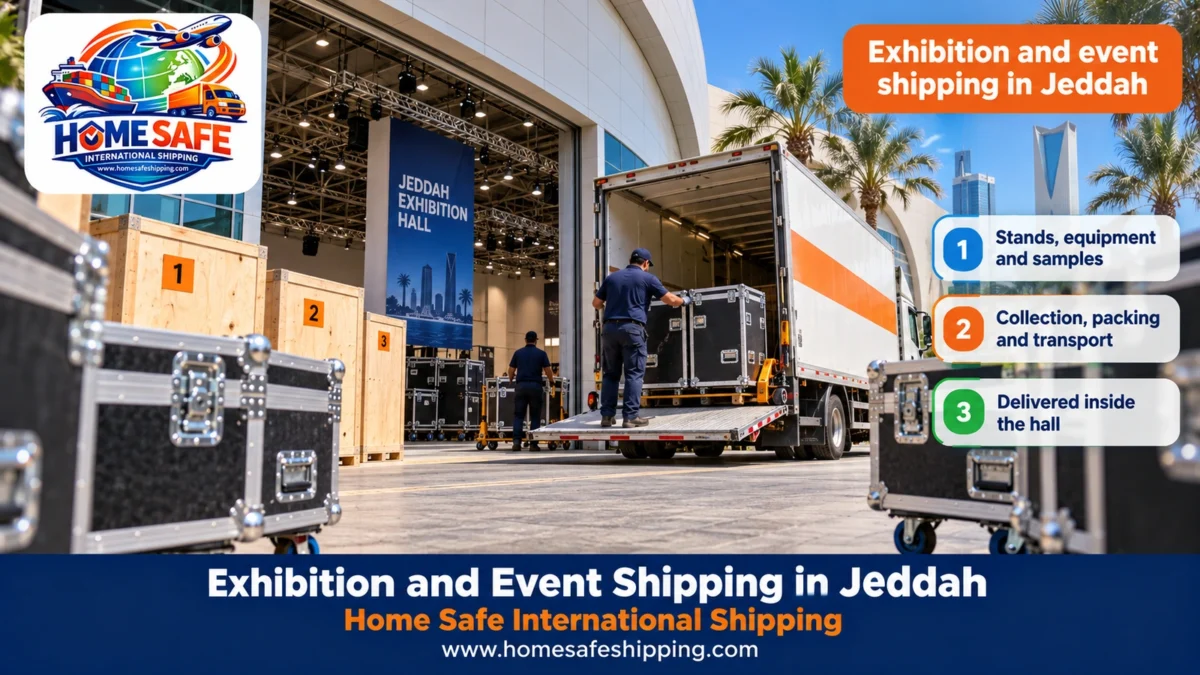
Exhibiting at a show or running an event in Jeddah and need your stands, equipment and samples in the hall before opening? Home Safe collects the materials from your warehouse, packs them in custom-sized wooden crates and delivers them to the stand position, then dismantles them after the close and returns them to your warehouse or ships them to your next show by land, sea or air from King Abdulaziz International Airport. Air freight starts from SAR 14 per kilo, a cubic metre by land to the Gulf from SAR 550 and a 20ft container from SAR 4,600, while on-site services are set on request.
Home Safe provides exhibition and event shipping in Jeddah for exhibitors and organisers: we collect stands, equipment and samples from your warehouse, pack them in custom-sized crates, transport them and deliver them to the stand position inside the hall before opening, then dismantle them after the close and return them or ship them on to your next show. Transport to shows abroad starts from SAR 14 per kilo by air, from SAR 550 per cubic metre by land to the Gulf, and from SAR 4,600 for a 20ft container by sea. For bookings and enquiries: 0552803439.
In this guide45ShowHide
- What is exhibition and event shipping?
- Who needs this service in Jeddah?
- What do we ship for exhibitions and events?
- The stages of the service, from your warehouse to the hall
- Deadlines: when should you start arranging an exhibition shipment?
- Packing display stands, screens and samples in Jeddah in custom crates
- Numbering the pieces, the packing list and the stand plan
- Delivering and setting up exhibition materials inside the hall in Jeddah before opening
- Exhibition halls and event sites in Jeddah
- Equipment and handling: forklifts and heavy pieces
- Storage before the show and keeping the empty crates
- Receiving shipments from exhibitors arriving from abroad
- Temporary admission and the ATA carnet for exhibition materials
- Documents required for an exhibition shipment
- What is the HS code and why is it required on an exhibition invoice?
- Items that need prior approval and items that cannot enter
- Exhibition and event shipping prices in Jeddah
- Which mode suits your show: land, sea or air?
- Air freight of exhibition materials from Jeddah to exhibitions abroad
- Return shipping from Jeddah after the exhibition ends
- Equipment for conferences, ceremonies and events
- Insurance and tracking
- Steps to book exhibition shipping
- Tips for exhibitors before shipping
- How do you choose an exhibition shipping company?
- Common mistakes in exhibition shipping
- Why Home Safe for your exhibition?
- Related articles and pages
- Tags
- Frequently asked questions about exhibition and event shipping in Jeddah
- What does exhibition and event shipping in Jeddah mean?
- How much does exhibition shipping in Jeddah cost?
- How many days before the show should I start arranging things?
- Do you deliver the materials inside the hall at the stand position?
- Do you build wooden crates to custom sizes?
- Where are the empty crates kept during the show days?
- Does Saudi Arabia accept the ATA carnet for exhibition materials?
- What if I do not have an ATA carnet?
- Which documents does an exhibition shipment arriving from abroad need?
- Do you ship exhibition materials from Jeddah to shows outside the Kingdom?
- How long does air freight of exhibition materials take?
- What happens to the materials after the exhibition ends?
- Do you insure exhibition materials?
- Do you move equipment for non-commercial events?
- How do I book exhibition shipping with Home Safe?
In brief
- The service: collecting, packing and transporting exhibition and event materials, and delivering them inside the hall in Jeddah.
- What we ship: display stands, screens, equipment, samples, printed matter and event equipment.
- Packing: custom-sized wooden crates, protection for sensitive pieces and a number on every piece.
- After the close: dismantling and repacking, then to your warehouse or your next show.
- Outside the Kingdom: by air from King Abdulaziz International Airport, by sea from Jeddah Islamic Port and by land to the Gulf.
- Prices: air freight from SAR 14 per kilo; on-site services are set on request.
- Booking: 0552803439 by call or WhatsApp.
What is exhibition and event shipping?
Exhibition shipping is a kind of freight with one rule that never changes: the opening waits for nobody. Ordinary goods that are a day late arrive the next day, but a stand that turns up after the ribbon is cut has cost its owner the space rental, the team’s tickets and a whole season’s opportunity. That is why the entire job is built as a countdown from the move-in hour at the hall, not from the day the shipment leaves.
It has a second feature: the shipment is not delivered and finished with, but opened, displayed, then closed and sent back. So the crate is designed to be used several times, the list the materials went in with is the list they come out with, and customs clearance, where there is any, runs in both directions. We handle these links together so that your stand is not split between a carrier, a packer and a broker, none of whom knows what the others did. General business freight is covered on the commercial shipping page.
Who needs this service in Jeddah?
Jeddah is a city of trade shows, seasonal events and conferences, and the service has more than one kind of customer there. Each asks about something different: a local exhibitor cares about the move-in slot, while one arriving from abroad cares about customs before anything else.
| Who is asking | What they usually move | What matters most to them |
|---|---|---|
| A local company exhibiting in Jeddah | A ready-made stand, screens and products for display | Entering at the set hour and delivery at the stand |
| A Saudi company exhibiting abroad | Samples, marketing materials and a portable stand | Arriving before move-in and returning without paying duties twice |
| A foreign exhibitor coming to Jeddah | Equipment, devices and products from its country | Temporary admission, clearance, then re-export |
| An exhibition or conference organiser | Stages, signage, temporary furniture and registration equipment | A disciplined move-in schedule for dozens of suppliers |
| An event management company | Sound, lighting, decor and gifts | Night-time set-up and clearing out as soon as the event ends |
| A government body or embassy | Information stands, artefacts and printed matter | An exact inventory and the safety of valuable pieces |
What do we ship for exhibitions and events?
Exhibition materials mostly fall into three groups: the stand structure itself, the equipment that runs inside it, and the samples and printed matter that are displayed or handed out. Each group is packed differently and treated differently by customs, since what returns complete is not the same as what is used up during the show.
| Category | Examples | What it needs in transport |
|---|---|---|
| Display stands | Aluminium frames, panels, flooring, reception counters, shelving | Dismantling and numbering, with bags or long crates for the panels |
| Screens and display systems | Large screens, LED walls, projectors, computers | A padded crate for each screen, standing upright, never flat |
| Equipment and machines for display | Machines, working models, medical or industrial devices | A timber base and lashing, and a forklift at unloading |
| Samples and products | Commercial samples, display packs, models | Reinforced cartons, keeping giveaways apart from what returns |
| Printed matter and gifts | Brochures, banners, bags, promotional gifts | Small cartons that can be carried by hand and kept dry |
| Event equipment | Stages, speakers, lighting, drapes, temporary furniture | Hard flight cases, loaded in the order of set-up |
The stages of the service, from your warehouse to the hall
Your stand materials pass through seven stations between your warehouse and the day of return. We set them out in order because most mistakes happen at the hand-over from one station to the next: a crate that was not numbered, an access pass that was not issued, or return instructions that were never written.
| Stage | What happens | Who does it |
|---|---|---|
| 1. Inventory | A list of the pieces with dimensions and values, and the stand plan | You, and we review it with you |
| 2. Packing | Building the crates, padding and numbering | Our crew, at your warehouse or ours |
| 3. Transport | A closed truck to the hall, or to the airport or port | We do |
| 4. Access | A pass and a slot at the loading gate | The organiser issues it and we keep to it |
| 5. Delivery | Unloading, opening the crates and placing the pieces on the stand | Our crew |
| 6. Show days | Keeping the empty crates | We do |
| 7. The close | Dismantling, repacking and return freight | Our crew, on your instructions |
Deadlines: when should you start arranging an exhibition shipment?
Start from the move-in date at the hall and work backwards. A local show inside Jeddah needs two to three weeks, most of it for building the crates and fixing the move-in slot. A shipment that crosses a border has receiving deadlines set by the show’s agent in the exhibitor manual; the figures below are what is customary at shows held in the Kingdom, and we always work to what your show’s manual says.
| Type of shipment | Usual arrival before the move-in days | Note |
|---|---|---|
| Local, from within Jeddah | On the move-in day allotted to you | Packing comes days earlier |
| By road from another Saudi city | One to 3 days earlier | Held with us until the move-in hour |
| By road across a border | About 7 working days | Documents are sent before the truck reaches the crossing |
| By air from abroad | About 10 working days | Documents pre-alerted before departure |
| By sea from abroad | About 12 working days at the port | Not counting the sailing time itself |
| Items needing prior approval | Roughly five weeks before shipping | Food, cosmetics and wireless devices |
What delays an exhibition shipment?
- An incomplete invoice: no HS codes, or no serial numbers for the devices.
- Restricted items sent without the approval of the competent authority.
- Large quantities of printed matter packed inside the equipment crates, which holds the whole shipment for inspection.
- The shipment arriving after the receiving deadline set by the show’s agent.
- Fridays, Saturdays and public holidays, which do not count as working days.
Packing display stands, screens and samples in Jeddah in custom crates
Exhibition materials are loaded and unloaded at least six times in a single show, and each time is a chance for breakage. The carton a screen arrived in from the factory was designed for one journey, so it will not survive a round trip or a forklift. That is why we build a wooden crate to the size of every sensitive piece, padded inside and closed with screws so that it can be opened in the hall and closed after the show without falling apart.
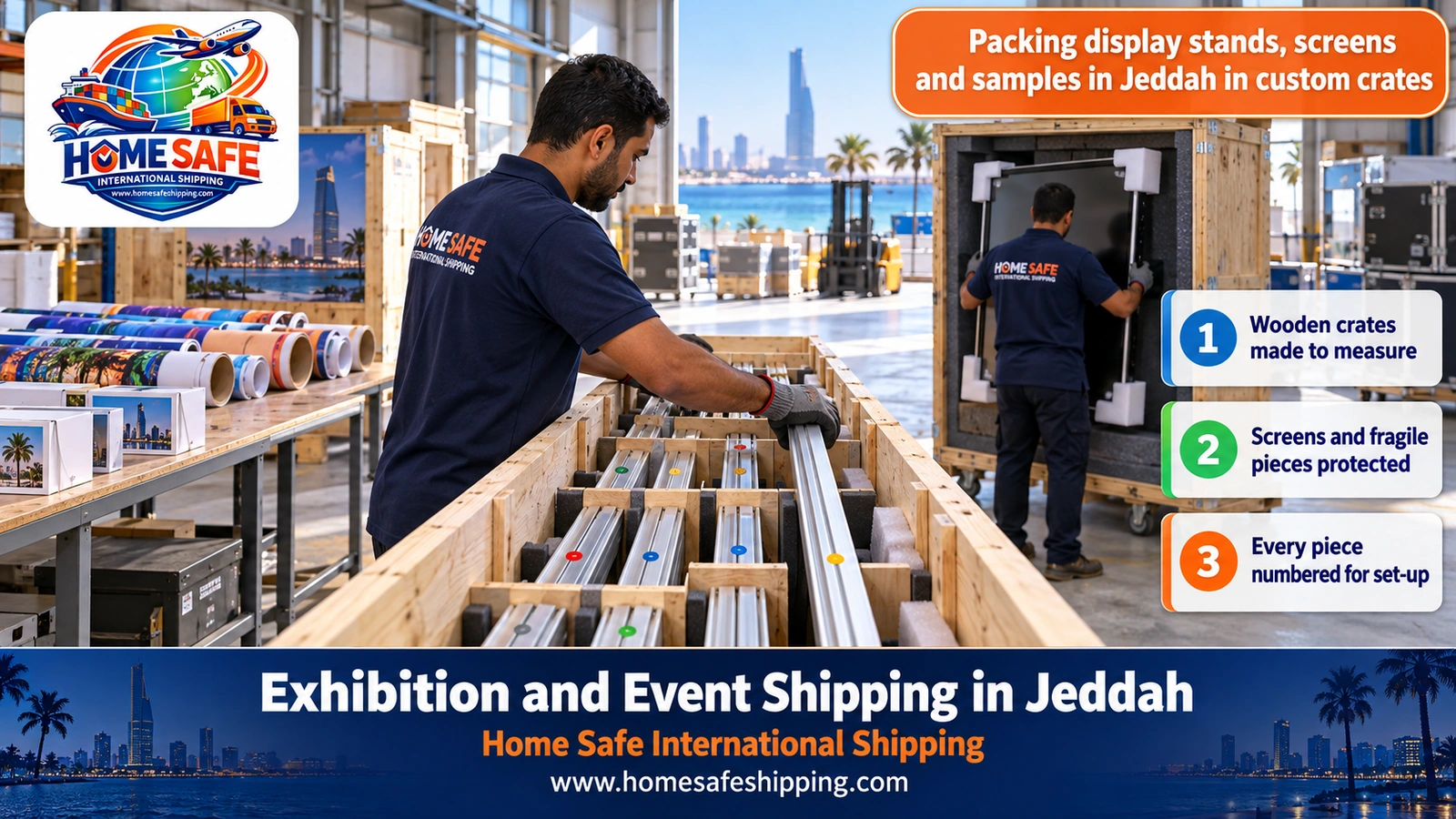
A good crate serves you for years. An exhibitor who takes part in three or four shows a year recovers the cost of the crates in the first season, with no repacking each time and no broken screen to pay for. Materials and securing methods are detailed on the packing and lashing page.
| Piece | How it is packed | Why |
|---|---|---|
| Large screen or LED wall | Foam-lined wooden crate, with the screen upright | Pressure on the surface is what breaks it |
| Printed stand panels | Soft separators between panels, in a flat crate | A scratch shows under the hall lighting |
| Dismantled aluminium frame | Numbered bundles, with bags for bolts and connectors | One missing part stops the assembly |
| Machine or heavy model | Timber base, strap lashing and a cover | So that the forklift lifts it from underneath |
| Model or art piece | A crate within a crate, with filling that prevents movement | It cannot be replaced if damaged |
| Samples and printed matter | Double-wall cartons on a wrapped pallet | Counted and handed over in one go |
For shipments leaving the Kingdom we build the crates from heat-treated timber carrying the international wood-packaging stamp, since many countries send unstamped wood back or order it fumigated at the owner’s expense.
Numbering the pieces, the packing list and the stand plan
Numbering is what turns a pile of crates into a standing booth in two hours. Every crate carries a uniform label: the name of the show, the exhibitor name, the hall and stand number, the crate number out of the total, and the weight and dimensions. It goes on two faces so that it can be read however the crate is set down.
Matching the labels is a packing list that states what is in each crate, piece by piece. This list is the crew’s first working paper in the hall, it is the same one customs asks for if the shipment crosses a border, and we count the pieces against it on the day of return. If you send us the stand plan with the list, we write on each crate the side where it is to be set down, so that a heavy crate is not dragged twice inside a tight space.
Delivering and setting up exhibition materials inside the hall in Jeddah before opening
Delivery in exhibition shipping does not end at the loading dock. We bring the crates to your stand number inside the hall, unload and open them, put each piece in its place on the plan, and reassemble the ready-made pieces that we took apart ourselves: shelving, tables, screen mounts and portable stands. The aim is for your team to find the stand ready to switch on before the opening, with enough time left for a test run.
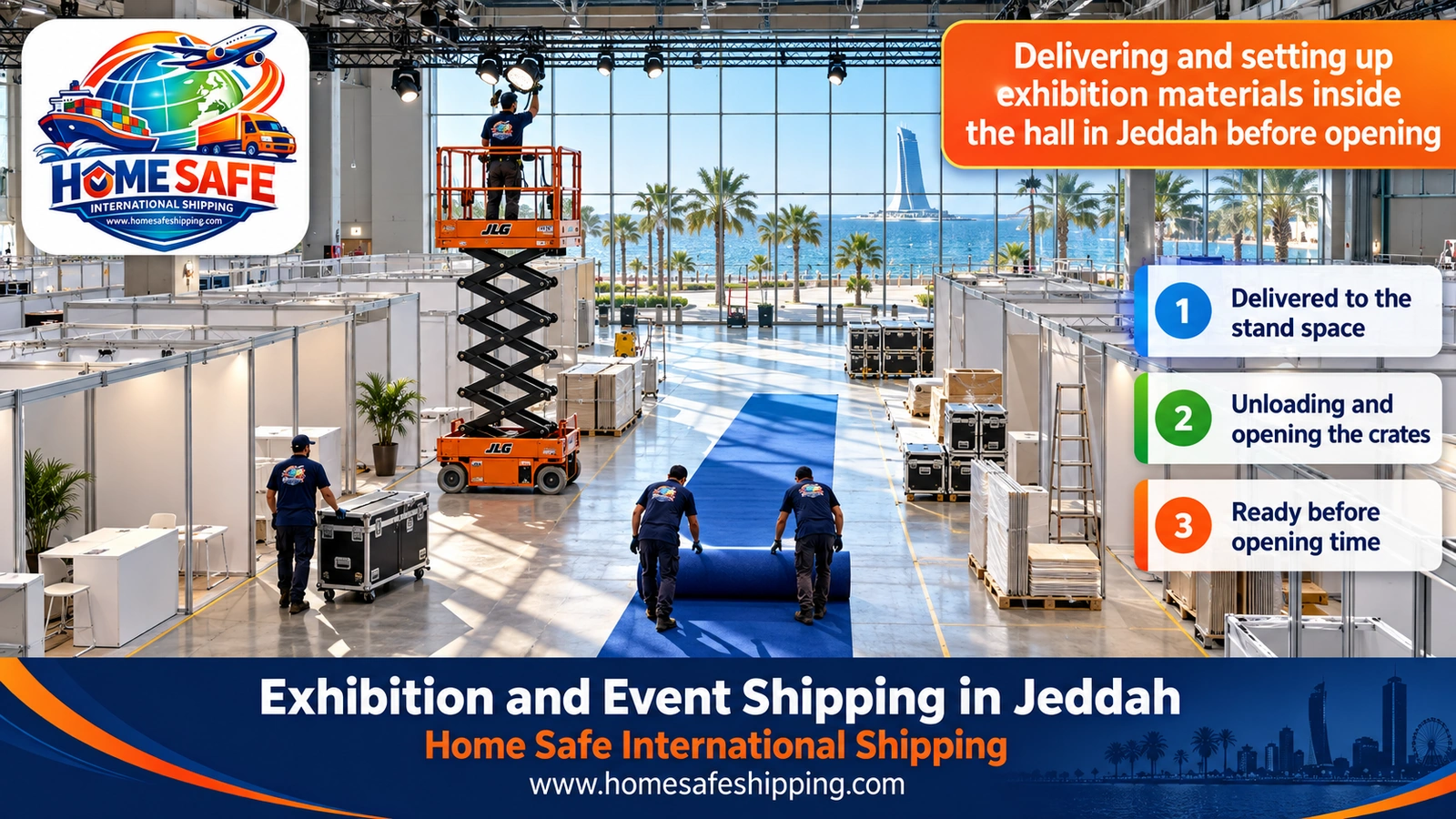
Entry to the hall is organised, not open. Each exhibitor has move-in hours set by the organiser according to where the stand is, passes for the vehicle and the workers, and usually safety rules requiring boots and vests. We ask you for these papers early and time the truck’s departure by them. Truck movement within Jeddah itself is subject to hours set by the traffic department, so we choose the size of the vehicle and its departure time on that basis.
We also say plainly what is not our work: building custom stands from timber and print, connecting electricity and internet, and rigging structures from the hall ceiling. These belong to the stand contractor or the hall’s official contractor, and we coordinate the arrival of the materials with them so that neither gets ahead of the other.
Exhibition halls and event sites in Jeddah
Jeddah’s exhibitions and events are held at scattered sites, and each has loading gates and access rules of its own. The table lists the known kinds of site and what changes in transport for each; the conditions of every site are set by its operator, and we confirm them before the move-in day.
| Site | Nature | What changes in transport |
|---|---|---|
| Jeddah Centre for Forums and Events | An exhibition centre on Madinah Road | Truck loading gates and a move-in schedule for each hall |
| Jeddah Centre for Exhibitions and Events | Run by the Jeddah Chamber, with about 10,000 square metres of covered space | Waiting yards and stores agreed with the operator |
| Jeddah Superdome | A vast dome with no internal columns for major exhibitions and events | Access for heavy equipment and tall stands |
| Hotel ballrooms | Conferences, forums and launch ceremonies | Service lifts and narrow corridors, so crates are made smaller |
| Shopping centres | Display corners and temporary exhibitions | Entry at night after the shops close |
| Open-air sites | Seasonal events and festivals | Protection from heat and humidity, and uneven ground |
Equipment and handling: forklifts and heavy pieces
A crate heavier than four workers can carry needs a machine, and knowing that before the move-in day avoids an awkward moment at the gate. We ask you for the weight and size of every heavy piece and bring what suits it. In some halls, forklifts inside the building are reserved for the official contractor, so we take the piece to the gate and hand it over against a signed list.
| Load | Handling equipment | Note |
|---|---|---|
| Cartons and cases | Hand trolleys | They fit in service lifts |
| Pallets and medium crates | Hand pallet truck | Needs level ground |
| Heavy crates | Forklift | The crate’s weight is stated on its label |
| Machines and large models | Crane or crane truck | An early move-in slot is booked for them |
Large equipment that does not fit in a closed truck travels on flatbeds and has a page of its own: heavy equipment shipping.
Storage before the show and keeping the empty crates
Storage in exhibition shipping means three different needs. The first is before the show: a shipment that arrived from abroad or from another city days ahead of move-in and is held in a closed warehouse until its hour. The second is during the show: the empty crates that have no room behind the stand. The third is afterwards: a stand that will appear at another show in two months and need not go back to its home city.
We keep the empty crates numbered with your name and stand number, because getting them back incomplete means a piece with no crate on breakdown day. Anything stored between two shows is inventoried on the way in and on the way out. Storing commercial goods in general is explained in our article on goods storage in Jeddah, and the service is on the storage page.
Receiving shipments from exhibitors arriving from abroad
A foreign exhibitor sends its materials to Jeddah through Jeddah Islamic Port or King Abdulaziz International Airport, or by road from neighbouring countries. We receive the shipment in the name of the agreed local consignee, follow its clearance through a licensed customs broker, and move it from the port of entry to our warehouse and then to the hall on move-in day.
We advise an exhibitor coming from abroad to do three things before shipping. Send the draft invoice and packing list for us to check before the originals are issued. Separate what will return from what will stay in the Kingdom into two sets of documents and two bills of lading, since mixing temporary admission with permanent import on one bill complicates clearance. And do not carry exhibits in travel luggage: they are subject to clearance at the airport and may stay there until after the opening.
Temporary admission and the ATA carnet for exhibition materials
Exhibition materials enter a country to be shown and then leave, and in principle no duties are paid on them as they would be on goods for sale. The Kingdom is part of the ATA temporary admission carnet system, and the Federation of Saudi Chambers is the guaranteeing and issuing body there. Under the rules in force the carnet is accepted for goods for exhibitions and events, and the goods may stay for up to six months before being re-exported in full; we confirm the current procedure before shipping.
| Customs route | How it works | Suits | What to know |
|---|---|---|---|
| ATA carnet | An international document issued by your country’s chamber and stamped on entry and exit | Equipment and stands that return complete | Advance application to the Zakat, Tax and Customs Authority; consumables are not covered |
| Temporary admission against a guarantee | A bank guarantee or cash deposit for the duties, refunded after re-export | High-value shipments with no carnet | Subject to customs approval, and the refund takes months |
| Permanent import | Paying the customs duty and 15% VAT | Samples to be handed out and low-value materials | The simplest and quickest, with no refund |
Whichever route is used, customs matches the goods to the paperwork on entry and on exit. That is why the serial number and model number must be visible on the device itself, not on a removable sticker, and the shipment must be re-exported in full through the port it entered by. Any piece that is sold or stays in the Kingdom has its duties paid. A Saudi exhibiting abroad uses the same carnet in the opposite direction, so the equipment leaves and returns with no duties in either country. The general explanation is on the triptik and carnets page, and clearance on the customs clearance page.
Documents required for an exhibition shipment
A local exhibition shipment inside Jeddah needs no more than the packing list and the access pass. One that crosses a border needs more paperwork than an ordinary commercial shipment, because it has to prove that it is going to a show and coming back from it.
| Document | What it must contain | When it is required |
|---|---|---|
| Commercial invoice | Description, value, HS code, country of origin and serial number of each item, signed and stamped | Every international shipment |
| Packing list | Contents, weight, dimensions and marks of each crate | Every shipment |
| Transport document | Air waybill, bill of lading or truck waybill | Every international shipment |
| Certificate of origin | From the chamber of commerce in the exporting country | Usually, and especially for road freight |
| Letter of participation | From the show organiser, naming the exhibitor and stand number | Temporary admission |
| Re-export undertaking | On the exhibitor’s official letterhead | Temporary admission |
| Broker’s authorisation | Authority to clear in the consignee’s name | At the port of entry |
| Health certificates and approvals | For food, cosmetics and restricted devices | Depending on the item |
Handwritten invoices and pro forma invoices are not normally accepted. The list of documents for every kind of shipping is on the shipping documents page.
What is the HS code and why is it required on an exhibition invoice?
The Harmonized System code, or HS code for short, is an international system for naming and numbering goods drawn up by the World Customs Organization. Every product has a numerical heading that a customs officer in any country reads the same way, and that heading determines the rate of duty on it and the authority whose approval is needed if it is restricted. Most countries in the world base their customs tariff on it.
In an exhibition shipment its value shows quickly. A screen, its mount and a printed brochure are three different headings with different duties, and if they are all written down as “exhibition materials” customs holds the shipment until it is classified. So write the code against every line of the invoice, and if there are more than two codes attach a sheet summarising them. If you do not know the code for your product, send us its description and a photo and we will help you identify it with the broker.
Items that need prior approval and items that cannot enter
Some exhibits need more than ordinary clearance: they need the consent of a competent authority before they are shipped. Those consents take weeks, so anyone who discovers them after the shipment has arrived opens the stand with nothing on it. The table gathers what comes up repeatedly at shows; the rules in force change, so we confirm the current ones before shipping.
| Item | Rule in force | What we do |
|---|---|---|
| Food and drink samples | Prior permit from the Saudi Food and Drug Authority, with health certificates | We start the application weeks before shipping |
| Cosmetics | Listing with, or approval from, the same authority | We review the product list and ingredients |
| Wireless and telecom devices | Approval from the Communications, Space and Technology Commission | We ask for the device specifications and frequencies |
| Dangerous goods and batteries | Safety data sheet and special packing | We classify them before booking the flight |
| Printed matter, films and books | Subject to release approval and may be inspected | Shipped on their own, not with the equipment |
| Alcohol and pork products | Strictly prohibited | Not shipped |
| Materials contrary to public morals | Prohibited | Removed from the shipment |
The general list of what cannot be shipped is on the prohibited items page.
Exhibition and event shipping prices in Jeddah
The price of exhibition shipping is the sum of two parts: on-site services and transport. On-site services, meaning crates, packing, unloading, dismantling and storage, follow the number and size of the pieces and the hall’s conditions; no figure is sound before the list of materials, which is why they are set on request. International transport we calculate at our standing rates for shipping from Jeddah, shown in the table.
| Item | Price | Note |
|---|---|---|
| Air freight to nearby destinations and the Gulf | Starts from SAR 14 per kilo | On chargeable weight |
| Air freight to Europe | Starts from SAR 23 per kilo | On chargeable weight |
| Documents and invitations by express courier | Starts from SAR 83 | Per envelope |
| A carton by land to the Gulf states | Starts from SAR 140 | In a shared load |
| A cubic metre by land to the Gulf states | Starts from SAR 550 | For crates and pallets |
| 20ft container by sea | Starts from SAR 4,600 | To Turkey, for example, from Jeddah port |
| Custom-sized wooden crates | Set on request | By size and padding |
| Transport within Jeddah and in-hall delivery | Set on request | By volume and move-in hours |
| Dismantling, repacking and return freight | Set on request | By the return instructions |
| Empty-crate keeping and storage | Set on request | By volume and duration |
Prices seen in the market: companies working in exhibition logistics in the Kingdom do not publish fixed prices; they issue a handling tariff sent to exhibitors with each show’s manual, charged per cubic metre or by weight, whichever is greater, with a minimum per shipment. The side charges that some show agents do publish are a fee on customs deposit refunds, taken as a percentage of the amount refunded, and a surcharge for urgent re-export within a week. That is why quotes differ widely, and the sound comparison is item against item, not total against total.
| Factor | How it affects the price |
|---|---|
| Volume and weight of the materials | Decides the truck size, the number of workers and the forklift |
| Number of custom crates | Each crate is built to the size of its piece |
| The venue and its conditions | Night entry, lifts and distances inside the building |
| Mode of international transport | Air is dearer and faster; sea is cheaper and slower |
| Customs route | Carnet, guarantee or permanent import |
| Shortage of time | Booking in the final week pushes every item up |
How do you cut the cost?
- Book early so that heavy stands go by sea or land and air is kept for urgent items only.
- Invest in crates that are used many times rather than fresh packing for every show.
- Combine the materials of your branches in one shipment with one list.
- Print brochures in the country of the show if there are many, since paper is paid for by the kilo.
- Store the stand near its next show instead of sending it home and out again.
Which mode suits your show: land, sea or air?
Two things decide the mode: the distance to the show and the time left. Shows in Riyadh, Dammam, the Gulf and Jordan are served by a closed truck that leaves Jeddah and arrives within days. Distant shows are served by sea if arrangements begin two months ahead, and by air if time is short or the materials are few. Many exhibitors combine the two: the heavy structure by sea, and the samples that are ready late by air.
| Mode | Suits | Door-to-hall time | What to allow for |
|---|---|---|---|
| Land, by closed truck | Saudi cities, the Gulf and Jordan | One to 7 days | Time at crossings and city entry hours |
| Sea, in a container | Large stands to Turkey, Europe and Asia | 15–40 days | Port days on arrival |
| Air | Samples and urgent, light equipment | One to 8 days | Volumetric weight and battery restrictions |
Land transport from Jeddah to the Gulf is explained in our article on shipping from Saudi Arabia to the Gulf states, and the other two services on the land freight and sea freight pages. Sea freight to the Gulf states from Jeddah, however, is impractical, because the ship sails round the peninsula and the truck beats it by weeks.
Air freight of exhibition materials from Jeddah to exhibitions abroad
Air is the mode for urgent materials: samples that were only ready two weeks before the show, a replacement for a screen that failed, printed matter amended at the last minute. The shipment leaves King Abdulaziz International Airport in Jeddah and lands at the airport of the show city, where our partner receives it, clears it and delivers it to the exhibition hall at your stand.
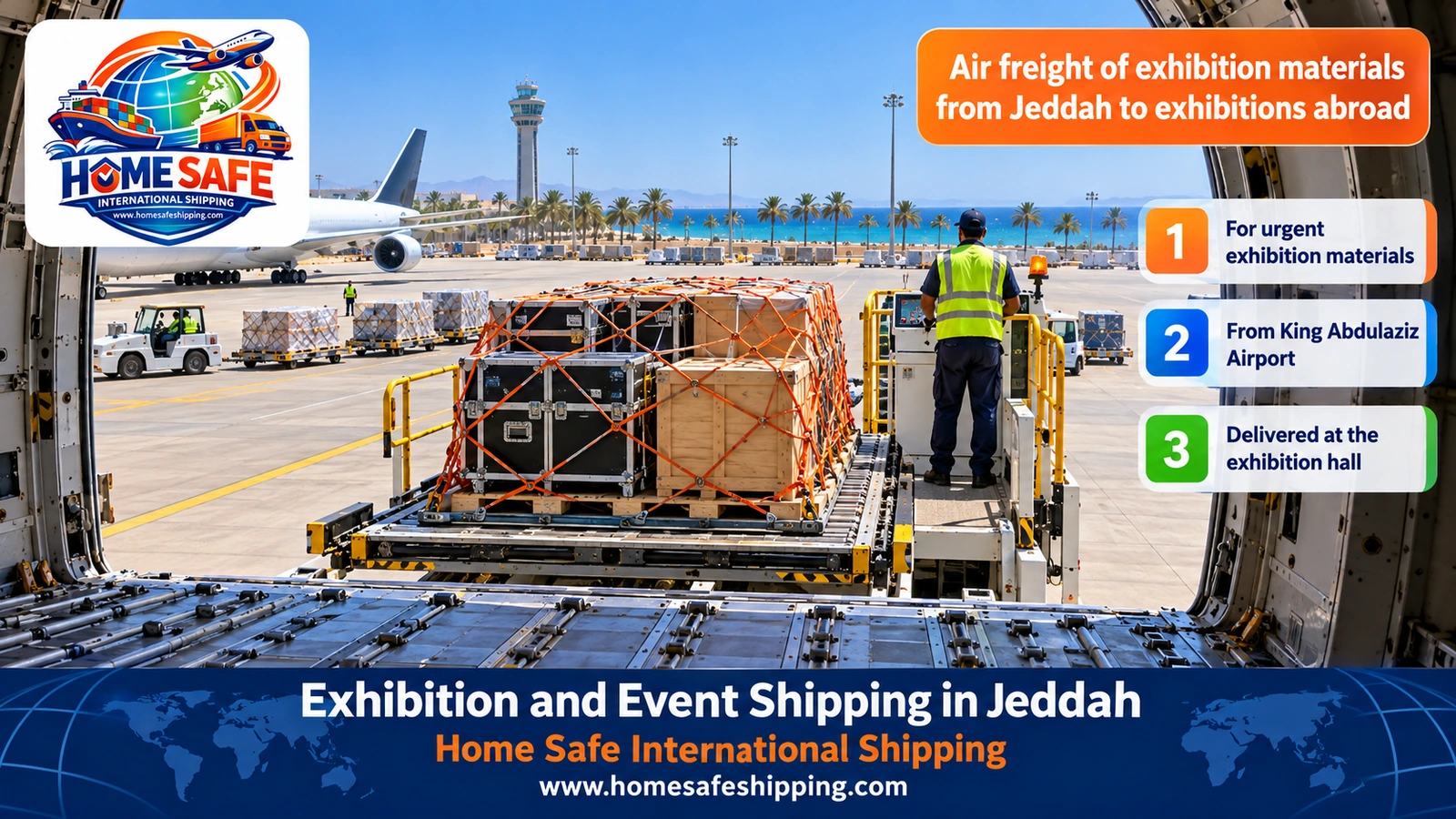
Door-to-hall time is one to 3 days for the Gulf states, 3 to 6 days for Europe and Asia, and 5 to 8 days for the Americas. But the show’s agent in the destination country usually requires the cargo to arrive ahead of the move-in days by a margin set in the exhibitor manual, so we plan the booking around that margin and not around the flight time alone.
The price is calculated on chargeable weight, meaning the greater of actual and volumetric weight, and starts from SAR 14 per kilo to nearby destinations and from SAR 23 to Europe. A large, light wooden crate is charged by its volume, so for air we slim the packing down as far as the safety of the piece allows. Work out your shipment’s weight with the volumetric weight calculator. Display devices containing lithium batteries face restrictions in air transport, so tell us about them before booking. The service is detailed on the air freight page and in our article on the air freight office in Jeddah.
Return shipping from Jeddah after the exhibition ends
The closing hour is the busiest of the whole show: every exhibitor is dismantling at once, and the hall has to be cleared within hours. Anyone who has not arranged the return beforehand leaves the materials in a crowded aisle with no crates. That is why we ask for written return instructions before the last day and bring your empty crates back to the stand on the morning of breakdown.
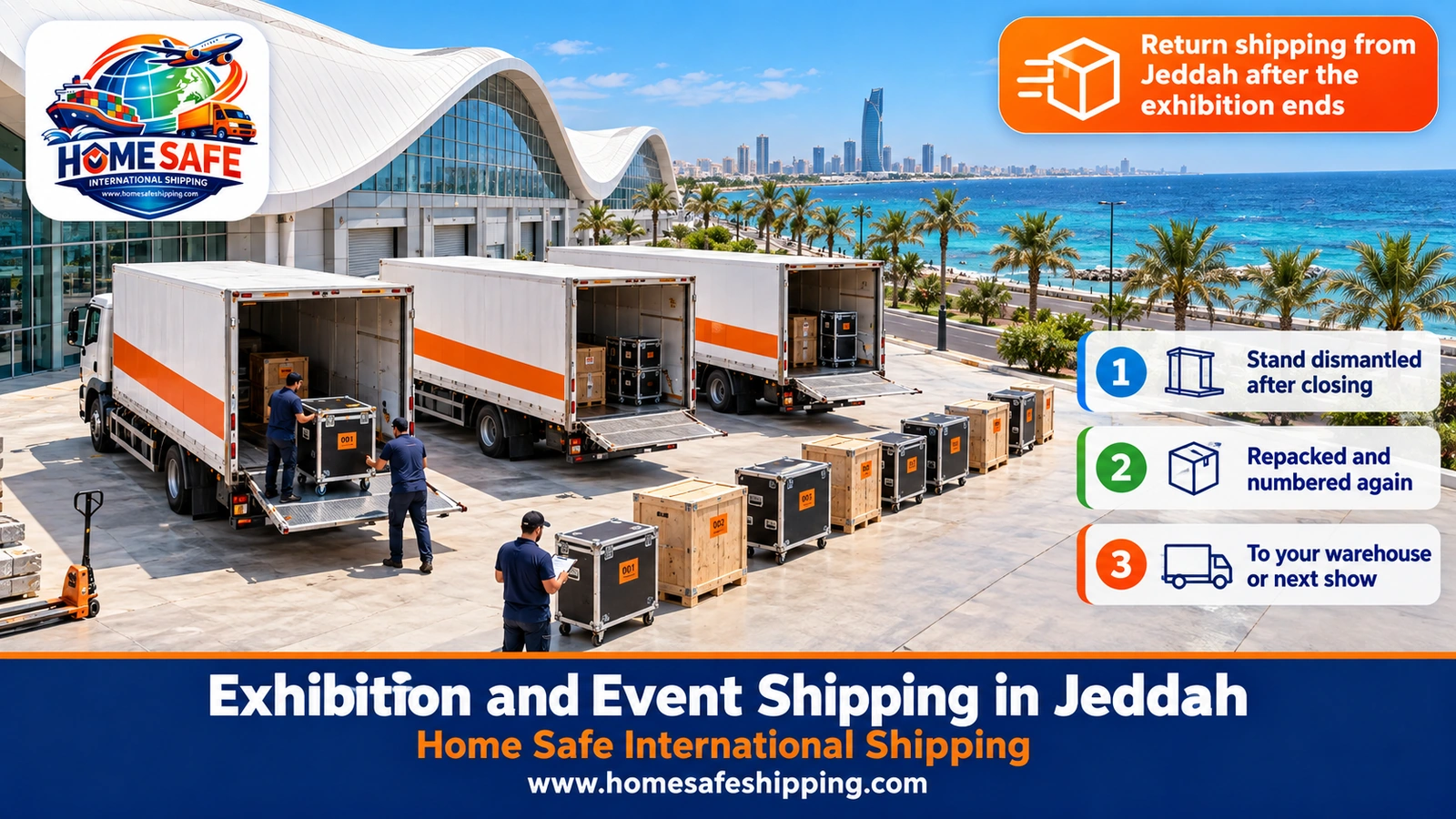
We then dismantle the stand after the close, put each piece back in its numbered crate, check the count against the inbound list and note what is missing: samples handed out, printed matter used up, a piece that was sold. After that the shipment goes to one of three places: your warehouse or showroom in Jeddah, our warehouse until your next participation, or straight to your next show in another city or country.
Whatever entered the Kingdom under temporary admission is re-exported in full and through the same port of entry, and processing an international return shipment usually takes weeks, not days, so do not promise your equipment to another show starting a week later unless we have arranged urgent dispatch in advance. We recommend that someone from your team attends the repacking, since they know the pieces best.
Equipment for conferences, ceremonies and events
A non-commercial event has a shorter life than an exhibition and tighter timing. A conference lasts two days, a launch ceremony one evening, and the hall is handed over hours before the event and taken back hours after it. Transport here is measured by the hour: a truck that arrives within the set-up window, workers who unload and arrange, then come back after the last guest to clear everything away.
For these events we move stages, sound and lighting systems, screens, temporary furniture, registration boards and gifts for guests. Sound and lighting gear travels in its hard cases and is loaded in reverse order of set-up, so the last item on is the first one off. For events at open-air sites we cover the equipment against heat and humidity, since Jeddah’s coastal air is hard on exposed electronics.
Insurance and tracking
Exhibition materials are high in value and handled often, so insuring them is no luxury. The right policy covers all three stages: the road to the hall, the show days and the journey back. It is separate from the organiser’s insurance on the hall, which does not include your exhibits. We arrange the policy on request with the list of values and serial numbers, and its limits and exclusions are written in it. Details are on the cargo insurance page.
You follow your shipment with a single number from collection to delivery at the stand. On international shipments we send you an update at every station: leaving the warehouse, take-off or sailing, arrival, customs release and hand-over to the show’s agent. How to follow it is on the shipment tracking page.
Steps to book exhibition shipping
- Send the name of the show or event, its venue and the move-in, opening and closing dates.
- Attach the list of materials with photos, approximate dimensions and weights, and the stand plan if there is one.
- We agree the mode and the customs route with you and send a plan with the timetable and an itemised cost.
- Once you agree, we fix the booking with a confirmation message stating what the service includes.
- We build the crates, pack and number at your warehouse or ours.
- We transport the materials and deliver them at the stand at the set move-in hour.
- We keep the empty crates during the show and return them on breakdown day.
- We dismantle, pack and ship the return according to your written instructions.
Tips for exhibitors before shipping
- Read the whole exhibitor manual: it holds the receiving deadlines, move-in hours, gate dimensions and floor loading.
- Photograph every piece before it is packed: the photos are your reference for assembly and for any claim.
- Separate giveaways from what returns: in the crates and on the invoices alike.
- Put the assembly tools in crate number one: it is the first thing you need in the hall.
- Write the stand number on every face: on move-in day the hall is hundreds of crates that look alike.
- Carry a copy of the list with you: on paper and on your phone.
- Book the return with the outbound trip: prices and dates are better when both journeys are arranged together.
How do you choose an exhibition shipping company?
An ordinary goods carrier may move your stand, but it does not know what a move-in hour or return instructions mean. The signs below separate those who know this work from those who would be trying it out on your show.
| What to look at | Reassuring sign | Warning sign |
|---|---|---|
| The first question they ask | When is move-in and what is the stand number? | How many cartons do you have? |
| Pricing | Itemised, after the list of materials | A lump sum over the phone |
| Packing | Crates that open and close, with numbering | Cardboard and tape |
| Delivery | At the stand inside the hall | At the door of the building |
| The return | Asks for instructions before the close | Leaves it to breakdown day |
| Customs | Explains the three routes and their cost | Promises duty-free entry |
| Legal standing | Commercial registration and a booking confirmation in writing | Verbal promises |
Common mistakes in exhibition shipping
- Counting time from the transit alone and forgetting the clearance days and the show agent’s receiving deadline.
- Shipping screens in their factory cartons for a round trip.
- Putting printed matter and food samples with the equipment on one bill of lading.
- Writing “exhibition materials” on the invoice instead of describing each item with its code and value.
- Carrying exhibits in travel luggage in the hope of walking them through the airport.
- Leaving the hall on closing day without written instructions for the return.
- Skipping insurance because the show is “only three days”.
Why Home Safe for your exhibition?
Because we hold all the links from your warehouse to the stand and on to the return journey, and we put what we commit to in writing before you pay. We say plainly what is not ours to decide: the customs ruling, the organiser’s schedule and the stand contractor’s work. What is ours we keep under control: a crate that fits, a truck on its hour, and a list whose end matches its beginning.
A registered establishment
Home Safe Logistics Services Establishment, commercial registration 4030601060.
Packing for exhibitions
Custom-sized wooden crates that open and close many times, with a number on every piece.
Delivery at the stand
Unloading, opening and placing inside the hall before the opening.
There and back
Dismantling, repacking and shipping to your warehouse or your next show by land, sea and air.
To book: 0552803439 by call or WhatsApp, 7 am to 11 pm. Or use the request a quote page.
Related articles and pages
- International shipping companies in Jeddah
- Customs clearance in Jeddah
- Air freight from Jeddah to Europe
- Logistics services in Saudi Arabia
- Door-to-door shipping company
- Home Safe services
Tags
exhibition and event shipping in Jeddah, exhibition shipping services in Jeddah, exhibition equipment shipping, exhibition stand transport in Jeddah, exhibition and conference logistics, display stand packing, wooden crates for exhibition materials, in-hall delivery of exhibition materials, return shipping after an exhibition, temporary admission of exhibition goods, ATA carnet in Saudi Arabia, air freight of exhibition materials, shipping commercial samples for exhibitions, event and conference equipment transport in Jeddah, exhibition materials storage in Jeddah, shipping exhibition materials to the Gulf
Frequently asked questions about exhibition and event shipping in Jeddah
What does exhibition and event shipping in Jeddah mean?
It is moving everything your stand or event needs to the venue by a date that cannot slip: the stand structure, screens, equipment, samples and printed matter. It covers collection from your warehouse, packing in crates that survive handling, transport to the hall, unloading at the stand position, then dismantling, repacking and return freight after the close. It differs from ordinary shipping because the date is fixed and the same consignment comes back or carries on to another show.
How much does exhibition shipping in Jeddah cost?
There is no single figure, because the price follows the volume of the materials, the number of crates, the venue and the labour and lifting gear you need. On-site services, meaning packing, unloading, dismantling and empty-crate storage, are set on request once we have the list of materials. International transport follows our standing rates: air freight starts from SAR 14 per kilo to nearby destinations and from SAR 23 to Europe, a cubic metre by land to the Gulf from SAR 550, and a 20ft container by sea from SAR 4,600.
How many days before the show should I start arranging things?
For a local show inside Jeddah, contacting us two to three weeks ahead is enough for the crates to be built and the move-in slot to be booked. Shipments arriving from abroad or leaving for it start earlier: air cargo is usually required about ten working days before move-in, sea cargo about twelve working days at the port on top of the sailing time, and road cargo about one working week. The exhibitor manual of each show sets its own deadlines, and those are the ones we work to.
Do you deliver the materials inside the hall at the stand position?
Yes. Delivery is to your stand number inside the hall, not to the door of the building, and we unload the crates, open them and place the pieces according to the stand plan. We enter during the move-in hours the organiser sets and with the access passes it issues to you. Ready-made pieces that we took apart ourselves we put back together, while custom stand construction and electrical connections belong to the stand contractor or the official contractor of the hall.
Do you build wooden crates to custom sizes?
Yes. We measure every sensitive piece, such as screens, models and devices, and build a crate to fit it, padded inside and closed with screws rather than nails so that it can be opened and closed more than once. For shipments leaving the Kingdom we use heat-treated timber stamped with the international wood-packaging mark, because many countries reject untreated wood.
Where are the empty crates kept during the show days?
Once the crates are opened we label them with the exhibitor name, the stand number and their count, then remove them from the hall and keep them until closing day. The yards at exhibition sites are often uncovered and not meant for safekeeping, so we prefer to take the crates to a closed warehouse, especially padded wooden ones that suffer from humidity. They come back to your stand on the morning of the breakdown day.
Does Saudi Arabia accept the ATA carnet for exhibition materials?
Yes. The Kingdom is part of the ATA carnet system, and the Federation of Saudi Chambers is the guaranteeing and issuing body there. Under the rules in force, the carnet is accepted for goods for exhibitions and events, and the goods may stay in the Kingdom for up to six months before being re-exported in full. It does not cover foodstuffs, consumables or anything handed out to visitors. An application is filed in advance with the Zakat, Tax and Customs Authority before the shipment arrives, and we confirm the current procedure before shipping.
What if I do not have an ATA carnet?
You have two routes. The first is temporary admission against a bank guarantee or cash deposit equal to the duties, refunded after the goods are re-exported in full; it is subject to customs approval and the refund takes months. The second is permanent import, paying the customs duty and 15% VAT, which is the simplest for low-value materials and for samples that will be handed out and will not return. We compare the two costs for you before you choose.
Which documents does an exhibition shipment arriving from abroad need?
A signed and stamped commercial invoice stating each item, its value, HS code, country of origin and serial number; a packing list with the contents, weight and dimensions of every crate; the bill of lading or air waybill; a certificate of origin; the letter of participation in the show; and an undertaking to re-export if entry is temporary. Health certificates are added for foodstuffs, and approvals from the competent authorities for restricted items.
Do you ship exhibition materials from Jeddah to shows outside the Kingdom?
Yes. By land in closed trucks to shows in Riyadh, Dammam, the Gulf states and Jordan; by sea in containers from Jeddah Islamic Port for large stands shipped weeks before the show; and by air from King Abdulaziz International Airport for urgent materials. In the destination country our partner receives the shipment, clears it and delivers it to the exhibition hall. You give us the move-in date and we plan the journey backwards from it.
How long does air freight of exhibition materials take?
The flight itself is a day or two, but the right calculation is door to hall: one to 3 days to the Gulf states, 3 to 6 days to Europe and Asia, and 5 to 8 days to the Americas. Add the time the show’s agent requires to receive the cargo before the move-in days. That is why we book air freight with a safety margin and do not wait for the final week.
What happens to the materials after the exhibition ends?
Before the close you write us clear instructions for every crate: back to your warehouse in Jeddah, into storage with us until your next show, or on to another city or country. We then return the empty crates to the stand, take apart what we assembled, repack and renumber against the same list, and move the shipment out during the set move-out hours. Whatever entered under temporary admission is re-exported through the same port of entry.
Do you insure exhibition materials?
Yes, on request. An exhibition goods policy covers three stages: transport to the hall, the show days and the return journey. We need a list of the pieces with the value and serial number of each, and the premium is calculated on the total value. The limits of cover and the exclusions are written in the policy itself, so read it before shipping.
Do you move equipment for non-commercial events?
Yes. Conferences, launch ceremonies, forums and seasonal events need the same transport: stages, screens, sound and lighting systems, temporary furniture and gifts for guests. We take them to the hotel, hall or open-air site during the set-up hours and come back to collect them straight after the event, because halls are usually handed over to the next event on the same day.
How do I book exhibition shipping with Home Safe?
Send to 0552803439 the name of the show or event and the move-in and opening dates, a list of the materials with photos and approximate dimensions, the collection address and what you want after the close. We reply with a plan, a timetable and an itemised cost, and once you agree the booking is fixed with a confirmation message stating what the service includes and what it does not.
That is the guide — now let us price your shipment
Choose what applies to you and receive a reply with the price, the method and the time.
RoRo, container or sling lift — we recommend what suits your vehicle’s value and its destination.
Get a vehicle priceA full or shared container, or urgent air freight, with packing and clearance.
Get a shipment priceRoutes in the same section
Options related to the same type of service.