
International Shipping Company from Saudi Arabia to the Arab Countries 0552803439 | Cargo & Car Shipping by Land, Sea, Air

Ship furniture, luggage, parcels, goods and cars from Riyadh, Jeddah, Dammam and every other Saudi city to the UAE, Kuwait, Qatar, Bahrain, Oman, Jordan, Syria, Lebanon, Iraq, Egypt, Libya, Tunisia, Algeria, Morocco, Mauritania and Sudan. A closed truck reaches the Gulf in 1–6 days and the Levant in…
Home Safe is an international shipping company from Saudi Arabia to the Arab Countries, carrying furniture, luggage, parcels, goods and cars from any city in the Kingdom to sixteen Arab destinations. The route follows geography: closed trucks to the Gulf, the Levant and Iraq that arrive within 1 to 12 days, a truck that boards the ferry to Egypt, sea containers to Libya, Tunisia, Algeria and Morocco, and air for anything urgent. A carton starts from SAR 140, a bedroom from SAR 740 and a car on a carrier from SAR 830. To book: 0552803439.
In this guide52ShowHide
- What does an international shipping company from Saudi Arabia to the Arab Countries offer?
- Who ships to the Arab countries, and what do they ship?
- The Arab destinations we ship to
- The three shipping methods: land, sea and air
- How do you choose between them?
- Land freight from Saudi Arabia to the Gulf states and the Levant
- Dedicated truck or shared truck?
- Sea freight from Saudi Arabia to Morocco, Algeria, Tunisia and Libya, and by truck and ferry to Egypt
- A 20ft or 40ft container, full or shared?
- Egypt: a truck that boards the ferry
- Shipping to Sudan and Mauritania
- Shipping prices from Saudi Arabia to the Arab countries
- What determines the price?
- How do you bring the cost down?
- How long does a shipment take to each Arab country?
- What lengthens the transit time?
- Shipping to the Arab countries from Saudi cities
- Furniture shipping and moving returnees’ homes
- Packing and protecting the shipment on the way
- Shipping parcels, luggage and gifts
- Shipping commercial goods between the Kingdom and the Arab countries
- Car shipping from Saudi Arabia to the Arab countries
- Customs in the Arab countries: what is alike and what differs
- Documents required for shipping
- What may not be shipped, and what is restricted
- Delivering shipments from Saudi Arabia in Arab capitals and cities
- What happens on delivery day?
- Air freight from Saudi Arabia to the Arab countries
- Shipping steps from the first call to delivery
- Tracking, insurance and customer service
- Reverse shipping from the Arab countries to the Kingdom
- How do you choose an international shipping company for the Arab countries?
- Common mistakes when shipping to the Arab countries
- Why Home Safe for shipping to the Arab countries?
- Related articles and pages
- Tags
- Frequently asked questions about shipping from Saudi Arabia to the Arab countries
- Which Arab countries does Home Safe ship to from Saudi Arabia?
- How much does shipping from Saudi Arabia to the Arab countries cost?
- What is the fastest way to ship to an Arab country?
- Why does shipping to Morocco, Algeria and Tunisia go by sea?
- How does a land shipment reach Egypt when a sea lies between the two countries?
- Do you ship to Sudan and Mauritania?
- What is the difference between a dedicated truck and a shared truck?
- Is customs duty paid on used furniture?
- Do you ship cars to all the Arab countries?
- Which Saudi cities do you collect from?
- What documents do I need to ship?
- Does the price include customs clearance and delivery to the door?
- Can I ship commercial goods duty-free to an Arab country?
- How do I follow my shipment once it has left?
- Do you ship from the Arab countries to Saudi Arabia?
Route: your city in the Kingdom → a land border, port or airport → the destination country → the consignee’s door · Expected time: 1–14 days by land, 7–15 days by truck and ferry to Egypt, 14–55 days by sea, 1–8 days by air.
In brief
- The Gulf, the Levant and Iraq: land freight in closed trucks, dedicated or shared.
- Egypt: a truck that crosses the Red Sea on the ferry with its load.
- Libya, Tunisia, Algeria and Morocco: containers from Jeddah Islamic Port.
- Sudan and Mauritania: by sea and air only.
- Starting prices: a carton from SAR 140, a bedroom from SAR 740, air from SAR 14 per kilogram.
- What we ship: furniture, appliances, luggage, parcels, goods and cars.
- Booking: 0552803439 by call or WhatsApp.
What does an international shipping company from Saudi Arabia to the Arab Countries offer?
It offers one service with two ends: it collects the shipment from your address in the Kingdom and delivers it at an address in another Arab country. Everything in between is its job: packing, transport, papers, clearance and distribution. The company’s value shows in these middle links that the sender never sees, because they decide whether the shipment passes in two days or stands for a week at a border post.
And the Arab world is not a single lane. Doha is a few hours’ drive from Al-Ahsa, while Casablanca is weeks away by sea. That is why one method does not suit every destination, and neither does one price. This page is a general map that points you to each country’s method, transit time and starting price, then refers you to its article.
Who ships to the Arab countries, and what do they ship?
Senders fall into roughly six groups, and each group has a method that suits it. An employee moving to Dubai does not need what a trader sending pallets to Amman needs.
| Sender | What they usually ship | Best method |
|---|---|---|
| An Arab resident returning home | The home’s furniture, appliances and cartons | Truck to the Gulf and the Levant, ferry to Egypt, container to the Maghreb |
| An employee moving between Gulf states | The furniture of a flat and a car | Dedicated truck and car carrier |
| A resident sending to family | Cartons of clothes, gifts and household items | Consolidated land or sea freight |
| An Umrah or Hajj pilgrim, or a visitor | Luggage beyond the airline allowance | Consolidated cartons, or air for urgent items |
| A trader or factory | Goods on pallets or in containers | Full truck or container |
| A company or organisation | Documents, samples and spare parts | Express air |
The Arab destinations we ship to
These are sixteen destinations arranged by region, each with its main method and the article that explains it, with the crossings and ports in the tables of the sections below. The main method is what most shipments use, not the only one, as air freight is available to nearly all of them.
| Destination | Main method | Details |
|---|---|---|
| UAE | Land | Shipping to the UAE |
| Kuwait | Land | Moving to Kuwait |
| Qatar | Land | Shipping to Qatar |
| Bahrain | Land | Shipping to Bahrain |
| Oman | Land | Shipping to Oman |
| Jordan | Land | Shipping to Jordan |
| Syria | Land through Jordan | Shipping to Syria |
| Lebanon | Land through Jordan and Syria, or sea | Shipping to Lebanon |
| Iraq | Land | Shipping to Iraq |
| Egypt | Truck and ferry | Shipping to Egypt |
| Sudan | Sea and air | Arranged on request |
| Libya | Sea | Shipping to Libya |
| Tunisia | Sea | Shipping to Tunisia |
| Algeria | Sea | Shipping to Algeria |
| Morocco | Sea | Shipping to Morocco |
| Mauritania | Sea and air | Shipping to Nouakchott |
All destinations, Arab and otherwise, are on the shipping destinations page.
The three shipping methods: land, sea and air
The method is not chosen by preference but by three things: where the country lies, how big the shipment is and how much waiting it can bear. A country joined to the Kingdom by road gets a truck. A country separated from it by a long sea gets a container. And the plane remains for whatever is light and urgent, wherever it is going.
| Method | Where to | Time to the door | What suits it | Price starts from |
|---|---|---|---|---|
| Land by truck | The Gulf, Jordan, Syria, Lebanon and Iraq | 1–14 days | Furniture, cars, goods and cartons | SAR 140 per carton |
| Truck on the ferry | Egypt | 7–15 days | Returnees’ furniture, appliances and cartons | SAR 140 per carton |
| Sea by container | Libya, Tunisia, Algeria, Morocco, Mauritania, Sudan and Lebanon | 12–55 days | Whole homes, cars and traders’ goods | SAR 415 per cubic metre |
| Air | Nearly every Arab capital | 1–8 days | Documents, parcels and urgent luggage | SAR 14 per kilogram |
How do you choose between them?
Start with the destination, as it settles most of the matter. Someone shipping to Doha will not think of a container, and someone shipping to Oran will not find a truck. Then look at the volume: what can be carried by hand flies, and what fills a room travels by road or sea. If you have both urgent and heavy items, split the shipment between two methods. A fuller comparison is on the shipping methods comparison page.
Land freight from Saudi Arabia to the Gulf states and the Levant

The Kingdom shares land borders with seven Arab countries, which is why the closed truck is the standard to the Gulf and the Levant. It is loaded at the sender’s door, sealed, taken through the border post with its papers and unloaded at the consignee’s address. Each piece is lifted once and set down once.
The border post differs with the country. Trucks for the UAE, Qatar, Bahrain and Oman head east through Al-Ahsa. Trucks for Kuwait go up through the north of the Eastern Province. Trucks for Jordan, Syria and Lebanon head north-west to Qurayyat or Tabuk. And trucks for Iraq leave through Arar.
| Country | Saudi border post and its counterpart | Time by full truck |
|---|---|---|
| UAE | Batha – Ghuwaifat | 1–6 days depending on the city |
| Kuwait | Khafji – Nuwaiseeb, or Ar-Ruqi – Salmi | 1–5 days |
| Qatar | Salwa – Abu Samra | 1–4 days |
| Bahrain | King Fahd Causeway between Khobar and Jasra | 1–7 days |
| Oman | Rub’ al-Khali – Ramlat Khaylah, or through the UAE | 3–10 days |
| Jordan | Haditha – Al-Omari, or Halat Ammar – Mudawwara | 2–7 days |
| Syria | Through Jordan, then Jaber – Nassib | 5–8 days |
| Lebanon | Through Jordan and Syria to the Masnaa crossing | 5–12 days |
| Iraq | Jadidat Arar | 4–8 days |
The road to Lebanon passes through two countries before arrival, the state of the crossings on it changes, and the load may be moved from one truck to another at one of them. So we confirm the route available in the week of shipping before we book, and we offer a sea container to Beirut port as the alternative when the road is uncertain. The article that brings the five Gulf routes together is shipping from Saudi Arabia to the Gulf states, and the service itself is explained in the land freight company in Saudi Arabia article.
Dedicated truck or shared truck?
The question here is about the date before the money. A dedicated truck leaves on the day you want, crosses the border with one file, yours, and arrives without stopping at a warehouse. A shared truck waits until it fills with other people’s shipments, and then its clearance hangs on everyone’s papers being complete. In return, you pay only for what you occupy.
- Choose dedicated: if you are moving a whole home, or goods that fill half the truck or more, or you have a fixed delivery date.
- Choose shared: if the shipment is cartons or one or two rooms, and you have a few days to spare.
Sea freight from Saudi Arabia to Morocco, Algeria, Tunisia and Libya, and by truck and ferry to Egypt
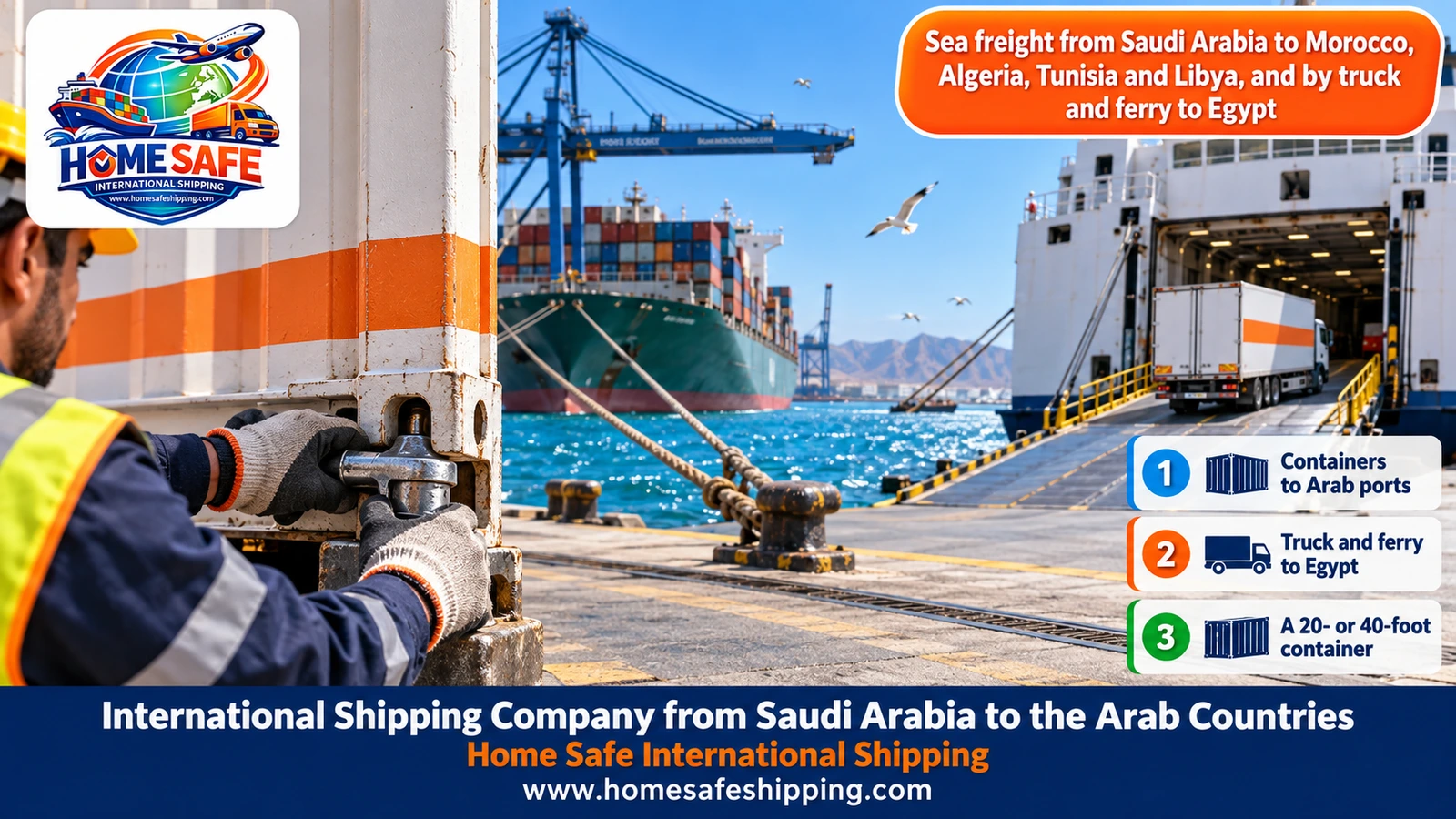
West of the Red Sea everything changes. There is no continuous road to North Africa that a truck from the Kingdom travels regularly, so the sea is the road. The container is loaded in your city or at the Jeddah warehouse, sealed and lifted onto a vessel at Jeddah Islamic Port. The ship sails up the Red Sea, passes through the Suez Canal and then heads west across the Mediterranean to the arrival port. From inland cities the container first reaches the port by truck.
| Country | Arrival ports | Time to the door for a full container | Cubic metre starts from | 20ft container starts from |
|---|---|---|---|---|
| Libya | Tripoli, Misrata, Khoms and Benghazi | 14–30 days | SAR 415 | SAR 4,600 |
| Tunisia | Rades, then Sfax and Sousse | 20–35 days | SAR 415 | SAR 4,600 |
| Algeria | Algiers, Oran and Annaba | 20–35 days | SAR 415 | SAR 4,600 |
| Morocco | Tanger Med and Casablanca | 20–35 days | SAR 780 | SAR 7,800 |
Not every shipping line sails direct. Many containers are moved from one vessel to another at an intermediate Mediterranean port, which is what makes the transit time a range rather than a figure. The service is explained in the sea freight company in Saudi Arabia article and on the sea freight page.
A 20ft or 40ft container, full or shared?
A 20ft container holds about 28 usable cubic metres, which is the furniture of a two- to three-room flat. A 40ft container holds roughly double that, so it takes a large home or a car with furniture. Anyone whose shipment is under a third of a container is better off in a shared container, paying by the cubic metre. A 40ft container to Libya, Tunisia and Algeria starts from SAR 5,200. Exact dimensions are on the container sizes page.
Egypt: a truck that boards the ferry
Egypt is a case of its own. No continuous road reaches it from the Kingdom, yet it is close across the Red Sea, so the answer came halfway. Shipments are consolidated in Riyadh, Jeddah or elsewhere, and the closed truck drives mostly to the port of Duba, or to Jeddah port or Aqaba in Jordan. There the whole truck drives onto the ferry with everything on it and rolls off at Safaga, Nuweiba or Hurghada. Inspection and clearance take place at the arrival port, then the truck continues to the warehouse in Egypt, and the shipments are distributed to their addresses by small vehicles.
It takes between 7 and 15 days to the door, a medium carton starts from SAR 140 and a bedroom from SAR 1,650. We give no ferry sailing date before the line confirms it. Details are in the shipping from Saudi Arabia to Egypt article, and the method stage by stage in the land freight from Saudi Arabia to Egypt article.
Shipping to Sudan and Mauritania
These are two destinations no truck from the Kingdom reaches, so shipping to them is by sea and air only. Sudan is close: Port Sudan faces Jeddah on the other shore of the Red Sea, and the sailing between them is short. But conditions there change which ports, airports and distribution routes are working, so we publish no fixed transit time or price for Sudan, and set both on request once we have confirmed what is available.
Mauritania is the farthest Arab destination by sea. The container leaves Jeddah, passes Suez, the Mediterranean and the Strait of Gibraltar, then runs down the Atlantic to the port of Nouakchott and reaches the address in 30 to 55 days. A saloon car by sea starts from SAR 2,800, and an air parcel of up to 5 kilograms from SAR 110, arriving in 4 to 8 days.
Shipping prices from Saudi Arabia to the Arab countries
These are Home Safe’s starting prices for each country, taken unchanged from our detailed articles. The final figure follows the collection city, the delivery city and the size of the shipment after packing. Where something cannot properly be priced before the details are known, we have written that it is set on request and have not put an estimate against it.
| Destination | Carton or smallest shipment, starts from | Bedroom, starts from | Car, starts from | Air per kilogram, starts from |
|---|---|---|---|---|
| UAE | SAR 140 | SAR 1,380 | SAR 1,100 | SAR 14 |
| Kuwait | SAR 140 | SAR 920 | SAR 1,850 | SAR 14 |
| Qatar | SAR 140 | SAR 1,650 | SAR 1,100 | SAR 14 |
| Bahrain | SAR 140 | SAR 740 | SAR 830 | SAR 14 |
| Oman | SAR 140 | SAR 1,700 | SAR 2,950 | SAR 14 |
| Jordan | SAR 140 | SAR 1,650 | SAR 1,290 | SAR 14 |
| Syria | SAR 370 for parcels up to 50 kg | Set on request | Set on request | SAR 14 |
| Lebanon | SAR 55 for a small parcel | SAR 1,195 | SAR 2,800 in a container | SAR 14 |
| Iraq | SAR 140 | SAR 2,300 | SAR 2,300 | SAR 41 |
| Egypt | SAR 140 | SAR 1,650 | Set on request | Set on request |
| Libya | SAR 140 | SAR 1,650 | SAR 3,220 | SAR 28 |
| Tunisia | SAR 140 | SAR 1,650 | SAR 3,220 | SAR 28 |
| Algeria | SAR 140 | SAR 1,650 | SAR 1,655 sea freight | SAR 28 |
| Morocco | SAR 780 per cubic metre | SAR 2,300 for part-load furniture | SAR 2,800 by RoRo | SAR 28 |
| Mauritania | SAR 110 for an air parcel | Set on request | SAR 2,800 | SAR 28 |
| Sudan | Set on request | Set on request | Set on request | Set on request |
An envelope of documents by express starts from SAR 83 to most of these destinations and from SAR 55 to Egypt. A parcel of up to 5 kilograms by land to the UAE and Bahrain starts from SAR 32.
Market prices for shipping to the Arab countries are seldom published broken down by country. What is usually published is the express couriers’ parcel tariff: an international parcel starts with some of them from about SAR 250, and between SAR 40 and SAR 120 per kilogram is quoted depending on the type of customer. As for furniture, cars and containers, the price is described as depending on weight, volume and destination. The times the market quotes are 3 to 7 days for express and up to 15 days for economy.
What determines the price?
| Factor | Its effect on the price |
|---|---|
| Destination country | A neighbouring country by truck costs less than one a container sails to for three weeks |
| Collection city | Dammam is nearer the Gulf borders, and Jeddah nearer the port and the Egypt ferry |
| Volume after packing | It is the basis for pricing furniture, and the rate per metre falls as the shipment grows |
| Scope of service | To the border post or port costs less, to the door with clearance covers more |
| Season | The run-up to the Eids and the start of summer raises demand for trucks and ferries |
How do you bring the cost down?
- Use the country’s own method: do not ask for air when a truck gets there in two days.
- Dismantle and shrink: a dismantled wardrobe takes a third of its standing volume.
- Combine, do not split: one shipment costs less than three small ones to the same address.
- Leave what is not worth it: a piece that costs less there than its freight is sold here.
- Book early: two weeks before the season secures a place at the ordinary-day price.
Your shipment’s volume can be measured with the cubic metre calculator, and each cost item is set out on the pricing factors page.
How long does a shipment take to each Arab country?
The times in this page’s tables run from the collection day to the delivery day and include clearance and distribution. To the Gulf, 1 to 7 days by full truck and 4 to 10 days shared; to the Levant and Iraq, 2 to 14 days; to the Maghreb ports, 14 to 35 days. The lower figure is always for a dedicated truck from a city near the border.
What lengthens the transit time?
- Filling the load: a shared truck and a shared container do not move part-full.
- Border congestion: weekends and the Eids lengthen the queue at the causeway and the border posts.
- An incomplete file: a list that does not match the contents stops the truck until it is corrected.
- Changing vessel: a container waiting for its second ship at an intermediate port loses days.
Times for the other destinations are on the transit times page.
Shipping to the Arab countries from Saudi cities
We collect from the whole Kingdom, and where your city lies decides which destinations are nearest to you. The east is the gateway to the Gulf, the west the gateway to the sea, the north the gateway to the Levant and Iraq, and Riyadh in the centre reaches them all.
| Collection city | What lies nearest to it | Port and airport used | More |
|---|---|---|---|
| Riyadh and Al-Kharj | Qatar, Bahrain, the UAE and Kuwait within 1 to 4 days | King Khalid Airport, and containers to Jeddah or Dammam port | International shipping company in Riyadh |
| Dammam, Khobar, Jubail and Al-Ahsa | Bahrain, Qatar, Kuwait and the UAE, the shortest distances of all | King Fahd Airport and King Abdulaziz Port | International shipping company in Dammam |
| Jeddah | Containers to North Africa, the Egypt ferry, and Jordan | Jeddah Islamic Port and King Abdulaziz Airport | Shipping from Jeddah to the Arab countries |
| Makkah and Taif | Whatever leaves from Jeddah, about 80 km from Makkah | Jeddah’s port and airport | Umrah pilgrims’ luggage is collected from hotels |
| Madinah and Yanbu | Jordan and the Egypt ferry | Madinah airport or Jeddah airport, and Yanbu or Jeddah port | Dates and visitors’ luggage are among the most shipped items |
| Qassim and Hail | Iraq, Kuwait and Jordan | Through Riyadh, or Qassim airport | International shipping company in Qassim |
| Tabuk, Al-Jouf and Arar | Jordan, Syria, Lebanon and Iraq, and the port of Duba | Through Jeddah or Riyadh for air and sea | The shortest roads to the Levant |
| Abha, Khamis Mushait and Jazan | Joined to the Jeddah shipments | Jeddah’s port and airport | Two or three days are added to reach Jeddah |
In Makkah and Madinah the hours at which large trucks may enter are regulated, and tightened in Ramadan and Hajj, so we collect with smaller vehicles and confirm the hours in force before loading day. The list of cities is on the cities page.
Furniture shipping and moving returnees’ homes
Furniture is the largest thing by volume that we carry to the Arab countries. The work is the same at the start whatever the destination: a survey, then a list, then dismantling, packing and numbering.
Then the roads part. Furniture for the Gulf and the Levant is stacked in a truck and unloaded in the new home days later, so packing that stands up to the road is enough. Furniture for the Maghreb goes into a container that spends weeks at sea and is lifted by cranes, so it needs firmer lashing and protection from damp. Furniture for Egypt is unloaded at the warehouse and loaded again into a small vehicle, so it is packed with two handlings in mind.
A bedroom starts from SAR 740 to Bahrain and from SAR 920 to Kuwait, and the furniture of a small flat from SAR 1,380 to both. The furniture of a small flat to Jordan, Syria or Lebanon starts from SAR 3,700. The service is set out in the international furniture shipping company from Saudi Arabia article and on the furniture shipping page.
Packing and protecting the shipment on the way
Packing is not a layer of plastic wrapped round everything. Each item has its material, and each route its hazard. The road shakes and coats things in dust, the sea brings damp and rolling, so we choose the material by the item and the strength of the lashing by the route.
- Wood and wardrobes: corrugated cardboard and reinforced corners, with panels numbered and each piece’s fittings tied to it.
- Glass, mirrors and marble: foam and bubble wrap inside a wooden frame marked with the carrying direction.
- Electrical appliances: moving parts secured, and carried upright in a reinforced carton.
- Lashing in the body: ratchet straps and dividers that stop the load shifting under braking or as the ship rolls.
- Protection from damp: absorbent bags inside the container on long sea voyages.
Packing materials and the method for each item are in the packing guide.
Shipping parcels, luggage and gifts
Not everyone who ships is moving a home. To the Gulf the parcel travels in the consolidation truck and arrives in days, starting from SAR 32 for up to 5 kilograms to the UAE and Bahrain, with a carton from SAR 140 and a suitcase from SAR 230. To Egypt the carton rides the ferry truck. To North Africa it goes into a shared container, or flies if it is urgent.
The rule for a carton is the same wherever it goes: a weight that will not tear its base, a list of its contents handed to us, and the consignee’s name and mobile number on two faces. Gold, cash, passports and new phones stay with their owner and do not go into a carton. The parcel service is on the parcel shipping page.
Shipping commercial goods between the Kingdom and the Arab countries
The Kingdom’s trade with its Arab neighbours is daily: building materials, plastics, foodstuffs, dates and factory products. To the Gulf, Jordan and Iraq it moves on full trucks or on pallets in a shared truck, and a pallet starts from SAR 550 to Jordan, Iraq and Qatar. To North Africa it moves in containers.
Origin has a direct effect on duty. The GCC states are a customs union, so a Gulf product moves between them without duty, and an import from outside pays the unified tariff once at the first point of entry. A product of Arab origin benefits from the Greater Arab Free Trade Area exemption in member states, provided an attested certificate of origin shows the rules of origin are met. How this is applied differs by country and item, so we check your goods’ tariff line before shipping. Details are on the commercial shipping page.
Car shipping from Saudi Arabia to the Arab countries
A car takes the road furniture takes: a road carrier to the neighbours, and a ship to what lies beyond the sea. On the carrier it is strapped by its wheels, in the open with other cars or inside an enclosed body for a luxury model. At sea it is either driven into the hold of a RoRo vessel or lashed inside a container.
A carrier starts from SAR 830 to Bahrain, from SAR 1,100 to Qatar and the UAE, from SAR 1,290 to Jordan, from SAR 1,850 to Kuwait, from SAR 2,300 to Iraq and from SAR 2,950 to Oman. By sea a saloon starts from SAR 2,800 to Morocco, Mauritania and Lebanon and from SAR 3,220 to Libya and Tunisia, and its sea freight to Algeria from SAR 1,655. To Egypt, Syria and Sudan the price is set on request.
Transport is the easier half of the matter. The other half is whether the car is accepted in the destination country. Each country has a limit on the car’s age, its specification and its duties, and some are very strict, with Egypt and Algeria the clearest examples. So we check your car’s position against the rules in force before we price. Anyone travelling with their car temporarily and bringing it back should ask about the customs carnet. The methods are on the car shipping page, and the guide is in the car shipping from Saudi Arabia article.
Customs in the Arab countries: what is alike and what differs
Customs worries the sender most and is explained to them least. The general picture is simpler than people think: used personal effects are treated leniently in most countries, while new, repeated and commercial items are assessed for duty. The details differ from country to country and change, so what is in the table is current practice, and we confirm what is in force before shipping.
| Region | A mover’s used furniture and effects | What the sender should watch |
|---|---|---|
| The Gulf states | Usually pass without duty if for personal use | A residence permit or job contract in the destination country, a clear list, and VAT on new items where it applies |
| Jordan | An exemption for the returning Jordanian, with conditions on the length of stay abroad | A passport showing the cancelled residence, the owner or an agent present, and sales tax on what is not exempt |
| Lebanon and Syria | Exemptions for returnees with conditions and attested documents | An authenticated list of contents, and the owner present |
| Iraq | Inspected at the border and assessed on the contents | Naming the items precisely, and a declared value for appliances |
| Egypt | Used effects and furniture are among the exemption cases, under controls | Appliances are scrutinised, and phones are not shipped |
| Tunisia, Algeria and Morocco | Special regimes for a citizen returning for good that exempt the furniture on conditions | Residence certificates from the consulate, and a deadline for shipping after the return |
We state in the booking confirmation who pays the duties: the consignee on receipt, or the sender within an all-in service. A general explanation is on the customs clearance page.
Documents required for shipping
Papers are few for a personal shipment and many for a commercial one, and the most important in both is the list of contents. A list that names the items and their quantities passes, and a list that says “personal belongings” opens the door to a full inspection.
| Type of shipment | From the sender | For the consignee |
|---|---|---|
| Luggage, cartons and parcels | A copy of the ID or residence permit, and the list of contents | Name, address and a local mobile number |
| Furniture of a mover or returnee | Passport and residence permit or final exit, and a numbered list of pieces | A residence permit or job contract in the Gulf, or the returnee’s exemption documents at home |
| Commercial goods | Commercial invoice, packing list, certificate of origin and commercial register | The importer’s register and any licences the item requires |
| Car | The registration, deregistration from the traffic department with export plates, and the owner’s ID | The consignee’s ID and whatever their country requires for registration |
The bill of lading and the export declaration are issued by us. Sample forms sit on the shipping documents page.
What may not be shipped, and what is restricted
Prohibited items are alike across the Arab countries in principle and differ in detail. What is banned in the destination country is refused by us at collection, because a single offending item holds up a shared truck carrying other people’s shipments.
| Item | Ruling |
|---|---|
| Drugs, weapons, ammunition and explosives | Prohibited to every destination |
| Alcohol, pork and indecent material | Prohibited from the Kingdom and to most destinations |
| Medicines | For personal use, in a small quantity and with the prescription, and some medicines are restricted in the Gulf |
| New phones and appliances in quantity | Treated as trade, and Egypt has a registration and fee system for phones |
| Gas, fuel, paints and wet batteries | Prohibited as a hazard in the truck, the container and the aircraft |
| Zamzam water | Not shipped as cargo, and the traveller has the dedicated pack at the airport |
| Gold, cash and official documents | Stay with their owner |
The general list is on the prohibited items page.
Delivering shipments from Saudi Arabia in Arab capitals and cities

The shipment does not end at the border post or at the port. It ends when it is unloaded in the consignee’s home and its pieces are counted in front of them. In the Gulf and Jordan the truck itself usually reaches the address. In Egypt and the Maghreb the load is discharged at a warehouse or port, and then a smaller distribution vehicle goes out into the neighbourhoods.
| Country | Main delivery cities | How delivery is made |
|---|---|---|
| UAE | Dubai, Abu Dhabi, Sharjah, Ajman, Al Ain and Ras Al Khaimah | The truck to the door, with assembly |
| Kuwait | Kuwait City, Hawalli, Farwaniya, Ahmadi and Jahra | The truck to the door |
| Qatar | Doha, Al Rayyan, Al Wakrah, Lusail and Al Khor | The truck to the door, with assembly |
| Bahrain | Manama, Muharraq, Riffa and Isa Town | The truck to the door |
| Oman | Muscat, Sohar, Nizwa, Sur and Salalah | The truck to the door |
| Jordan | Amman, Zarqa, Irbid and Aqaba | The truck or a distribution vehicle |
| Syria and Lebanon | Damascus, Aleppo and Homs; Beirut, Tripoli and Sidon | According to the route available at the time of shipping |
| Iraq | Baghdad, Basra, Najaf, Karbala, Erbil and Mosul | Distribution from Baghdad, or by dedicated truck |
| Egypt | Cairo, Giza, Alexandria and the cities of the Delta and Upper Egypt | From the warehouse by small vehicles |
| Libya and Tunisia | Tripoli, Misrata and Benghazi; Tunis, Sfax and Sousse | From the port by truck |
| Algeria and Morocco | Algiers, Oran and Constantine; Casablanca, Rabat, Marrakesh and Tangier | From the port by truck |
What happens on delivery day?
The courier calls the consignee before arriving to make sure they are at the address. The pieces are unloaded and their numbers checked against the list, and anything whose condition is in doubt is opened before signing. In the full furniture service to the Gulf, what was dismantled is assembled again and put in its room. On the sea routes, assembly and carrying to upper floors are agreed in advance and written into the booking confirmation. Fast delivery is the outcome of a complete file, a consignee who answers the phone and a clear address. The service is explained on the door to door page.
Air freight from Saudi Arabia to the Arab countries
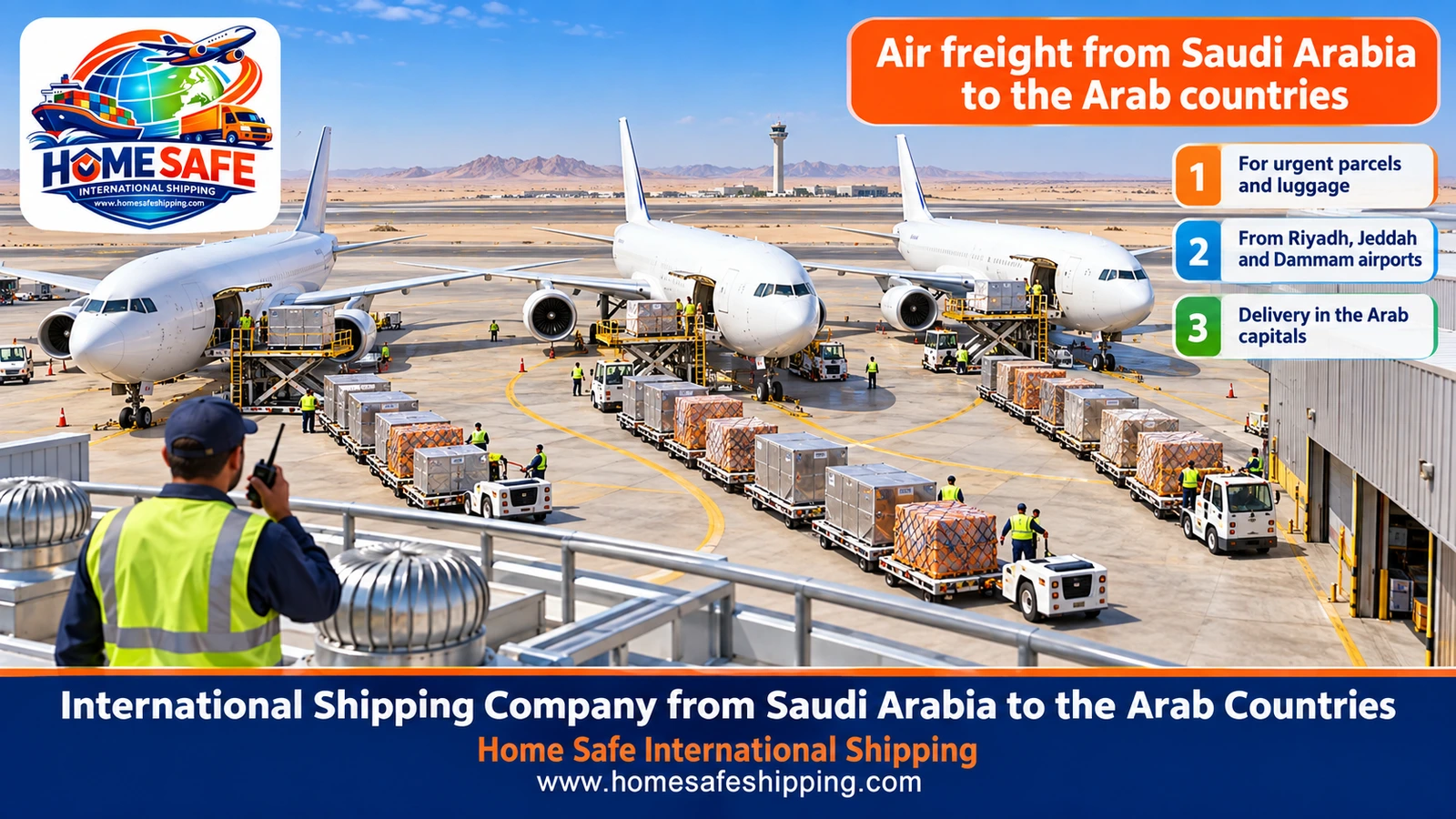
The plane cuts weeks down to days, and the price of that is being charged for every kilogram. Air shipments leave from King Khalid Airport in Riyadh, King Abdulaziz Airport in Jeddah and King Fahd Airport in Dammam, are delivered in the Arab capitals and distributed from there.
| Region | Usual arrival airports | Time to delivery | Kilogram starts from |
|---|---|---|---|
| The Gulf | Dubai, Abu Dhabi, Kuwait, Doha, Manama and Muscat | 1–3 days | SAR 14 |
| Jordan, Syria and Lebanon | Amman, Damascus and Beirut | 1–4 days | SAR 14 |
| Iraq | Baghdad, Erbil, Basra and Najaf | 2–5 days | SAR 41 |
| Egypt | Cairo, then Alexandria | 3–6 days | Set on request |
| Libya, Tunisia, Algeria and Morocco | Tripoli, Tunis, Algiers and Casablanca | 2–7 days | SAR 28 |
| Mauritania | Nouakchott | 4–8 days | SAR 28 |
The weight you are charged for is not always what the scale reads. A light, bulky parcel is charged on its volumetric weight: length by width by height in centimetres divided by 6000 in general air freight, and by 5000 with most express courier services, and the higher of the two weights is taken. So a carton of pillows weighing 6 kilograms and measuring 60 by 50 by 40 centimetres is charged as 20 kilograms. Work it out before you book with the volumetric weight calculator.
In the Gulf in particular, do not rush to choose the plane. A truck reaches Doha or Manama from Riyadh in a day or two at a fraction of the price, so air only makes sense for an envelope or a small urgent parcel. More is in the air freight from Saudi Arabia article and on the air freight page.
Shipping steps from the first call to delivery
- Tell us the destination and the shipment: the country and city, and what you want to ship, with photos or a list.
- A proposed method: the usual method to your country and its alternative, with the time for each.
- The price and its limits: a figure in writing that shows what it covers and where it ends.
- Checking the papers: we ask for photos of the documents and verify them before collection day.
- Collection and packing: the team dismantles, packs, numbers and hands you a receipt with the piece count.
- Transport and clearance: we handle the papers for leaving the Kingdom and entering the destination country.
- Follow-up: the stages of the trip reach you on WhatsApp under your reference number.
- Delivery: the shipment is unloaded at the address, its pieces are counted and the consignee signs.
Tracking, insurance and customer service
Follow-up begins with a reference number you receive with the receipt. By land we tell you the stages of the road, by sea you follow the container by its number on the shipping line’s website, and by air you use the air waybill. The shipment tracking page shows the latest recorded status.
Insurance is optional, and we recommend it for valuable furniture, appliances and commercial goods, especially on long sea voyages. It is calculated as a percentage of the declared value, and the terms and limits of compensation are written in the insurance policy and in the booking confirmation. The explanation is on the cargo insurance page.
Our team answers the phone and WhatsApp from 7 am to 11 pm. And the person who deals with you from the first call is the one who follows your shipment.
Reverse shipping from the Arab countries to the Kingdom
The road works in both directions. Someone returning from Dubai or Amman and someone importing goods from Egypt or Morocco use the same border posts and ports: our partners collect there, and the shipment is cleared in the Kingdom and delivered in your city. Saudi customs exempts a mover’s used effects under its own controls, and food, medicines, cosmetics and appliances carry registration and conformity conditions that we go through with you. The price for the reverse direction is set on request, because it follows the collection country.
How do you choose an international shipping company for the Arab countries?
Offers are not judged by the figure alone. Two companies may give you prices far apart because one priced to the door and the other to the border post. Ask everyone the same questions, then compare.
| What you ask about | A reassuring sign | A warning sign |
|---|---|---|
| Legal status | A commercial register and a known address | A mobile number in an advert and nothing else |
| Knowledge of your country | Names the border post or port and the papers without being asked | General talk about “every country in the world” |
| Scope of the price | Written down, with what it covers and what it does not | A low figure given verbally |
| Customs | Asks about the contents and anticipates the duties | Promises that everything passes without duty |
| The other end | A partner or clearing agent in the destination country | Leaves the consignee to fend for themselves at the port |
Common mistakes when shipping to the Arab countries
- Assuming that shipping to every Arab country goes by land, then being surprised by the sea time to the Maghreb.
- Comparing a price to the door with a price to the border post as if they were the same thing.
- Hiding a new appliance or a phone among clothes, so that the whole carton is stopped.
- Shipping a car before making sure the destination country accepts its year of manufacture.
- Handing over the shipment without a receipt stating the number of pieces and their numbers.
- Leaving only the sender’s number as the contact, while the consignee in another country knows nothing of the date.
- Neglecting the returnee’s exemption papers until the shipment arrives, so that duties are charged which could have been avoided.
Why Home Safe for shipping to the Arab countries?
Because we start from your country, not from a list of services. We tell you which route people use to your destination, how long it really takes and what we cannot promise you. Then we handle every link with one team until the consignee signs.
A registered establishment
Home Safe Logistics Services Est., commercial register 4030601060.
Sixteen Arab destinations
From the Gulf, the Levant and Iraq to Egypt, Sudan, the Maghreb countries and Mauritania.
Each country has its route
A truck for the neighbours, a ferry for Egypt, a container for beyond the sea and a plane for the urgent.
Door to door
Collection from every Saudi city, clearance, and delivery at the consignee’s address.
To book: 0552803439 by call or WhatsApp, from 7 am to 11 pm. Or through the request a quote page.
Related articles and pages
- Shipping from Saudi Arabia to the Gulf states
- Shipping company from Jeddah to the Arab countries
- Shipping from Saudi Arabia to Egypt
- Land freight company in Saudi Arabia
- International shipping companies in Jeddah
- Land freight
Tags
international shipping company from Saudi Arabia to the Arab Countries, international shipping company to the Arab countries, shipping from Saudi Arabia to the Arab countries, shipping prices to the Arab countries, land freight from Saudi Arabia to the Arab countries, sea freight from Saudi Arabia to the Maghreb, air freight to the Arab countries, shipping from Saudi Arabia to the Gulf states, shipping from Saudi Arabia to Jordan, shipping from Saudi Arabia to Egypt, furniture shipping to the Arab countries, car shipping from Saudi Arabia to the Arab countries, cargo shipping to the Arab countries, parcel shipping to the Arab countries, door-to-door shipping, international shipping company in Saudi Arabia
Frequently asked questions about shipping from Saudi Arabia to the Arab countries
Which Arab countries does Home Safe ship to from Saudi Arabia?
Sixteen Arab destinations that we serve regularly: the UAE, Kuwait, Qatar, Bahrain and Oman in the Gulf; Jordan, Syria and Lebanon in the Levant; Iraq; Egypt and Sudan; and Libya, Tunisia, Algeria, Morocco and Mauritania in North Africa. All are in the destinations table near the top of the page, each with a link to its article.
How much does shipping from Saudi Arabia to the Arab countries cost?
It differs from country to country and from item to item. A carton from SAR 140 to most destinations. A bedroom starts from SAR 740 to Bahrain, from SAR 920 to Kuwait and from SAR 1,650 to Jordan, Egypt and the Maghreb countries. A 20ft container starts from SAR 4,600 to Libya, Tunisia and Algeria, and air from SAR 14 per kilogram to the Gulf and the Levant. Send your list to 0552803439.
What is the fastest way to ship to an Arab country?
The plane, which delivers in 1 to 3 days within the Gulf, in 1 to 4 days to the Levant and in 3 to 7 days to North Africa. But it is charged by the kilogram, so it is for what is light and urgent. For furniture the truck remains the fastest practical answer to the Gulf.
Why does shipping to Morocco, Algeria and Tunisia go by sea?
Because the overland distance runs to several thousand kilometres and crosses many borders with no regular freight line through them. The container leaves Jeddah Islamic Port, sails up the Red Sea, passes through the Suez Canal and then heads west across the Mediterranean to Rades, Algiers, Oran, Casablanca or Tanger Med.
How does a land shipment reach Egypt when a sea lies between the two countries?
The closed truck carries the shipments from Saudi cities to a Red Sea port, most often Duba. Then the whole truck drives onto the ferry with its load and rolls off at Safaga, Nuweiba or Hurghada, where inspection and clearance take place. After that it continues to the warehouse, and the shipments are distributed by small vehicles within 7 to 15 days of collection.
Do you ship to Sudan and Mauritania?
Yes, by sea and air only. For Sudan the container leaves Jeddah port for Port Sudan on the opposite shore of the Red Sea, and air freight depends on which airports are operating at the time of booking, and its price is set on request. For Mauritania the container sails to Nouakchott in 30 to 55 days.
What is the difference between a dedicated truck and a shared truck?
A dedicated truck carries your shipment alone, leaves on the day you choose and has a single customs file. A shared truck gathers the shipments of several senders, you pay for the space you occupy, and it waits until it is full. The first is for a whole home or a trader’s goods, the second for cartons or one or two rooms.
Is customs duty paid on used furniture?
In the Gulf states the furniture and used personal effects of a resident who is relocating usually pass without duty, as long as they are for personal use and in reasonable quantities. In Jordan, Lebanon, Egypt and the Maghreb countries there are exemptions for returning nationals, with conditions on the length of stay abroad and on documents. The rules change, so we check your case against those in force before loading.
Do you ship cars to all the Arab countries?
We carry cars to the Gulf, Jordan and Iraq on road carriers, and to Libya, Tunisia, Algeria, Morocco, Mauritania and Lebanon by sea, on a RoRo vessel or inside a container. A road carrier starts from SAR 830 to Bahrain and from SAR 1,100 to Qatar and the UAE. But acceptance depends on the destination country’s rules, and some are very restrictive, such as Egypt, so we check that before any booking.
Which Saudi cities do you collect from?
From Riyadh, Jeddah, Makkah, Madinah, Taif, Dammam, Khobar, Jubail, Al-Ahsa, Qassim, Hail, Tabuk, Abha, Khamis Mushait and Jazan. The collection city changes the transit time and the price, because its distance from the border post or the port is part of the journey.
What documents do I need to ship?
For a personal shipment: a copy of the ID or residence permit and the passport, a list of the contents, and the consignee’s name, address and mobile number in the destination country. Someone leaving for good adds the final exit visa. A trader needs a commercial invoice, a packing list and a certificate of origin. A car needs its registration, its deregistration papers from the traffic department and export plates.
Does the price include customs clearance and delivery to the door?
The booking confirmation spells out the point at which our price stops: the border post or port, or the consignee’s door including clearance. Duties are a separate matter decided by customs in the destination country once it sees the contents, so what you get from us is an estimate built on your list.
Can I ship commercial goods duty-free to an Arab country?
Goods of Gulf origin move between the GCC states within the customs union. Goods of Arab origin benefit from the Greater Arab Free Trade Area exemption in member states, if they travel with an attested certificate of origin. Goods made outside the region are charged the destination country’s tariff.
How do I follow my shipment once it has left?
You receive a reference number with the collection receipt. For land freight we send you the stages of the trip on WhatsApp. For sea freight you follow the container or bill of lading number on the shipping line’s website. For air freight you use the air waybill.
Do you ship from the Arab countries to Saudi Arabia?
Yes, from most of the destinations we serve, through our partners there. The shipment is collected there and enters the Kingdom through the same land border, port or airport we export from, then it is delivered in your city. Before packing we go through with you what Saudi customs requires for food, medicines and appliances.
That is the guide — now let us price your shipment
Choose what applies to you and receive a reply with the price, the method and the time.
RoRo, container or sling lift — we recommend what suits your vehicle’s value and its destination.
Get a vehicle priceA full or shared container, or urgent air freight, with packing and clearance.
Get a shipment priceRoutes in the same section
Options related to the same type of service.